Backing up the current controlfile is one of the most important jobs for any Oracle database administrator. The controlfile holds essential information about your database’s structure—like datafiles, redo logs, and backups themselves. If you lose it without a backup, recovery becomes complex or even impossible without risking data loss or extended downtime.
In this article, we’ll explain what the current controlfile is and why it matters so much. You’ll learn step-by-step how to back it up using both RMAN and SQL*Plus tools—covering manual commands as well as automation options. We’ll also show you how modern solutions like Vinchin can make protecting your Oracle environment easier than ever.
What is the current controlfile?
The current controlfile is a small but critical binary file that every Oracle database relies on. It stores metadata about your entire database: where each datafile lives on disk, which redo logs are active or archived, checkpoint details, backup records—even structural changes over time.
Oracle uses this file during startup to assemble your database from its parts. It also depends on it during recovery operations after crashes or failures. Without an intact controlfile—or at least a recent backup—you cannot open or restore your database reliably.
Why backup current controlfile?
Regularly backing up the current controlfile protects against disaster scenarios that could otherwise halt business operations. Even if you have all your datafiles and archived logs safe elsewhere, losing an up-to-date controlfile means you may not be able to recover them into a working system.
Oracle’s official documentation highlights frequent backups as best practice. This is especially true after any change that affects the physical layout of your database—such as adding new tablespaces or changing log configurations.
Key Scenarios Requiring a Control File Backup
Certain actions should always prompt an immediate backup of the current controlfile:
Adding or dropping datafiles or tablespaces
Changing redo log groups (adding/dropping members)
Switching between ARCHIVELOG and NOARCHIVELOG modes
Renaming global names with ALTER DATABASE RENAME GLOBAL_NAME
Creating new temporary tablespaces
Performing major upgrades or migrations
These events alter fundamental aspects of your database’s structure recorded only in the controlfile—not elsewhere—so capturing its latest state right away ensures recoverability if anything goes wrong later.
Method 1: Backup current controlfile with RMAN
RMAN (Recovery Manager) is Oracle’s built-in tool for managing backups efficiently and safely across all environments—from single-instance setups to clustered databases.
Before starting with RMAN commands below, ensure you have SYSDBA privileges on your target instance.
Performing a Manual RMAN Backup
Manual backups give you direct control over timing and storage location:
1. Open a terminal window.
2. Connect to RMAN using:
rman target /
3. At the RMAN prompt type:
BACKUP CURRENT CONTROLFILE;
By default this saves output in whatever destination RMAN has configured.
4. To specify exactly where to store it—and create unique filenames—use:
BACKUP CURRENT CONTROLFILE FORMAT '/your/backup/path/controlfile_%U.bkp';
Here %U generates a unique name based on timestamp and session info; for more readable names try 'controlfile_%d_%T.bkp', where %d inserts DB name and %T adds date.
5. Watch output messages for confirmation of success plus exact file path written.
This approach lets you schedule regular manual backups before planned maintenance windows or after major changes—giving peace of mind that you can always restore from a known good point.
Configuring and Using CONTROLFILE AUTOBACKUP
For ongoing protection without manual intervention every time something changes:
1. Check if automatic autobackup is enabled by running:
SHOW CONTROLFILE AUTOBACKUP;
2. If off (shows OFF), enable it with:
CONFIGURE CONTROLFILE AUTOBACKUP ON;
With autobackup active, RMAN creates a fresh copy of the current controlfile automatically after every successful BACKUP DATABASE, BACKUP TABLESPACE, or structural change operation—even if you forget to run explicit commands yourself.
Autobackups are stored separately from other sets using special naming conventions like c-IIIIIIIIII-YYYYMMDD-QQ, making them easy to locate during disaster recovery procedures when no catalog access exists.
Remember: even with autobackup enabled it's wise to take additional manual copies before risky operations such as patching or hardware upgrades—for extra insurance against rare edge cases where automated jobs might fail due to configuration errors or space issues.
Advanced users should note: When running BACKUP DATABASE with CONTROLFILE AUTOBACKUP OFF, Oracle still includes an image copy inside main backup sets—but not as an independent piece—which can complicate standalone restores later on.
Method 2: Backup current controlfile using SQL*Plus
SQL*Plus offers another way to protect your Oracle environment by creating either binary images suitable for direct restoration—or human-readable scripts useful for reconstructing lost files from scratch in emergencies.
Both approaches require SYSDBA privileges; always connect securely before issuing sensitive commands below!
Creating a Binary Copy (for direct restore)
To make an exact binary snapshot:
1. Launch SQL*Plus:
sqlplus / as sysdba
2. Run this command:
ALTER DATABASE BACKUP CONTROLFILE TO '/your/backup/path/controlfile.bkp';
This writes out an identical copy at whatever path you specify—a fast option when preparing for risky maintenance tasks like storage migrations or OS upgrades where quick rollback capability matters most.
Binary copies are ideal because they allow rapid replacement via simple file-level restores if corruption occurs—but remember they must match both platform architecture (e.g., Linux vs Windows) AND Oracle version exactly!
Generating a Recreate Script (to TRACE)
Sometimes disasters wipe out every multiplexed copy—including all binaries—and leave only archived logs behind elsewhere; here’s where trace scripts shine:
1. Still connected in SQL*Plus type:
ALTER DATABASE BACKUP CONTROLFILE TO TRACE;
This writes detailed SQL statements into one .trc file within Oracle's diagnostic directory tree (diagnostic_dest/diag/rdbms/<dbname>/<instance>/trace). To locate this folder quickly check parameter values:
SHOW PARAMETER diagnostic_dest;
or
SHOW PARAMETER user_dump_dest;
Then browse into /trace subdirectory looking for recently modified files containing "CREATE CONTROLFILE" near top lines—they hold everything needed (with some editing) to rebuild missing structures from scratch!
After generating such scripts always copy them off-server immediately—to secure locations outside normal production paths—and review contents so future restores go smoothly under pressure when minutes count most!
Trace-based recreate scripts are invaluable because they document not just physical layout but also logical settings like character set choices—which may be forgotten years later during audits or compliance checks.
Modern Enterprise Oracle Database Protection with Vinchin Backup & Recovery
Beyond traditional methods, organizations seeking robust automation often turn to enterprise solutions tailored for databases like Oracle. Vinchin Backup & Recovery stands out as a professional-grade platform supporting today’s mainstream databases—including full support for Oracle alongside MySQL, SQL Server, MariaDB, PostgreSQL, PostgresPro, and TiDB environments.
Vinchin Backup & Recovery delivers advanced features such as incremental backup, batch database backup management, multiple level data compression options, GFS retention policy enforcement, and comprehensive integrity checks—all designed to streamline large-scale protection while minimizing resource usage and ensuring regulatory compliance across diverse infrastructures.
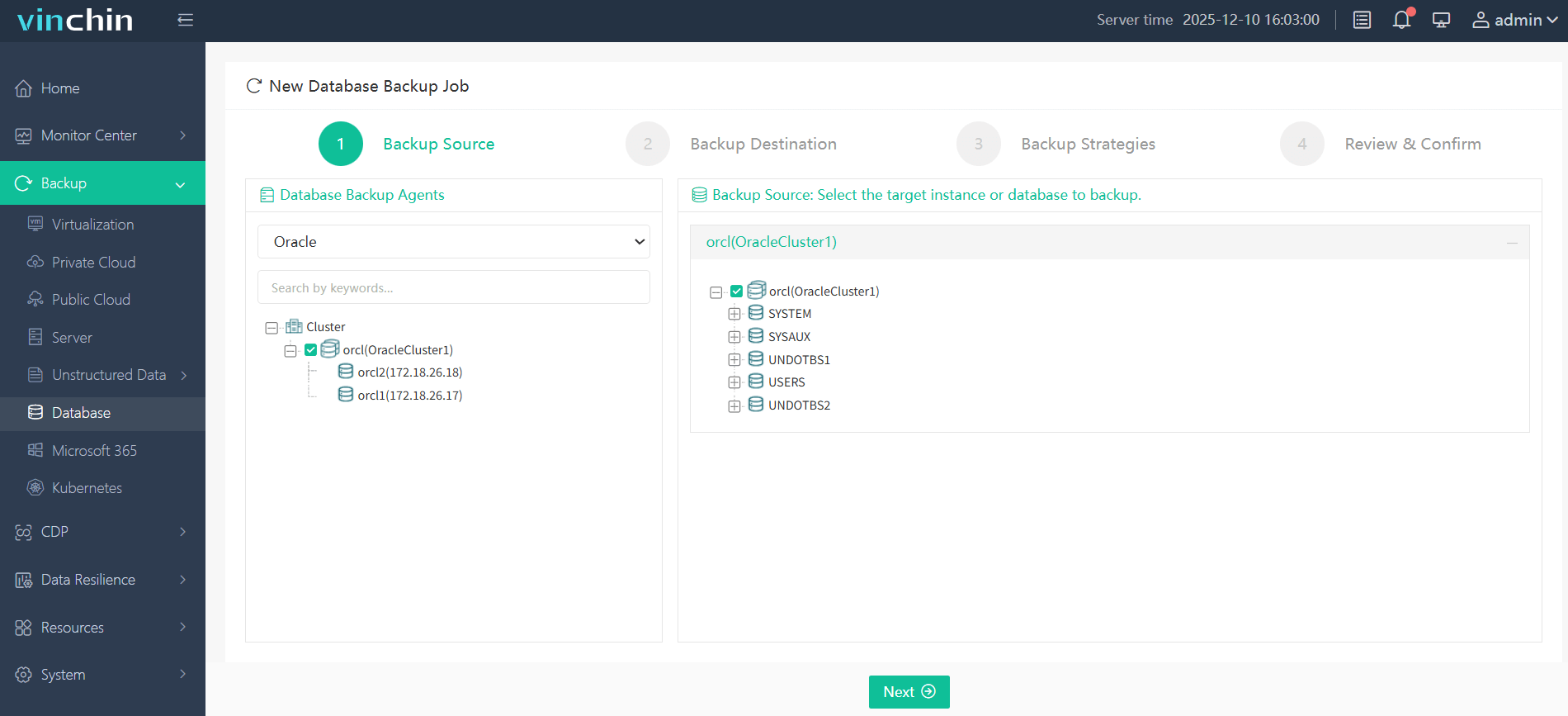
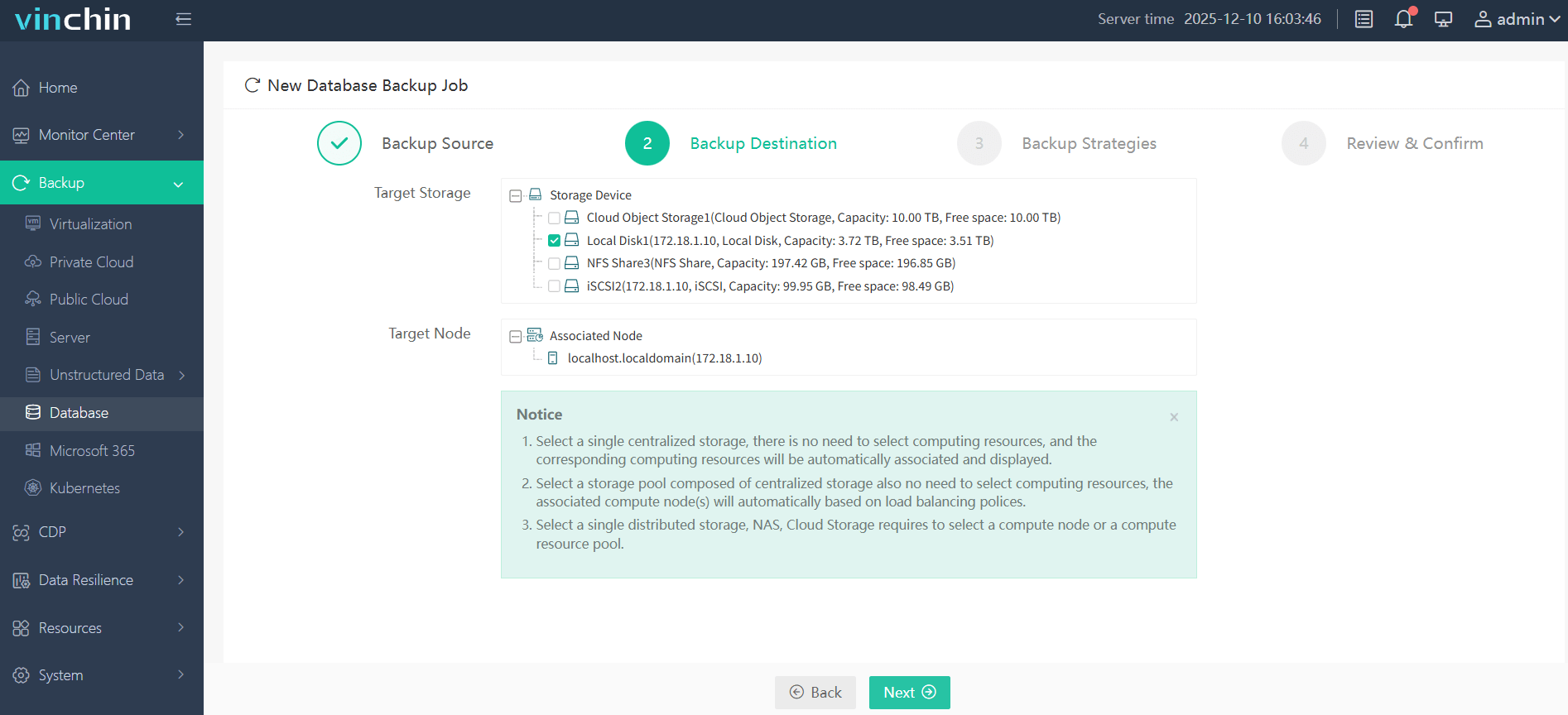
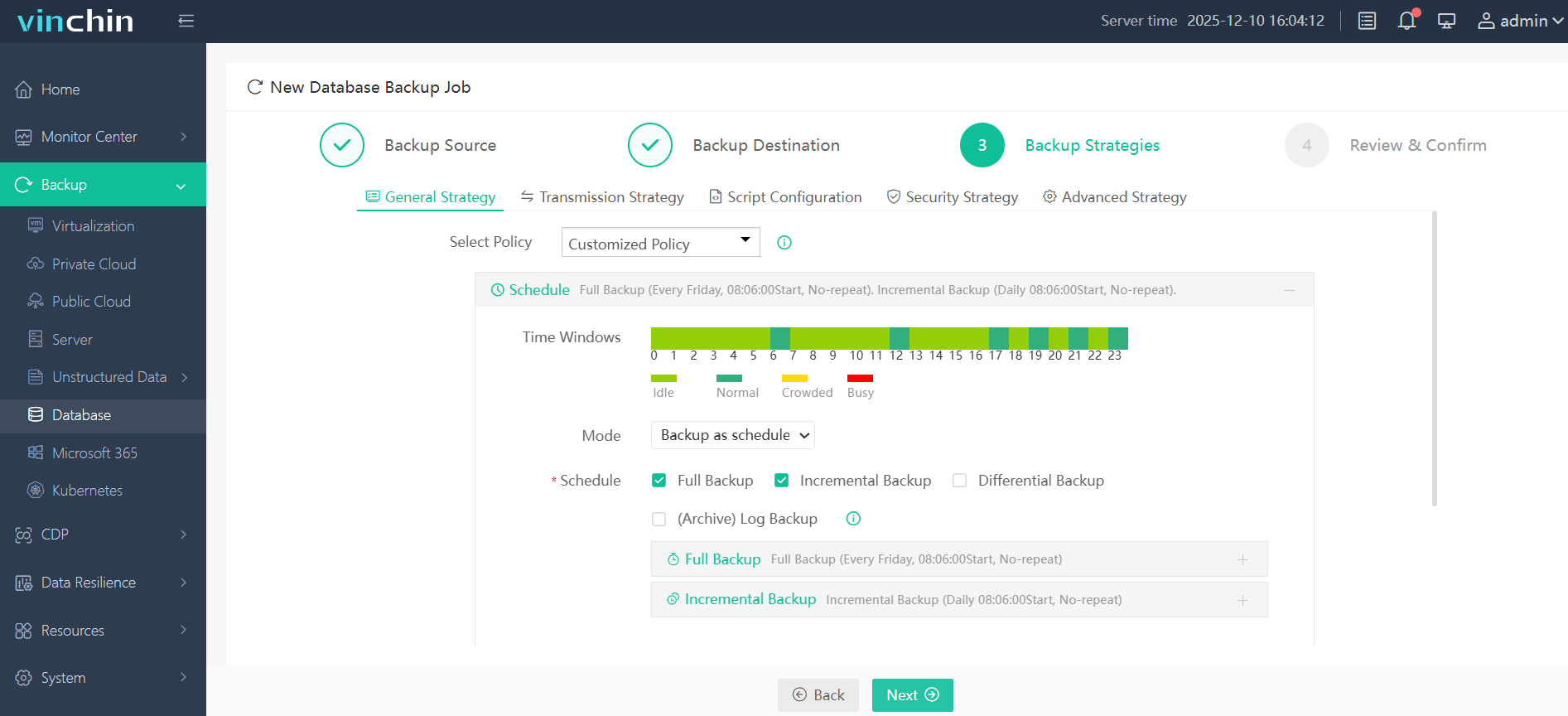
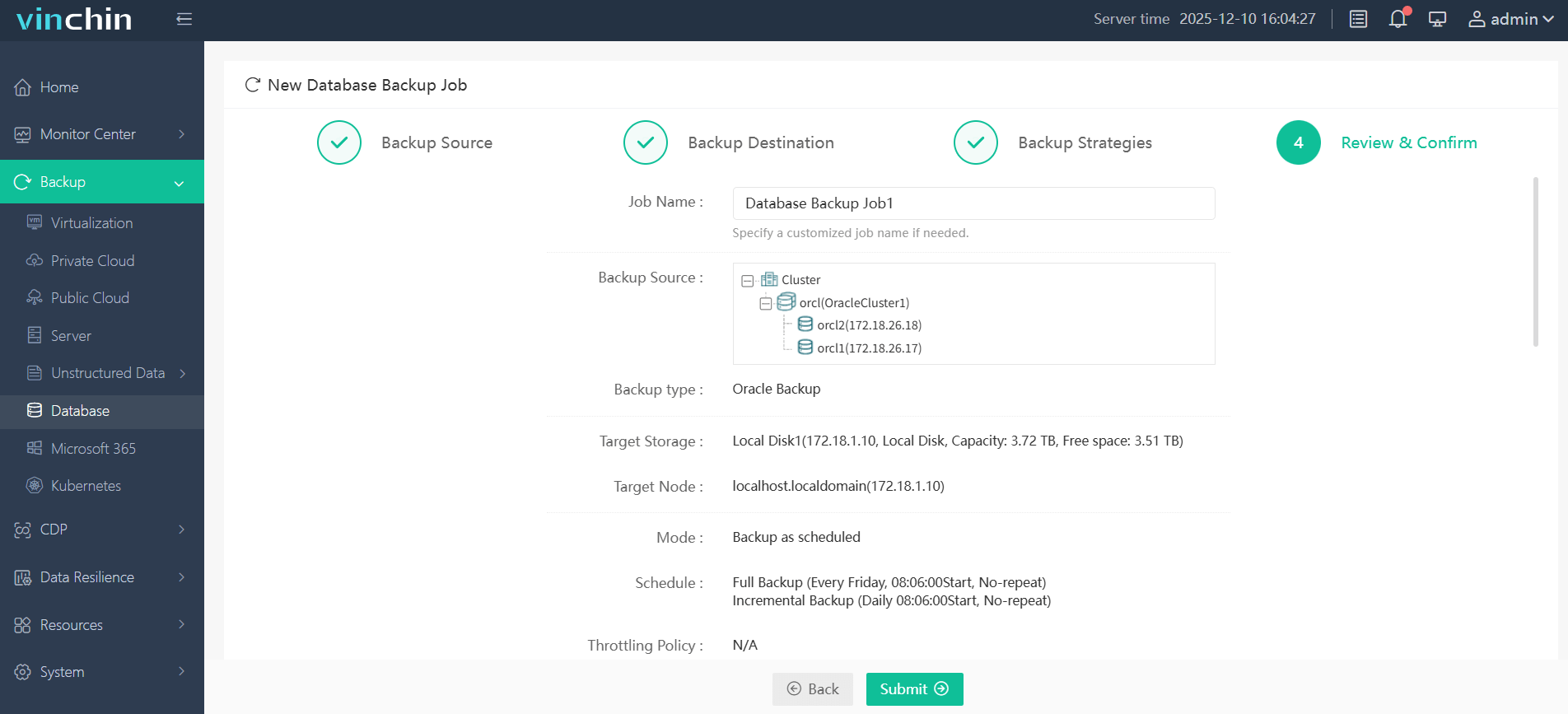
The web console makes safeguarding your Oracle environment remarkably straightforward:
Step 1. Select the Oracle database to back up
Step 2. Choose the backup storage
Step 3. Define the backup strategy
Step 4. Submit the job
Recognized globally by thousands of enterprises—with top ratings for reliability—Vinchin Backup & Recovery offers a fully featured free trial valid for 60 days so you can experience its power firsthand; click download now to get started.
Backup current controlfile FAQs
Q1: What happens if my only available backup is from several days ago?
A1: You may lose recent structural changes; always keep daily backups plus immediate ones after major modifications.
Q2: Can I use these methods while my database stays online?
A2: Yes; both RMAN's BACKUP CURRENT CONTROLFILE command and SQL*Plus's binary/trace options work while online in ARCHIVELOG mode unless restricted by specific maintenance states.
Q3: Where should I store my backed-up controlfiles?
A3: Always save copies outside primary server disks—in secure network shares/cloud/tape—to survive local hardware failures.
Conclusion
Backing up your current controlfile keeps recovery options open no matter what happens next—from routine admin mistakes through full-blown disasters! Use both RMAN automation plus periodic manual snapshots via SQL*Plus trace files whenever possible; Vinchin makes orchestrating these best practices simple across any scale environment.