Protecting your Oracle database is essential for business continuity. But with so many backup options in Oracle Recovery Manager (RMAN), how do you choose? Each RMAN backup type offers unique strengths. Knowing these differences helps you design a reliable, efficient recovery plan that fits your needs. Let’s explore what makes each Oracle RMAN backup type distinct—and when to use them.
What Is Oracle RMAN?
Oracle Recovery Manager (RMAN) is Oracle’s built-in tool for backing up, restoring, and recovering databases. It works closely with the database engine at block level, giving you powerful control over data protection. With RMAN, you can back up datafiles, control files, server parameter files (spfile), and archived redo logs—all while tracking detailed metadata about every operation.
A key advantage of RMAN is its centralized management of backups through either the control file or an external recovery catalog. This eliminates manual tracking of backup files and reduces human error. RMAN comes included with every licensed Oracle Database installation; no extra cost applies for basic features.
For operations teams, this means less time spent on manual scripting and more confidence in automated recoverability. Advanced features like block change tracking or Data Guard integration may require specific editions or licenses—but core backup functions are available out-of-the-box.
What Are Oracle RMAN Backup Types?
Oracle RMAN organizes backups into two main categories: full backups and incremental backups. Both serve different roles in a robust data protection strategy.
Full backups capture all used blocks in selected files—providing a complete snapshot at a point in time. Incremental backups only save blocks changed since a previous reference point (either another incremental or a base full). This distinction lets you balance storage use against speed of both backup creation and recovery.
It’s also important to understand that there are two physical formats: Backup Sets (an efficient proprietary format) and Image Copies (exact byte-for-byte copies). Full backups can be created as either format; incremental backups are always stored as backup sets.
Incremental backups come in three flavors: level 0 (base), level 1 differential (changes since last level 0 or 1), and level 1 cumulative (all changes since last level 0). Choosing wisely among these options shapes your overall disaster recovery posture.
What Is an Oracle RMAN Full Backup?
A full backup includes every allocated block in your chosen datafiles, tablespaces, or entire database at that moment. If you use backup sets, unused blocks are skipped thanks to compression—saving space without losing any active data. In contrast, an image copy creates an exact replica of every block—including unused ones—making it ideal for certain restore scenarios but requiring more storage.
You can create a full database backup using:
RMAN> BACKUP DATABASE;
This command generates a compressed backup set containing all current datafiles. For an image copy instead:
RMAN> BACKUP AS COPY DATABASE;
If you want your full backup to include all necessary archived redo logs for consistent recovery—even if users keep working during the process—add:
RMAN> BACKUP DATABASE PLUS ARCHIVELOG;
Full backups stand alone; they cannot serve as parents for incremental chains unless explicitly taken as “level 0” incrementals (see below). They’re simple but can be slow on large databases due to their size.
When Should You Use Full Backups?
Full backups work best when simplicity matters most—such as before major upgrades or after significant schema changes. They’re also useful if your environment is small enough that storage space isn’t tight or if regulatory policies require periodic complete snapshots kept offline for long-term retention.
However, running frequent fulls on large systems increases both I/O load and storage costs—a trade-off worth considering carefully.
What Is an Oracle RMAN Incremental Backup?
Incremental backups help save time and disk space by only capturing changed blocks since a prior reference point—a huge benefit when managing large production databases with limited maintenance windows.
There are two levels:
Level 0 Incremental Backup:
This acts just like a full backup—it includes all used blocks—but it serves as the foundation (“parent”) for future incrementals within an incremental strategy chain:
RMAN> BACKUP INCREMENTAL LEVEL 0 DATABASE;
Level 1 Incremental Backups:
These only include changed blocks since either the last level 0 or another recent level 1:
RMAN> BACKUP INCREMENTAL LEVEL 1 DATABASE;
Cumulative Level 1: Captures all changes since the last level 0 only—ignoring any intervening differential incrementals.
RMAN> BACKUP INCREMENTAL LEVEL 1 CUMULATIVE DATABASE;
Incrementals always produce backup sets, not image copies. This keeps them compact but means restores require applying multiple layers if using differentials frequently.
Block Change Tracking: Boosting Performance
By default, creating incrementals requires scanning every block to detect changes—a process that can take hours on big databases! To fix this bottleneck, enable Block Change Tracking:
SQL> ALTER DATABASE ENABLE BLOCK CHANGE TRACKING USING FILE '/path/to/bct.f';
With BCT enabled, Oracle maintains a lightweight bitmap file recording which blocks have changed—so future incrementals run much faster.
When to Use Each Oracle RMAN Backup Type?
Choosing between fulls and incrementals depends on how quickly you need to recover—and how much storage/time you can spare during routine maintenance windows.
Fulls provide maximum simplicity but consume more resources; they’re best suited for weekly baselines or infrequent archival purposes where rapid restore isn’t critical day-to-day.
Incremental strategies shine when daily change rates are low compared to total database size—or when minimizing impact on production workloads is vital. By combining weekly “level 0” bases with frequent “level 1” differentials/cumulatives throughout the week, admins achieve fast nightly jobs while keeping restore chains manageable.
Designing Tiered Strategies: A Practical Example
Many organizations adopt this schedule:
Take one level 0 incremental every Sunday night
Run level 1 differential increments Monday through Saturday
Optionally add one mid-week cumulative if weekend downtime isn’t possible
This approach balances quick nightly jobs against short RTOs during emergencies.
Considering Recovery vs Backup Efficiency
Differential increments minimize daily job duration—but lengthen restores because each must be applied in order after restoring Sunday’s base image copy. Cumulatives grow larger across days yet make restores easier—you need only Sunday plus Friday’s cumulative rather than six separate files!
If meeting strict RTO targets matters most—for example in financial services environments—favor cumulatives even if they take longer nightly.
Common Pitfalls & How To Avoid Them
Even seasoned DBAs sometimes overlook these traps:
Forgetting regular validation checks (RESTORE VALIDATE) leaves gaps undetected until disaster strikes
Not enabling Block Change Tracking slows down large-scale incrementals unnecessarily
Deleting old archivelogs too soon breaks point-in-time recovery chains
Always test both backup AND restore procedures regularly—not just once!
Beyond Basics: Optimizing Your Backup Performance
Want even better results? Consider these advanced tips:
Enable SET CONTROLFILE AUTOBACKUP ON so metadata survives accidental loss of control files
Use MAXPIECESIZE within BACKUP commands to split output into manageable chunks
Multiplex channels (ALLOCATE CHANNEL) across disks/networks for parallelism
For very large tablespaces (“bigfile”), leverage SECTION SIZE parameters so multiple streams handle parts concurrently
Validating Your Strategy: Why Testing Matters
Backups mean nothing unless they restore cleanly! Always run periodic tests using:
RMAN> RESTORE VALIDATE DATABASE;
RMAN> RECOVER TEST DATABASE UNTIL TIME 'SYSDATE - n';
These commands confirm both media integrity AND logical recoverability without disrupting production workloads.
Archivelog Management: The Key To Point-In-Time Recovery
Archivelogs record ongoing transactional changes between scheduled database checkpoints—they’re essential if you ever need point-in-time restoration following user error or corruption events!
Back up archivelogs frequently using:
RMAN> BACKUP ARCHIVELOG ALL DELETE INPUT;
The DELETE INPUT clause removes logs already backed up safely elsewhere—helping manage disk usage automatically.
Set clear deletion policies (CONFIGURE ARCHIVELOG DELETION POLICY TO...) so old logs don’t accumulate unchecked—or vanish prematurely before safe offsite replication completes.
How Can You Back Up Oracle Databases Using Vinchin
For organizations seeking streamlined enterprise-level protection beyond native tools like RMAN, Vinchin Backup & Recovery delivers comprehensive support for today’s leading databases—including first-class coverage for Oracle alongside MySQL, SQL Server, MariaDB, PostgreSQL, PostgresPro, and TiDB environments. With Vinchin Backup & Recovery’s robust feature set—including advanced source-side compression tailored specifically for Oracle workloads; efficient incremental backup; batch database processing; flexible retention policies such as GFS; plus multi-level data compression—you gain optimized performance while reducing resource consumption across complex infrastructures. These capabilities collectively ensure secure automation of routine tasks while maintaining compliance-ready recoverability standards at scale.
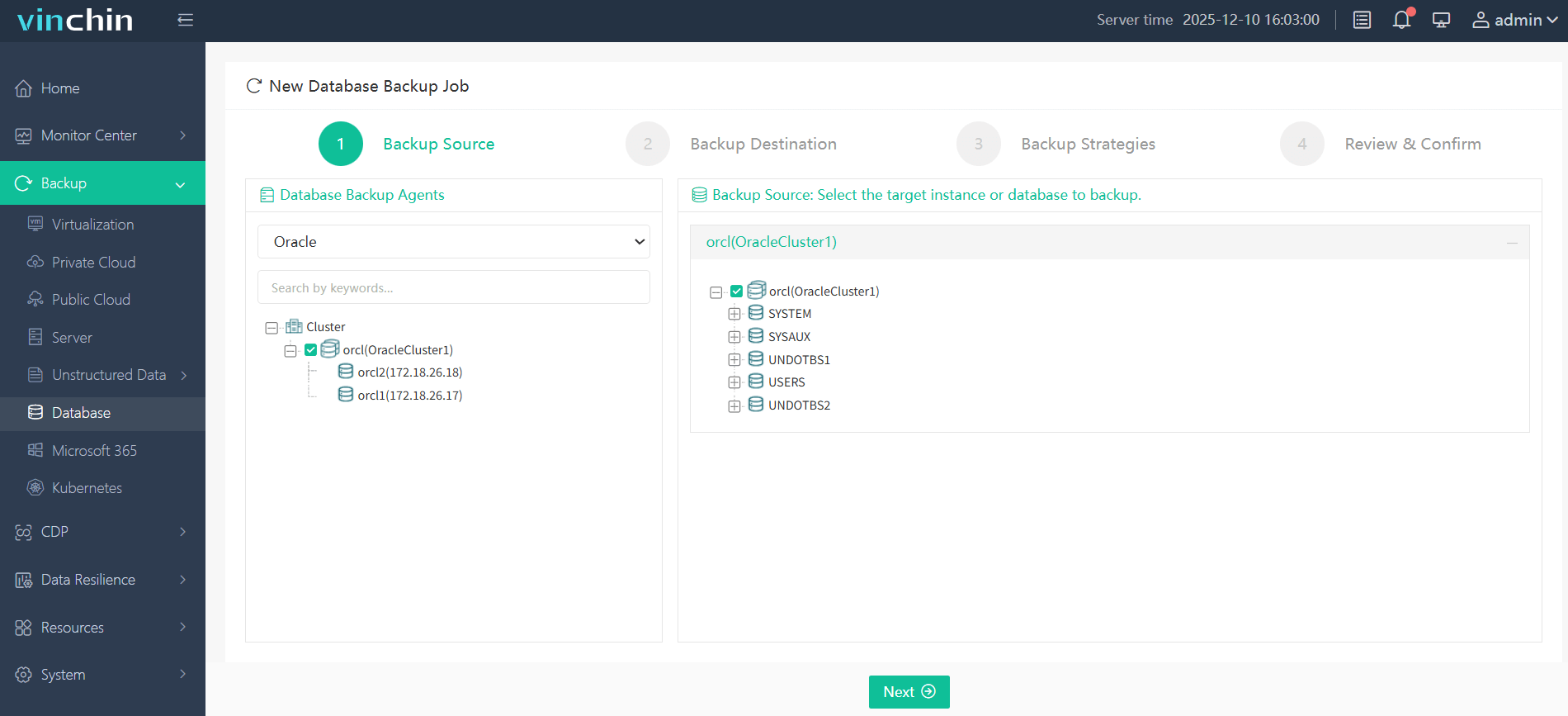
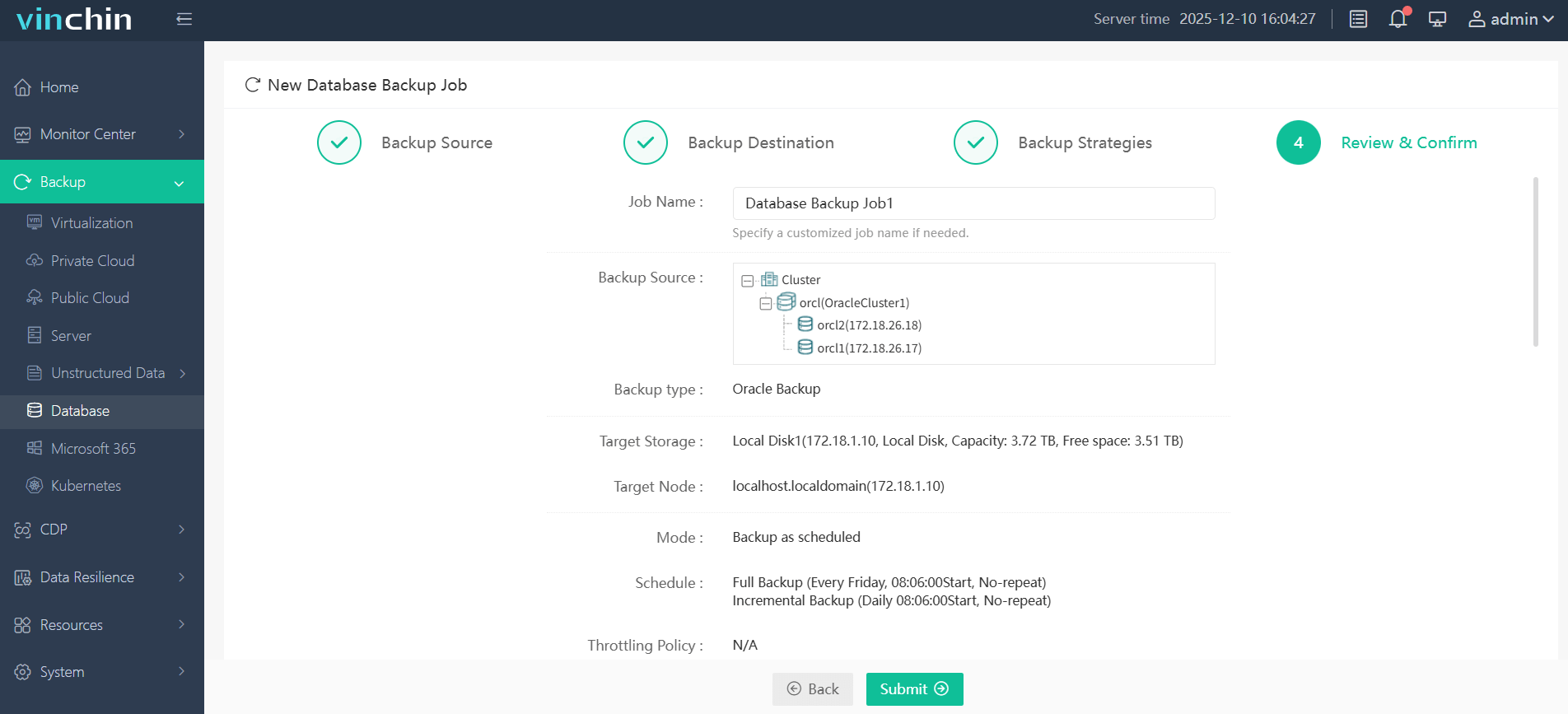
Vinchin Backup & Recovery stands out with its intuitive web console designed around operational simplicity—even non-specialists can protect mission-critical systems efficiently by following four straightforward steps: Step 1. Select the Oracle database to back up;
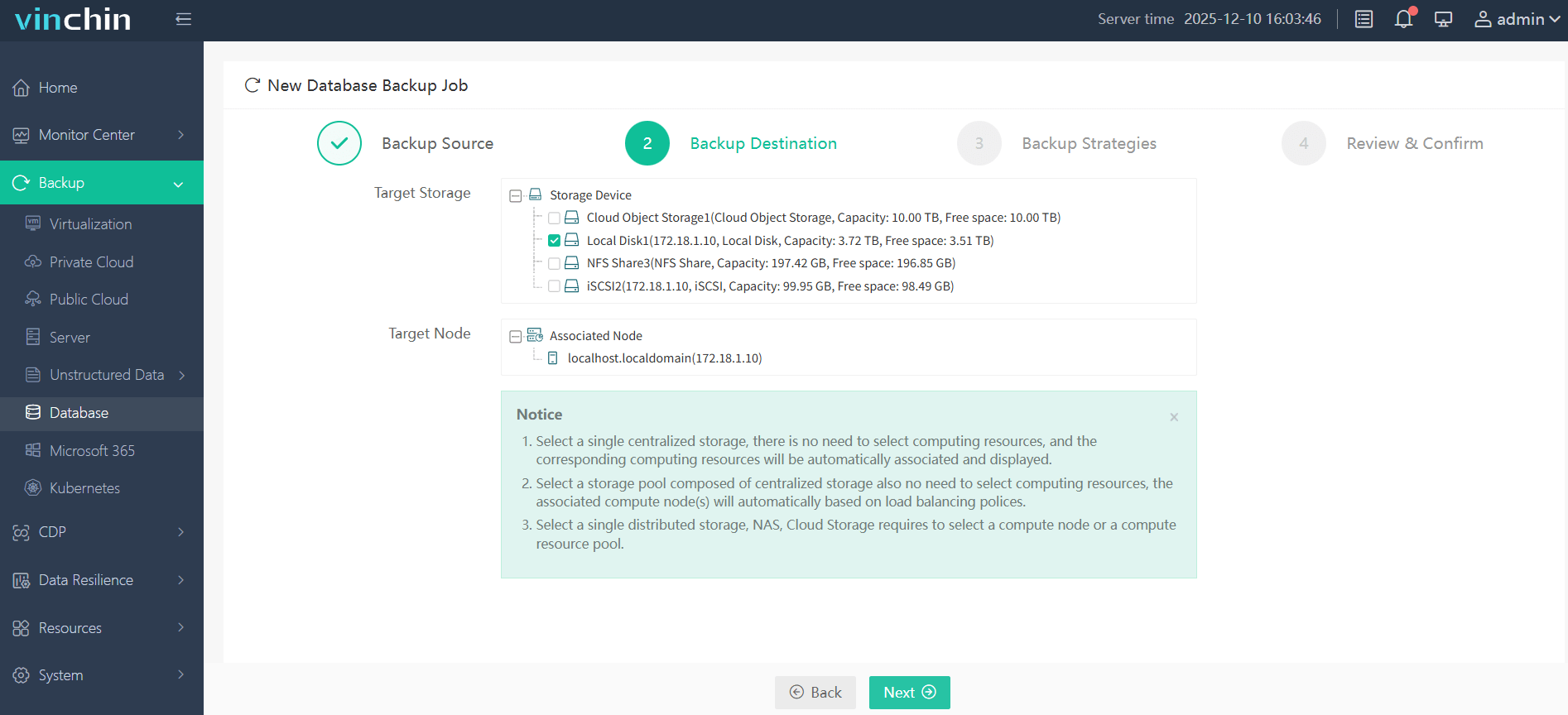
Step 2. Choose preferred storage location;
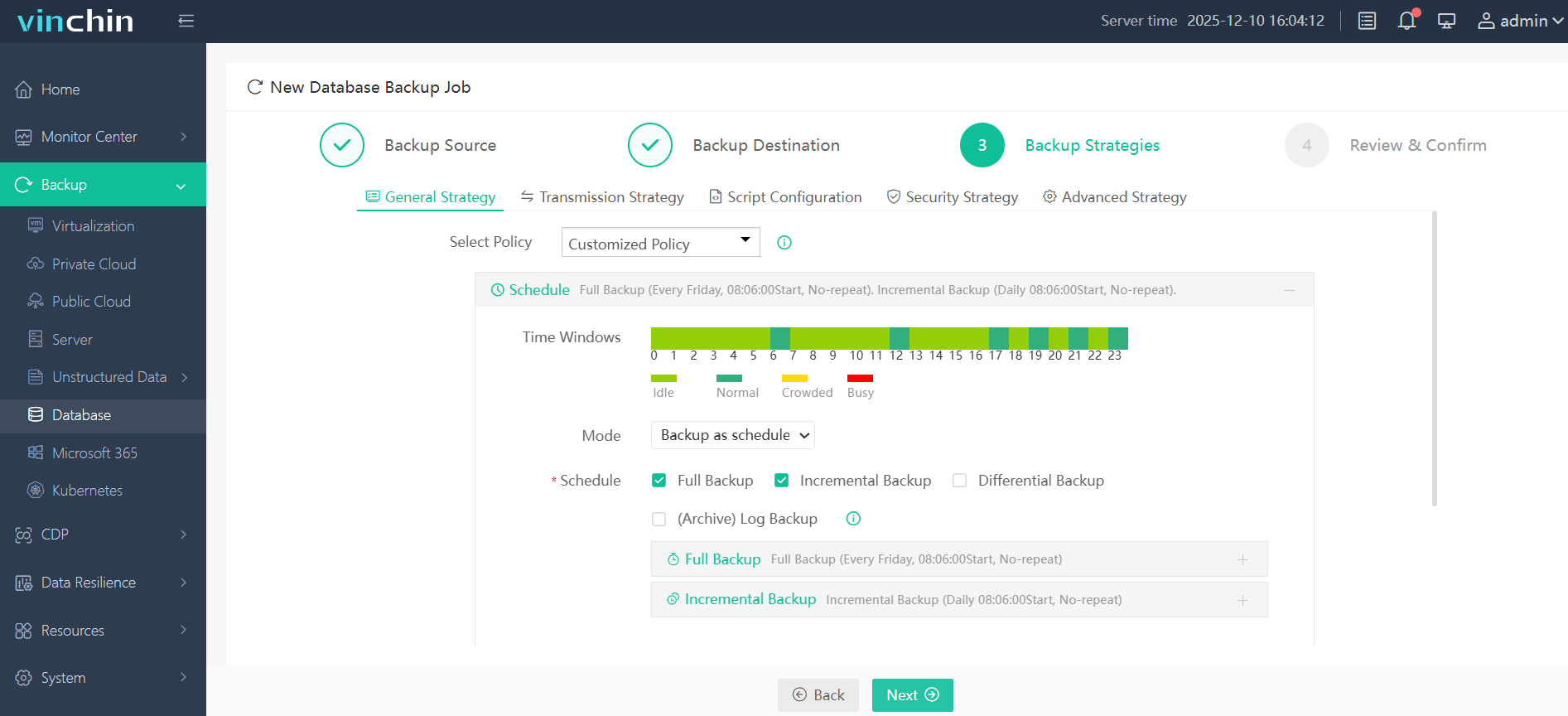
Step 3. Define scheduling and retention strategies;
Step 4. Submit the job for execution.
Recognized globally by thousands of enterprises—with top ratings from industry analysts—Vinchin Backup & Recovery offers a fully featured free trial valid for sixty days so you can experience its power firsthand before committing further investment.
Oracle RMAN Backup Types FAQs
Q1: How do I check if my latest incremental chain allows me to restore until yesterday?
Run LIST BACKUP OF DATABASE COMPLETED AFTER 'date' then verify presence of required Level 0 plus subsequent Level 1(s).
Q2: Can I run online (“hot”) backups while users access my database?
Yes; as long as your database runs in ARCHIVELOG mode and uses BACKUP DATABASE or BACKUP AS COPY commands via RMAN hot online operation is supported without downtime.
Q3: What should I do if my archivelog destination fills up during heavy activity?
Immediately back up archived logs using BACKUP ARCHIVELOG ALL DELETE INPUT, then increase destination size or configure automatic log deletion policy.
Conclusion
Selecting proper oracle rman backup types ensures strong protection against outages. Fulls offer simplicity while incrementals boost efficiency. Test often optimize settings. For streamlined enterprise-grade automation try Vinchin—the trusted choice worldwide.