Oracle’s Recovery Manager (RMAN) is an essential tool for database backup and recovery. One of its most important roles is managing the control file—the backbone of your Oracle database’s metadata. But how do you check which control file backups or copies exist? That’s where rman list controlfile commands come into play. In this guide, we’ll explain what the control file does, why listing its backups matters for operations administrators, and how to use RMAN—both from the command line and Oracle Enterprise Manager—to get all necessary details.
What Is an RMAN Control File?
The control file is a small but critical binary file in every Oracle database. It tracks key information about your database: datafiles, redo logs, checkpoints, backup history—even archive log details. Without a valid control file, you cannot mount or recover your database.
RMAN uses the control file as its local repository to record backup metadata. This includes when backups were taken, their type (backup set or image copy), location on disk or tape, status (available or expired), tags for identification, and more. If you use an external recovery catalog database with RMAN, it stores even more historical data there—but every Oracle instance still needs its own current control file.
Losing your only good copy of a control file can mean losing access to all other backups. That makes understanding—and regularly checking—your available control file backups vital for any DBA.
Why Use RMAN List Controlfile?
Knowing which control file backups exist is crucial for disaster recovery planning. Imagine facing sudden corruption or loss of your production server’s storage; would you know exactly where your last usable control file backup resides? The rman list controlfile commands let you see all available backup sets and image copies so you can plan restores confidently.
These commands help you:
Verify that recent backups exist before making major changes
Check compliance with retention policies
Prepare for audits by showing evidence of regular protection
Validate that at least one healthy copy exists before deleting old files
Would you risk a restore without knowing if your only backup was expired? Regularly listing your available copies helps avoid surprises during emergencies.
How to Run RMAN List Controlfile Command?
The core way to view existing control file backups in Oracle is through RMAN’s LIST command family. These commands show both backup sets (pieces created by RMAN jobs) and image copies (exact byte-for-byte disk snapshots). Each entry displays completion time, status (“A” means available), device type (disk/tape), size in bytes or blocks, tag name if used during creation—and most importantly—the full path on disk or tape library.
You can run these commands from the command line interface or view similar information using graphical tools like Oracle Enterprise Manager.
Let’s walk through both methods step by step.
Method 1: Listing Control Files via Command Line
Most DBAs rely on the RMAN command line for fast access to backup information—especially when automating checks with scripts. Here’s how you can list all types of control file protection:
First connect to your target database using:
rman target /
This connects directly as OS authentication user; adjust as needed if connecting remotely or through a catalog.
Once connected:
1. To list all control file backups stored as part of backup sets:
LIST BACKUP OF CONTROLFILE;
This shows each backup set containing a copy of the current or previous state of your database's control files—including key columns like Backup Key (unique reference number), Status ("A" = Available; "X" = Expired), Device Type ("DISK" or "SBT_TAPE"), Completion Time (when finished), Size in bytes/blocks, Tag name if specified during creation.
2. To list all image copies made directly from disk:
LIST COPY OF CONTROLFILE;
This displays each physical image copy along with its unique key number (“Key”), status (“A”=Available), completion time (“Completion Time”), checkpoint SCN (“Ckp SCN”) which marks up-to-date consistency point for recovery purposes—and full path under “Name”.
3. To display details about one specific image copy by key number:
LIST CONTROLFILECOPY <key>;
Replace <key> with any value shown from earlier output—for example:
LIST CONTROLFILECOPY 25;
Here’s what sample output might look like:
List of Control File Copies
===========================
Key     S Completion Time Ckp SCN    Ckp Time
------- - --------------- ---------- ---------------
25      A 15-AUG-15       3324254    15-AUG-15
        Name: /u01/app/oracle/copy/cf_D-TEST_id-2066695660_23qekadv
        Tag: TAG20150815T001910
20      A 14-AUG-15       3322965    14-AUG-15
        Name: /u01/app/oracle/copy/cf_D-TEST_id-2066695660_1tqek8bd
        Tag: TAG20150814T234341
Notice how each row provides enough detail to identify exactly which files are safe to restore based on their checkpoint time—a critical factor during point-in-time recovery operations.
If you need to remove an obsolete copy after confirming safety elsewhere:
DELETE CONTROLFILECOPY <key>;
Or specify by absolute path:
DELETE CONTROLFILECOPY '/u01/app/oracle/copy/cf_D-TEST_id-2066695660_1tqek8bd';
Filtering Your Output
Sometimes you want only recent results—for example after weekly maintenance—or just those created under certain tags:
To see only those completed within last week:
LIST BACKUP OF CONTROLFILE COMPLETED AFTER 'SYSDATE-7';
To filter by tag name used during job creation:
LIST BACKUP OF CONTROLFILE TAG 'WEEKLY_FULL';
You can also combine date ranges using BETWEEN syntax:
LIST BACKUP OF CONTROLFILE COMPLETED BETWEEN '2024-06-01' AND '2024-06-07';
Understanding Output Columns
Let’s break down some common columns seen in LIST output:
Key: Unique identifier assigned by RMAN; useful when referencing specific entries.
S: Status flag—“A” means Available; “X” means Expired; “D” means Deleted.
Completion Time: When this particular piece finished writing.
Ckp SCN/Ckp Time: System Change Number/checkpoint timestamp marking consistency point.
Name: Full filesystem path where image copy resides.
Tag: Optional label applied at creation time—helpful for grouping related jobs together.
Method 2: Viewing Control Files in Oracle Enterprise Manager
For those who prefer working visually—or need quick overviews without memorizing syntax—Oracle Enterprise Manager offers robust reporting features around backup management.
After logging into OEM Cloud Control:
1. Go to Targets, then select Databases from menu bar.
2. Click on your desired instance name under monitored targets list.
3. Navigate into either Availability > Backup & Recovery > Backup Reports, or find similar options under main dashboard widgets depending on version installed.
4. Inside Backup Reports screen look specifically under sections labeled “Control File Backups”—here you'll see tables listing both Backup Sets and Image Copies side-by-side along with dates/status/location fields matching CLI outputs described above.
5. Use built-in filters/search boxes near top right corner if needed—for example enter “Control File” keyword—or sort columns chronologically so newest appear first at top.
Some versions may require drilling down further via links such as Manage Current Backups before seeing individual pieces listed out fully expanded per job run date/tag/device type combination chosen previously during scheduling phase inside OEM Job Library module itself!
One limitation worth noting: older records may be hidden unless default retention settings are increased inside OEM preferences panel—which could cause confusion if searching far back historically compared against direct CLI queries issued outside GUI context.
Protecting Your Oracle Database with Vinchin Backup & Recovery
Beyond mastering manual checks and best practices for safeguarding Oracle databases, organizations increasingly turn to enterprise-grade solutions for comprehensive protection and streamlined management workflows. Vinchin Backup & Recovery stands out as a professional solution supporting today’s mainstream platforms—including Oracle first and foremost—as well as MySQL, SQL Server, MariaDB, PostgreSQL, PostgresPro, and TiDB environments.
With Vinchin Backup & Recovery, users benefit from features such as incremental backup support (for Oracle), batch database backup capabilities across multiple instances simultaneously, flexible data retention policies including GFS retention models tailored for compliance needs, integrity check mechanisms ensuring recoverability confidence before disaster strikes, and robust storage protection against ransomware threats—all designed to simplify administration while maximizing resilience against data loss events.
The intuitive web console makes safeguarding your Oracle environment straightforward:
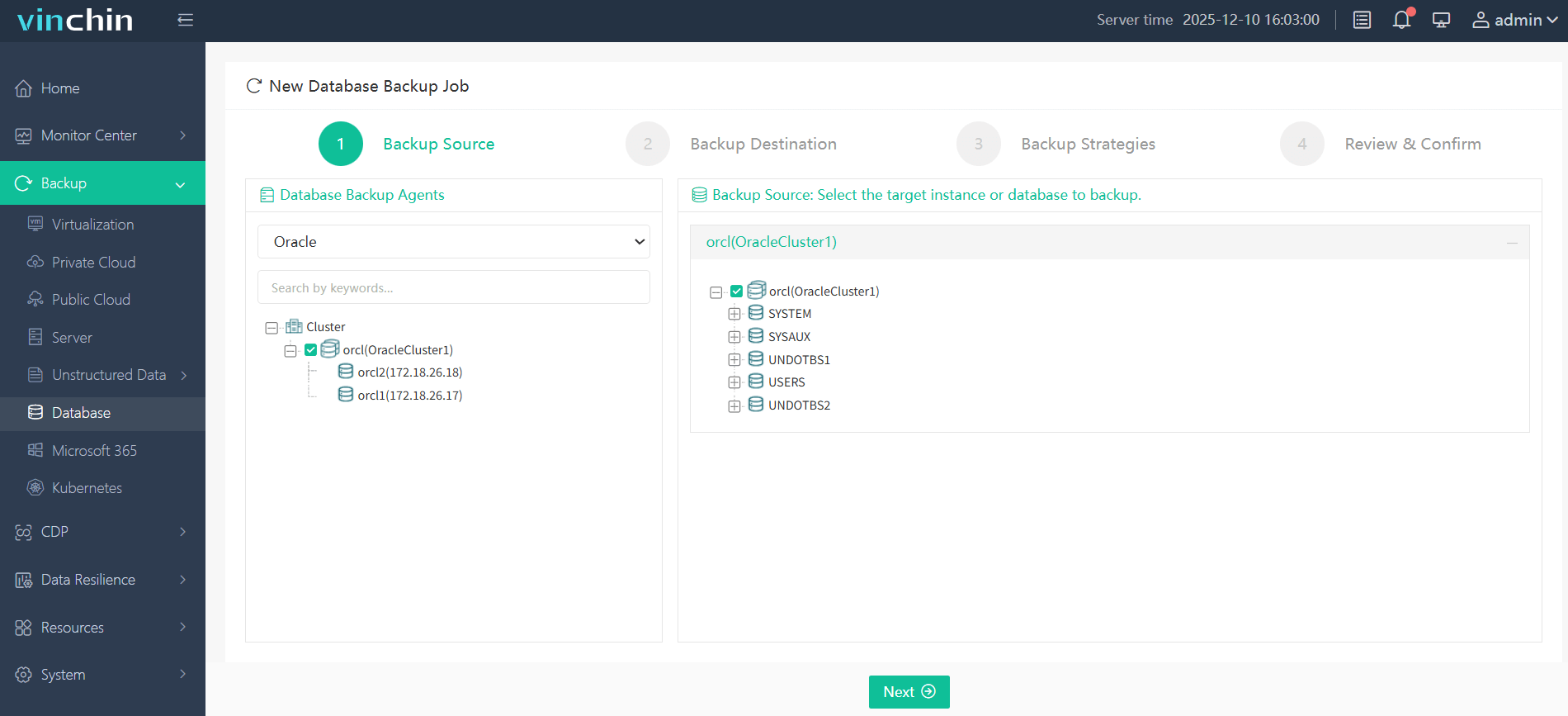
Step 1. Select the Oracle database to back up
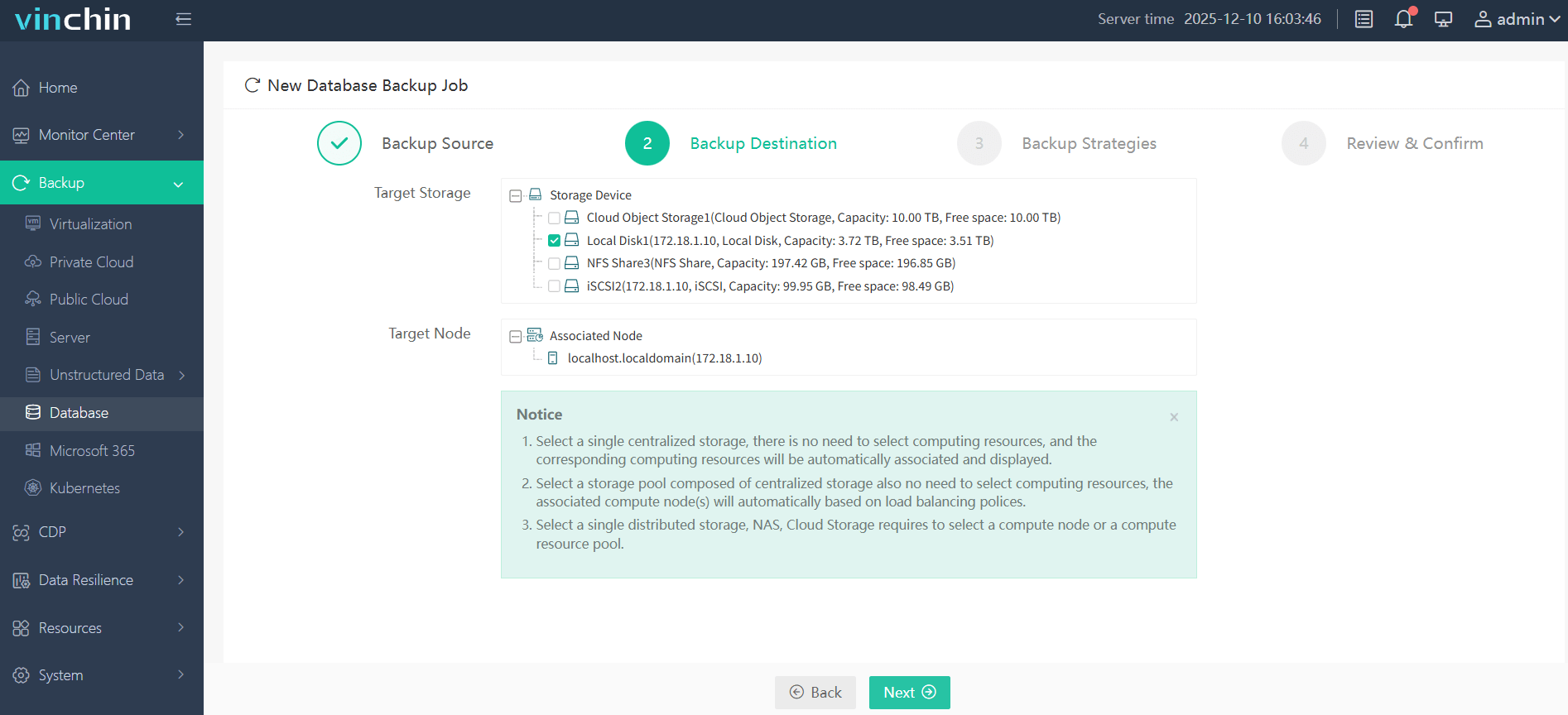
Step 2. Choose the backup storage
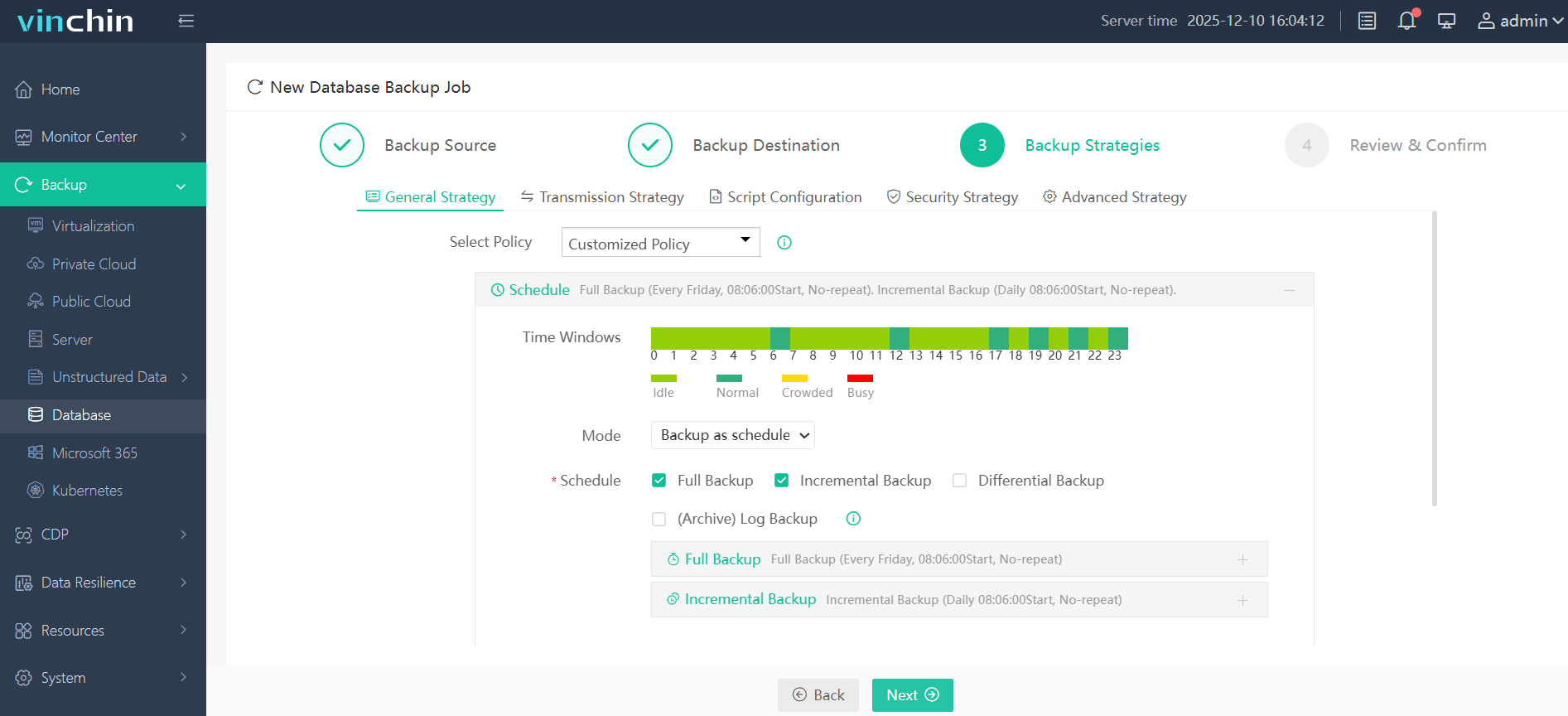
Step 3. Define the backup strategy
Step 4. Submit the job
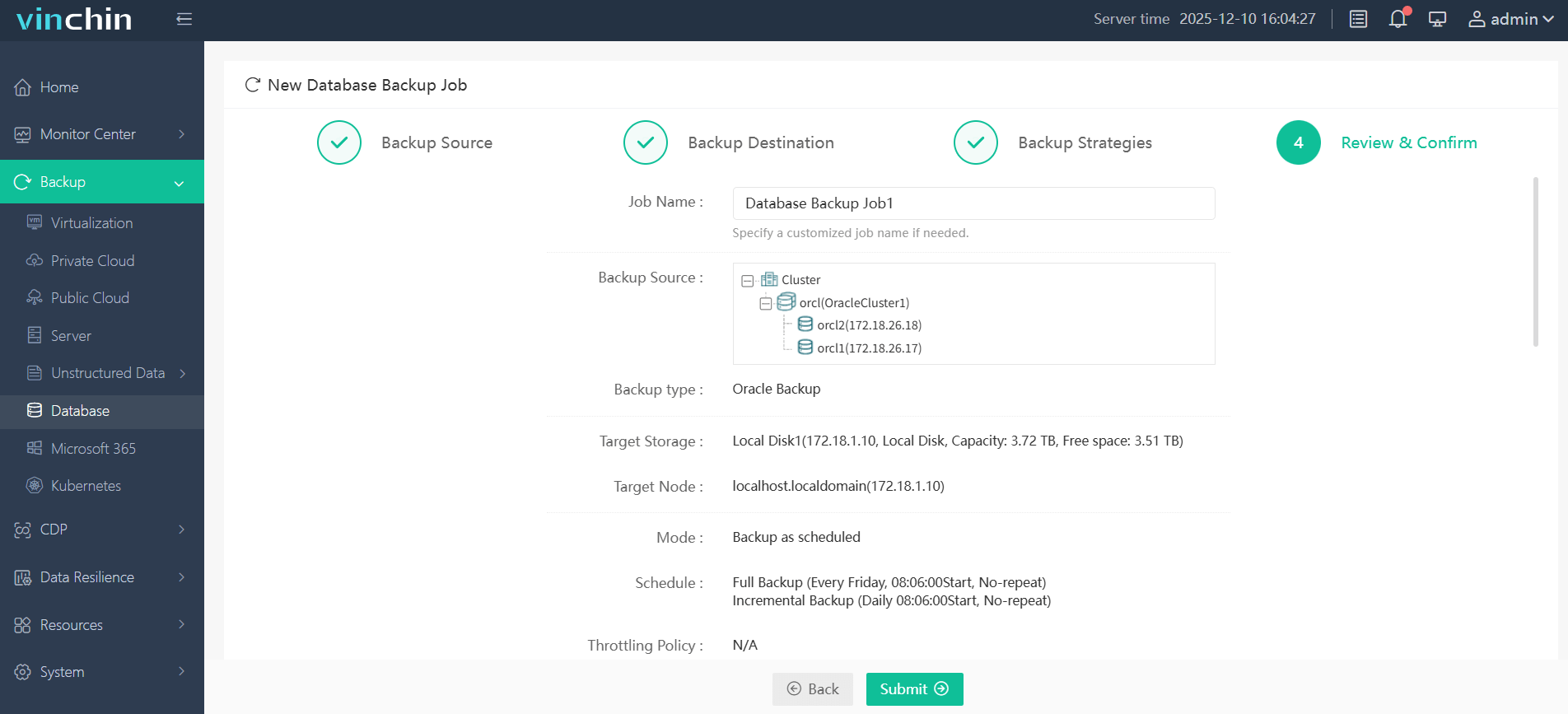
Recognized globally among enterprise IT teams—with thousands of satisfied customers worldwide—Vinchin Backup & Recovery consistently earns top ratings for reliability and ease-of-use. Experience every feature free for 60 days by clicking below to download now.
RMAN List Controlfile FAQs
Q1: Can I validate my existing control file backups without restoring them?
A1: Yes—you can run VALIDATE BACKUP OF CONTROLFILE; in RMAN to check integrity without performing an actual restore operation.
Q2: How do I ensure my scripted reports include both local disk copies and tape-based sets?
A2: Always run both LIST COPY OF CONTROLFILE; (for disk) plus LIST BACKUP OF CONTROLFILE DEVICE TYPE SBT_TAPE;.
Q3: Can I use these listings when migrating databases between platforms?
A3: Yes—as long as platform compatibility rules are met—you should confirm presence/location/status via these commands before starting migration procedures.
Conclusion
Listing Oracle control file backups using RMAN keeps administrators ready for any disaster scenario—from accidental deletions through full site failures alike! Whether working via command line automation scripts or graphical dashboards inside OEM Cloud Control suite—the right visibility ensures smooth recoveries every time they’re needed most. For even greater peace-of-mind protecting mission-critical workloads end-to-end consider trying Vinchin today!