OpenStack powers many enterprise clouds by offering flexibility and scalability. Managing backups across multiple OpenStack clusters presents unique challenges due to distributed architecture, varied APIs, and complex storage backends. Centralized monitoring is vital for organizations seeking unified oversight of backup operations in such environments. This approach ensures that administrators can track all backup jobs from one place, reducing operational complexity and risk of data loss. As cloud deployments grow in size and number, centralized monitoring becomes a cornerstone for reliable disaster recovery strategies.
Why Centralized Monitoring Matters in Enterprise Environments?
Centralized monitoring addresses critical gaps found in multi-cluster OpenStack environments. It helps organizations maintain visibility over all backup activities while supporting compliance requirements and minimizing downtime.
● Eliminates Blind Spots: Without centralized monitoring, teams must check each cluster individually for backup status or failures. This fragmented approach increases the chance of missing failed jobs or incomplete backups, which can lead to data loss during recovery scenarios.
● Reduces Downtime: Centralized dashboards allow IT staff to detect issues quickly across all clusters. Fast detection leads to faster remediation—critical when every minute of downtime impacts business operations or customer trust.
● Supports Compliance: Regulatory frameworks often require consistent data protection policies across all systems. Centralized monitoring enforces uniform policy application and provides audit trails needed for compliance audits.
● Improves Incident Response: When alerts from multiple clusters are consolidated into one interface, response times improve significantly. Teams can prioritize incidents based on severity rather than location or cluster ownership.
Centralized monitoring aligns with the CIA triad (Confidentiality, Integrity, Availability) by ensuring that backup processes are visible (Integrity), available for review (Availability), and protected through consistent policy enforcement (Confidentiality).
How To Choose The Best OpenStack Backup Solution for Centralized Monitoring?
Selecting an effective OpenStack backup solution requires careful evaluation of its centralized management capabilities alongside other enterprise needs. A robust solution should simplify oversight without sacrificing security or scalability.
● Unified Dashboard Aggregation: Solutions must offer a single dashboard that displays real-time status updates from every connected cluster. This “single pane of glass” view streamlines daily operations by eliminating the need to log into separate interfaces.
● Scalability Across Clusters: As organizations expand their cloud footprint, adding new clusters should not introduce extra management overhead or degrade performance. Scalable solutions let you connect additional clusters seamlessly under one management layer without reconfiguring existing setups.
● Automation Capabilities: Automated scheduling of backups reduces manual intervention while enforcing retention policies uniformly across environments. Automation also includes generating reports on job success rates or anomalies—key for operational reviews and regulatory reporting.
● Role-Based Access Control (RBAC): Secure multi-tenancy is essential in large enterprises where different teams manage different resources. RBAC ensures users only access what they need while maintaining detailed logs for auditing purposes.
Agentless backups are another important consideration; this means no software agents need installation on individual nodes—a design that simplifies deployment and reduces maintenance risks compared to agent-based models.
Other features worth evaluating include instant recovery options that minimize downtime after failures; granular restore capabilities allowing file-level recoveries; real-time alerting; comprehensive reporting tools; support for various storage backends; compatibility with evolving OpenStack APIs; encryption at rest/in transit; integration with external authentication sources like LDAP or Active Directory; API-driven automation support; detailed logging/auditing functions; customizable notification settings; flexible retention rules per project/tenant/workload type—all contributing toward a resilient enterprise-grade solution.
Vinchin Backup & Recovery: Enterprise-Level VM Protection Across Multi‑Platform Environments
For enterprises managing OpenStack infrastructure alongside other virtualization platforms such as VMware, Hyper-V, Proxmox, oVirt, OLVM, RHV, XCP-ng, XenServer, ZStack and more (15+ total), Vinchin Backup & Recovery offers professional virtual machine protection with robust centralized monitoring capabilities. Supporting agentless backups across these mainstream hypervisors—including full compatibility with OpenStack—Vinchin Backup & Recovery delivers features like LAN-free backup on supported platforms, CBT tracking where available, instant recovery except on Hyper-V VMs, SpeedKit acceleration on select hypervisors, plus comprehensive scheduling options everywhere.
Among its most relevant features are agentless operation for simplified deployment in large-scale clouds like OpenStack; LAN-free backup to optimize network usage where supported; incremental backup methods including forever-incremental strategies to save space and time; granular restore enabling file-level recoveries within VMs; and automated scheduling combined with GFS retention policies to ensure compliance without manual effort—all designed to maximize efficiency while minimizing risk in dynamic enterprise environments.
The intuitive web console makes protecting your environment straightforward:
Step 1: Select the OpenStack VM to back up;

Step 2: Choose the target backup storage location;
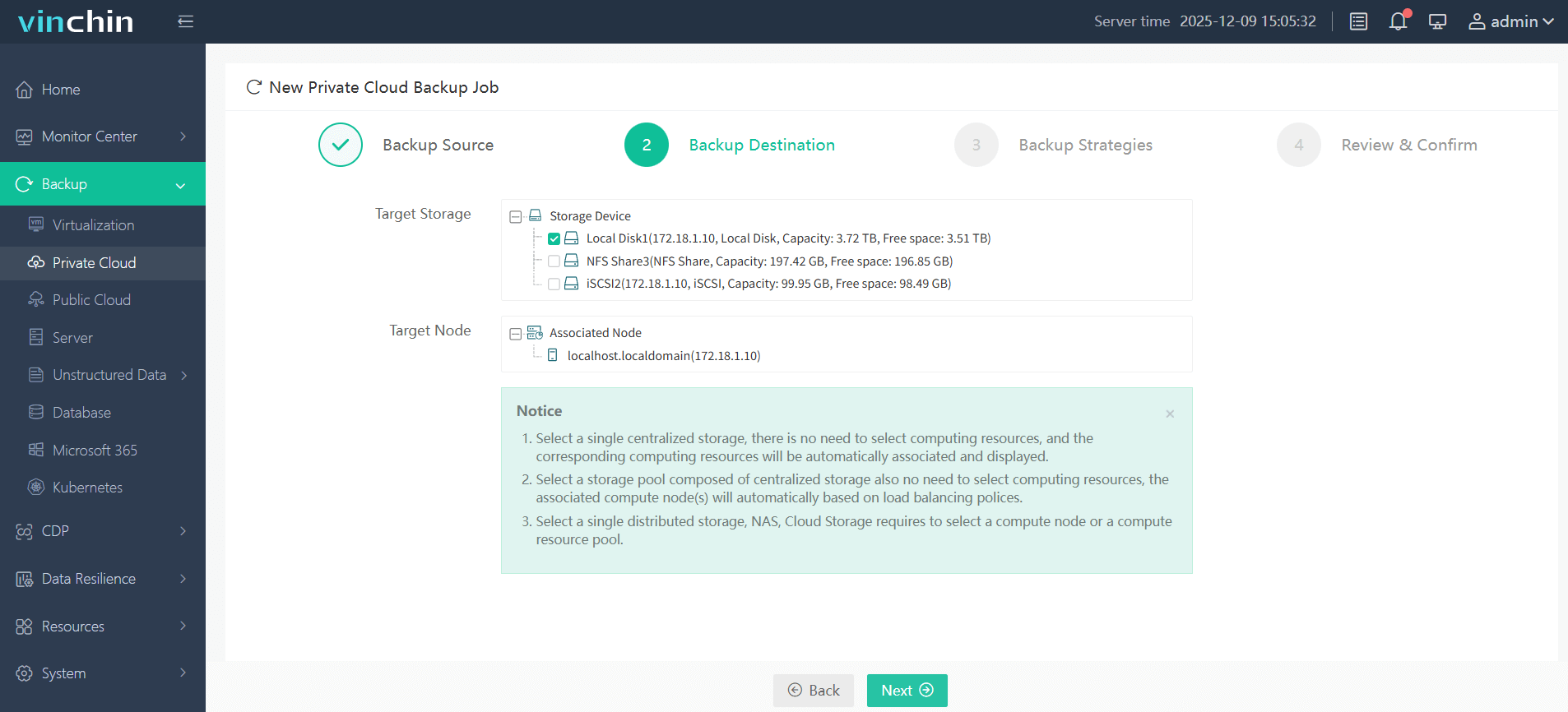
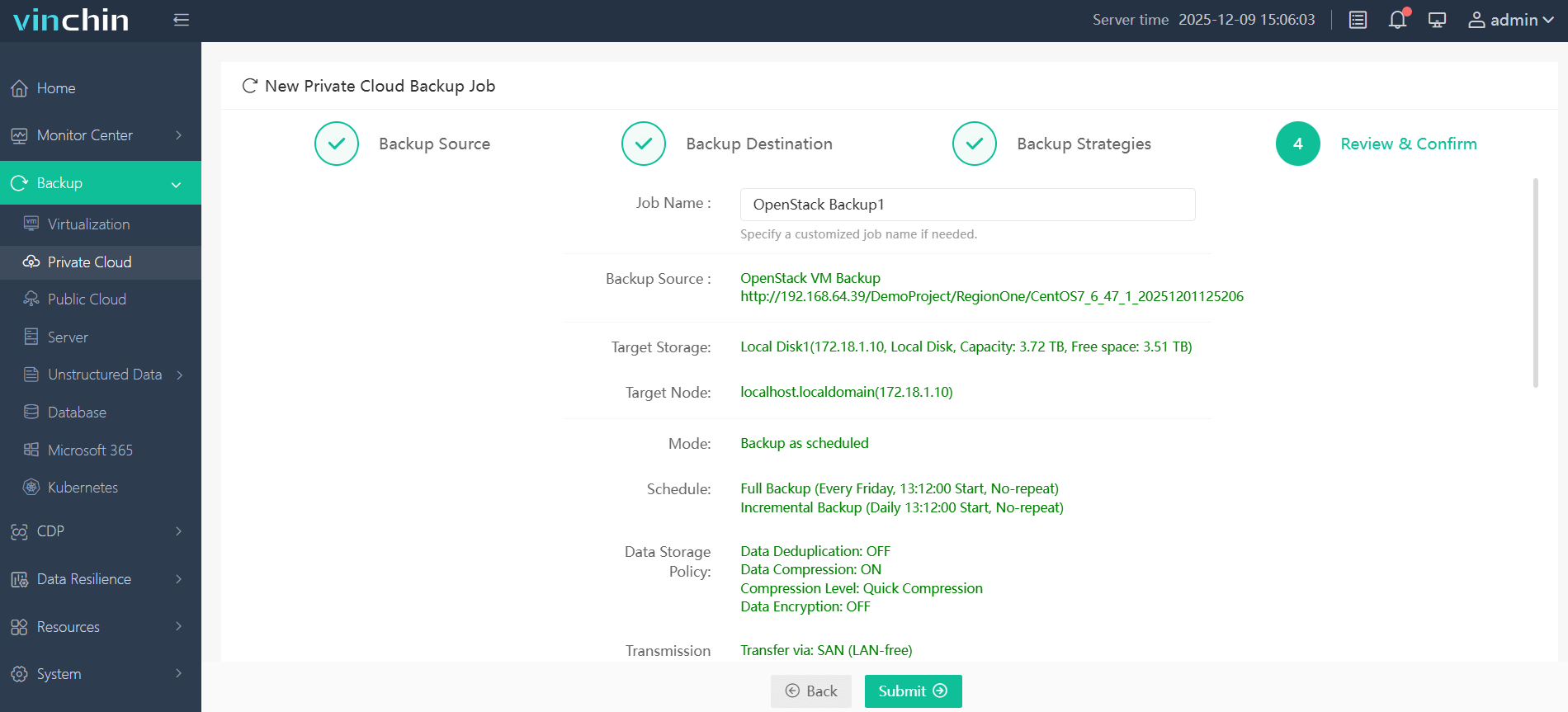
Step 3: Configure the desired backup strategy including schedule and retention policies;

Step 4: Submit the job with one click.
With a global reputation among thousands of customers worldwide—and top ratings from industry analysts—Vinchin Backup & Recovery stands out as trusted enterprise data-protection software. Try it free for 60 days with full features by clicking the download button below!
Best OpenStack Backup Software FAQs
Q1: Why is centralized monitoring important in multi-cluster OpenStack environments?
Centralized monitoring ensures consistent protection policies, rapid issue detection, streamlined compliance processes across all clusters regardless of their location or configuration differences.
Q2: Can centralized dashboards improve operational efficiency?
Yes. They reduce manual oversight needs by consolidating alerts and reports into one interface so administrators spend less time switching between systems while responding faster to incidents as they arise.
Q3: Does centralized monitoring impact security or compliance?
It enhances both by supporting audit trails through detailed logging mechanisms while enabling standardized policy enforcement—making it easier to demonstrate regulatory adherence during audits—and facilitating faster incident response times when issues occur anywhere within your environment.
Q4: Is scalability affected by adding more clusters?
A well-designed solution integrates new clusters without degrading system performance or increasing management complexity so your organization remains agile as infrastructure grows over time without compromising reliability nor introducing unnecessary administrative burdens along expansion paths.
Conclusion
Centralized monitoring transforms multi-cluster OpenStack management by reducing risk through unified control at scale while boosting efficiency—empowering IT teams to focus on strategic initiatives instead of routine firefighting.