Uncontrolled RMAN backups can saturate storage I/O and slow down critical applications. When Oracle databases grow large or run on shared infrastructure, backup jobs can affect other workloads if not managed well. The RATE parameter in RMAN gives you a way to limit backup speed by capping each channel’s throughput. This guide explains what “allocate channel rate” means in RMAN, why it matters for performance, and how to use it step by step—from beginner basics to advanced tuning.
What is RMAN allocate channel?
An RMAN channel is a dedicated connection between Recovery Manager (RMAN) and your Oracle database instance. Each channel acts like a worker process that reads or writes data during backup or restore operations. You can run one or many channels at once; each handles its own stream of data.
Channels are allocated either manually inside a RUN block using the ALLOCATE CHANNEL command or automatically with persistent settings via CONFIGURE CHANNEL. Each channel has options that let you control its behavior, such as where files are written, file size limits, device type used (disk or tape), and transfer speed.
Allocating multiple channels lets you run backups in parallel across disks or tape drives. This speeds up jobs but also increases load on hardware resources like CPU and storage bandwidth. Choosing the right number of channels depends on your system’s configuration and available resources.
Why set channel rate in RMAN?
By default, an RMAN channel uses all available I/O bandwidth. It reads and writes as fast as possible until limited by hardware or network constraints. While this maximizes backup speed, it can slow down other applications sharing those same disks or networks.
The RATE parameter lets you set an upper limit on bytes per second for each channel, essentially acting as a throttle so that no single backup job overwhelms your system during production hours.
For example:
If your disk delivers 3 MB/s but you want to reserve bandwidth for other applications, set RATE 1M so only 1 MB/s is used by that backup job.
On busy systems with shared storage arrays or SANs, this prevents backups from causing latency spikes.
For tape devices writing over remote links or WANs, limiting RATE helps avoid saturating network connections.
Setting RATE does not make backups faster. It slows them down deliberately to protect overall system health during business hours when responsiveness matters most.
How does the RATE parameter work in RMAN?
When you specify the RATE parameter for an allocated channel in RMAN, Oracle internally paces data transfer so that throughput does not exceed your specified value per second. This is done by introducing brief pauses within read operations if needed, ensuring average speed stays below the cap you set.
Even if underlying disks could deliver more throughput, each RMAN process holds back just enough to stay within its assigned limit.
It’s important to note:
The RATE applies per-channel, not globally across all channels.
It limits read speed from input files. Actual write speed may vary depending on compression settings or device type.
Setting too low a value will extend total backup time beyond what may be acceptable for your maintenance window.
To remove any existing rate limit: reconfigure without the RATE clause (CONFIGURE CHANNEL DEVICE TYPE DISK CLEAR) or omit it from manual allocations.
How to use the RATE parameter in RMAN allocate channel
You can set the RATE parameter either when manually allocating channels inside a RUN block or when configuring automatic channels globally using CONFIGURE commands.
Manual allocation example
Suppose you want two disk channels: one limited to 50 MB/s and another capped at 30 MB/s:
RUN {
    ALLOCATE CHANNEL ch1 DEVICE TYPE DISK FORMAT '+DATA' MAXPIECESIZE=200M RATE=50M;
    ALLOCATE CHANNEL ch2 DEVICE TYPE DISK FORMAT '/SHARED/backup1/%U' MAXPIECESIZE=100M RATE=30M;
    BACKUP DATAFILE 1,2;
}
Each ALLOCATE CHANNEL line creates a named server process with its own speed limit enforced by Oracle’s internal pacing mechanism. You can specify units as K (kilobytes), M (megabytes), or G (gigabytes). Use this approach if you need fine-grained control over specific jobs—for example during peak business hours versus overnight windows.
Automatic configuration example
To always limit all SBT (tape) channels to 1 MB/s:
CONFIGURE DEVICE TYPE SBT PARALLELISM 2;
CONFIGURE DEFAULT DEVICE TYPE TO SBT;
CONFIGURE CHANNEL DEVICE TYPE SBT RATE 1M;
Now every time an SBT job runs without manual overrides both tape channels will never exceed 1 MB/s each—helpful when backing up over slower network links or constrained WAN connections.
Syntax notes
Remember:
The RATE parameter applies per-channel, not globally.
It caps read speed from source files; final write rates depend on device type/compression.
Removing any existing rate limit requires clearing configuration (CONFIGURE CHANNEL ... CLEAR) or omitting RATE from manual allocations.
Setting too low a value makes backups take longer than necessary. Always test before applying changes broadly.
Monitoring and validating RATE limits
After setting up rate limits in RMAN channels it’s important to verify they’re working as intended and not inadvertently slowing down backups too much (or failing to protect production workloads).
Starting by watching output messages during an active backup session, RMAN displays elapsed time after each piece is written which helps estimate effective throughput per channel compared against your configured rates.
For deeper insight:
Query dynamic performance views such as V$BACKUP_SYNC_IO or V$BACKUP_ASYNC_IO during active jobs; check columns like EFFECTIVE_BYTES_PER_SECOND for actual observed speeds.
Map running RMAN processes back to OS-level activity using V$SESSION/V$PROCESS views then monitor disk utilization with tools like iostat atop sar dstat etc. Look for sustained usage matching expected rates rather than short bursts above/below target values.
If observed speeds differ greatly from configured rates double-check syntax spelling units device types and confirm no external bottlenecks exist elsewhere in storage/network stack!
Practical use cases for RATE limiting
Why would administrators want precise control over Oracle backup speeds? Here are some common scenarios:
In environments where multiple databases share one SAN array throttling individual backups prevents one job from starving others of I/O bandwidth especially during peak transaction periods, a must-have safeguard against unpredictable slowdowns.
When sending backups offsite over WAN links capping transfer rates avoids saturating limited bandwidth ensuring ongoing replication traffic email services video calls etc remain unaffected throughout lengthy full-backup cycles.
Tape libraries often require steady streaming speeds. Setting appropriate rates matches drive capabilities preventing stop-start “shoe-shining” which wears out tapes prematurely while still maximizing safe throughput.
Cloud-based object storage sometimes charges based on egress volume/time windows. Throttling upload/download speeds keeps costs predictable avoids triggering provider-side throttling policies and ensures compliance with service-level agreements around restore times.
Wherever resource contention exists between mission-critical apps routine batch jobs disaster recovery pipelines or cost/performance tradeoffs matter. The ability to fine-tune Oracle backup velocity pays dividends both operationally and financially.
How to control backup speed in RMAN using parallelism
While the RATE parameter throttles individual streams another way to influence total throughput is by adjusting parallelism. The number of active channels working at once across available devices/disks/tapes/networks/etc.
Set parallelism using:
CONFIGURE DEVICE TYPE DISK PARALLELISM 4;
This tells RMAN to use four disk channels simultaneously whenever possible, increasing concurrency but also raising aggregate load on CPUs memory controllers interconnects etc. More isn’t always better though. Adding too many concurrent workers can cause contention actually slowing things down due excessive queueing context switches lock waits etc especially if underlying hardware isn’t sized accordingly.
When allocating manually:
RUN {
    ALLOCATE CHANNEL c1 DEVICE TYPE DISK;
    ALLOCATE CHANNEL c2 DEVICE TYPE DISK;
    -- Add more if needed
    BACKUP DATABASE;
}
Each allocated channel processes part of workload independently so total elapsed time drops IF infrastructure supports higher concurrency but beware diminishing returns. A good starting point is matching number of physical LUNs/spindles dedicated for backup without exceeding CPU core count then testing under load before scaling further.
Best practices include:
Monitor system load closely. Watch CPU usage I/O wait times memory pressure network saturation etc during test runs.
Combine FILESPERSET/MAXOPENFILES tuning options alongside PARALLELISM/RATE controls for optimal distribution among sets/pieces/devices.
Don’t forget about potential bottlenecks outside database host itself, especially NFS/CIFS mounts cloud gateways remote tape libraries etc where aggregate traffic may hit hard-coded platform/service limits regardless local settings.
Total potential impact = PARALLELISM x individual RATE values, so tune both levers together based on holistic view of environment needs/constraints.
Parallelism boosts performance but only up until infrastructure capacity gets saturated after which further increases yield little/no benefit while risking instability elsewhere.
Vinchin Backup & Recovery: Unified Oracle Database Protection
Building upon these best practices, organizations seeking streamlined management should consider Vinchin Backup & Recovery.
Vinchin supports most of the mainstream databases inculding Oracle 10g, 11g/11g R2, 12c, 18c, 19c, 21c, Oracle RAC, MySQL, SQL Server, MariaDB, PostgreSQL, PostgresPro, and TiDB.
It provides various effective backup strategies. Reliability is ensured through features such as automatic integrity checks and isolated recoverability validation tests so restores work when they matter most. Additionally, organizations can build robust disaster recovery strategies via automated retention policies and cloud archiving/backups. All managed through Vinchin's intuitive B/S web console featuring wizard-driven workflows that simplify setup even further.
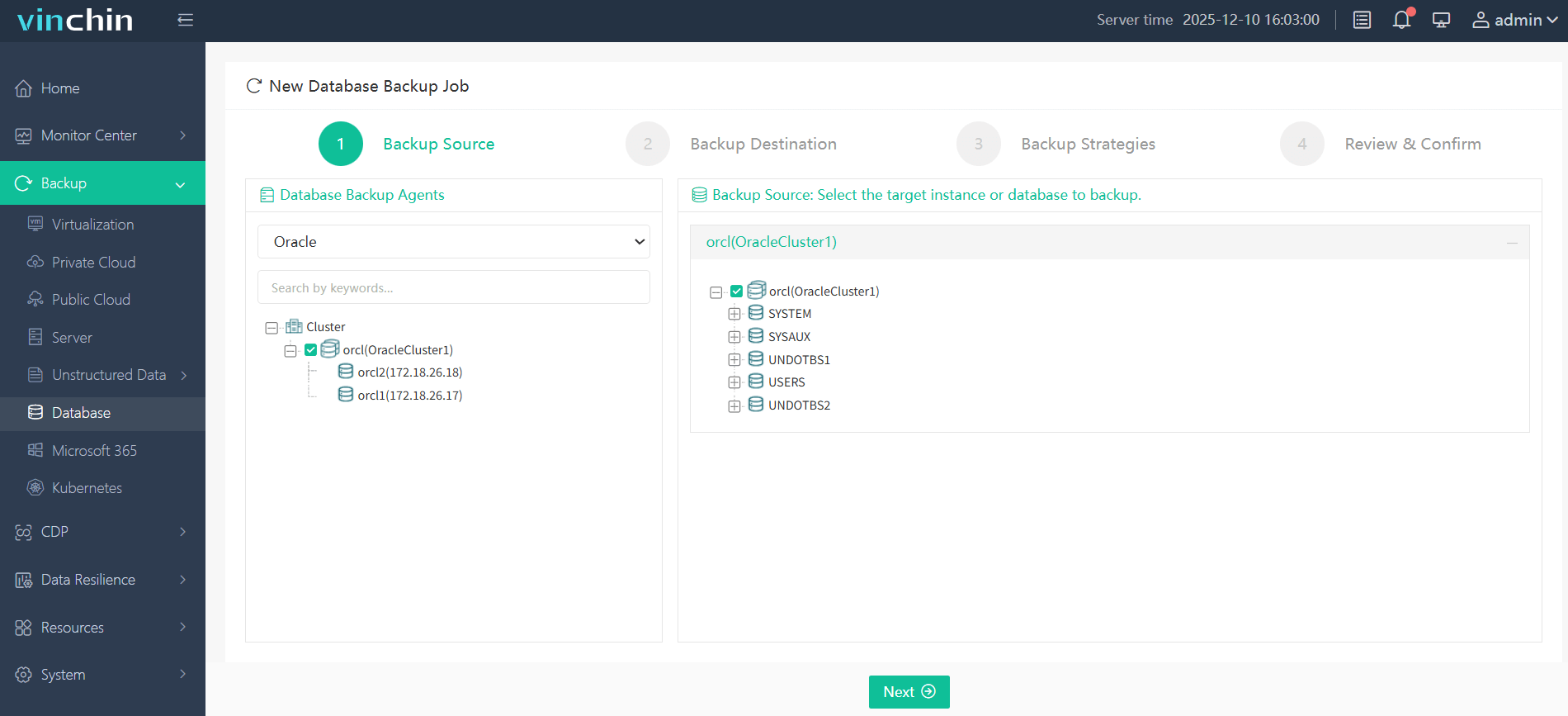
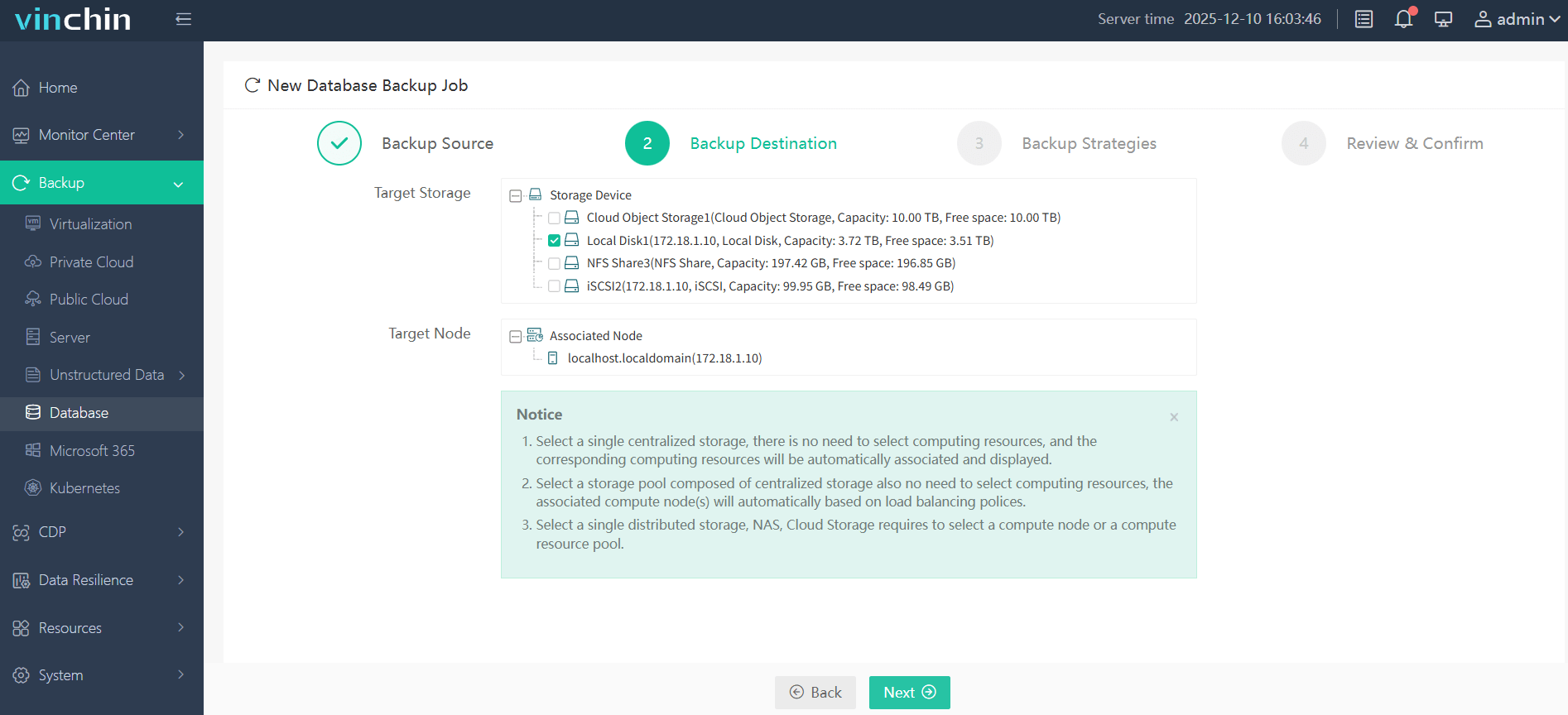
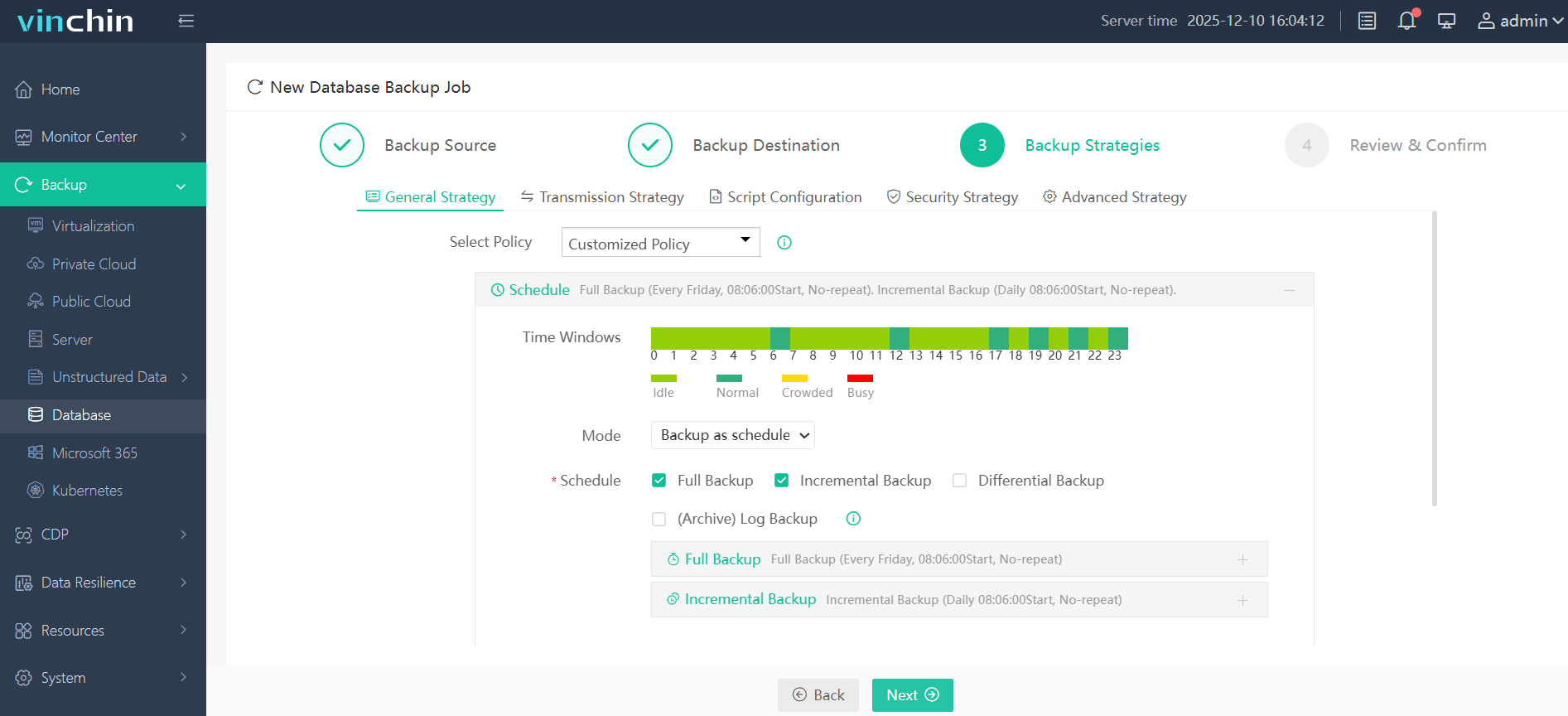
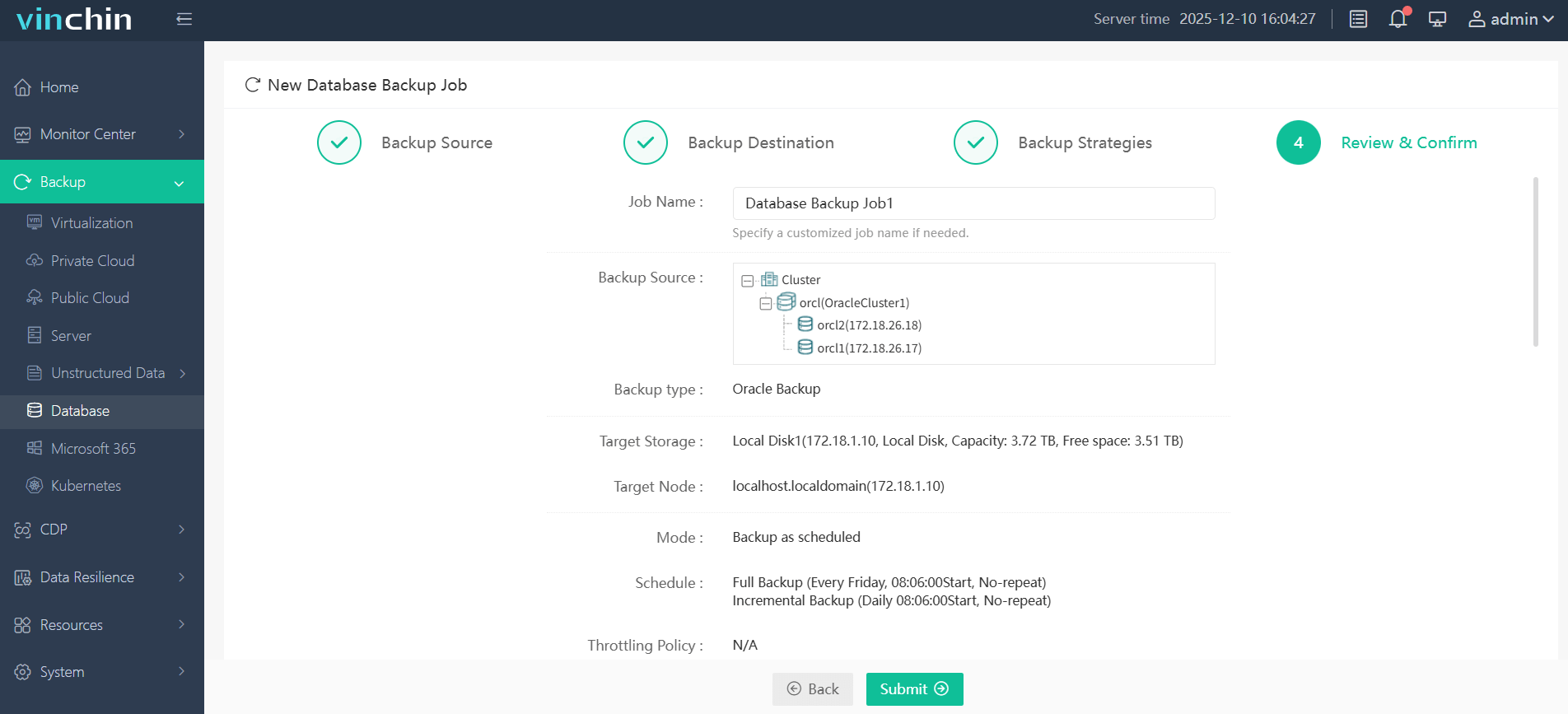
A typical database workflow includes just four steps:
Step 1. Select the Oracle databases
Step 2. Select the backup destination
Step 3. Select the backup strategies
Step 4. Submit the job
Vinchin Backup & Recovery comes with a free 60-day trial plus detailed documentation and responsive support engineers to help ensure smooth deployment tailored precisely for your environment.
RMAN allocate channel rate FAQs
Q1: Can I change the RATE value while a backup is running?
No; stop the current job first then restart with new allocation settings as needed.
Q2: How do I map an allocated RMAN channel's process ID at OS level?
Query V$SESSION join V$PROCESS match SPID column then check OS process list using ps/top/iostat tools as needed.
Q3: My manually allocated disk channel fails immediately so what should I check?
Verify free space at target location ensure oracle user has write permissions confirm directory path spelling check device compatibility before rerunning job
Q4: Does setting RATE also affect restore operations?
Yes; any specified RATE cap applies equally during both backup and restore actions performed through that same allocated channel type/device class combination
Q5: What happens if my configured RATE value is too low?
Backups will complete much slower possibly exceeding allowed window but no error occurs unless other resource/timeouts intervene adjust upward after testing baseline performance first
Conclusion
Controlling Oracle backup speed with “allocate channel rate” gives administrators direct power over resource usage helping balance performance against business needs safely at scale. For streamlined protection across complex IT landscapes consider Vinchin’s unified solution. It’s easy-to-use yet powerful enough for any enterprise scenario.