Setting up reliable Oracle RMAN backups is a top priority for database administrators. But have you ever wondered if using the default SYS account is the best practice? Creating a dedicated user for RMAN backup operations can improve both security and manageability. In this guide, we’ll walk through what RMAN backup is, why a special user matters, how to create and configure that user step by step—and how to test your setup. We’ll also cover advanced tips so you can handle even complex environments with confidence.
What Is RMAN Backup in Oracle?
Oracle Recovery Manager (RMAN) is the built-in tool for backing up, restoring, and recovering Oracle databases. It integrates tightly with the Oracle engine. With RMAN, you can automate full or incremental backups, validate backup integrity before restore, and perform point-in-time recovery when needed. Because it operates at a low level within Oracle’s architecture, RMAN can recover individual blocks or verify backups without restoring them first. This makes it essential for any robust Oracle backup strategy. If you want peace of mind about your data safety—or need to meet compliance requirements—RMAN should be part of your toolkit.
Why Create a Dedicated User for RMAN Backup?
While you can run RMAN backups as the SYS user, this approach is not ideal. Granting SYSDBA to every backup script or operator increases risk—one mistake could impact the entire database. By creating a dedicated user with only the necessary privileges, you reduce your attack surface and make audits easier.
Oracle introduced the SYSBACKUP privilege in version 12c specifically to support this best practice. Using a dedicated user helps separate backup operations from other administrative tasks so your environment stays secure and manageable. Auditors will thank you too—tracking actions becomes much simpler when each function has its own account.
Understanding Key Privileges: SYSDBA vs SYSOPER vs SYSBACKUP
Not all high-level privileges are created equal in Oracle:
SYSDBA grants full control over all aspects of an Oracle database—including startup/shutdown commands or structural changes like adding tablespaces.
SYSOPER allows basic operational tasks such as starting up or shutting down but does not permit structural changes.
SYSBACKUP, introduced in 12c, gives just enough power to perform all backup/recovery operations without broader administrative rights.
For most modern environments focused on security best practices, granting only SYSBACKUP to your dedicated user is recommended unless legacy compatibility requires otherwise.
How to Create a User for RMAN Backup via SQL*Plus?
Creating a user for RMAN backup is straightforward if you follow these steps carefully. The goal is to ensure that your new account has exactly what it needs—no more and no less—to keep things secure.
First, connect to your Oracle database as someone who already has SYSDBA privileges. Make sure you're running SQL*Plus from an environment where ORACLE_HOME and ORACLE_SID are set correctly; usually this means working directly on the server in $ORACLE_HOME/bin.
sqlplus / as sysdba
Once connected:
1. Create your new user by replacing rman_user with your chosen username (and strong_password with something secure):
CREATE USER rman_user IDENTIFIED BY strong_password;
2. Next comes privilege assignment:
GRANT SYSBACKUP TO rman_user;
GRANT SYSDBA TO rman_user;
That’s it—the new account now has what it needs for all standard backup tasks using RMAN.
Remember: There’s no need to grant extra system privileges like CREATE SESSION because both SYSDBA and SYSBACKUP already allow connection when specified during login (AS SYSDBA or AS SYSBACKUP). Avoid giving additional rights unless absolutely required by another process.
How to Grant Privileges for RMAN Operations?
Granting correct privileges ensures only authorized users can perform sensitive operations—and nothing else slips through unnoticed.
The SYSBACKUP privilege was designed specifically for safe separation of duties related to data protection tasks starting in version 12c. It covers everything needed for full/incremental backups plus restore/recover actions—but cannot alter core database structures unrelated to recovery.
To assign this role after logging in as someone with sufficient authority:
GRANT SYSBACKUP TO rman_user;
If operating system authentication fits better into automated scripts (especially on Linux/Unix), add relevant OS users into group OSBACKUPDBA. On Windows systems use group ORA_DBA. This lets those users connect without specifying passwords directly—a safer choice than embedding credentials in scripts:
rman target /
Or connect explicitly as your dedicated backup account using network authentication:
rman target "rman_user/strong_password@ORCL AS SYSBACKUP"
After connecting successfully via either method above—you’re ready!
Testing and Validating the RMAN Backup User
Before putting anything into production schedules or automation jobs—it pays off big time to test thoroughly! Here’s how:
1. Connect using SQL*Plus or directly through RMAN CLI:
sqlplus rman_user/strong_password@ORCL AS SYSBACKUP
For direct command-line access:
rman target "rman_user/strong_password@ORCL AS SYSBACKUP"
2. Once inside an active session run:
SHOW ALL;
This displays current configuration settings; seeing output confirms proper connection rights.
3. To check actual permissions further without writing files yet:
BACKUP VALIDATE DATABASE ARCHIVELOG ALL;
This command simulates full validation of datafiles/archive logs—if successful then everything’s set!
4. Finally—for audit purposes—you may wish verify which accounts hold key roles:
SELECT USERNAME,SYSDBA,SYSOPER,SYSBACKUP FROM V$PWFILE_USERS WHERE USERNAME='RMAN_USER';
If any error appears during these steps review group memberships (for OS auth), spelling/case sensitivity of usernames/passwords—or consult alert logs (alert.log) under $ORACLE_BASE/diag/rdbms/... paths for deeper clues.
Vinchin Backup & Recovery: Enterprise-Level Protection for Your Oracle Backups
After configuring an appropriate Oracle RMAN user, selecting an enterprise-grade solution like Vinchin Backup & Recovery ensures comprehensive protection of critical data assets across diverse environments including Oracle databases—the focus here—as well as MySQL, SQL Server, MariaDB, PostgreSQL, PostgresPro, and TiDB platforms widely used today. Vinchin Backup & Recovery delivers robust features such as incremental backup tailored for efficient storage utilization in large-scale deployments; log backup supporting any-point-in-time recovery; scheduled automated backups; storage protection against ransomware threats; and integrity checks that guarantee recoverability under real-world conditions—all contributing toward streamlined management while minimizing risks associated with manual processes.
Managing backups through Vinchin Backup & Recovery's intuitive web console takes just four clear steps:
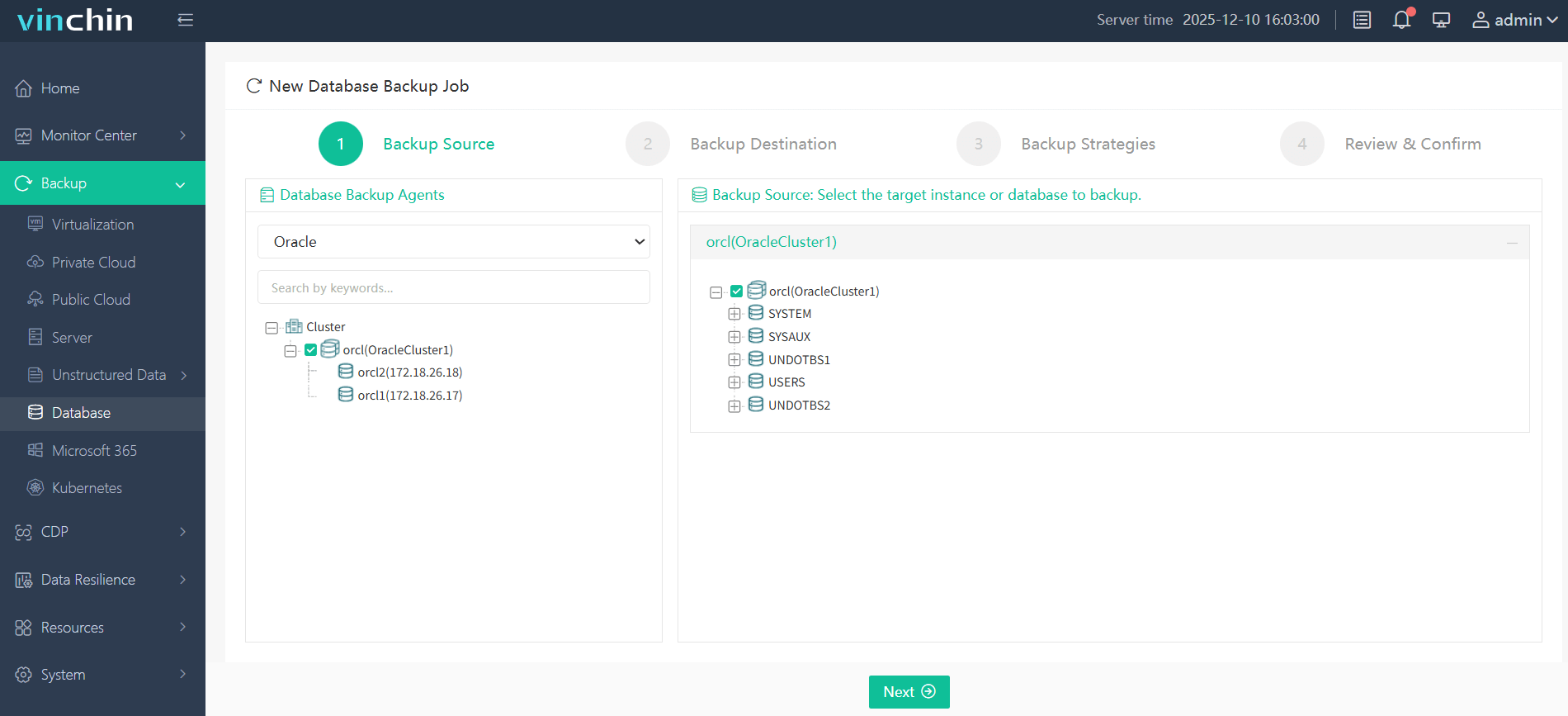
Step 1. Select the Oracle database to back up
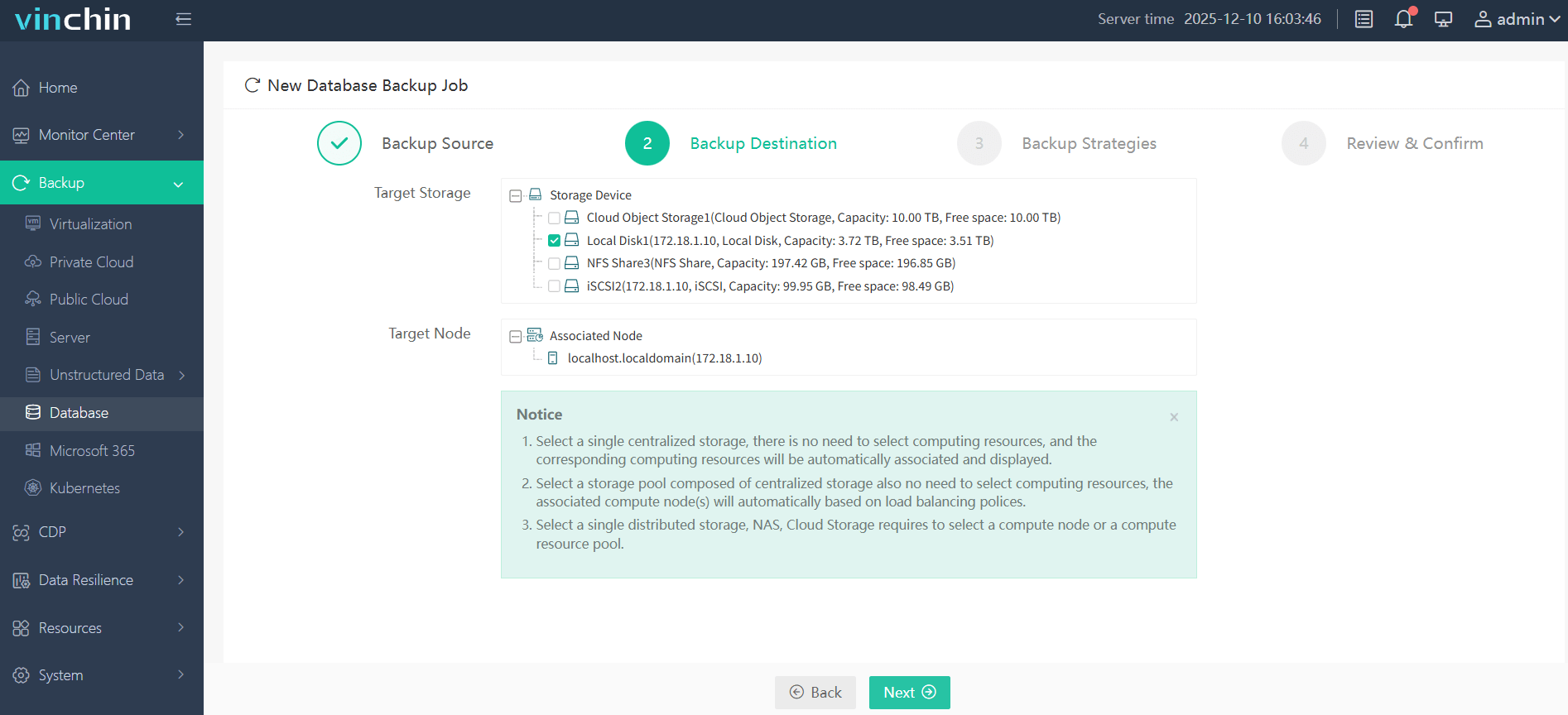
Step 2. Choose the backup storage
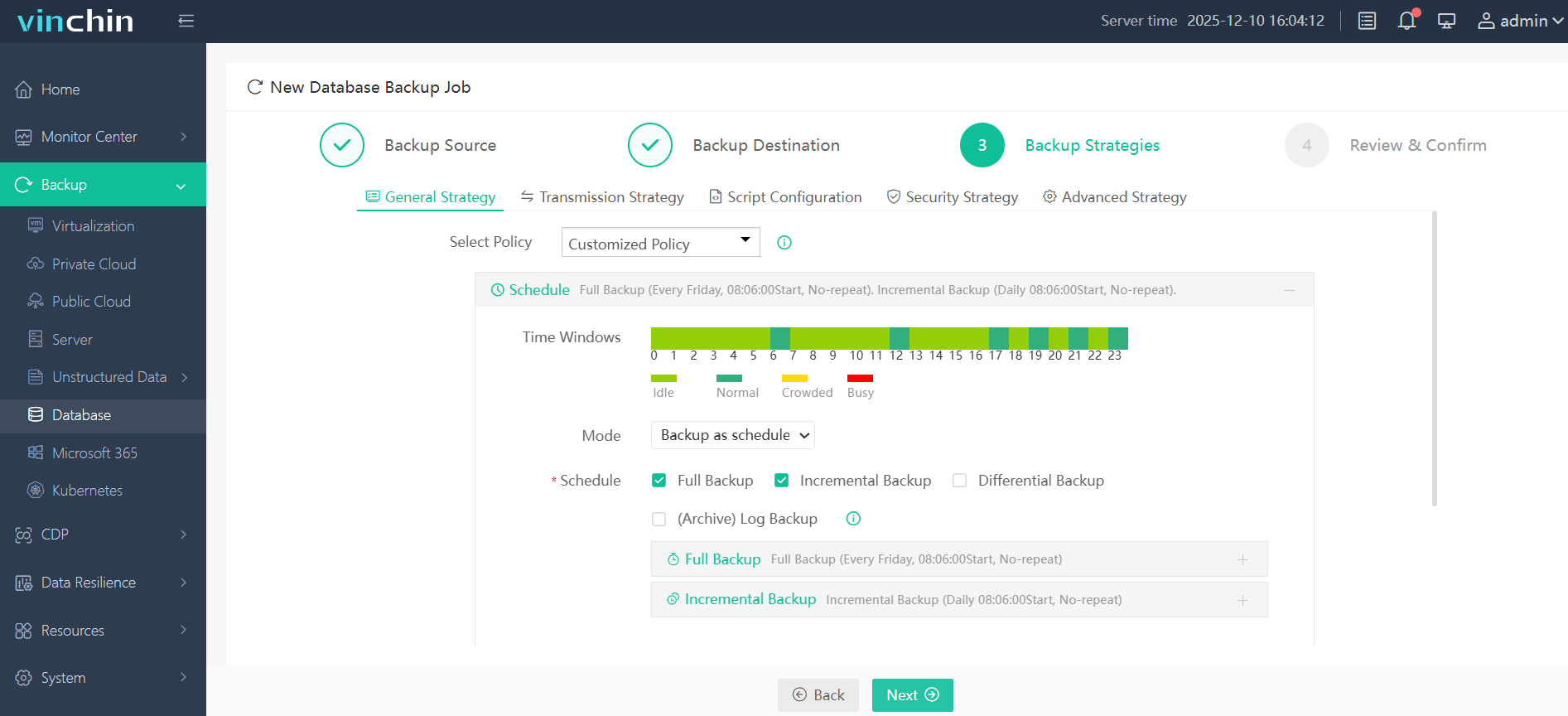
Step 3. Define the backup strategy
Step 4. Submit the job
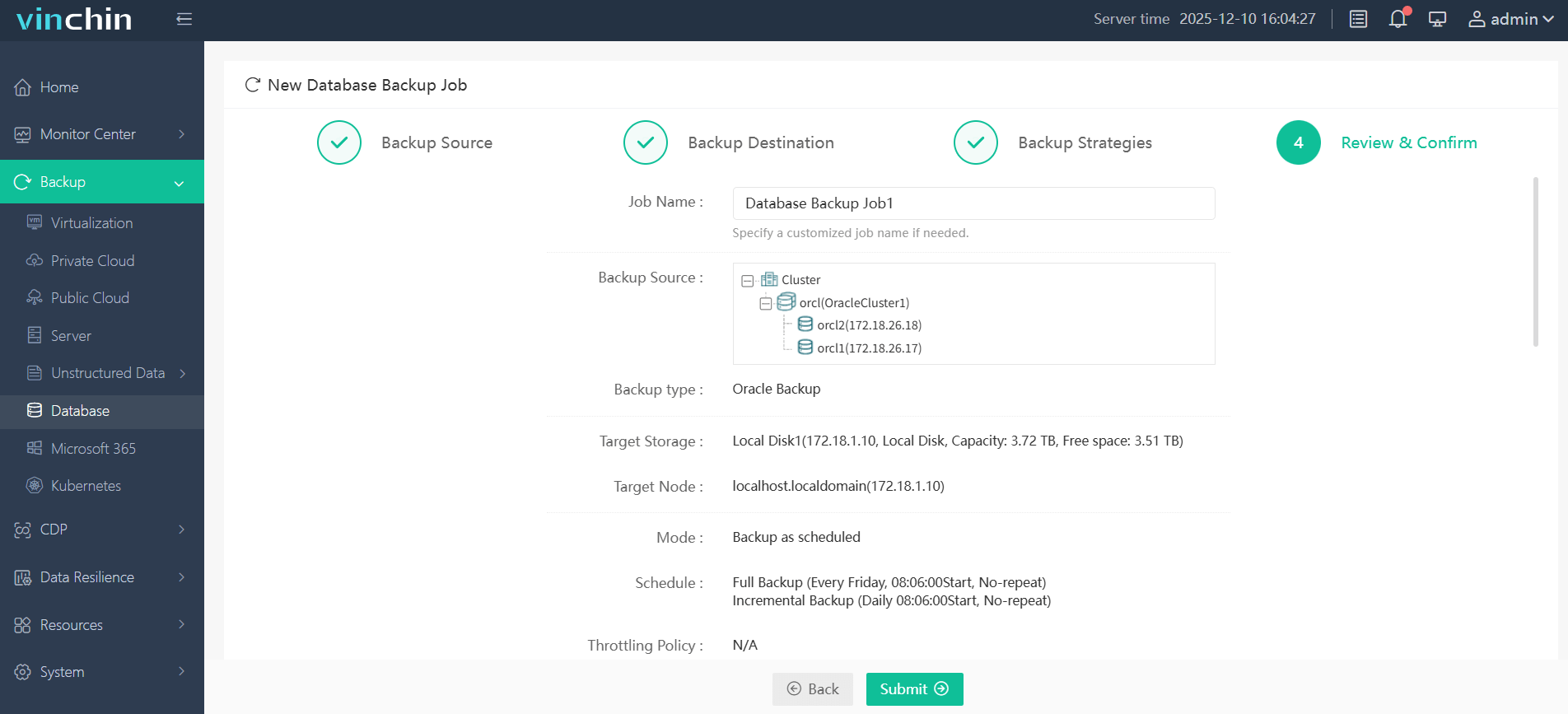
Recognized globally among enterprise customers—with top ratings from industry analysts—you can experience every feature free for 60 days by clicking download below and discover why Vinchin Backup & Recovery stands out among leading data-protection solutions.
Oracle Create User for RMAN Backup FAQs
Q1: Can I automate backups securely without storing plain-text passwords?
A1: Yes; use operating system authentication groups like OSDBA/OSBACKUPDBA so scripts do not require embedded credentials.
Q2: What should I do if my new user cannot connect as SYSBACKUP?
A2: Ensure they exist in both database accounts list (ALL_USERS) AND password file; check group membership if using OS authentication.
Q3: How do I enable auditing specifically on my dedicated RMAN user?
A3: Run AUDIT SESSION BY rman_user; while logged in as an administrator.
Conclusion
Creating an independent account just for Oracle RMAN backups strengthens security while simplifying audits—even across complex architectures like multitenant databases or automated job frameworks! Assign only essential privileges then let Vinchin handle scheduling plus monitoring so you stay focused on business priorities—not manual chores around data protection setups!