Managing backups for large Oracle databases is never simple—especially when you use bigfile tablespaces. These special tablespaces can store huge amounts of data in a single file. This design brings both convenience and complexity. Why? Because backing up one massive file requires careful planning to ensure speed and reliability. If you want your backups to finish quickly—and restore even faster—you need to understand how Oracle RMAN handles bigfile tablespaces. In this guide, we’ll walk through what makes bigfile tablespaces different, how RMAN works with them, best practices for efficient backup, monitoring strategies, automation tips, and more.
What Is an Oracle Bigfile Tablespace?
An Oracle bigfile tablespace is a type of tablespace that contains only one very large datafile instead of many smaller ones. Traditional smallfile tablespaces can have thousands of datafiles; bigfile tablespaces simplify things by using just one per tablespace. With an 8K block size, a single bigfile can grow up to 32TB; with a 32K block size, it can reach up to 128TB. This approach reduces file management overhead but introduces new challenges for backup and recovery.
Bigfile tablespaces are popular in environments where database sizes grow rapidly or where storage systems handle large files efficiently. They work well with Oracle Automatic Storage Management (ASM) and other logical volume managers that support striping across disks.
Why Use Bigfile Tablespaces?
Why would you choose a bigfile over traditional smallfiles? For starters, managing fewer files means less administrative effort—no more juggling hundreds or thousands of datafiles as your database grows into terabytes or beyond. This simplicity extends to backup routines since there’s only one file per tablespace.
Bigfile tablespaces also help you avoid hitting limits on the number of datafiles allowed in an Oracle database—a common concern in very large deployments. They integrate smoothly with ASM and modern storage arrays that excel at handling large sequential files rather than many small random ones.
Performance benefits come from easier striping across disks when used with ASM or similar tools. By reducing metadata overhead related to tracking multiple files, you may also see improvements in certain maintenance tasks.
What Is RMAN Backup?
RMAN (Recovery Manager) is Oracle’s built-in tool for backing up and restoring databases safely and efficiently. It supports full backups (everything), incremental backups (only changed blocks), compression for space savings, encryption for security needs, parallelism for speed—and much more.
Because RMAN integrates tightly with the database engine itself, it knows exactly which blocks need protection at any moment—even while users are working on the system. You can back up entire databases at once or focus on specific pieces like individual tablespaces or datafiles depending on your needs.
Advanced features include block change tracking (for faster incrementals), multisection backups (for splitting large files among channels), validation commands (to check backup integrity), retention policies (to manage old backups automatically), and more.
How to Back Up Bigfile Tablespace with RMAN
Backing up an Oracle bigfile tablespace using RMAN isn’t complicated—but doing it efficiently takes some know-how. Since there’s only one giant file per bigfile tablespace, using multiple channels becomes crucial if you want fast backups.
The secret weapon here is multisection backup—enabled by adding the SECTION SIZE clause in your BACKUP command. Each section gets processed by its own channel so you can split work across CPU cores or disk spindles.
Let’s break down the steps:
1. Connect to RMAN:
rman target /
2. Allocate channels based on your hardware resources—for example:
   RUN {
     ALLOCATE CHANNEL ch1 DEVICE TYPE DISK;
     ALLOCATE CHANNEL ch2 DEVICE TYPE DISK;
     ALLOCATE CHANNEL ch3 DEVICE TYPE DISK;
     ALLOCATE CHANNEL ch4 DEVICE TYPE DISK;
3. Use SECTION SIZE so each channel processes part of the file:
     BACKUP AS COMPRESSED BACKUPSET
       SECTION SIZE 32G
       TABLESPACE BIG_TBS
       FORMAT '/backup/BIG_TBS_%U.bkp';
   }
If your bigfile is around 1TB and you allocate four channels as above—a SECTION SIZE of about 256GB ensures each channel gets roughly equal work for maximum throughput.
You may also tag your backup jobs for easy identification later:
BACKUP AS COMPRESSED BACKUPSET
  SECTION SIZE 32G
  TABLESPACE BIG_TBS
  TAG='BIGFILE_BKP'
  FORMAT '/backup/BIG_TBS_%U.bkp';
After completion, check status using:
LIST BACKUP OF TABLESPACE BIG_TBS;
How to Automate Bigfile Tablespace Backups Using RMAN?
Manual backups are risky—they rely too much on human memory! Automation ensures consistent protection day after day without fail.
On Linux/Unix systems:
1. Create a shell script like this:
#!/bin/bash
export ORACLE_SID=yourdb
export ORACLE_HOME=/u01/app/oracle/product/19.0.0/dbhome_1
export PATH=$ORACLE_HOME/bin:$PATH

rman target / <<EOF
RUN {
  ALLOCATE CHANNEL ch1 DEVICE TYPE DISK;
  ALLOCATE CHANNEL ch2 DEVICE TYPE DISK;
  BACKUP AS COMPRESSED BACKUPSET
    SECTION SIZE 32G
    TABLESPACE BIG_TBS
    FORMAT '/backup/BIG_TBS_%U.bkp';
}
EOF

if [ $? -eq 0 ]; then
    echo "Backup succeeded."
else
    echo "Backup failed!" >&2
    exit 1
fi
This script runs two channels but adjust as needed based on server capacity.
2. Make it executable:
chmod +x /path/to/your_script.sh
3. Schedule daily execution via cron:
0 2 * * * /path/to/your_script.sh > /var/log/big_tbs_backup.log 2>&1
This example runs every day at 2 AM; change timing as needed based on business hours or load patterns.
Prefer Windows? Use Task Scheduler instead—or leverage Oracle Scheduler inside the database itself:
BEGIN
 DBMS_SCHEDULER.CREATE_JOB (
   job_name        => 'BFTBS_BACKUP_JOB',
   job_type        => 'EXECUTABLE',
   job_action      => '/path/to/your_script.sh',
   start_date      => SYSTIMESTAMP,
   repeat_interval => 'FREQ=DAILY;BYHOUR=2',
   enabled         => TRUE
 );
END;
/
Automated scripts should always log output somewhere safe so failures don’t go unnoticed!
Vinchin Backup & Recovery: Enterprise Solution for Oracle Bigfile Tablespace Protection
Beyond native tools like RMAN, organizations seeking streamlined management often turn to dedicated solutions designed specifically for enterprise environments supporting complex workloads such as Oracle databases—including those utilizing bigfile tablespaces—as well as MySQL, SQL Server, MariaDB, PostgreSQL, PostgresPro, and TiDB platforms.
Vinchin Backup & Recovery stands out as a professional enterprise-level database backup solution supporting most mainstream platforms mentioned above—with advanced features tailored especially for demanding scenarios like yours: advanced source-side compression reduces storage requirements; incremental backup accelerates daily operations; batch database backup simplifies scheduling; robust integrity check ensures recoverability; while WORM protection safeguards against ransomware tampering—all combining to deliver reliable performance while minimizing risk.
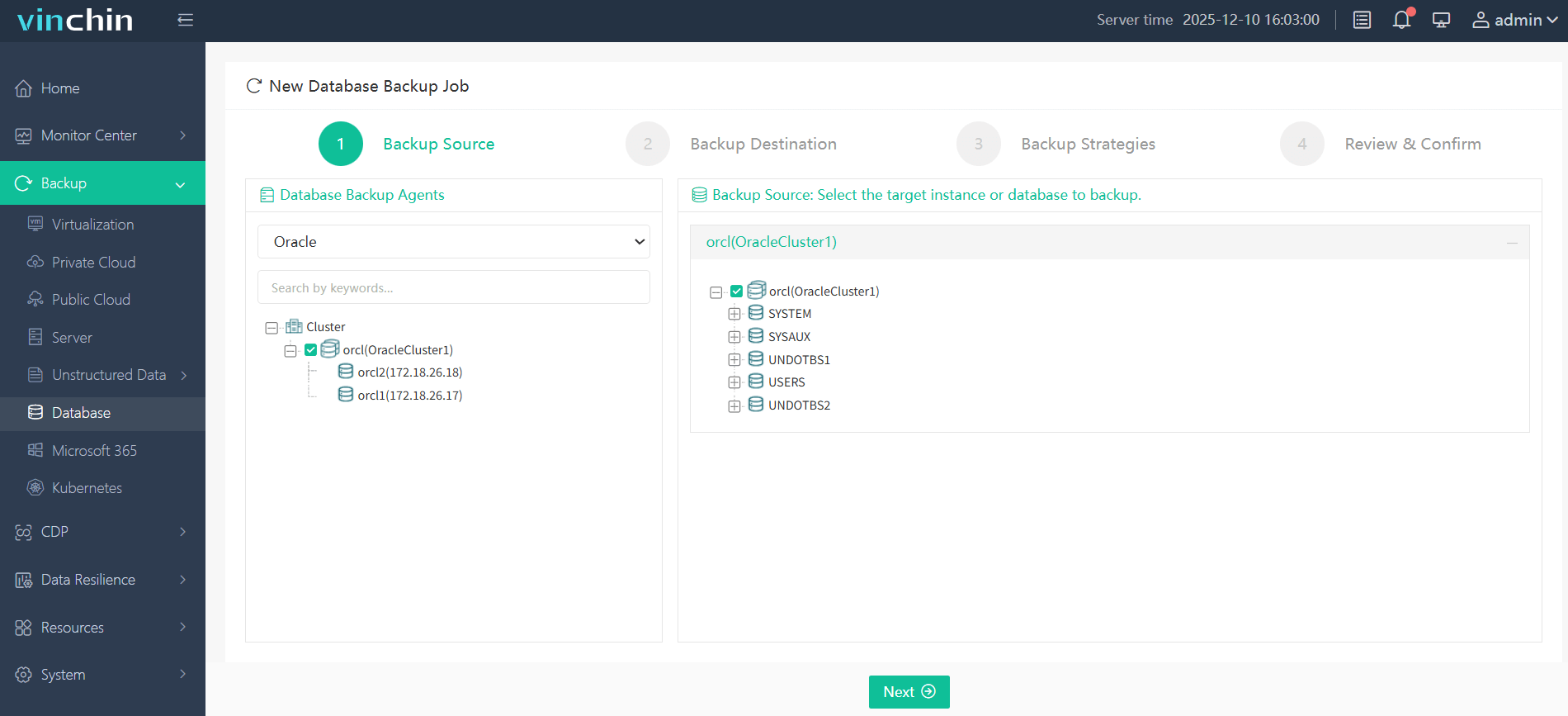
The intuitive web console makes protecting an Oracle database straightforward:
Step 1. Select the Oracle database to back up
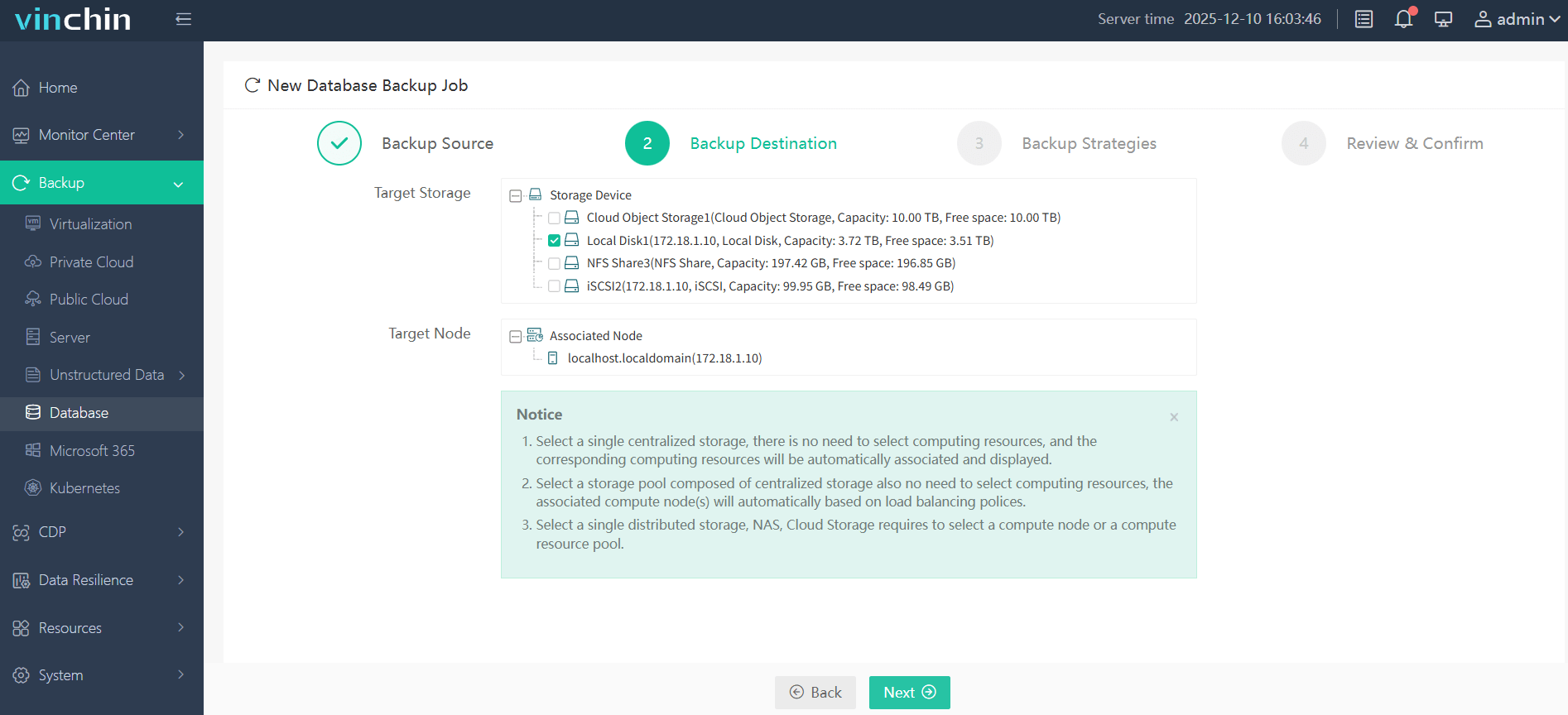
Step 2. Choose the backup storage
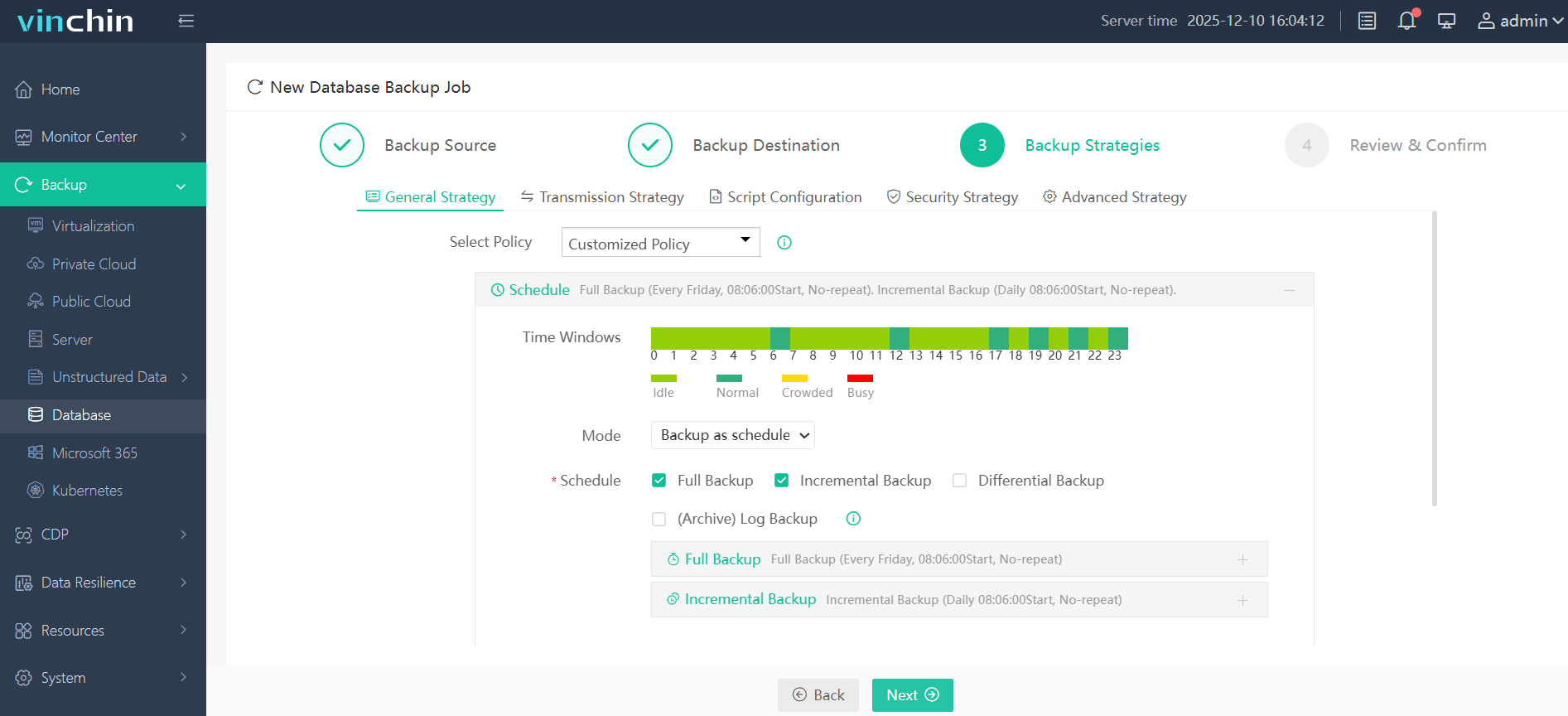
Step 3. Define the backup strategy
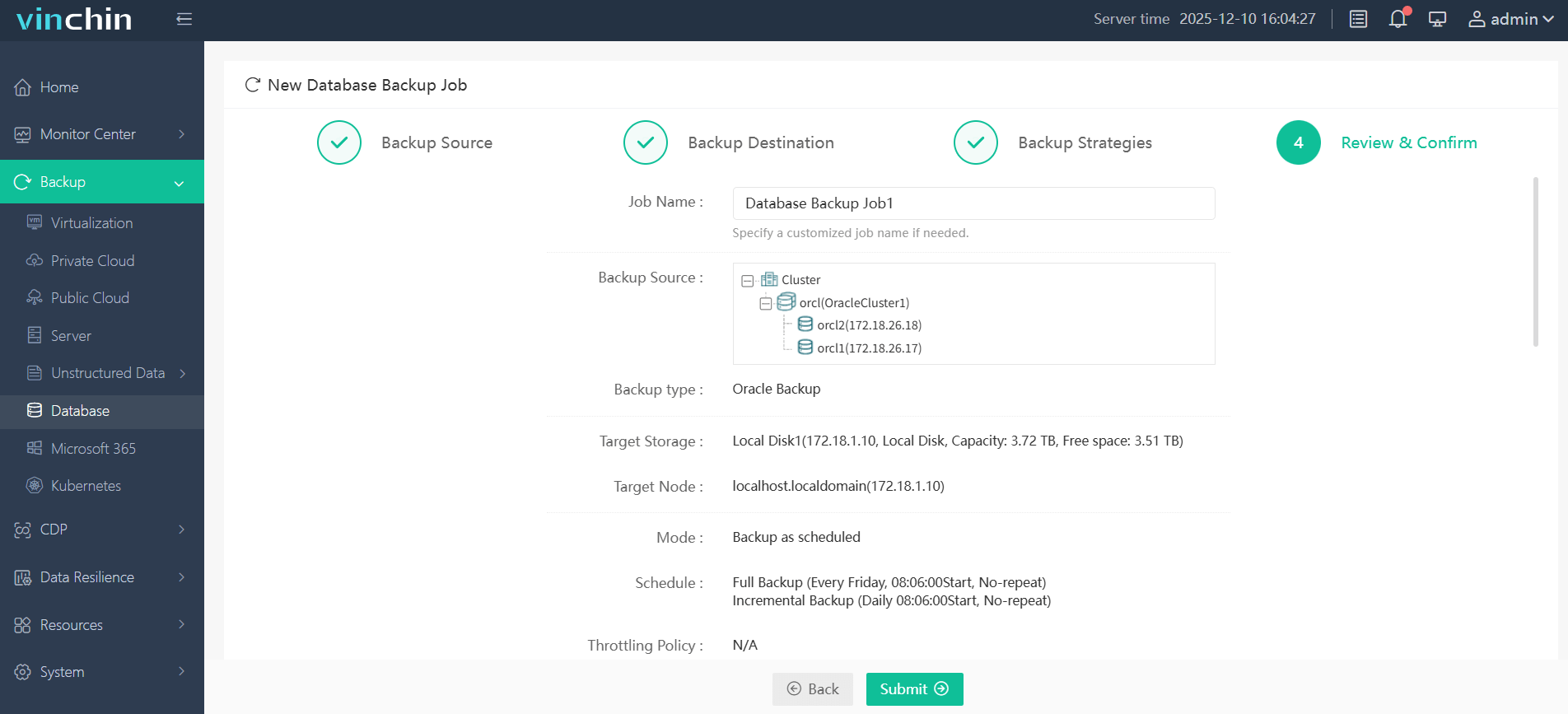
Step 4. Submit the job
Recognized globally by enterprises across industries—and consistently rated highly by users—Vinchin Backup & Recovery offers a fully featured free trial lasting sixty days so you can experience its benefits firsthand; click below to get started today!
Oracle Bigfile Tablespace RMAN Backup FAQs
Q1: Can I perform point-in-time recovery of just one table from my bigfile tablespace?
No; use Data Pump exports or consider Tablespace Point-in-Time Recovery (TSPITR) if table-level granularity is required but not directly supported by standard RMAN restore operations.
Q2: How do I confirm my scheduled automated backup ran successfully?
Check output logs generated by your script location or run LIST BACKUP OF TABLESPACE BIG_TBS within RMAN prompt mode after each scheduled run.
Q3: What should I do if my multisection backup fails halfway through?
First clean incomplete pieces using DELETE OBSOLETE then rerun your original multisection command; partial sets cannot be used until fully completed.
Conclusion
Backing up Oracle bigfile tablespaces with RMAN becomes straightforward when you use multisection strategies alongside automation tools tailored for enterprise needs—and always validate results regularly! For streamlined management plus advanced features beyond native tools alone consider trying Vinchin’s powerful solution today—it comes risk-free with a generous trial period included.