Backing up your Oracle database with RMAN to a network file system (NFS) is common in enterprise environments. Why? Because NFS offers flexibility, scalability, and cost savings compared to local storage or tape solutions. But configuring this setup takes care—one misstep can lead to failed backups or slow restores.
This guide covers everything you need: what RMAN and NFS are, why pairing them makes sense, how to configure each step safely—including performance tuning and security—and how to troubleshoot real-world issues that admins face every day.
What Are Oracle RMAN and NFS?
Oracle Recovery Manager (RMAN) is Oracle’s native tool for automating backup, restore, and recovery tasks across databases of any size. It supports incremental backups and point-in-time recovery while reducing manual intervention.
Network File System (NFS) lets you access files over the network as if they were local disks—ideal for centralizing backup storage or sharing data between servers.
Combining RMAN with an NFS share means you get robust Oracle protection plus flexible storage management—but only if you configure both sides correctly.
Prerequisites Before Configuring Oracle RMAN Backup to NFS
Before starting configuration steps:
Make sure your Oracle database runs in ARCHIVELOG mode so you can take online backups without downtime.
Confirm your network bandwidth meets your backup window needs; gigabit Ethernet or faster is recommended for large databases [Oracle Docs].
Check that your NFS server has enough disk space, fast disks (SSD preferred), proper export settings (sync/async), root squash enabled unless required otherwise, and isn’t oversubscribed by too many clients at once.
Testing basic connectivity between the database host and the NFS server using ping or traceroute helps avoid surprises later.
Why Use NFS for Oracle RMAN Backup?
Why do so many organizations choose NFS as their backup target? First: it separates backup storage from production servers—freeing up local disk space while making it easy to scale as data grows. Second: multiple servers can access the same share—a big win for disaster recovery scenarios or when cloning databases across environments.
Third: since Oracle officially supports backing up via NFS [Oracle Support], you’re not taking unnecessary risks by choosing this method.
But beware—not all setups are equal! The right mount options matter just as much as hardware specs when it comes to speed and reliability. Poorly tuned mounts can cause slow jobs or even silent data loss if not set correctly.
How to Set Up Oracle RMAN Backup to NFS?
Setting up an efficient backup pipeline involves several steps—from preparing the server side through validating restores on another machine if possible.
Step 1: Create & Export the NFS Share
On your dedicated backup server:
/nfs/backup oracle-db-server(rw,sync,no_root_squash)
Use sync for safer writes; only use async if you understand potential risks [Red Hat Docs].
Restrict access by IP address whenever possible.
Restart the export service (exportfs -ra) after changes.
Step 2: Mount the Share on Your Database Server
On your Oracle host:
Install client utilities (nfs-utils package).
Create a mount point such as /mnt/backup.
Mount with recommended options:
mount -t nfs -o rw,bg,hard,nointr,tcp,retrans=5,timeo=600,rsize=32768,wsize=32768,nfsvers=3,actimeo=0 nfs-server:/nfs/backup /mnt/backup
Here’s what these mean:
| Option | Purpose |
|---|
| hard | Keeps retrying if server unavailable—prevents silent failures |
| nointr | Avoids interruption during I/O |
| tcp | More reliable than UDP |
| rsize/wsize | Buffer sizes—tune higher on fast networks |
| timeo | Timeout in tenths of seconds |
| retrans | Number of retries before reporting failure |
| actimeo=0 | Disables attribute caching |
| nfsvers=3 | Stable version widely supported |
nfs-server:/nfs/backup /mnt/backup nfs rw,bg,hard,nointr,tcp,retrans=5,timeo=600,rsize=32768,wsize=32768,nfsvers=3,actimeo=0 0 0
Step 3: Set Permissions
Ensure the user running Oracle processes owns—or at least has read/write permissions—to /mnt/backup. As that user:
touch /mnt/backup/testfile && rm /mnt/backup/testfile
If either command fails due to permissions errors (like “Permission denied”), fix ownership with chown.
Step 4: Configure RMAN Channels
In RMAN prompt:
CONFIGURE CHANNEL DEVICE TYPE DISK FORMAT '/mnt/backup/ora_df%t_s%s_s%p';
Here %t, %s, %p insert timestamp/session/piece numbers into filenames—helpful when managing many files [Oracle Docs].
Or specify directly in scripts:
RUN {
 ALLOCATE CHANNEL c1 DEVICE TYPE DISK FORMAT '/mnt/backup/ora_df%t_s%s_s%p';
 BACKUP DATABASE PLUS ARCHIVELOG;
 RELEASE CHANNEL c1;
}
Step 5: Run & Monitor Backups
Start your job from within RMAN or via scheduled scripts (cron). Watch progress closely using alert logs or querying V$ views (V$BACKUP_SET). After completion:
Step 6: Test Restore Thoroughly
Don’t just trust that backups exist—test restoring them! Ideally restore onto another test system pointing at the same mounted share so you know files are portable—not tied only to one environment’s UID/GID mapping or OS quirks.
A simple test might look like this inside RMAN:
RESTORE DATABASE FROM TAG 'FULL_BACKUP_TEST';
If possible simulate disaster recovery by restoring onto fresh hardware/vm using only those files from /mnt/backup.
Following these steps ensures reliable operation—but there’s always room for improvement!
How Can Vinchin Enhance Database Protection for Oracle RMAN Backups on NFS
After establishing reliable Oracle RMAN backups on an NFS target, organizations seeking advanced protection should consider Vinchin Backup & Recovery. This professional enterprise-level solution supports most mainstream databases—including first-class support for Oracle—as well as MySQL, SQL Server, MariaDB, PostgreSQL, PostgresPro, and TiDB. Vinchin Backup & Recovery delivers critical features such as incremental backup capabilities tailored for Oracle environments, batch database backup operations across multiple instances, robust data retention policies including GFS retention strategies, cloud/tape archiving integration for offsite safety, and comprehensive integrity checks with automated recovery verification. Together these functions streamline administration while maximizing resilience against threats like ransomware and accidental deletion—all managed through a single intuitive web console interface.
The entire process is straightforward:
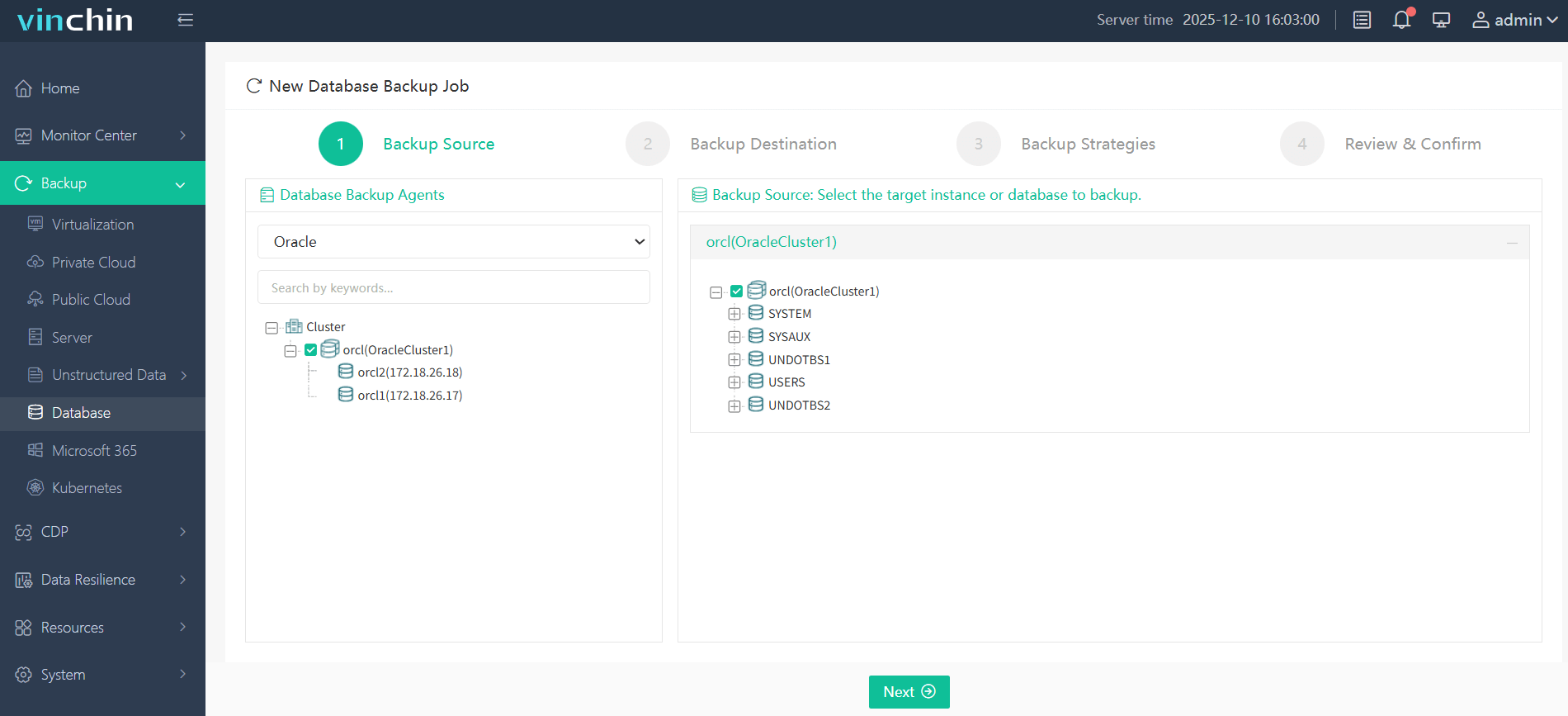
Step 1. Select the Oracle database to back up
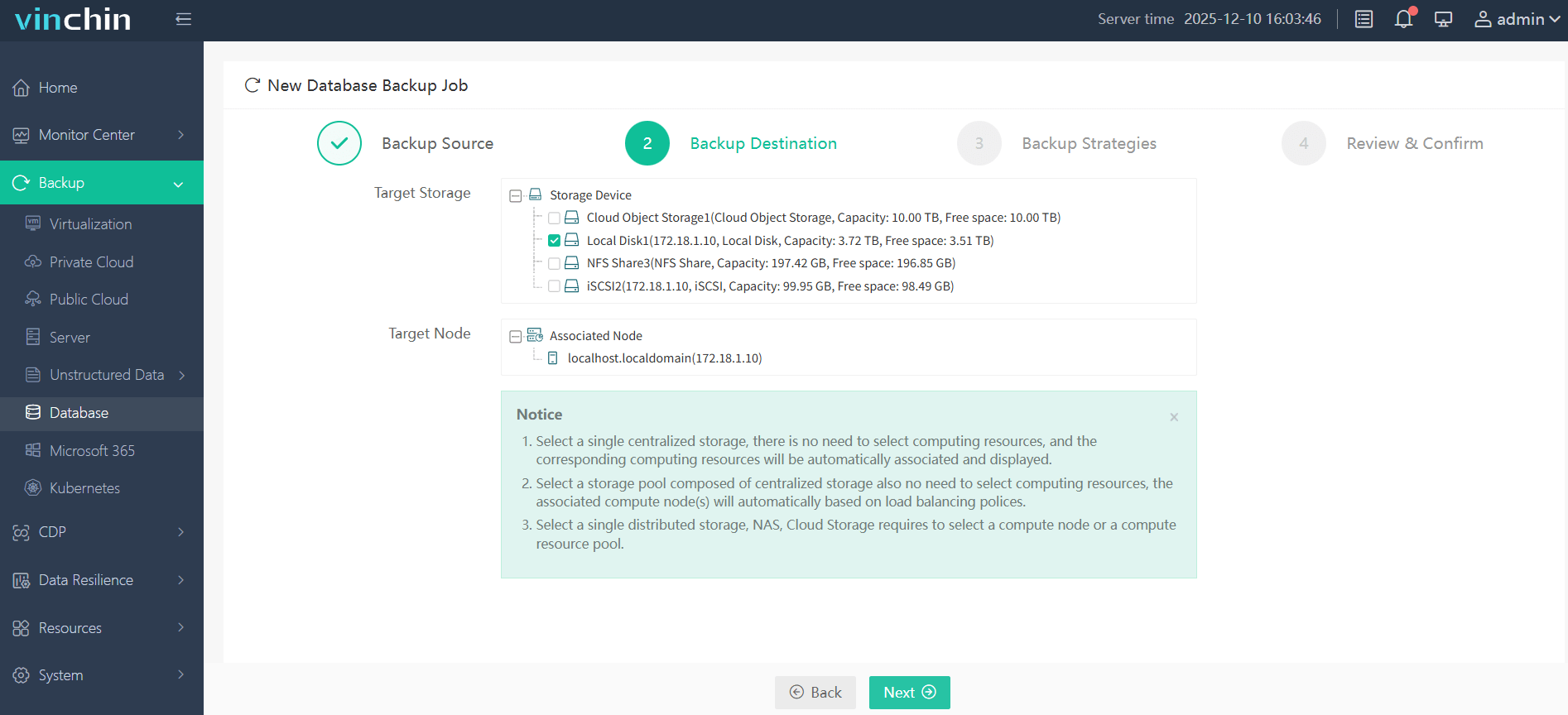
Step 2. Choose the backup storage
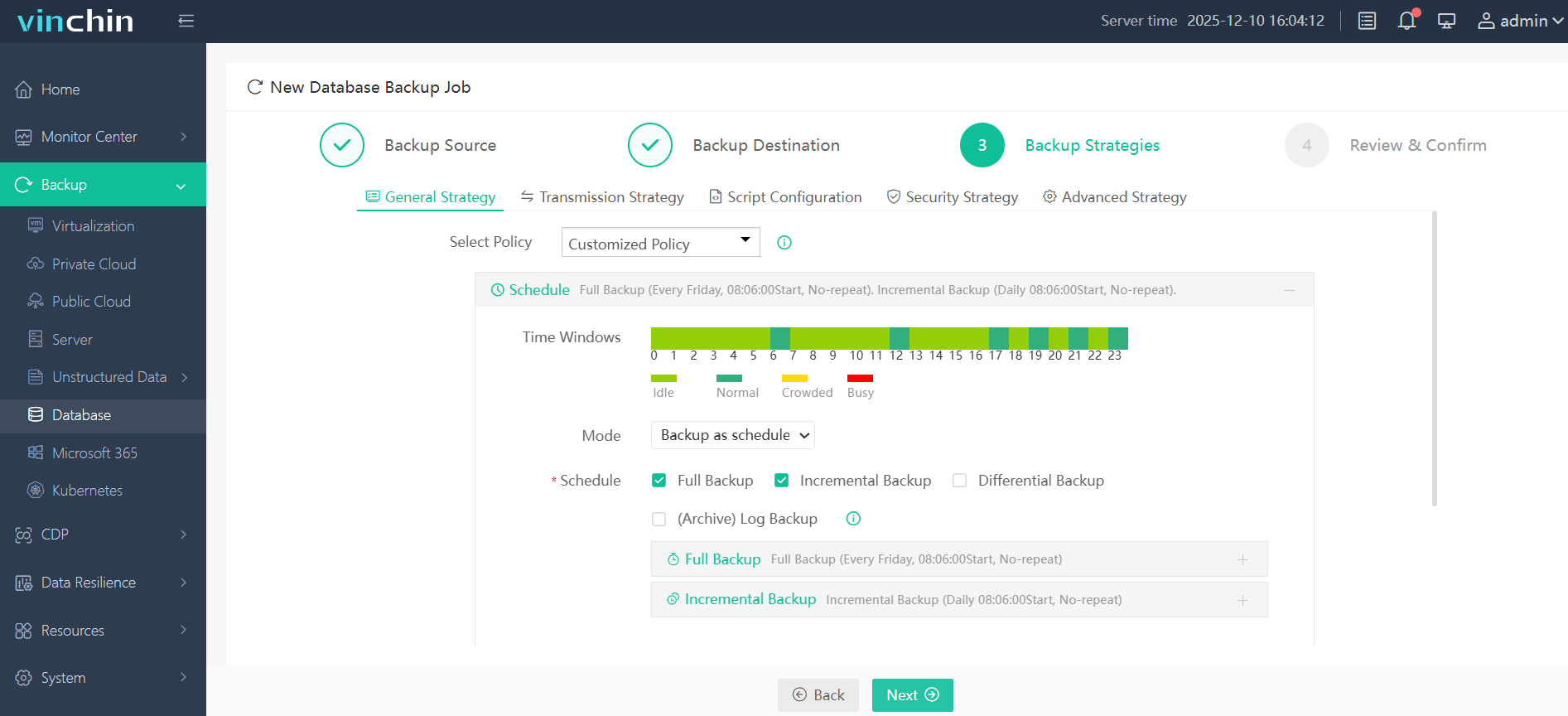
Step 3. Define the backup strategy
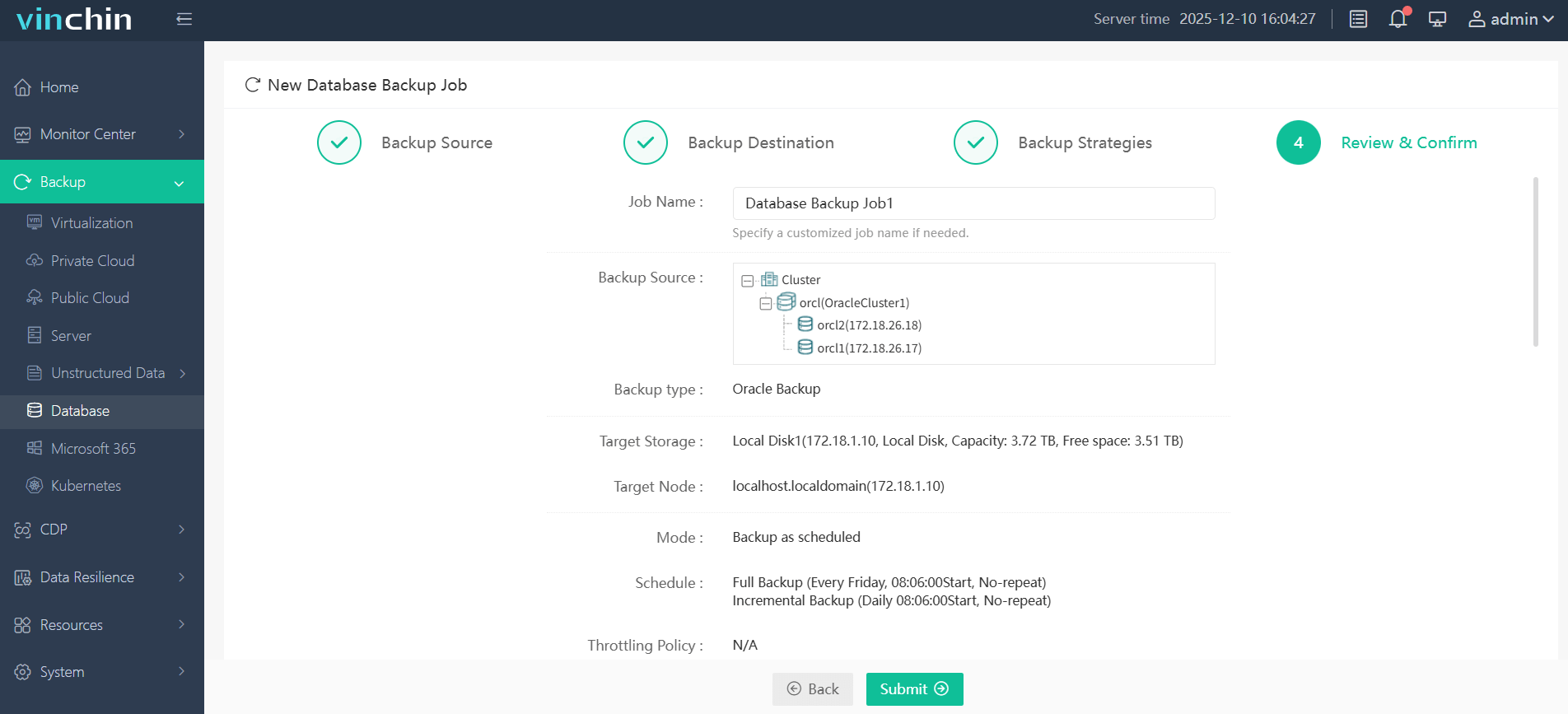
Step 4. Submit the job
Vinchin Backup & Recovery is trusted globally by thousands of enterprises and consistently receives top ratings from IT professionals worldwide. Experience its full feature set free for 60 days—click download now to get started!
Oracle RMAN Backup to NFS FAQs
Q1: What should I do if my scheduled nightly backups overlap due to slow performance?
A1: Increase parallel channels in your script; optimize rsize/wsize; check network congestion during peak times; baseline speed with dd/fio tests beforehand.
Q2: How do I handle planned maintenance/failover of my primary NAS without interrupting ongoing backups?
A2: Pause new jobs before maintenance begins STOP SCHEDULER/JOB QUEUE switch mounts/failover resume scheduling after verifying accessibility/data integrity from secondary node/share
Q3: What’s an effective way to manage long-term retention policies when storing hundreds of full/incremental sets?
A3: Use date-based subdirectories automate cleanup scripts crosscheck/cross-reference regularly prune expired sets according retention policy
Conclusion
Configuring reliable “oracle rman backup to nfs” requires careful attention—from prerequisites through security hardening—to ensure smooth operation under real-world loads. For advanced automation beyond manual scripting consider trying Vinchin's comprehensive solution risk-free today!