Cloning an Oracle database is a routine task for many administrators. Whether you need to refresh a test environment, migrate to new hardware, or set up disaster recovery, having an exact copy of your production data is essential. Oracle 10g introduced the RMAN Duplicate From Active Database feature—a powerful tool that lets you clone a running database directly over the network without first creating backup files.
This guide explains what RMAN Duplicate From Active Database is, why it matters for both beginners and seasoned DBAs, and how to use it step by step. We’ll also cover common pitfalls and troubleshooting tips so you can complete your cloning project smoothly.
What Is RMAN Duplicate From Active Database?
RMAN Duplicate From Active Database is a feature in Oracle 10g that allows you to create a live copy of your database across the network in real time. Instead of restoring from backup files stored on disk or tape, RMAN copies data files directly from the source (primary) database to the target (auxiliary) database using image copies transferred over TCP/IP.
The process does not require taking the source database offline or interrupting user access—cloning happens while users continue working on production systems. This method ensures that your cloned environment matches the original at a specific point in time.
For advanced users, this approach supports both full clones and partial clones (such as subset schemas), depending on how you configure parameters during duplication. It’s efficient because it avoids extra storage overhead from intermediate backups.
Why Use RMAN Duplicate In Oracle 10g?
Why should you choose this method instead of traditional backup-and-restore workflows? First, it saves significant time by eliminating the need to generate or transfer large backup files before starting duplication. Second, since the source stays online throughout cloning, there’s no downtime—users can keep working without interruption.
Third, this technique reduces storage requirements because you don’t have to store additional backup sets just for cloning purposes; everything streams directly between servers over your existing network infrastructure.
For beginners setting up test environments quickly or intermediates refreshing development databases regularly, this method offers speed and simplicity. Advanced administrators benefit when migrating databases across data centers or preparing standby systems for disaster recovery—all with minimal disruption.
Prerequisites For Oracle 10g RMAN Duplication
Before starting duplication from an active database in Oracle 10g, several key requirements must be met:
Both source (production) and target (clone) servers need compatible versions of Oracle software installed—ideally matching patch levels for best results. The source database must run in ARCHIVELOG mode so that all changes are captured during duplication.
Network connectivity between servers is critical; verify communication using tnsping from each server to confirm TNS entries resolve correctly both ways. If firewalls exist between hosts, ensure required ports are open so connections succeed without delay.
You must prepare directories on the target server for data files, redo logs, control files, audit logs—and make sure there’s enough free disk space available for all expected data volumes plus some margin for growth during operation.
Each instance—the original (source) and auxiliary (target)—must have unique SIDs to prevent conflicts within listener configurations or OS-level processes.
A password file for the SYS user is mandatory on both servers; passwords must match exactly because RMAN uses these credentials when connecting remotely during duplication operations. If no password file exists on either side:
Next comes parameter management:
Generate a parameter file (PFILE) from your source instance using SQL*Plus (CREATE PFILE='/tmp/initclone.ora' FROM SPFILE;)
Transfer this PFILE securely to your target server
Edit values inside so DB_NAME, directory paths (CONTROL_FILES, DB_FILE_NAME_CONVERT, LOG_FILE_NAME_CONVERT) reflect correct locations on target disks
Set up Oracle Net connectivity:
Add TNS entries describing both databases into each server’s tnsnames.ora file
On target host specifically: edit listener.ora with a static entry referencing auxiliary SID (“clone”) so remote connections work even when instance is not yet mounted
Start listener service using lsnrctl start
Finally—for advanced setups—review memory settings like SGA/PGA sizes in PFILE if hardware differs significantly between environments.
Steps To Duplicate From Active Database
Once prerequisites are satisfied and connectivity confirmed via tnsping, proceed through these steps:
1. Start auxiliary instance in NOMOUNT mode using edited PFILE:
   export ORACLE_SID=clone
   sqlplus / as sysdba
   SQL> STARTUP NOMOUNT PFILE='/path/to/initclone.ora';
   SQL> exit;
2. Create or copy SYS password file on target:
orapwd file=$ORACLE_HOME/dbs/orapwclone password=your_sys_password entries=5
Ensure “clone” matches auxiliary SID exactly.
3. Test network connectivity again from both sides:
   tnsping clone
   tnsping prod
4. Connect to RMAN from any server where client tools are installed:
target refers to original/source DB (“prod”), auxiliary refers to blank/target DB (“clone”)
Both connections require SYS credentials matching those used when creating password files.
rman TARGET sys@prod AUXILIARY sys@clone
5. Run duplicate command inside RMAN prompt:
DUPLICATE TARGET DATABASE TO 'clone' FROM ACTIVE DATABASE NOFILENAMECHECK;
If directory structures differ between servers—or if you want more control—add conversion clauses such as:
      DUPLICATE TARGET DATABASE TO 'clone' FROM ACTIVE DATABASE
        DB_FILE_NAME_CONVERT='/u01/oradata/prod','/u02/oradata/clone'
        LOG_FILE_NAME_CONVERT='/u01/oradata/prod','/u02/oradata/clone'
        NOFILENAMECHECK;
For advanced cases needing custom initialization parameters at startup,
add SPFILE clause before NOFILENAMECHECK.
6. Monitor progress within RMAN session output window.
"ORA-19809" pointing toward insufficient disk space,
or other messages about missing archive logs.
7. After completion succeeds,
log into SQL*Plus on auxiliary host,
check status of cloned system,
confirm all expected datafiles exist at intended locations:
     sqlplus / as sysdba
     SQL> SELECT NAME FROM V$DATAFILE;
     SQL> SELECT STATUS FROM V$INSTANCE;
8. Clean up temporary scripts/files created during setup.
Update documentation reflecting new clone details—including SID mappings,
directory paths,
passwords used,
date/time of operation—for future audits or troubleshooting needs.
How To Back Up Oracle Databases With Vinchin
After completing tasks such as cloning or migration with Oracle databases, ensuring robust protection through reliable backups becomes crucial for ongoing security and business continuity needs. Vinchin Backup & Recovery stands out as an enterprise-grade solution supporting today’s leading platforms—including Oracle, MySQL, SQL Server, MariaDB, PostgreSQL, PostgresPro, and TiDB—with comprehensive features tailored especially well for Oracle environments like yours.
Among its most relevant capabilities are incremental backup support tailored specifically for Oracle workloads; batch database backup automation; flexible retention policies including GFS retention options; cloud backup combined with tape archiving integration; and any-point-in-time recovery functionality—all designed to streamline protection while reducing operational risk and storage costs across diverse deployment scenarios.
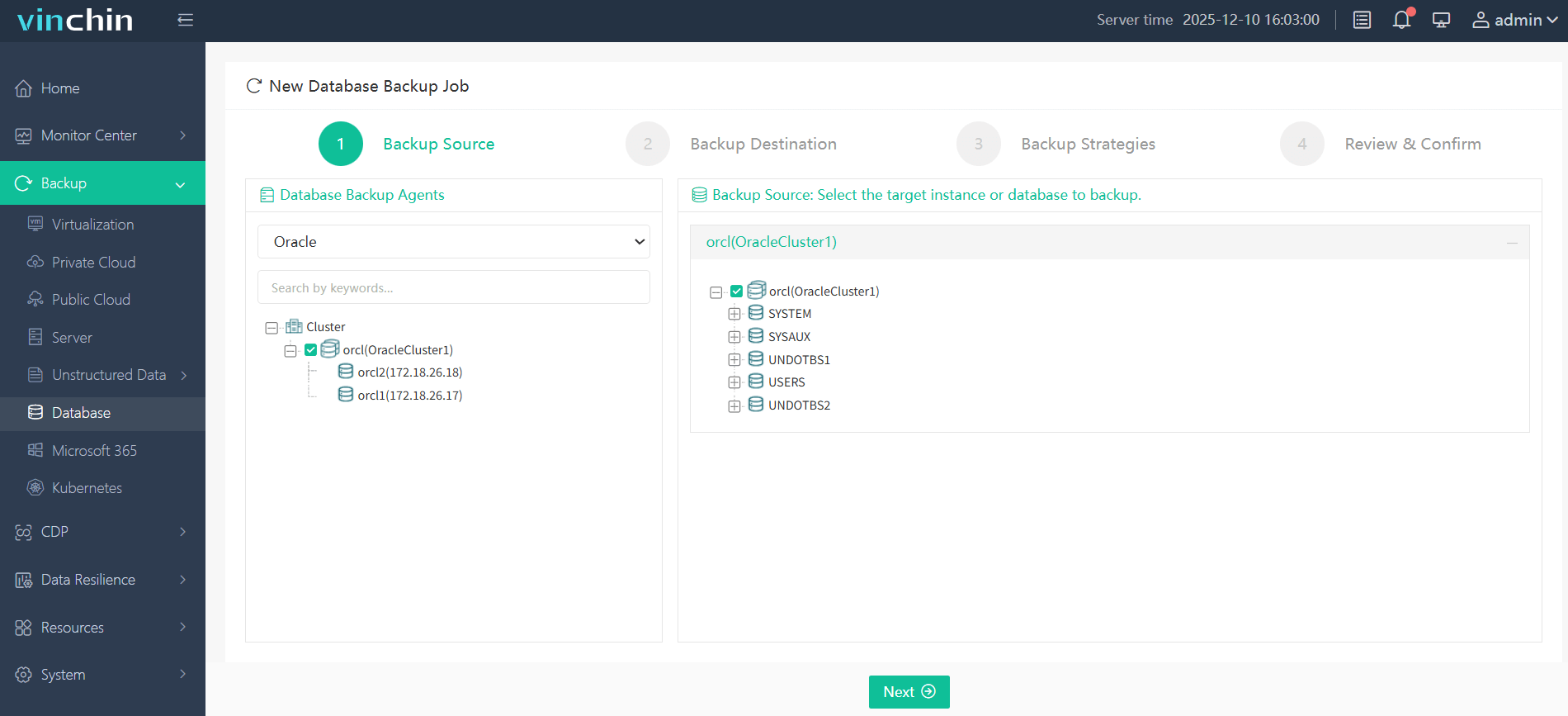
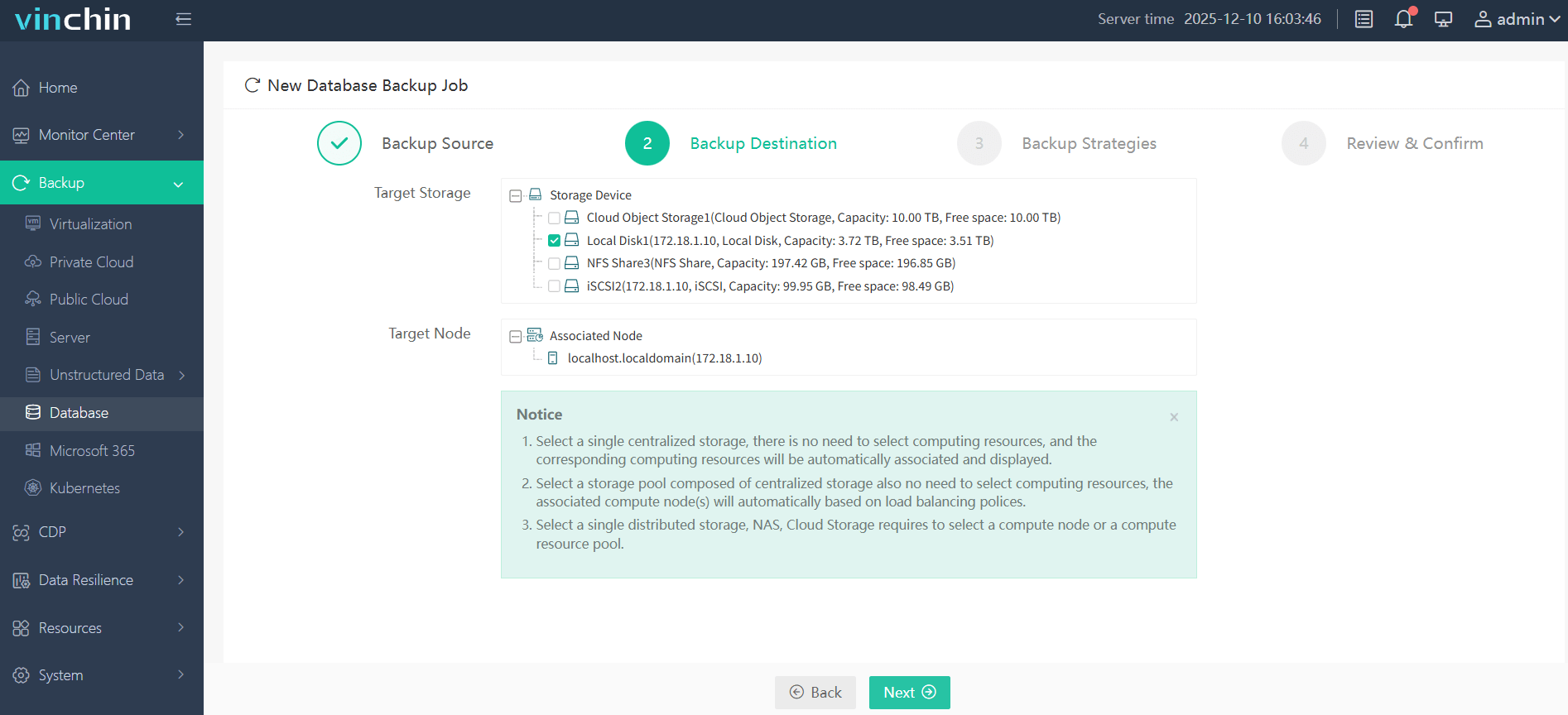
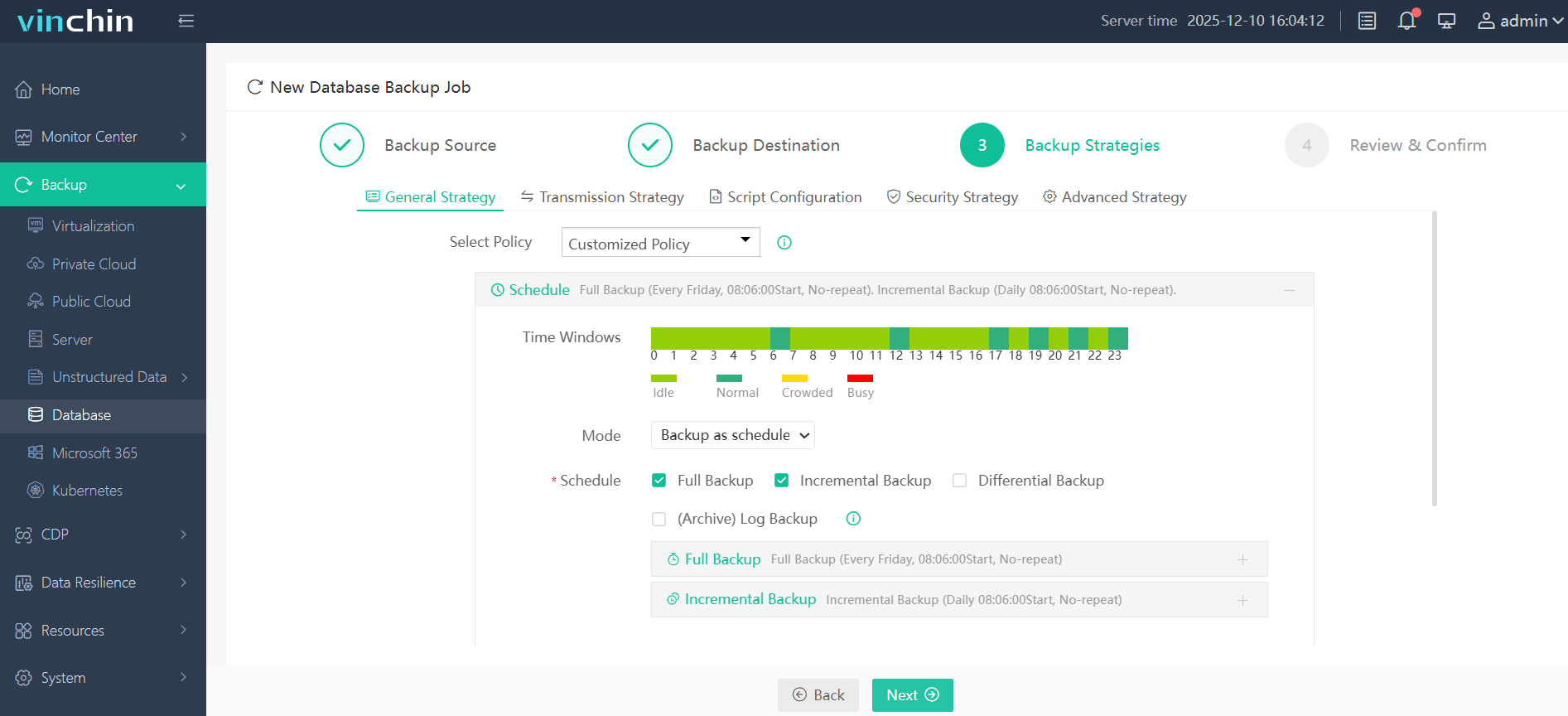
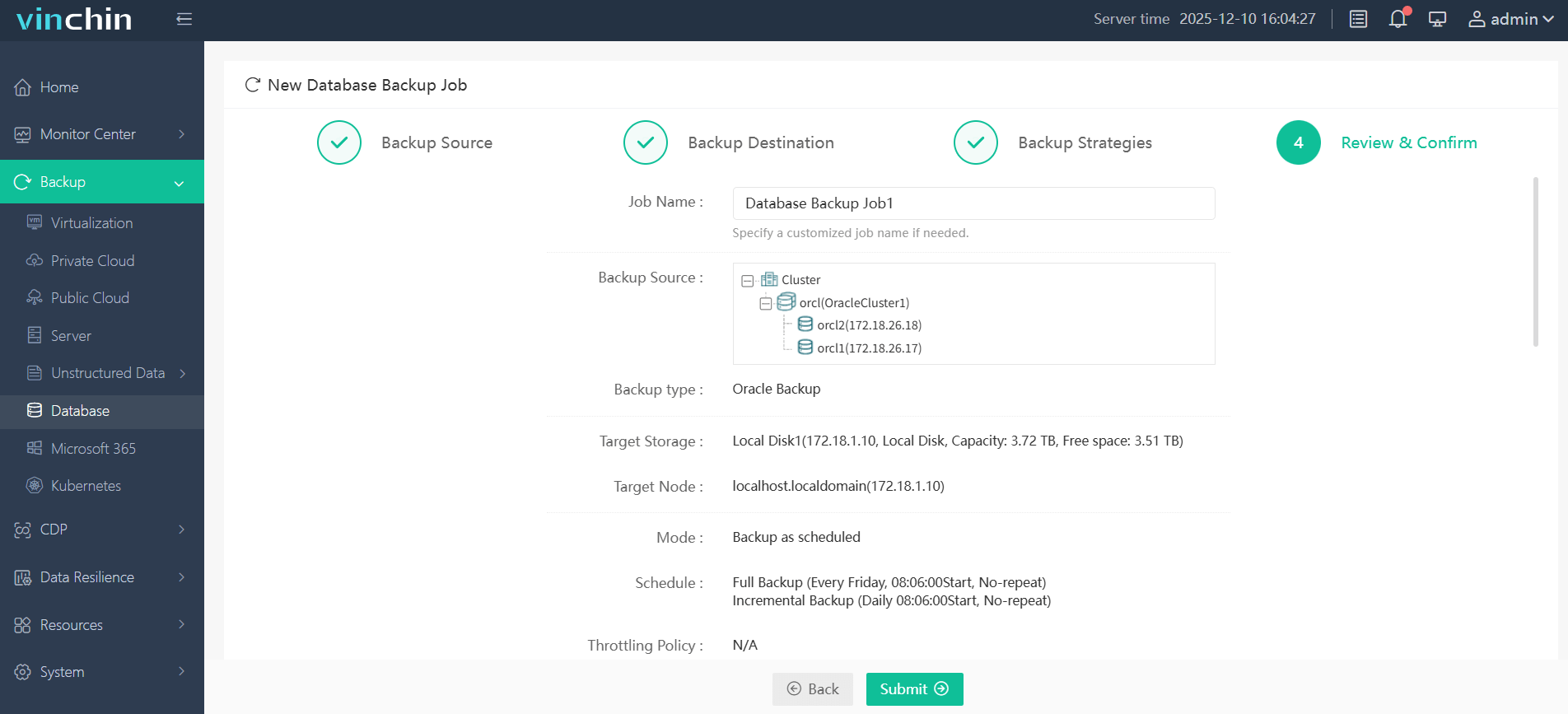
Vinchin Backup & Recovery features an intuitive web console that makes safeguarding your Oracle environment straightforward:
Step 1. Select the Oracle database to back up
Step 2. Choose the backup storage
Step 3. Define the backup strategy
Step 4. Submit the job
Recognized globally with top ratings and trusted by thousands of organizations worldwide,Vinchin Backup & Recovery offers a fully featured 60-day free trial—click download below and experience enterprise-class data protection firsthand.
Oracle 10g RMAN Duplicate From Active Database FAQs
Q1: Can I parallelize copying large databases during active duplication?
Yes; use SECTION SIZE parameter in DUPLICATE command so multiple channels copy different parts simultaneously if hardware allows it.
Q2: What should I do if my directory structure differs between source and target?
Set DB_FILE_NAME_CONVERT and LOG_FILE_NAME_CONVERT parameters in PFILE—or use SET NEWNAME FOR DATAFILE commands inside an RMAN RUN block before issuing DUPLICATE—to map old paths onto new ones precisely.
Q3: How can I estimate how long active duplication will take?
Monitor v$session_longops view after starting process; initial rates shown there give rough estimates based on current throughput.
Conclusion
RMAN Duplicate From Active Database enables fast cloning without downtime while keeping production online.For ongoing protection,Vinchin delivers robust enterprise backups.Try Vinchin’s free trial today—and safeguard every copy of your critical Oracle data!