Protecting your Oracle database goes beyond taking regular backups. You must also ensure those backups—and especially their archived redo logs—are healthy and restorable. This is where oracle rman validate archivelog becomes vital. In this article, you’ll learn what archivelogs are, why their integrity matters so much for recovery, how to use RMAN’s validation features step by step, how to automate these checks in production environments, and how to interpret results if something goes wrong. Let’s make sure your disaster recovery plan stands up when it counts.
What Are Oracle Archivelogs?
Oracle archivelogs are copies of redo log files that capture every change made in your database. When a redo log fills up during normal operation, Oracle moves its contents into an archive location using a process called archiving. These archived logs allow you to recover your database right up to any point in time—even after hardware failure or accidental data loss.
Archivelogs form the backbone of Oracle’s recovery strategy because they record all committed transactions since your last backup. Without them, restoring your database after an incident would mean losing all changes made since that last backup—a risk no business can afford.
Why Validate Archivelog Integrity?
Validating archivelog integrity means checking that every archived redo log is present and free from corruption. If even one archivelog is damaged or missing when you need it most—such as during a restore—you may not be able to bring your database back online fully.
Regular validation helps you catch problems early before they become disasters. Think of it as running health checks on critical files: would you want to discover corrupted logs only after an outage? By validating often, you reduce risk and gain confidence in your ability to meet recovery objectives.
How to Use RMAN Validate Command for Archivelogs?
The VALIDATE command in RMAN checks both physical and logical corruption within specified archivelogs. It reads every block in each file but does not alter or restore anything—it simply verifies integrity.
To validate all known archivelogs recorded in the control file or catalog, connect with RMAN and run:
RMAN> VALIDATE ARCHIVELOG ALL;
This scans every archived redo log registered with Oracle’s control file—not just those currently on disk but also those listed historically unless deleted via RMAN itself.
If you want deeper checking for logical errors (not just physical), add CHECK LOGICAL:
RMAN> VALIDATE CHECK LOGICAL ARCHIVELOG ALL;
You can target specific ranges by time or sequence number too:
RMAN> VALIDATE ARCHIVELOG FROM TIME 'SYSDATE-1';
To check by sequence range:
RMAN> VALIDATE ARCHIVELOG FROM SEQUENCE 100 UNTIL SEQUENCE 120;
After running these commands, review the output carefully. Normal messages include lines like "archived log file name=/path/to/log.arc" followed by status indicators such as "OK". If there are issues—like "CORRUPTION DETECTED" or error codes starting with "RMAN-"—these require immediate attention.
All detected corruptions are also logged in V$DATABASE_BLOCK_CORRUPTION, which you can query later for details:
SELECT * FROM V$DATABASE_BLOCK_CORRUPTION WHERE FILE# IN (SELECT FILE# FROM V$ARCHIVED_LOG);
No news is good news: if everything shows “OK,” your archivelogs are healthy.
Interpreting and Responding to Corruption Errors
When validation finds corruption or missing logs, act quickly. First, check whether valid backups exist for affected files using:
RMAN> LIST BACKUP OF ARCHIVELOG ALL;
A corrupt archivelog may prevent full point-in-time recovery through that log—but recovery up until just before it remains possible if earlier logs are intact.
If needed files are missing from disk but available in backup sets, restore them using:
RMAN> RESTORE ARCHIVELOG SEQUENCE <sequence_number>;
Replace <sequence_number> with the actual value shown in error messages or queries above.
Always investigate root causes—disk failures? Storage misconfiguration? Manual deletions outside of RMAN? Address these issues promptly so future validations pass cleanly.
How to Validate Archivelog Backups with RMAN?
Sometimes it’s not enough just to check active files—you also need assurance that backup copies stored elsewhere (on tape or remote storage) remain usable over time. That’s where RESTORE ... VALIDATE comes into play: it simulates restoring from backup media without actually writing data back out.
To validate all archived redo log backups:
RMAN> RESTORE ARCHIVELOG ALL VALIDATE;
For recent activity only—for example logs created yesterday—use:
RMAN> RESTORE ARCHIVELOG FROM TIME 'SYSDATE-1' VALIDATE;
Or specify a sequence range directly:
RMAN> RESTORE ARCHIVELOG FROM SEQUENCE 100 UNTIL SEQUENCE 120 VALIDATE;
If you want granular control over which backup set gets checked (perhaps due to storage migration), first list available sets:
RMAN> LIST BACKUP OF ARCHIVELOG ALL;
Then validate one specifically by key number shown above:
RMAN> VALIDATE BACKUPSET <backupset_key>;
Replace <backupset_key> with the correct identifier from your environment.
This process reads every block inside each selected backup set looking for signs of corruption—not just at file level but deep within storage blocks themselves. Any problems found will halt validation immediately; otherwise you'll see confirmation messages indicating success (“Backup Set Complete” / “OK”).
Validating offsite backups regularly is especially important if storing data on tape libraries or cloud platforms where silent bit rot could occur undetected until disaster strikes.
Enterprise-Grade Oracle Backup Made Simple With Vinchin Backup & Recovery
Beyond manual scripting and native tools, organizations seeking streamlined protection should consider Vinchin Backup & Recovery—a professional enterprise-level solution supporting today’s leading databases including Oracle, MySQL, SQL Server, MariaDB, PostgreSQL, PostgresPro, and TiDB. For Oracle users especially concerned about reliable backup management at scale, Vinchin Backup & Recovery delivers batch database backup capabilities alongside robust features like multiple level data compression options, flexible retention policies including GFS retention policy support, cloud/tape archival integration, and comprehensive integrity checks—all designed for efficient operations while maximizing security and compliance across diverse environments.
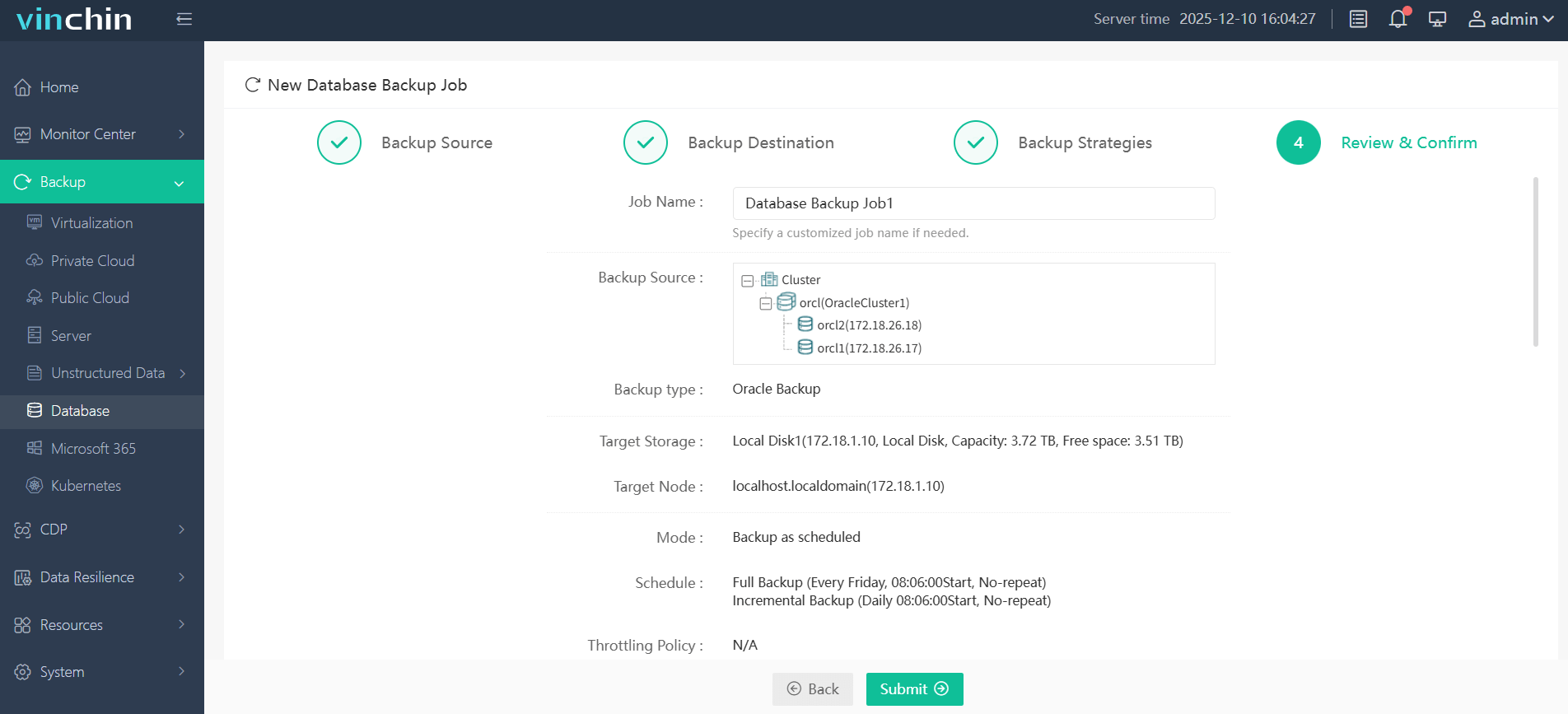
The intuitive web console makes safeguarding your Oracle databases straightforward:
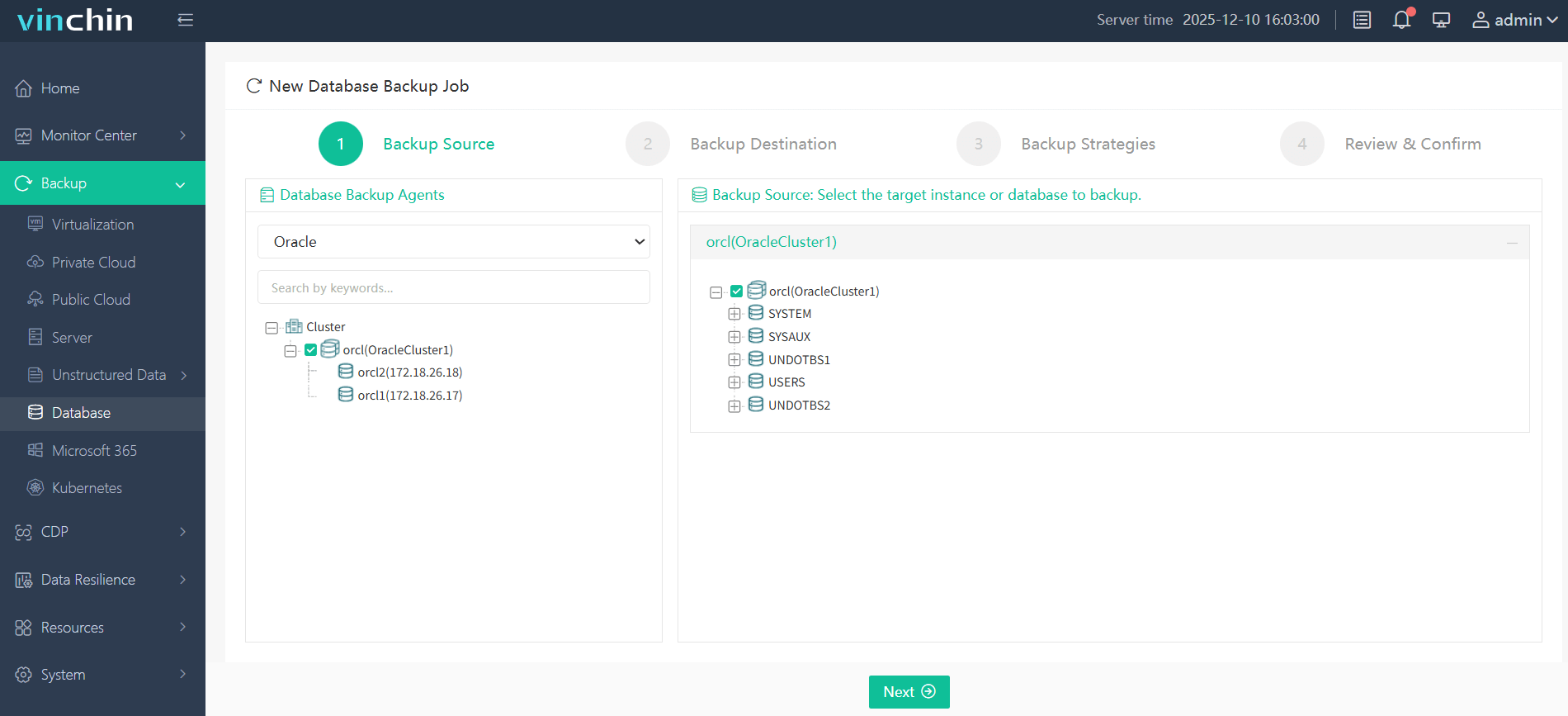
Step 1. Select the Oracle database to back up
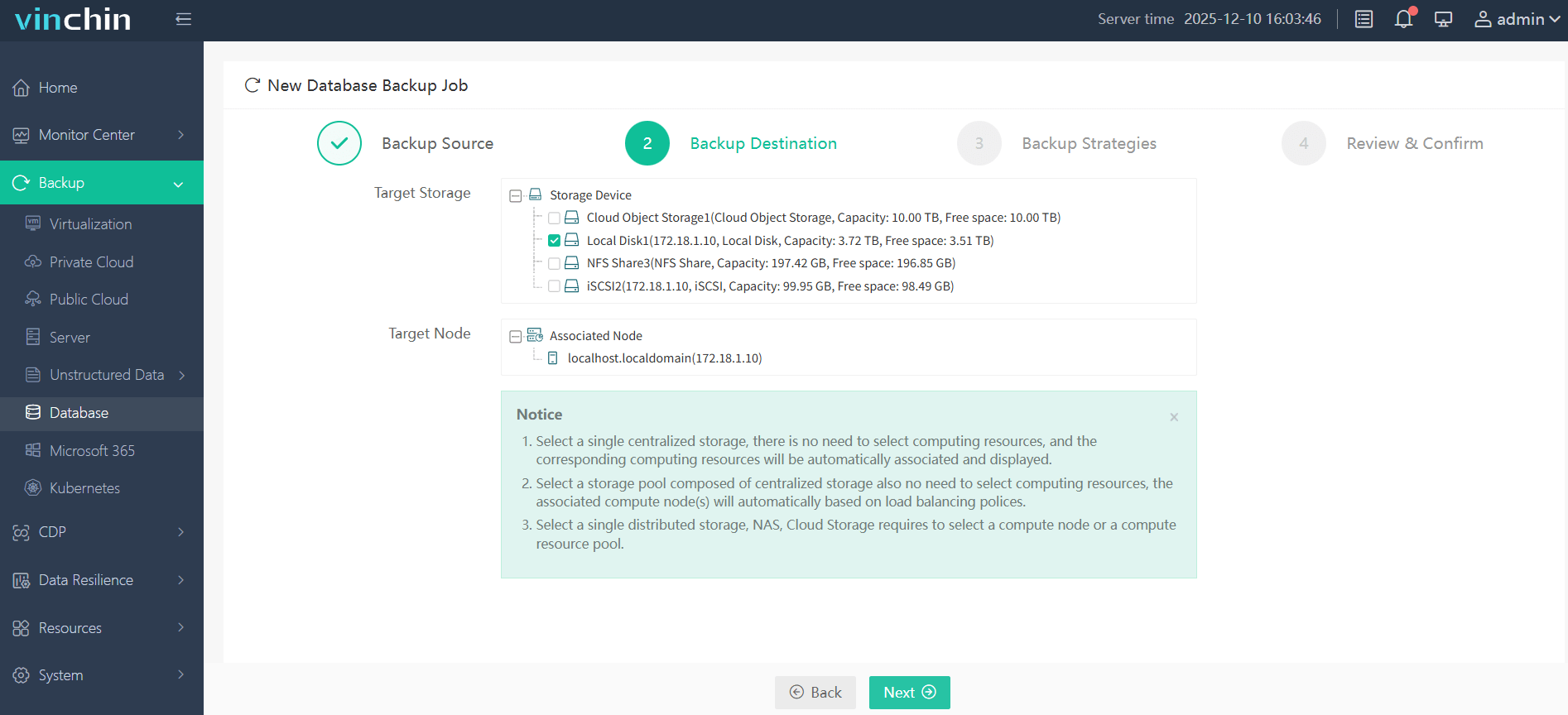
Step 2. Choose the backup storage
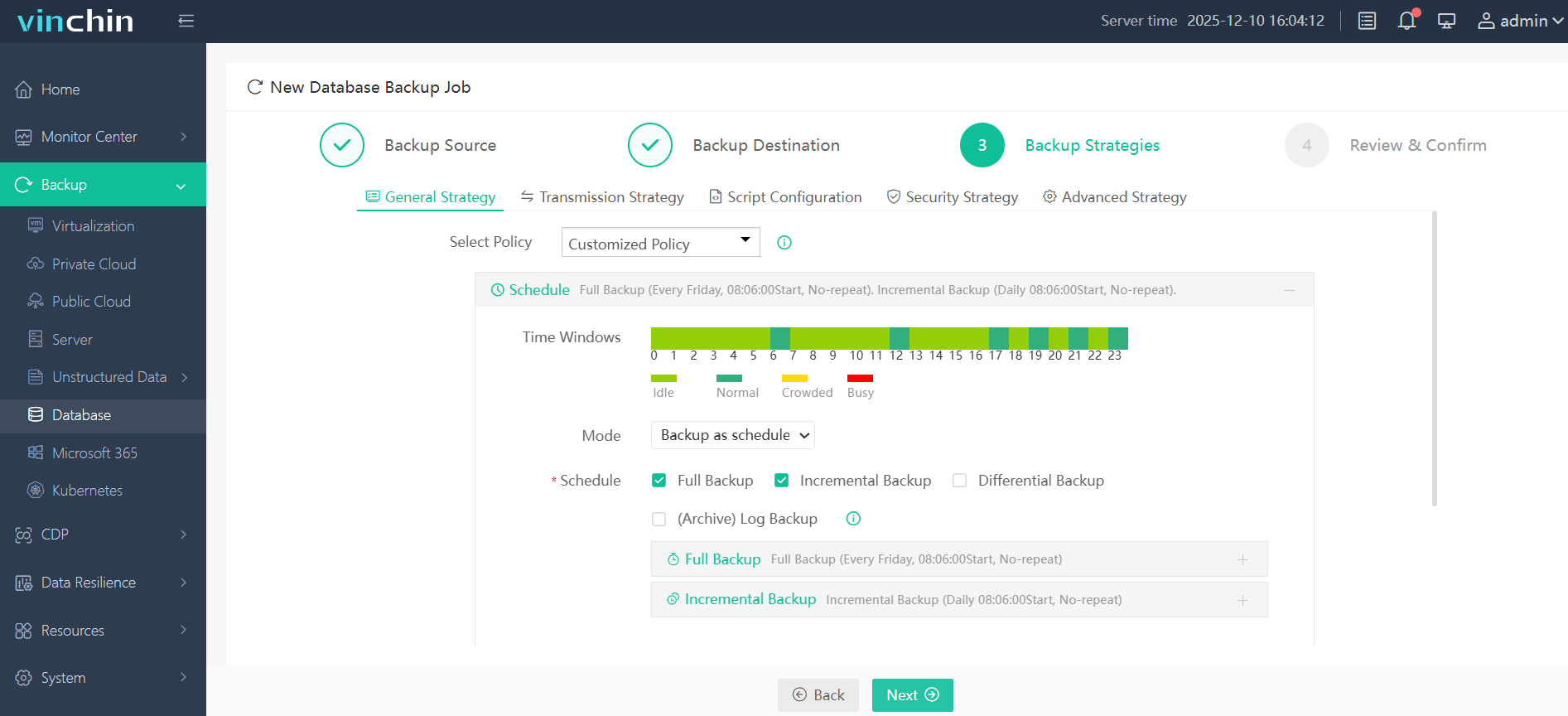
Step 3. Define the backup strategy
Step 4. Submit the job
Recognized globally among enterprise IT teams—with strong customer adoption and top industry ratings—Vinchin Backup & Recovery offers a full-featured free trial for 60 days so you can experience its power firsthand; click download now to get started risk-free!
Oracle RMAN Validate Archivelog FAQs
Q1: What should I do if oracle rman validate archivelog reports corruption?
A1: Check if valid backups exist; restore missing/corrupt logs using RESTORE commands; investigate underlying causes like disk failure or manual deletion outside RMAN control.
Q2: Can I schedule automatic oracle rman validate archivelog jobs?
A2: Yes; use OS-level schedulers like cron (Linux/UNIX) or Task Scheduler (Windows) combined with shell scripts calling RMAN commands regularly.
Q3: How do I monitor ongoing health of my archive logs between validations?
A3: Query V$DATABASE_BLOCK_CORRUPTION after each job; set alerts if any rows appear indicating new corruptions.
Conclusion
Regularly validating Oracle archivelogs using both VALIDATE and RESTORE ... VALIDATE ensures reliable recoverability when disaster strikes—and lets teams sleep easier at night knowing their safety net works as intended! For even simpler management across multiple databases try Vinchin’s enterprise-grade solution free today!