Oracle RMAN (Recovery Manager) is an essential tool for database backup and recovery in Oracle environments. But did you know that you can also run SQL commands directly from the RMAN prompt? This integration lets administrators manage databases more efficiently by reducing context switching between tools like SQL*Plus and RMAN during critical operations. In this article, we’ll explore what Oracle RMAN SQL commands are, how to use them effectively at different skill levels, and why they matter for daily database management.
What Is Oracle RMAN and Its Role?
Oracle RMAN is Oracle’s built-in utility designed to simplify backup, restore, and recovery tasks. It automates complex processes such as backing up entire databases or specific tablespaces, managing archived redo logs, performing incremental backups, validating data integrity, and supporting disaster recovery strategies. For any organization running Oracle databases—whether small or large—RMAN is vital for routine maintenance as well as emergency situations.
For those just starting out: think of RMAN as your command center for all things backup-related in Oracle. As you gain experience, you’ll find it supports advanced features like block-level corruption checks or point-in-time recovery that can save hours during outages.
What Are Oracle RMAN SQL Commands?
Oracle RMAN SQL commands allow you to execute certain SQL statements directly within the RMAN interface. This feature streamlines administrative workflows by letting you change database states or perform maintenance tasks without leaving the backup environment.
Not every type of SQL command is supported here; most commonly used are administrative statements such as ALTER SYSTEM, ALTER DATABASE, or PL/SQL blocks needed during backup or restore jobs. By integrating these capabilities into one interface, DBAs can reduce errors caused by switching between multiple tools.
Understanding the Scope: Supported vs Unsupported SQL in RMAN
Before using oracle rman sql command features extensively, it’s important to understand their boundaries.
RMAN supports many administrative DDL (Data Definition Language) commands—like ALTER SYSTEM, ALTER DATABASE, CREATE TABLESPACE, DROP TABLESPACE—and anonymous PL/SQL blocks wrapped in BEGIN...END; syntax. These are useful when changing archive log modes or modifying tablespace configurations mid-backup.
However, Data Manipulation Language (DML) statements such as INSERT, UPDATE, or DELETE are not supported through the oracle rman sql command interface. Additionally, SELECT queries do not return results within the RMAN console; if you attempt one, no output appears—even though no error occurs.
Session-specific settings (like setting NLS parameters), direct changes to catalog views (RC_*), or user-interactive scripts should also be avoided inside RMAN’s SQL environment due to risk of unexpected behavior.
For day-to-day administration: use oracle rman sql command for state changes and system-level adjustments—not general querying or data manipulation.
How to Run Oracle RMAN SQL Commands Directly?
Running oracle rman sql command operations from the prompt gives administrators fast access to key controls over their databases.
First connect to your target database:
rman TARGET /
At the prompt you can enter administrative commands using the SQL keyword followed by your statement inside double quotes:
RMAN> SQL "ALTER SYSTEM SWITCH LOGFILE";
If your statement includes single quotes—for example when specifying file paths—you must escape them by doubling each single quote:
RMAN> SQL "ALTER DATABASE DATAFILE ''/u01/oradata/users01.dbf'' OFFLINE";
Quoting and Syntax Nuances
The outer double quotes tell RMAN where your statement begins and ends; inner single quotes are part of standard Oracle syntax but need escaping so they’re interpreted correctly by both layers. For example:
RMAN> SQL "ALTER TABLESPACE users ADD DATAFILE ''/newpath/users02.dbf'' SIZE 100M";
This approach ensures file paths with spaces or special characters won’t cause parsing errors—a common pitfall if overlooked.
Critical State Management Sequences
Some operations require precise sequencing of state changes—especially during recovery scenarios:
1. Start up the instance in mount mode:
RMAN> STARTUP MOUNT;
2. Change archive log mode if needed:
RMAN> SQL "ALTER DATABASE ARCHIVELOG";
3. Restore data files:
RMAN> RESTORE DATABASE;
4. Recover transactions:
RMAN> RECOVER DATABASE;
5. Open the database after successful recovery:
RMAN> ALTER DATABASE OPEN;
Commands like SHUTDOWN IMMEDIATE, STARTUP MOUNT, or ALTER DATABASE OPEN are natively supported by RMAN—they don’t require wrapping with the SQL keyword because they map directly onto core database actions within this toolset.
Executing PL/SQL Procedures
You may need to call stored procedures during maintenance windows—for example when gathering statistics before a backup:
RMAN> SQL "BEGIN dbms_stats.gather_database_stats; END;";
Remember that output from these procedures won’t appear in your session unless specifically written into logs via autonomous transactions inside PL/SQL code itself.
How to Use Oracle RMAN SQL Commands in Backup Scripts?
Automating routine tasks is crucial for reliability—and scripting with oracle rman sql command makes this possible even at scale.
To include these commands within scripts:
1. Create a text file (for example backup_script.rman) containing both native and embedded SQL instructions:
    # backup_script.rman
    SHUTDOWN IMMEDIATE
    STARTUP MOUNT
    BACKUP DATABASE
    SQL "ALTER SYSTEM ARCHIVE LOG CURRENT"
    ALTER DATABASE OPEN
2. Execute it from your shell:
rman TARGET / @backup_script.rman
Building Resilient Scripts with RUN Blocks and Error Handling
Grouping related steps inside a RUN block helps ensure atomic execution—and allows inclusion of parallelism controls like channel allocation:
RUN {
  ALLOCATE CHANNEL ch1 DEVICE TYPE DISK;
  BACKUP AS COMPRESSED BACKUPSET DATABASE PLUS ARCHIVELOG DELETE INPUT;
  RELEASE CHANNEL ch1;
}
CROSSCHECK BACKUP;
LIST EXPIRED BACKUP;
Adding SET ECHO ON at script start improves auditability since all executed lines appear in logs—a best practice for compliance-driven environments.
If dynamic values are needed (such as dates), leverage substitution variables via %s placeholders along with the USING clause when invoking scripts—making automation flexible across different targets without rewriting code each time.
Example: Comprehensive Script With Validation Steps
A robust script might look like this:
# comprehensive_backup.rman
RUN {
  SET ECHO ON
  ALLOCATE CHANNEL ch1 DEVICE TYPE DISK;
  BACKUP AS COMPRESSED BACKUPSET DATABASE PLUS ARCHIVELOG DELETE INPUT;
  RELEASE CHANNEL ch1;
}
CROSSCHECK BACKUP;
LIST EXPIRED BACKUP SUMMARY;
SQL "ALTER SYSTEM SWITCH LOGFILE";
SQL "ALTER DATABASE BACKUP CONTROLFILE TO TRACE";
REPORT OBSOLETE;
DELETE OBSOLETE NOPROMPT;
This sequence covers full backup creation—including archivelog handling—followed by validation steps that help spot inconsistencies early on.
Pre/Post Scripting Tips
Consider using pre-backup scripts (to quiesce applications) or post-backup scripts (to notify admins). While not handled directly inside .rman files themselves, orchestration tools often call these alongside main jobs—so design scripts modularly whenever possible.
Enhance Your Oracle Backups with Vinchin Backup & Recovery
Beyond native tools like RMAN, organizations seeking greater automation and security often turn to specialized solutions for comprehensive protection. Vinchin Backup & Recovery stands out as a professional enterprise-level platform supporting mainstream databases including Oracle first among others such as MySQL, MariaDB, PostgreSQL, PostgresPro, TiDB, and Microsoft SQL Server. For users managing critical workloads on these systems—especially Oracle—it delivers robust features like incremental backup support, batch database backup management across multiple instances simultaneously, flexible data retention policies including GFS retention schemes for long-term compliance needs, cloud/tape archiving options for offsite safety, and integrity check mechanisms ensuring recoverability at all times. Together these capabilities streamline complex protection strategies while minimizing manual effort.
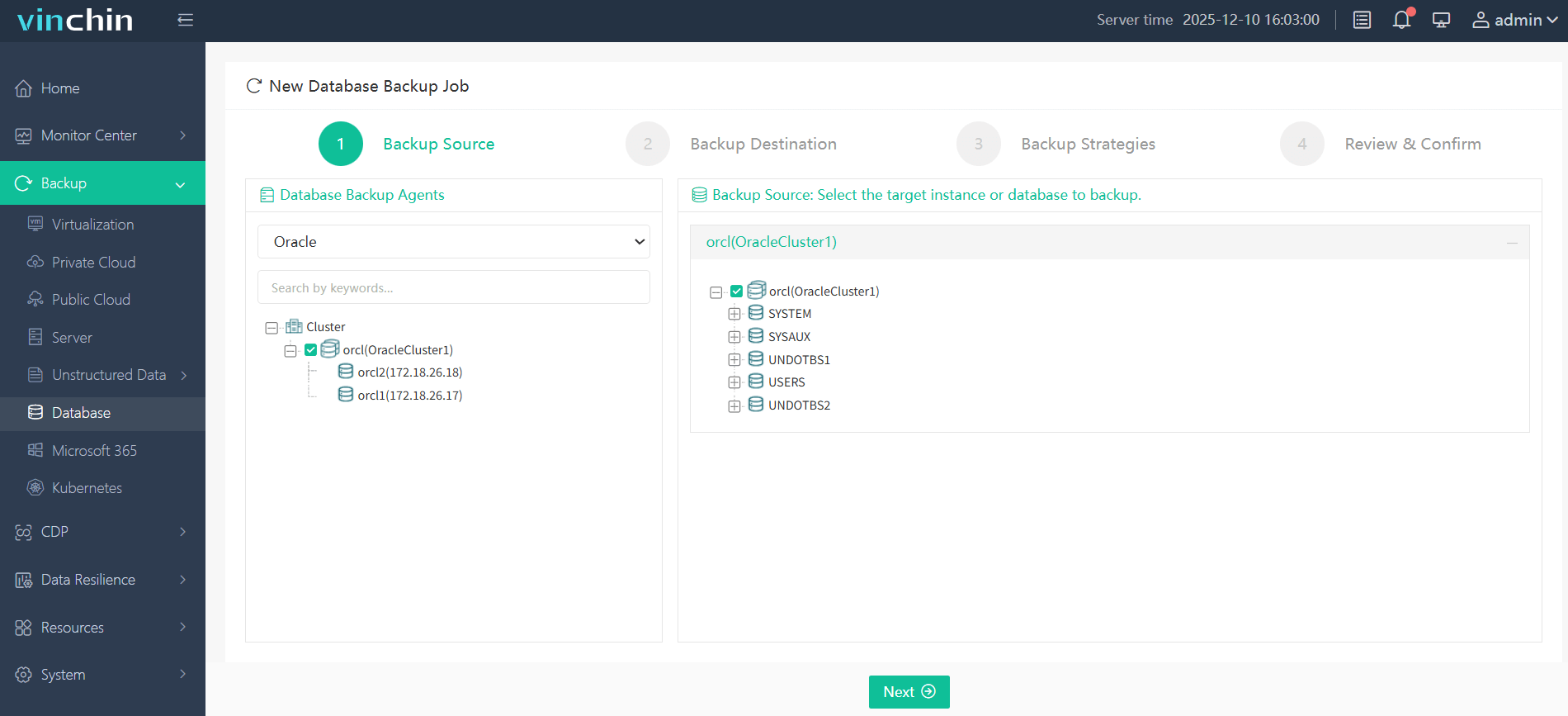
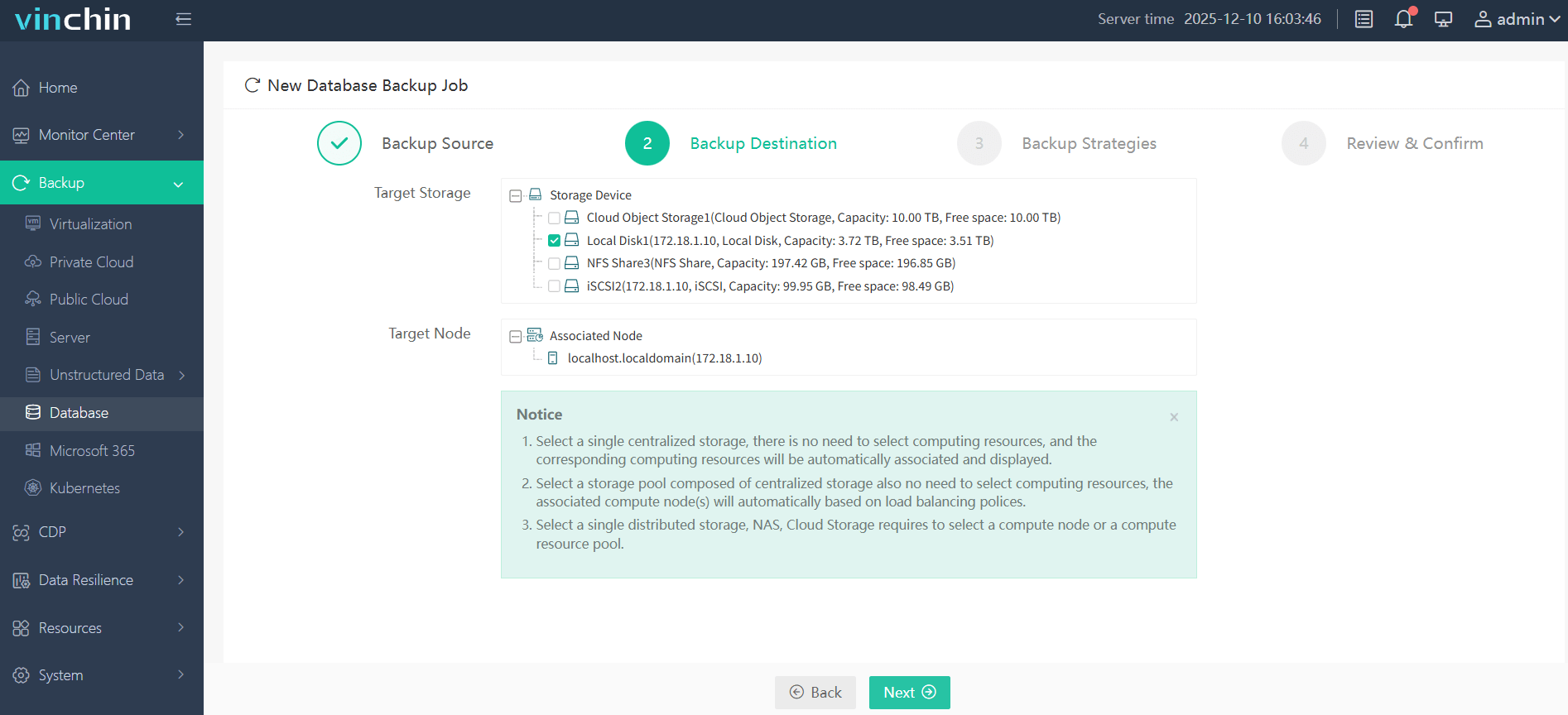
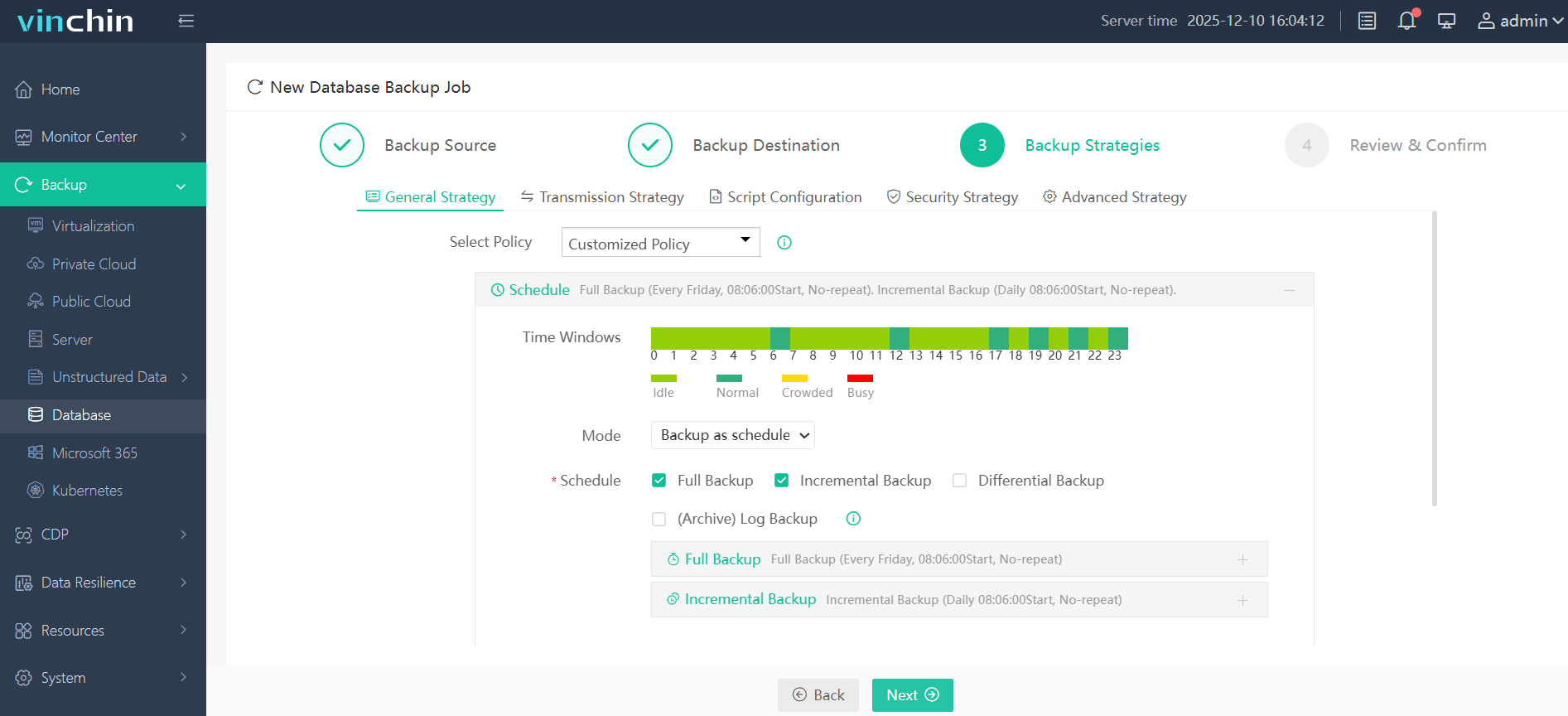
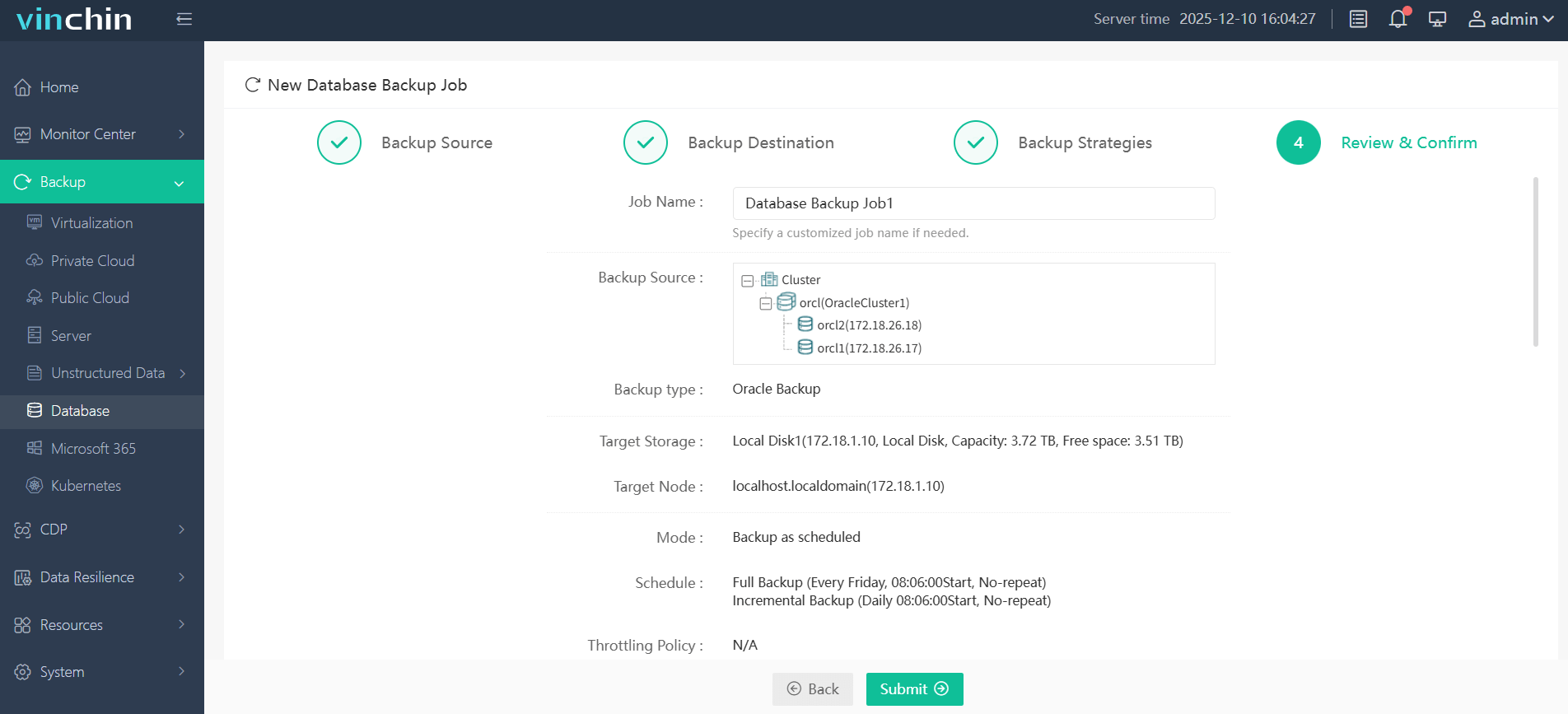
Vinchin Backup & Recovery offers an intuitive web console that simplifies every operation:
Step 1. Select the Oracle database to back up
Step 2. Choose your preferred storage destination
Step 3. Define a tailored backup strategy
Step 4. Submit your job
Recognized globally with thousands of satisfied customers and top industry ratings,Vinchin Backup & Recovery offers a fully featured free trial valid for 60 days—click download now to experience enterprise-grade data protection firsthand.
Oracle RMAN SQL Command FAQs
Q1: Can I view query results using an oracle rman sql command?
A1: No; SELECT queries run but do not display results—use another tool like SQL*Plus instead.
Q2: What happens if my script issues SHUTDOWN IMMEDIATE then tries another oracle rman sql command?
A2: Any subsequent commands fail until you restart with STARTUP since connection was closed after shutdown.
Q3: Can I modify catalog metadata directly using an oracle rman sql command?
A3: No; always use dedicated catalog management commands within RMAN rather than direct updates via embedded SQL.
Conclusion
Using oracle rman sql command lets administrators control key aspects of their databases right from one interface—streamlining both routine maintenance and complex recoveries alike.
For advanced automation across large environments—or simply peace of mind—Vinchin delivers reliable protection trusted worldwide.
Give it a try today!