Managing Oracle database backups is a core task for any operations administrator. You need to know what backups exist, their status, and if they are usable for recovery. Oracle Recovery Manager (RMAN) provides the LIST BACKUP command to help you view and verify your backup inventory. But how do you use it effectively? Let’s break it down step by step.
What Is Oracle RMAN Backup?
Oracle RMAN (Recovery Manager) is the built-in tool for backing up, restoring, and recovering Oracle databases. It automates many tasks that used to require manual scripting or third-party tools. RMAN stores metadata about every backup either in the control file of your database or in an external recovery catalog.
The location of this metadata matters. If you only use the control file as your repository, your LIST BACKUP queries show information limited to that database instance—and retention depends on how much space is allocated for records. When using a recovery catalog—a separate schema stored outside your production database—you get centralized tracking across multiple databases with longer history retention. This is essential when managing complex environments or meeting strict compliance requirements.
This metadata includes details about backup sets, image copies, archived logs, datafiles, control files, server parameter files (SPFILEs), tags applied during backup jobs, completion times, device types used (disk or tape), and more. With RMAN’s automation features—like scheduled jobs or scripts—you can ensure regular backups without manual intervention.
The LIST BACKUP command gives you a window into this rich set of information so you can audit what has been protected at any time.
How to Use the oracle rman list backup Command?
The LIST BACKUP command is the most direct way to see your Oracle database backups. It works at the RMAN prompt after connecting with required privileges such as SYSDBA or SYSBACKUP.
To display all recorded backups—including full sets and incremental pieces—enter:
RMAN> LIST BACKUP;
This shows detailed information about each backup set: its unique key number; type (backup set or proxy copy); level (full or incremental); size; device type; completion time; tag; and current status.
If you prefer a summary view instead of detailed output—for example when scanning large inventories—use:
RMAN> LIST BACKUP SUMMARY;
This produces one line per backup piece so you can quickly scan through results without getting lost in detail.
You may want to focus on specific objects within your environment:
RMAN> LIST BACKUP OF DATABASE;
For a particular datafile:
RMAN> LIST BACKUP OF DATAFILE 4;
Understanding key columns helps you assess health at a glance:
Key: Unique identifier assigned by RMAN
TY: Type—B means standard backup set; P means proxy copy
LV: Level—0/1 for incrementals; F for full; A for archived logs
S: Status—A means available now; U means unavailable but known in repository; X means expired/not found
Device Type: Where stored (DISK, SBT)
Completion Time: Date/time finished
Tag: User-defined label from job script or system-generated default
Why does status matter? If you see “X” under Status (“S”), it signals all pieces are expired—not present on disk/tape—and cannot be restored until replaced by fresh backups. “U” indicates unavailable: perhaps tapes were moved offsite or files deleted manually but not yet purged from metadata.
By reading these columns carefully before any restore operation—or during routine audits—you avoid surprises when disaster strikes.
How to List Backups with Advanced Options in RMAN?
As environments grow larger—with hundreds of datafiles across multiple servers—the basic listing becomes overwhelming fast. The good news? The oracle rman list backup command supports powerful options that let you filter results precisely.
For example:
To group results by file:
RMAN> LIST BACKUP BY FILE;
Now each datafile’s complete protection history appears together—a big help during audits or forensic investigations after incidents.
Need just archived log coverage?
RMAN> LIST BACKUP OF ARCHIVELOG ALL;
Want assurance that control files are backed up?
RMAN> LIST BACKUP OF CONTROLFILE;
Or check SPFILE protection:
RMAN> LIST BACKUP OF SPFILE;
Filtering by time range is also possible:
RMAN> LIST BACKUP COMPLETED AFTER 'SYSDATE-7';
This lists only those completed within seven days—a quick way to confirm recent activity matches policy expectations.
Looking for jobs tagged specifically?
RMAN> LIST BACKUP TAG 'WEEKLY_FULL_DB_BACKUP';
To find expired entries—those missing from expected locations:
RMAN> LIST EXPIRED BACKUP;
In multitenant setups with pluggable databases (PDBs), target just one PDB like this:
RMAN> LIST BACKUP OF PLUGGABLE DATABASE my_pdb;
Filter by storage medium if needed:
RMAN> LIST BACKUP OF DATABASE DEVICE TYPE DISK;
Or narrow down by exact dates:
RMAN> LIST BACKUP OF DATABASE COMPLETED BETWEEN '01-JUN-2024' AND '07-JUN-2024';
For even more precision—see only those still restorable now:
RMAN> LIST BACKUP RECOVERABLE;
And if investigating issues with a specific set number:
RMAN> LIST BACKUPSET 44;
These options make it easy to find exactly what you need whether planning restores or simply auditing compliance against internal policies.
Enterprise Database Protection with Vinchin Backup & Recovery
Beyond native tools like RMAN, organizations increasingly seek comprehensive solutions for safeguarding their Oracle databases alongside other platforms such as MySQL, SQL Server, MariaDB, PostgreSQL, PostgresPro, and TiDB. Vinchin Backup & Recovery delivers professional-grade protection across these mainstream environments—including advanced support for Oracle—with features designed for both operational efficiency and robust security needs.
Among its extensive capabilities are batch database backup management, granular data retention policies including GFS strategies, cloud and tape archiving integration, integrity checks with automated verification routines via SQL scripts, and seamless restore-to-new-server workflows—all helping streamline administration while ensuring reliable recoverability.
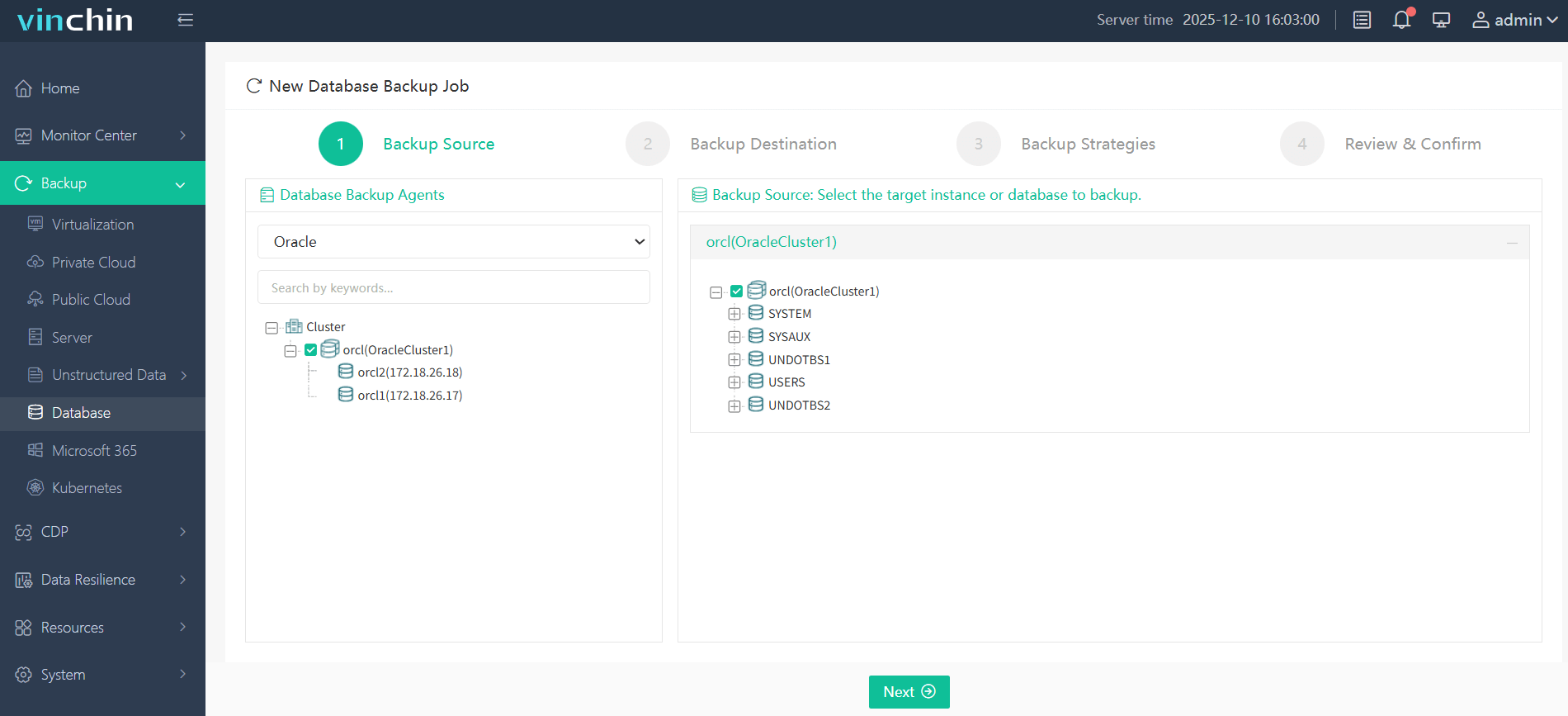
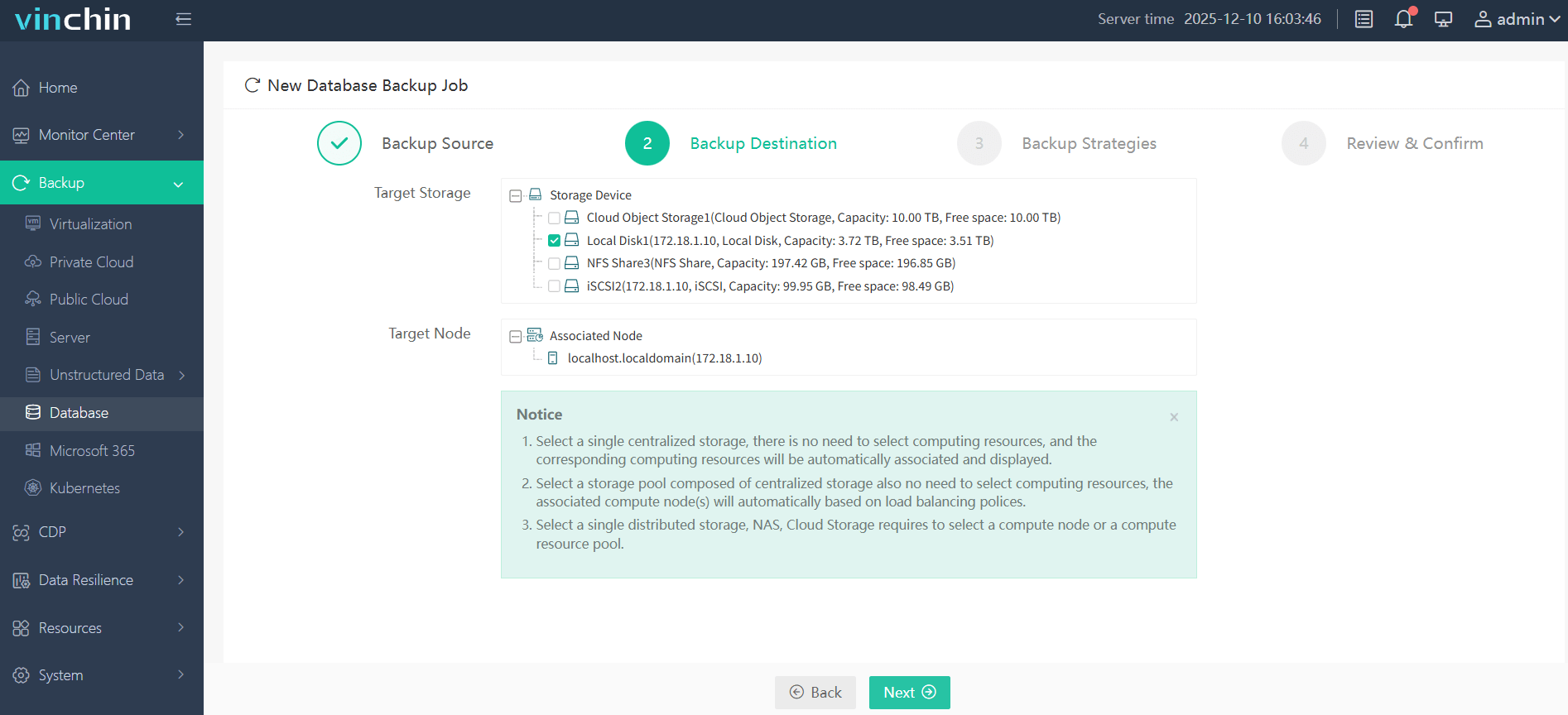
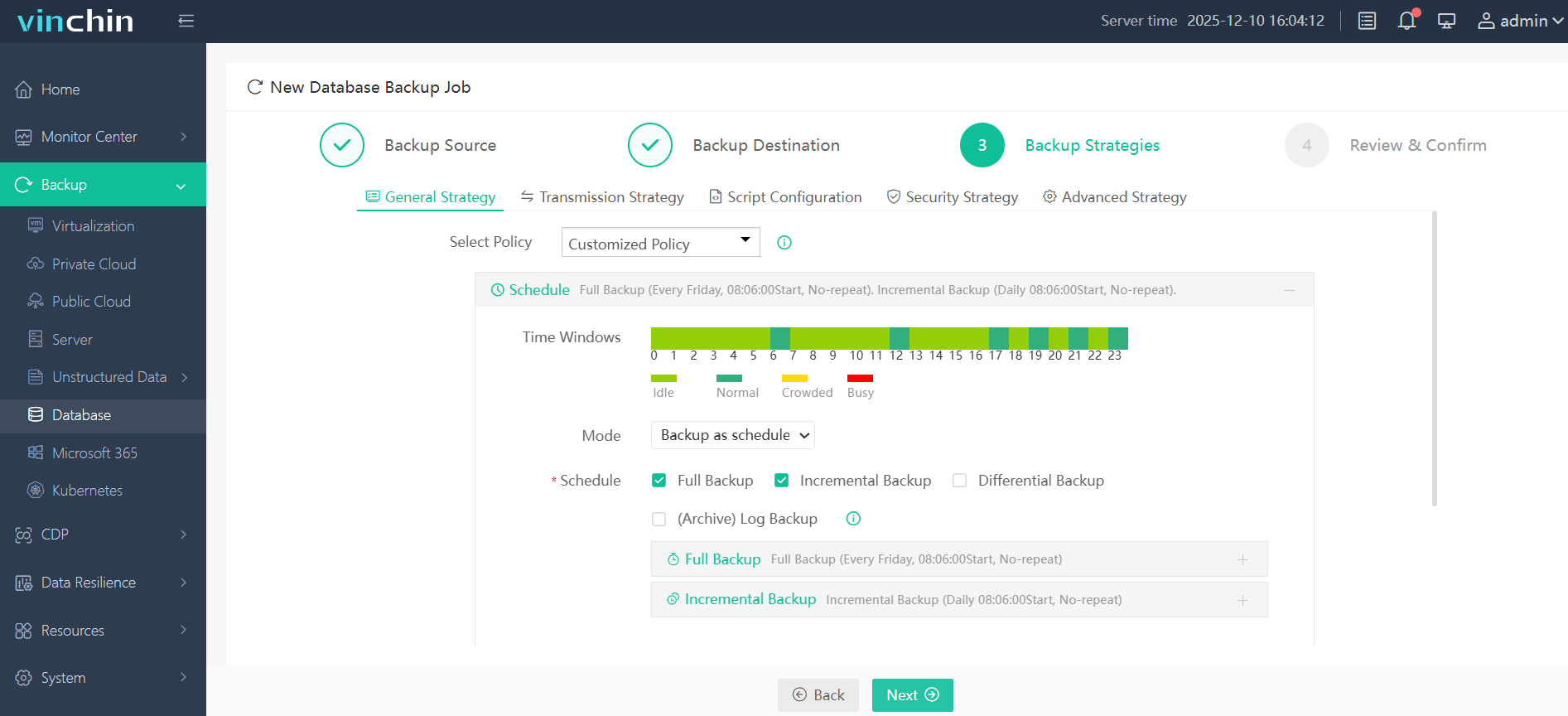
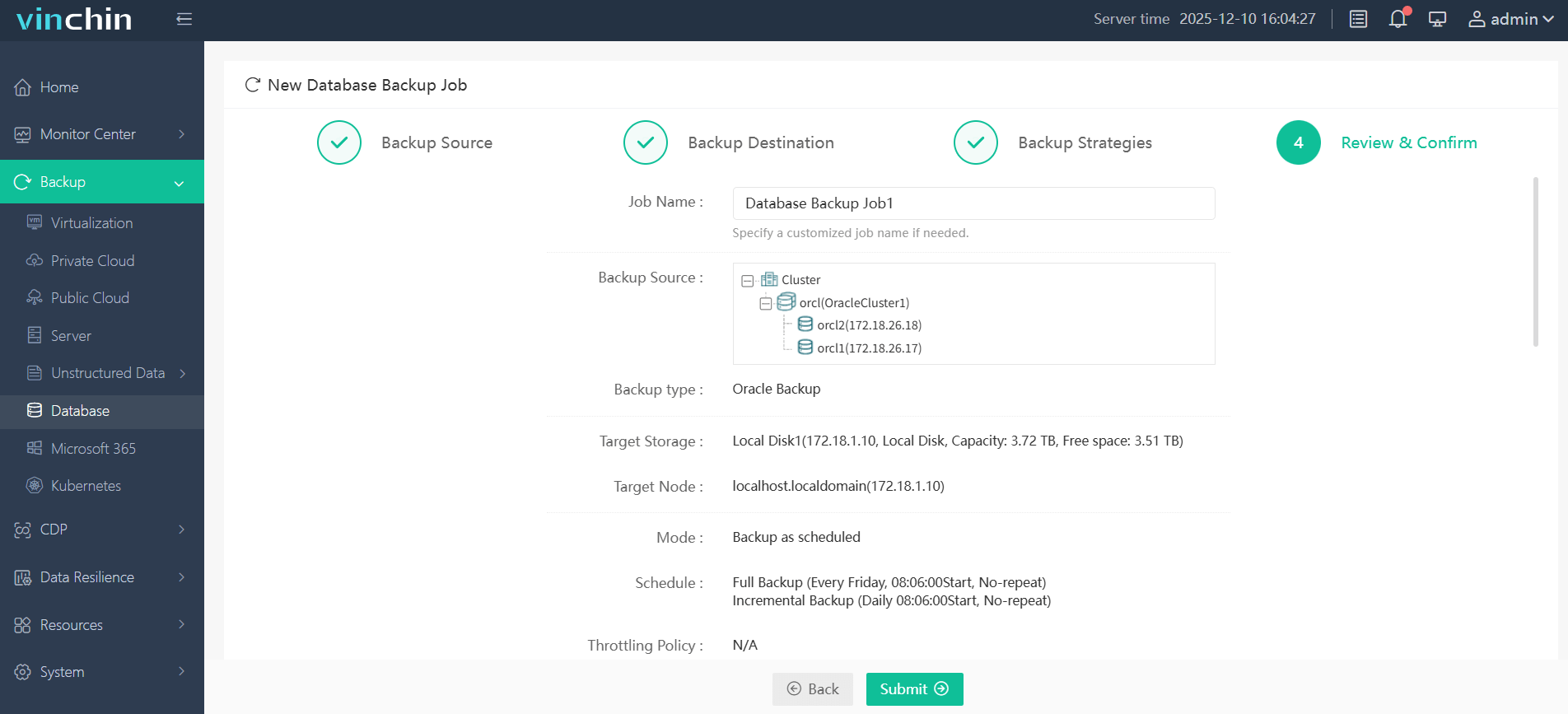
Vinchin Backup & Recovery stands out thanks to its intuitive web console interface. Backing up an Oracle database typically involves four straightforward steps:
Step 1. Select the Oracle database to back up
Step 2. Choose the backup storage
Step 3. Define the backup strategy
Step 4. Submit the job
With global recognition among enterprise users and consistently high ratings for reliability and usability worldwide, Vinchin Backup & Recovery offers a fully featured free trial lasting 60 days—click below to experience industry-leading data protection firsthand.
oracle rman list backup FAQs
Q1: How do I list only expired backups in RMAN?
A1: Run LIST EXPIRED BACKUP; at the RMAN prompt—it displays all expired entries clearly.
Q2: Can I filter RMAN listing results between two dates?
A2: Yes; use LIST BACKUP COMPLETED BETWEEN TO_DATE('2024-01-01','YYYY-MM-DD') AND TO_DATE('2024-01-07','YYYY-MM-DD');
Q3: How do I check which tablespaces have been backed up recently?
A3: Enter LIST BACKUP OF TABLESPACE tablespace_name COMPLETED AFTER 'SYSDATE–7'; replacing tablespace_name as needed.
Conclusion
The oracle rman list backup command gives operations teams clear insight into their Oracle protection posture—from basic inventory checks through advanced filtering options vital during audits or emergencies alike. For streamlined management beyond native tools alone consider trying Vinchin’s robust platform today—it could transform how easily your organization safeguards critical data assets!