Protecting your Oracle database is a top priority for any operations administrator. A full backup forms the backbone of your disaster recovery plan. But how do you perform an Oracle database full backup using RMAN, Oracle’s built-in tool? In this article, I’ll guide you through every step—starting from basics to advanced practices—and show you how to automate backups for peace of mind.
What Is an Oracle Database Full Backup?
An Oracle database full backup is a complete copy of all data files in your database at a specific point in time. This includes every used data block, the control file, and optionally archived redo logs. With a full backup, you can restore your entire database to its exact state when the backup was taken. This type of backup serves as the baseline for other types like incremental or differential backups.
A full backup ensures that no matter what happens—hardware failure or accidental deletion—you have everything needed to bring your system back online quickly.
Why Use RMAN for Full Backups?
Oracle Recovery Manager (RMAN) is Oracle’s recommended tool for managing backups and recovery tasks. RMAN integrates tightly with the Oracle engine so it can perform block-level integrity checks and optimize storage use automatically. Unlike manual methods such as OS-level copies, RMAN tracks your entire backup history within its catalog or control file.
With RMAN you get features like compression support, parallelism options for faster performance, automated scheduling capabilities via scripting tools, and detailed reporting on job status. It also supports both open (hot) and closed (cold) backups without disrupting user activity if configured properly.
Why make things harder than they need to be? RMAN simplifies complex tasks while reducing human error—a win-win situation.
How to Perform Oracle Database Full Backup Using RMAN?
Before starting any operation with RMAN, ensure you have proper privileges: connect as a user with SYSDBA or SYSBACKUP role. For most environments today, SYSBACKUP is preferred because it grants only necessary permissions related to backup operations—helping enforce least privilege principles.
If you want to back up while users are connected (online/hot), confirm that your database runs in ARCHIVELOG mode by querying:
ARCHIVE LOG LIST;
If not enabled yet—and downtime is acceptable—you can switch modes by shutting down cleanly then mounting:
SHUTDOWN IMMEDIATE;
STARTUP MOUNT;
ALTER DATABASE ARCHIVELOG;
ALTER DATABASE OPEN;
Let’s walk through each step required for a robust oracle database full backup using rman:
1. Connect to RMAN
Open a terminal or command prompt on your server hosting the target database instance. Start RMAN by running:
rman target /
Or if connecting remotely:
rman target sys@yourdb
2. Check & Configure Key RMAN Settings
It’s wise to review critical configurations before performing major backups—especially if this is your first run or after changes in policy.
First display current settings:
SHOW ALL;
Consider setting these two important parameters:
CONFIGURE RETENTION POLICY TO RECOVERY WINDOW OF 7 DAYS;
CONFIGURE DEFAULT DEVICE TYPE TO DISK;
SHOW ALL;
The retention policy controls how long old backups are kept before being marked obsolete; adjust according to business needs.
3. Run the Full Backup Command
To create a comprehensive copy—including all data files plus archived redo logs—use:
BACKUP DATABASE PLUS ARCHIVELOG;
Here’s what happens:
BACKUP DATABASE creates a logical set containing all data files.
PLUS ARCHIVELOG ensures all archived redo logs generated during this process are included so you can recover right up until completion time.
Want compression or custom naming? Try:
BACKUP AS COMPRESSED BACKUPSET DATABASE PLUS ARCHIVELOG FORMAT '/backup/ora_full_%U.bkp';
By default this produces backup sets—proprietary bundles requiring RMAN during restore—but if you prefer bit-for-bit image copies usable directly by Oracle utilities outside of RMAN:
BACKUP AS COPY DATABASE FORMAT '/backup/imagecopy_%U.dbf';
For disk space management in automated scripts consider adding DELETE INPUT after PLUS ARCHIVELOG. This deletes archive logs only after successful inclusion in the current backup set—but use caution! Make sure retention policies align so nothing vital gets removed prematurely:
BACKUP DATABASE PLUS ARCHIVELOG DELETE INPUT;
4. Verify Your Backup
After completion always check results—not just that files exist but that they’re valid!
Start simple:
LIST BACKUP OF DATABASE SUMMARY;
LIST BACKUP OF ARCHIVELOG ALL SUMMARY;
LIST BACKUP TAG='FULL_BACKUP_JUNE2024' SUMMARY; -- If tagged
This shows metadata about each piece: creation date/time/status/location/tag info.
Validating Backups: Beyond LIST
Listing confirms existence but not physical integrity or restorability! For deeper assurance use validation commands which read every block without writing output:
To validate recent sets by key number found above:
VALIDATE BACKUPSET <backupset_key>;
RESTORE DATABASE VALIDATE; -- Checks ability to restore whole DB
VALIDATE DATABASE;         -- Checks blocks within live DB
VALIDATE ARCHIVELOG ALL;   -- Checks archived log files
These steps help catch corruption early—before disaster strikes!
5. Tag Your Backup (Optional)
Tags make future identification easier especially when automating jobs across multiple databases or schedules:
BACKUP DATABASE TAG='FULL_BACKUP_JUNE2024' PLUS ARCHIVELOG;
LIST BACKUP TAG='FULL_BACKUP_JUNE2024' SUMMARY;
RESTORE DATABASE FROM TAG 'FULL_BACKUP_JUNE2024';
6. Exclude Archive Logs If Needed (Optional)
Sometimes regulatory requirements dictate keeping only data file snapshots without logs—for example test/dev environments where point-in-time recovery isn’t required:
BACKUP DATABASE; -- Data files only!
-- Remember: Without archive logs point-in-time restores aren’t possible!
7. Back Up When Database Is Closed (NOARCHIVELOG Mode)
In rare cases where archiving isn’t enabled—for example small test systems—you must shut down cleanly then mount before running any consistent cold/full backup:
SHUTDOWN IMMEDIATE;
STARTUP MOUNT;      -- Don’t open!
rman target /
BACKUP DATABASE;    -- No archive logs available!
ALTER DATABASE OPEN;

-- Note: Restores here return DB exactly as it was at shutdown time—not later
Automating Oracle Database Full Backup Using RMAN
Manual backups work fine during testing phases but production demands reliability through automation! Scheduling regular jobs reduces risk from human forgetfulness while ensuring compliance with internal SLAs or external regulations.
You can automate via shell scripts on Linux/Unix platforms using cron, or batch scripts on Windows platforms scheduled via Task Scheduler as described above.
Vinchin: Enterprise-Level Solution for Oracle Database Backups
For those seeking streamlined management beyond native tools, Vinchin Backup & Recovery delivers professional enterprise-grade protection supporting today's mainstream databases—including Oracle, MySQL, SQL Server, MariaDB, PostgreSQL, PostgresPro, and TiDB—with special emphasis on robust features tailored for Oracle environments first and foremost here. The solution offers advanced source-side compression, Incremental backups, batch processing options, flexible retention policies including GFS support, and multi-level data compression—all designed to maximize efficiency while minimizing storage costs and administrative overheads.
Key benefits include rapid any-point-in-time recovery even against ransomware threats thanks to secure storage protection mechanisms; seamless cloud backup and tape archiving integration; comprehensive integrity checks with automated verification routines; efficient log handling for granular restores; and intuitive scheduling workflows—all contributing toward resilient business continuity strategies across diverse infrastructures.
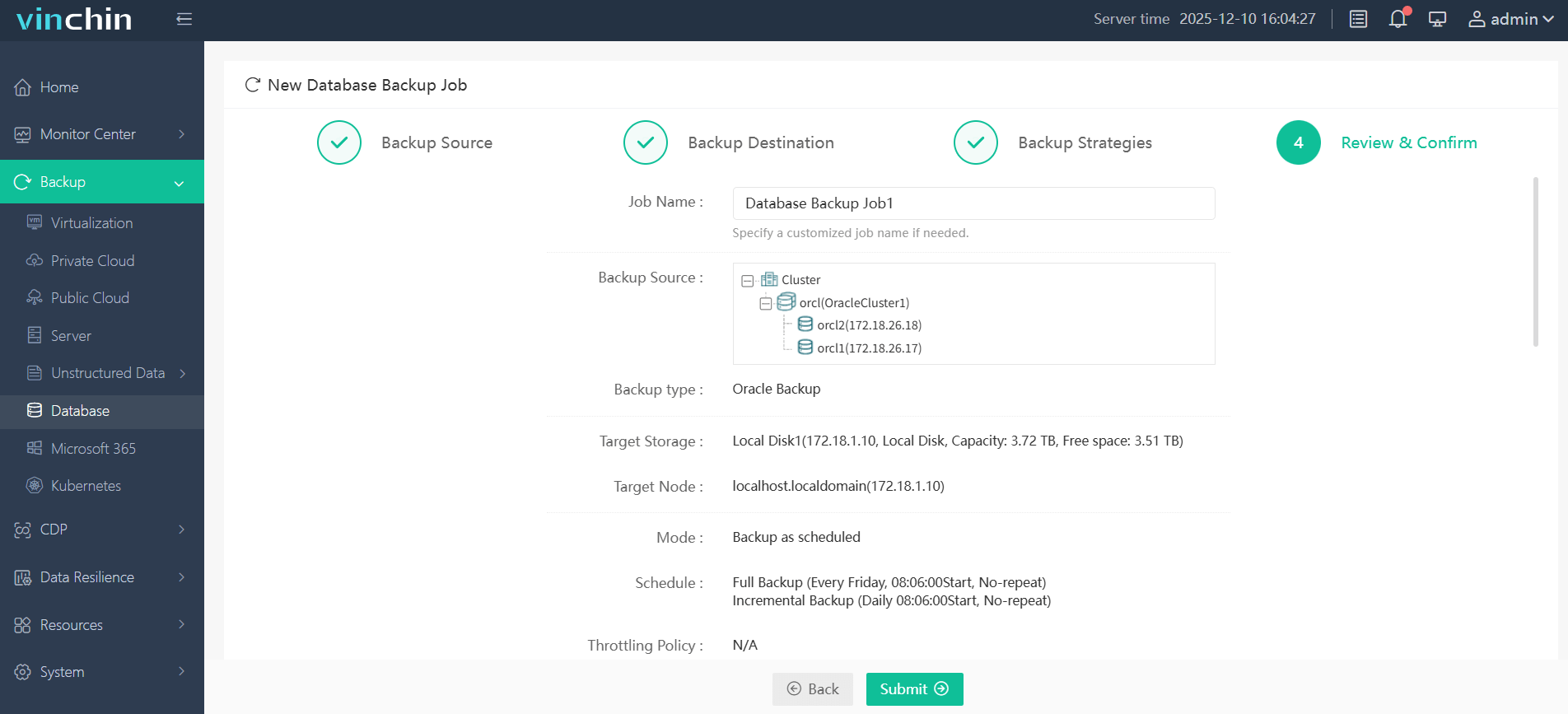
Using Vinchin Backup & Recovery's web console makes safeguarding your Oracle environment straightforward:
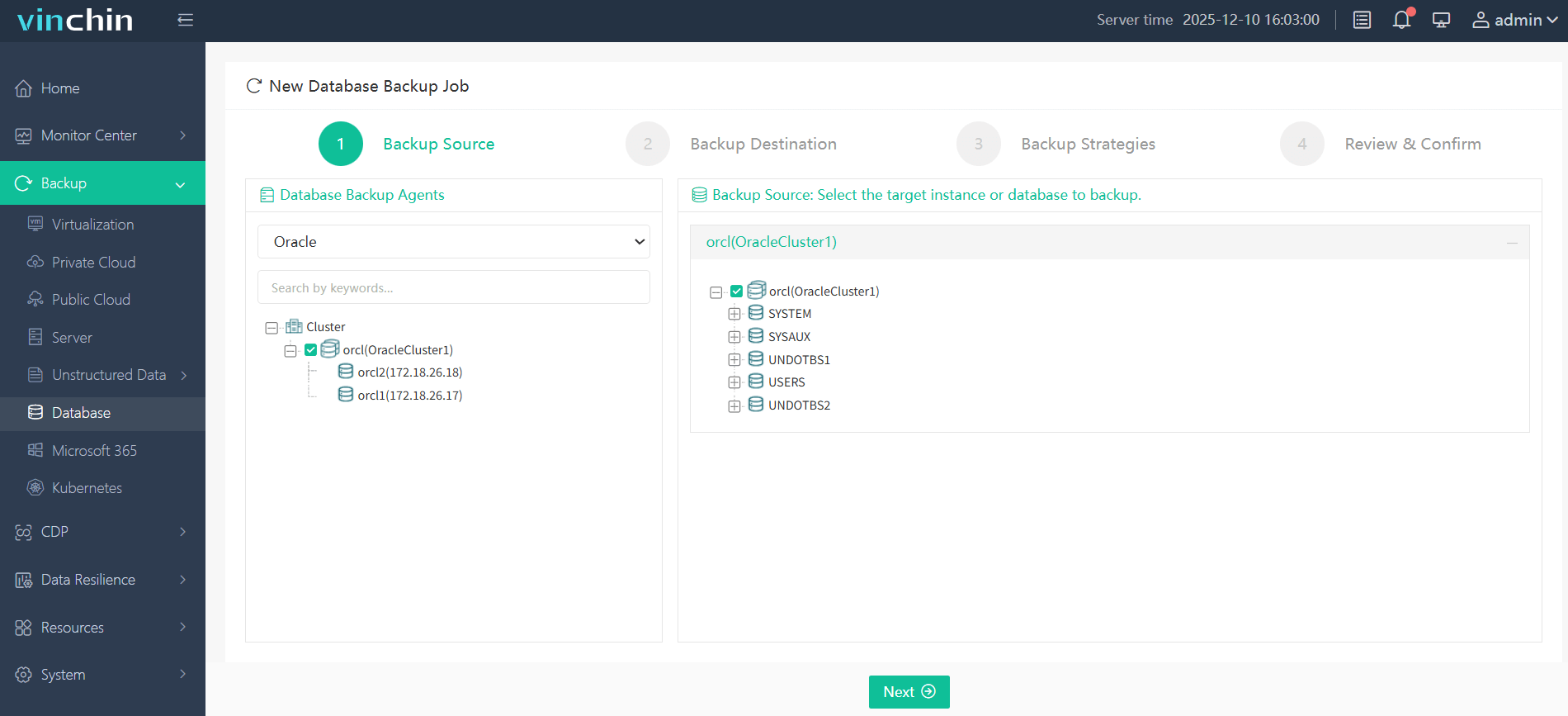
Step 1. Select the Oracle database to back up
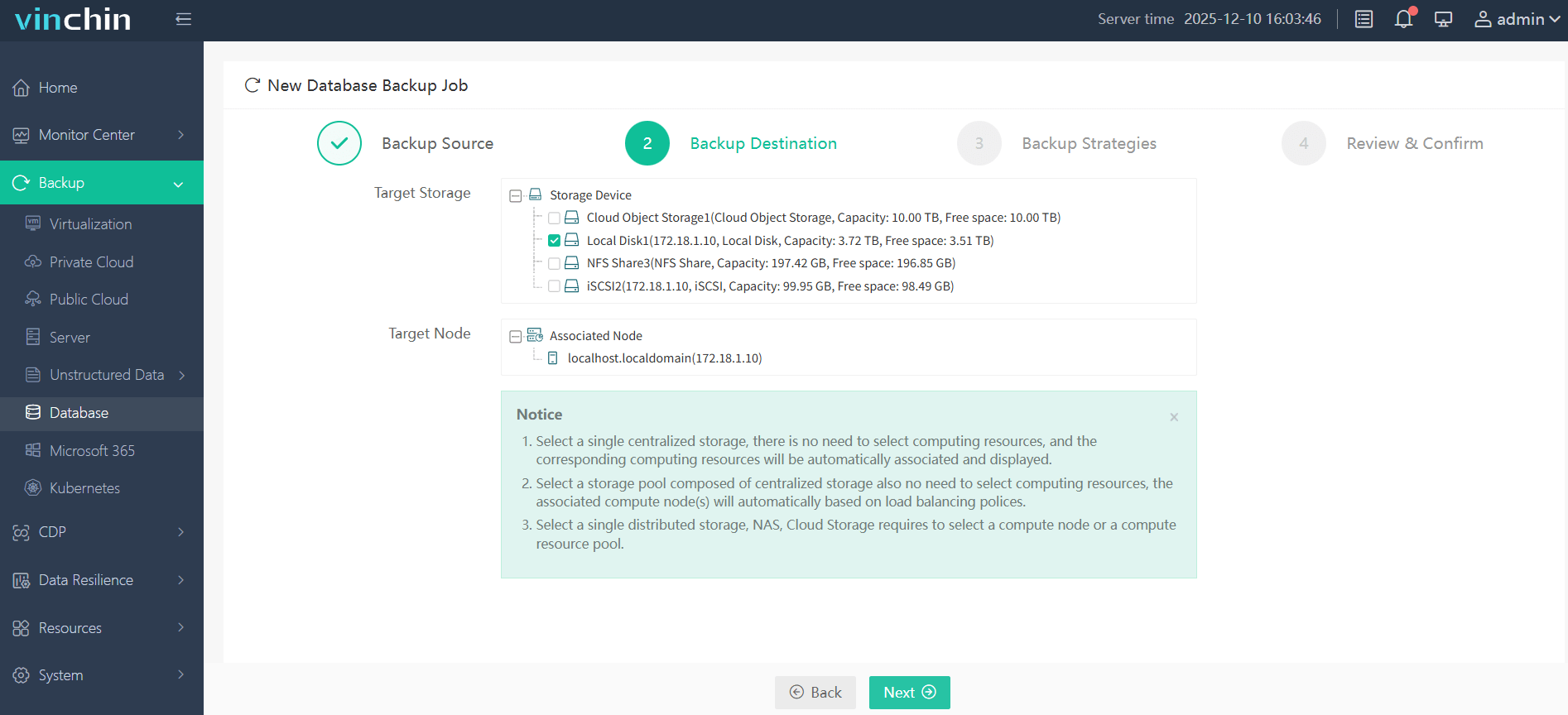
Step 2. Choose the backup storage
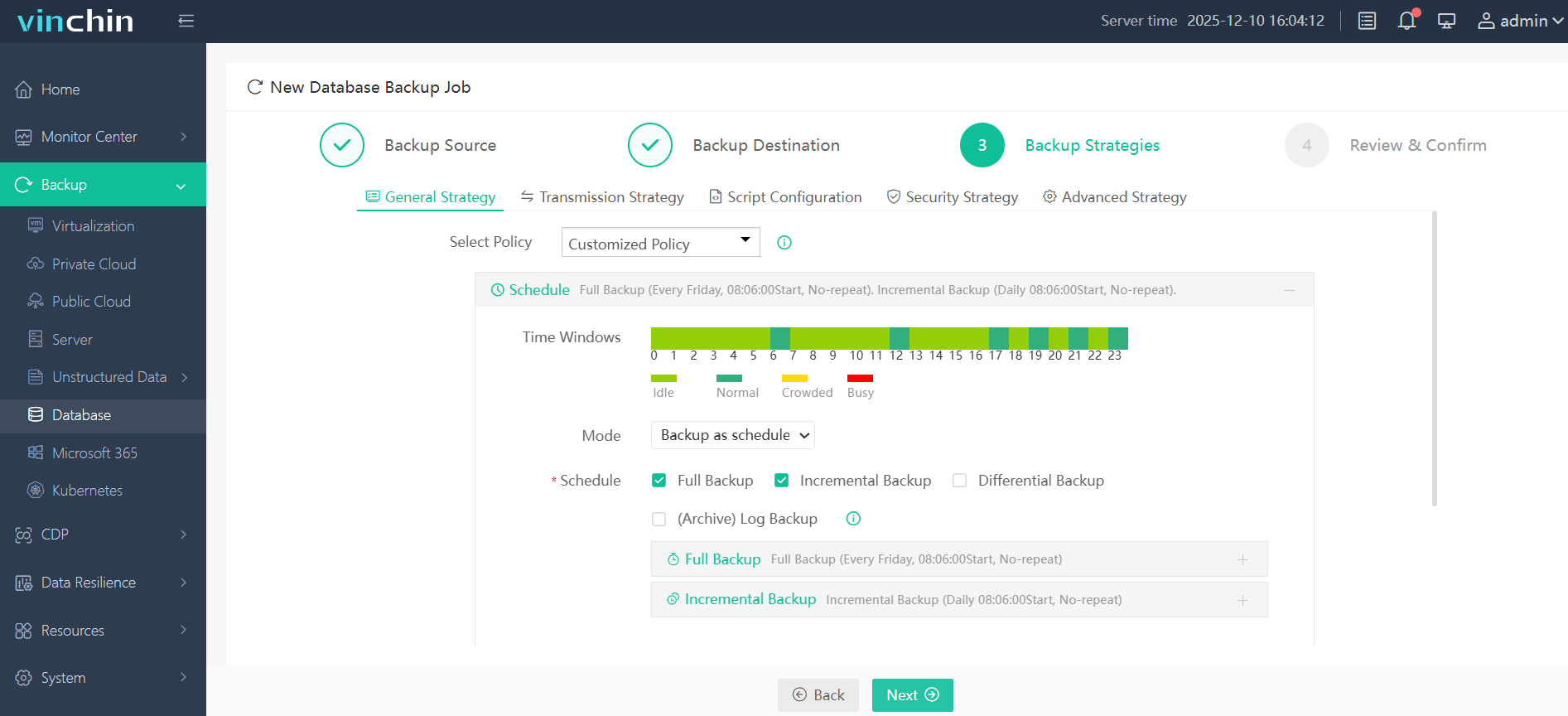
Step 3. Define the backup strategy
Step 4. Submit the job
Recognized globally among enterprise IT teams—with strong customer satisfaction ratings—Vinchin Backup & Recovery offers a fully featured free trial for sixty days below so you can experience leading-edge protection firsthand.
Oracle Database Full Backup Using RMAN FAQs
Q1: Can I run an oracle database full backup using rman while users are active?
A1: Yes—as long as your instance uses ARCHIVELOG mode—the operation won’t disrupt connected users’ sessions.
Q2: What should I do if my oracle rman full backup fails due to insufficient disk space?
A2: Free up space on both destination directories and FRA area before retrying—or adjust retention policies accordingly.
Q3: How do I verify my latest oracle rman full backup succeeded programmatically?
A3: Query V$RMAN_BACKUP_JOB_DETAILS view for STATUS column showing COMPLETED value after expected start/end times.
Conclusion
A solid oracle database full backup using rman protects against disasters large or small—and makes daily operations less stressful overall! For even greater ease-of-use plus advanced automation features consider trying Vinchin’s enterprise-grade solution today—it could transform how confidently you manage critical data assets going forward!