Duplicating an Oracle 10g database is a routine but vital task for operations administrators. Whether you need a test environment, want to offload reporting, or prepare for disaster recovery, Oracle Recovery Manager (RMAN) provides the tools to create a duplicate database safely and efficiently. In this guide, you’ll learn what duplication means, why it matters, and how to perform it step by step using RMAN.
What Is Oracle 10g Database Duplication?
Oracle 10g database duplication is the process of creating an independent copy of an existing database. This copy is often called a duplicate or clone and can be used for testing, development, or as a standby in disaster recovery scenarios. RMAN automates much of this work with built-in commands that restore datafiles and apply archived logs. The duplicate can reside on the same server or another one entirely. You can choose to duplicate from backups or directly from the active source database.
Why would you need such a clone? Imagine testing new patches without risking your production system. Or perhaps you want to run heavy reports without slowing down your main environment. With duplication, these tasks become safer and easier.
Why Duplicate Database Using RMAN?
Using RMAN for duplication is both safer and more efficient than manual copying methods. RMAN manages all details: restoring files, applying logs, ensuring consistency, even handling point-in-time recovery if needed. This reduces human error and saves valuable time.
You might use duplication to:
Create isolated test environments
Refresh development databases with recent production data
Set up standby databases for high availability
Troubleshoot issues by rolling back to specific points in time
RMAN also allows flexible options like duplicating only certain tablespaces or excluding others, a handy feature when storage space is limited.
Preparing for Oracle 10g Database Duplication
Before starting any duplication task, careful preparation is key. Both the source (original) and auxiliary (duplicate) environments must be ready for action.
Prerequisites and Pre-checks
Verify that Oracle software is installed on both servers, the source and the auxiliary, but do not create a new database on the auxiliary yet. The auxiliary instance should exist only as a set of binaries and no actual database files are present at this stage.
Check network connectivity between servers using ping and tnsping utilities to confirm they can communicate smoothly over TCP/IP networks.
Ensure you have enough disk space on the auxiliary server to hold all datafiles, control files, redo logs, archived logs, and temporary files required by the duplicate database.
If duplicating from backup (see Method 1), make sure recent full backups, including archived logs—are available and accessible from the auxiliary host.
Verify that character sets match between source and auxiliary environments; mismatches can cause subtle errors later during recovery or application testing.
Confirm that both servers’ listener processes are running correctly so connections via TNS names will succeed during RMAN operations.
Auxiliary Instance Setup
On the auxiliary server:
1. Use orapwd utility to create a password file matching your SYS user credentials.
2. Copy your parameter file (PFILE) from source to auxiliary server.
3. Edit parameters such as DB_NAME, CONTROL_FILES, DB_FILE_NAME_CONVERT, and LOG_FILE_NAME_CONVERT so paths reflect locations on your new host.
4. Build directory structures for datafiles, control files, redo logs—matching what’s specified in your PFILE.
5. Start SQL*Plus on the auxiliary host; issue STARTUP NOMOUNT PFILE='/path/to/initaux.ora' so background processes start but no datafiles are mounted yet.
6. Update both servers’ tnsnames.ora entries so each knows how to reach every relevant service name over the network.
7. Confirm listeners are running with lsnrctl status on each host; check registration if needed.
8. Test connectivity using tnsping against both source and auxiliary service names before proceeding further.
These steps ensure that when you launch RMAN commands later on, whether duplicating from backup or live, you won’t hit avoidable roadblocks due to missing directories or misconfigured listeners.
Method 1. Duplicating Oracle 10g Database from Backup
Duplicating from backup uses existing RMAN backups of your source database including archived redo logs to build out an identical copy elsewhere (often on another server). This method works well when cloning across hosts or when downtime isn’t possible on production systems.
First things first: make sure you have completed full backups plus all necessary archived logs using RMAN beforehand. Begin by creating a password file for SYS user access with orapwd if not already done:
orapwd file=/oracle/product/10g/dbs/orapwauxdb password=YourSysPassword entries=5
Copy your parameter file (PFILE) from source machine (for example /oracle/product/10g/dbs/initprod.ora) over to the target location (/oracle/product/10g/dbs/initauxdb.ora). Adjust key parameters:
Set DB_NAME = auxdb
Use CONTROL_FILES = '/oracle/oradata/auxdb/control01.dbf', ...
Map original paths with DB_FILE_NAME_CONVERT = ('/oradata/prod/', '/oradata/aux/')
Similarly adjust LOG_FILE_NAME_CONVERT
Create directories referenced above if they don’t already exist (mkdir -p /oracle/oradata/auxdb).
Start SQL*Plus as follows:
sqlplus / as sysdba
SQL> STARTUP NOMOUNT PFILE='/oracle/product/10g/dbs/initauxdb.ora';
Update network configuration:
Add entries in both machines’ tnsnames.ora pointing at each other’s services
Ensure listener processes are running (lsnrctl start)
Test connections: tnsping prod, tnsping auxdb
Copy any required backup pieces (datafile/image copies) plus archived log files onto local storage accessible by the auxiliary instance if not shared via NFS/SAN/etc.
Now connect through RMAN:
rman TARGET sys@prod AUXILIARY sys@auxdb
To begin duplication:
DUPLICATE TARGET DATABASE TO auxdb NOFILENAMECHECK;
If you wish to restore up until a specific point in time. For example before some unwanted changes occurred, add:
SET UNTIL TIME "TO_DATE('2024-05-01 12:00:00','YYYY-MM-DD HH24:MI:SS')";
DUPLICATE TARGET DATABASE TO auxdb NOFILENAMECHECK;
RMAN will restore all necessary datafiles based on available backups then apply archived redo logs until reaching either current state or specified point-in-time before opening with RESETLOGS mode—a clean slate ready for use!
Troubleshooting Common Issues During Backup-Based Duplication
Sometimes things go wrong even after careful setup:
If you see “RMAN–06054: ORACLE error from auxiliary,” double-check listener status (lsnrctl status) plus TNS entry spelling in tnsnames files.
Errors like “ORA–19809” often mean insufficient FRA space. You should review settings like DB_RECOVERY_FILE_DEST_SIZE in your PFILE.
File creation failures (“ORA–27038”) usually indicate incorrect path mappings in DB_FILE_NAME_CONVERT or missing OS write permissions. You should fix those before retrying!
Always check alert log (alert_auxdb.log) under $ORACLE_BASE/admin/auxdb/bdump for detailed diagnostics if startup fails unexpectedly.
Method 2. Duplicating Oracle 10g Database from Active Database
Active database duplication skips pre-existing backups entirely, instead streaming live datafiles directly across network links between hosts. This approach minimizes downtime since no intermediate backup staging occurs but does require robust network bandwidth plus stable access throughout operation window.
1.Create password file (orapwd) matching SYS credentials
2.Copy parameter file (PFILE) then edit DB_NAME / path conversion parameters just like above
3.Build required directory structure per edited PFILE values
Start SQL*Plus session:
sqlplus / as sysdba
SQL> STARTUP NOMOUNT PFILE='/oracle/product/10g/dbs/initauxdb_activecopy.ora';
Confirm listeners are up (lsnrctl status) then update tnsnames entries accordingly so both hosts recognize each other's services via TNS aliases (“prod”, “auxdb”).
From either host, but typically best initiated at source where load impact can be monitored closely, connect through RMAN:
rman TARGET sys@prod AUXILIARY sys@auxdb
Now launch active duplication command:
DUPLICATE TARGET DATABASE TO auxdb FROM ACTIVE DATABASE NOFILENAMECHECK;
This streams all required blocks directly into place at destination while simultaneously applying any necessary archived redo logs along way before opening new instance with RESETLOGS option enabled upon completion.
Troubleshooting Common Issues During Active Duplication
Active duplication brings its own challenges:
Network bottlenecks may slow transfer rates dramatically; monitor throughput carefully during operation window especially across WAN links!
Timeout errors often relate either poor connectivity quality—or buffer sizes too small within sqlnet/listener config files; consider increasing SEND_BUF_SIZE / RECV_BUF_SIZE settings temporarily if large datasets involved.
If there are file creation problems, double-check DB_FILE_NAME_CONVERT syntax matches real-world directory layout and verify OS-level permissions allow writing into those folders.
Easily Deduplicate Oracle Backup with Vinchin Backup & Recovery
For organizations seeking streamlined protection beyond native tools like RMAN, Vinchin Backup & Recovery delivers professional enterprise-level backup specifically designed for mainstream databases including Oracle 10g, 11g/11g R2, 12c, 18c, 19c, 21c, Oracle RAC, and MySQL, SQL Server, MariaDB, PostgreSQL, PostgresPro, and TiDB.
For Oracle database backup it provides features like advanced source-side compression and incremental backup capabilities to reduce backup size. It also provies general features for all databases like batch database backup management across multiple instances, robust cloud/tape archiving for offsite safety, integrity checks ensuring recoverability of every backup set.
The intuitive web console makes safeguarding your Oracle databases straightforward:
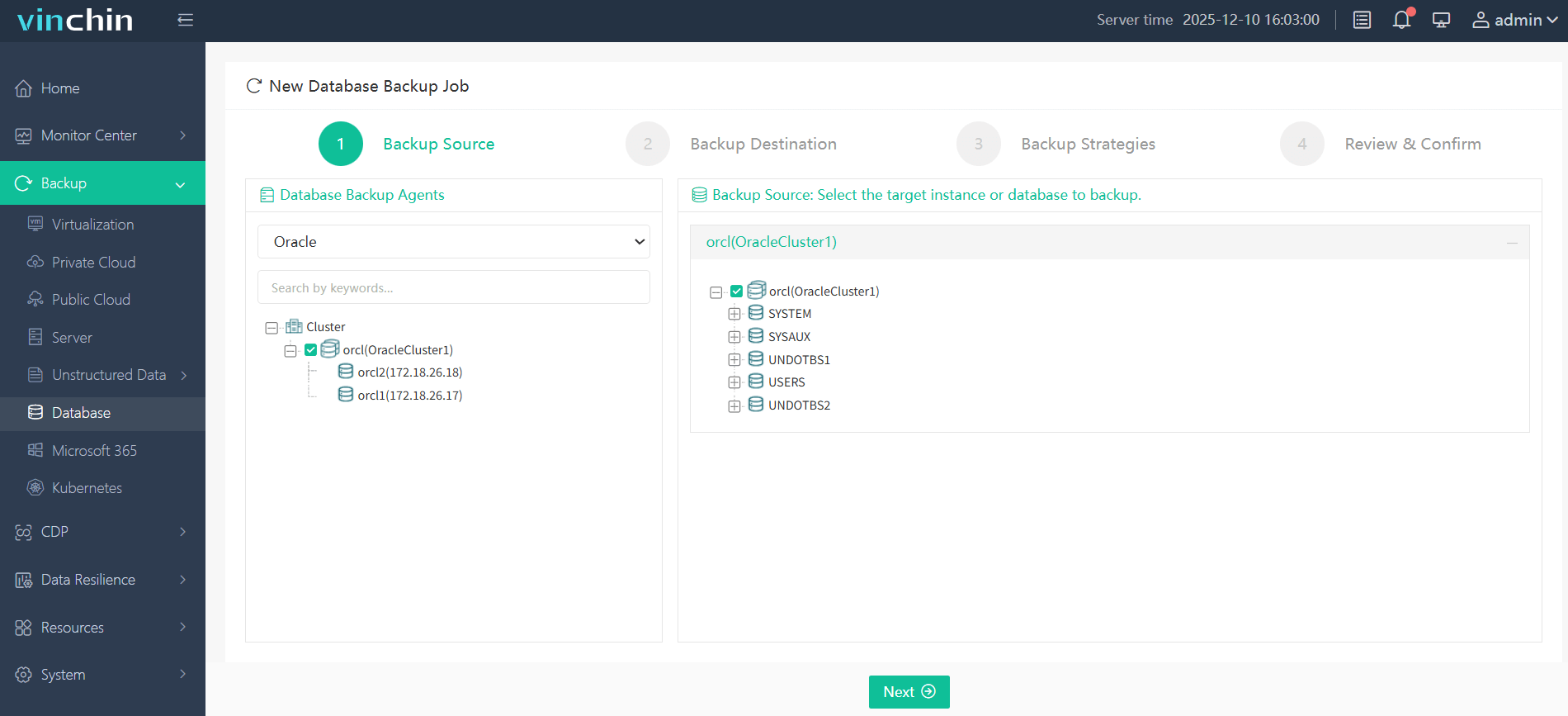
Step 1: Select the Oracle database to backup
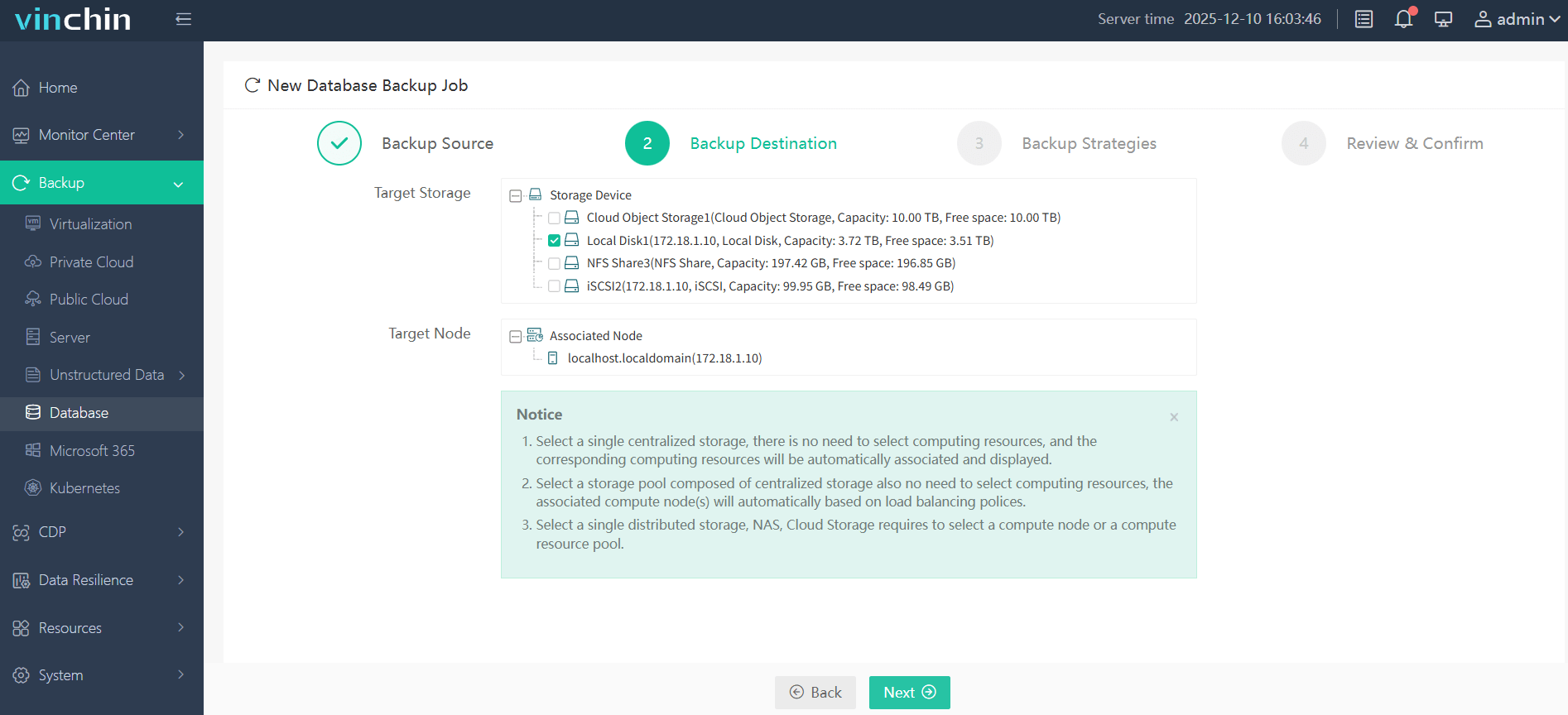
Step 2: Choose backup storage
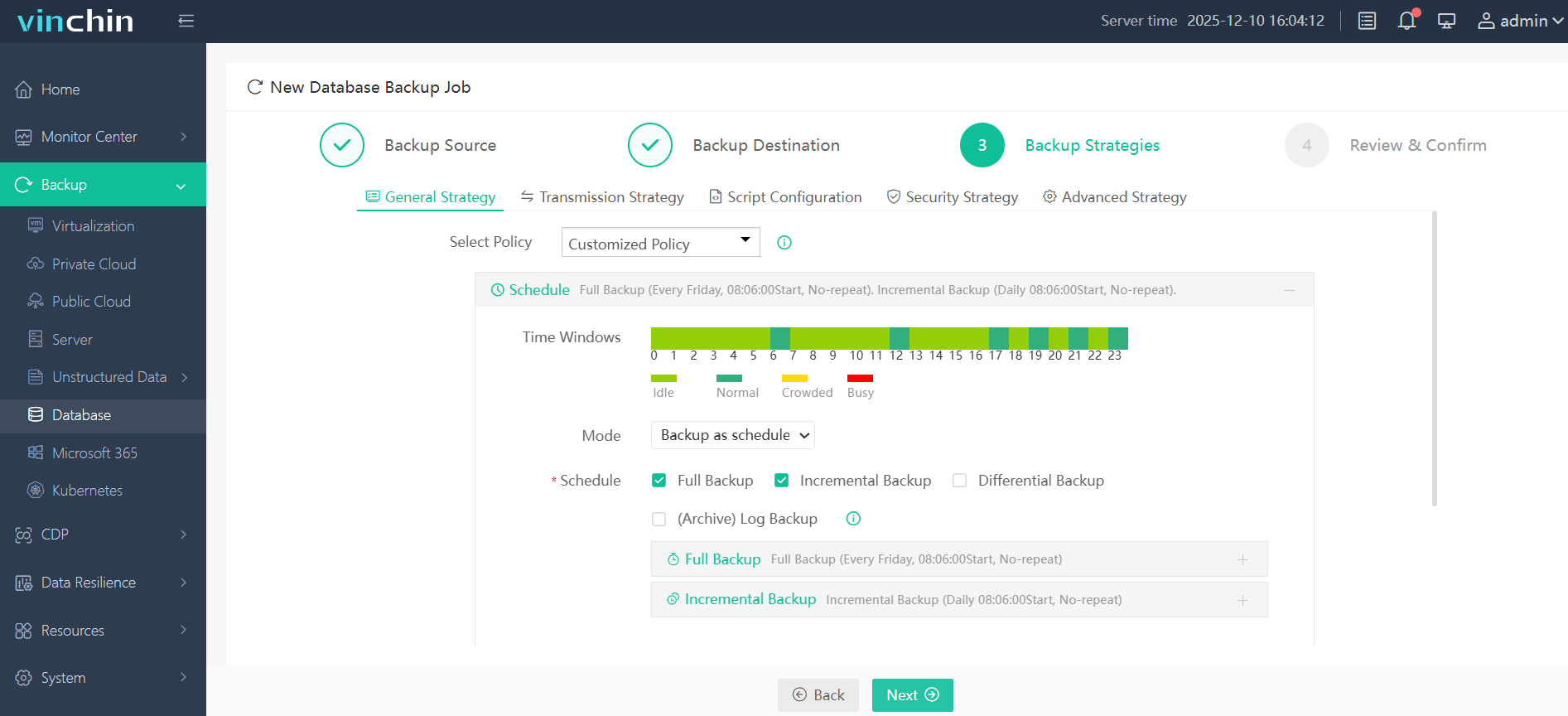
Step 3: Define your preferred backup strategy
Step 4: Submit the job
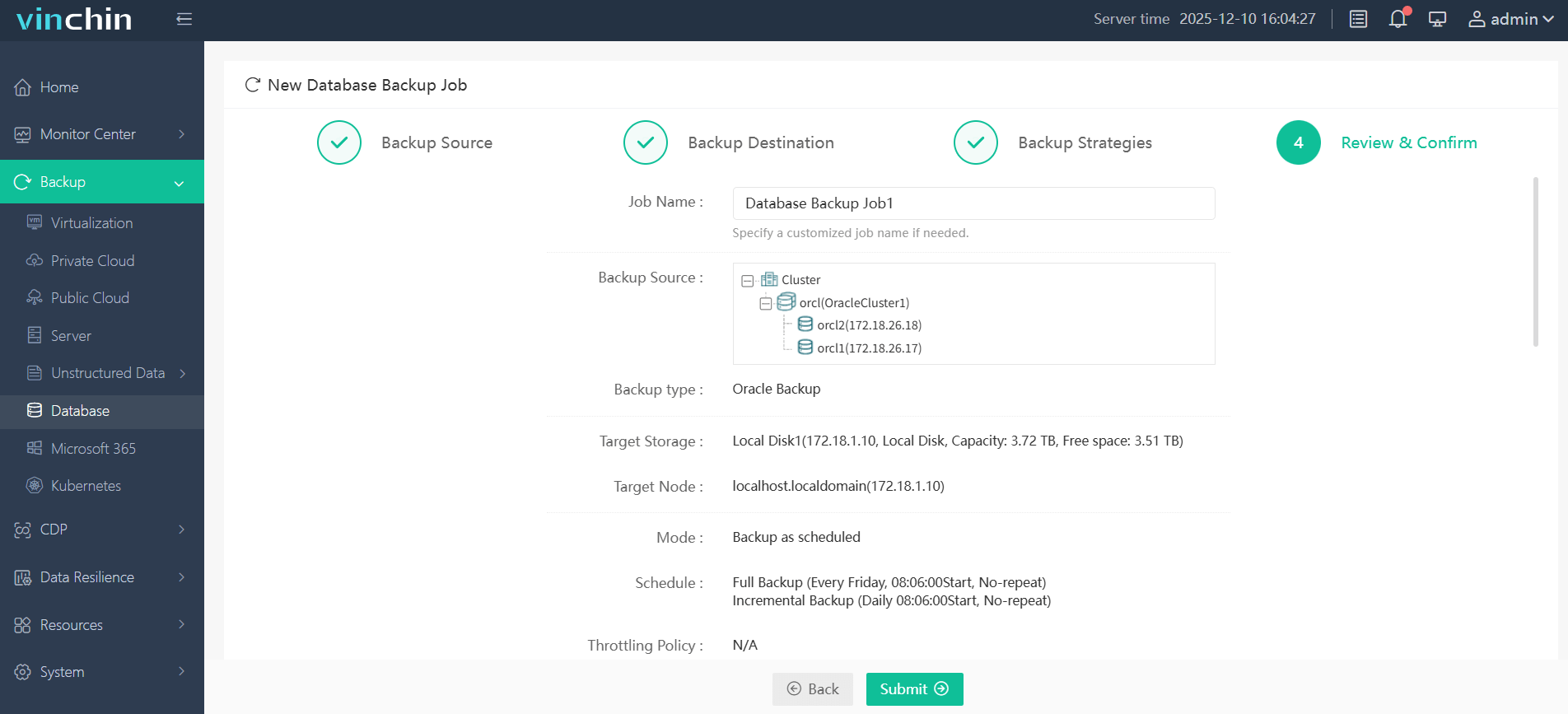
The backup also helps easy duplication. You just create a restore job, select the backup, and then select a new path to duplicate it.
Vinchin Backup & Recovery enjoys global recognition among enterprise users thanks to its reliability and top-rated customer satisfaction. Try every feature free for 60 days by clicking download below.
Oracle 10g Duplicate Database Using RMAN FAQs
Q1: Can I duplicate an Oracle 10g database onto different hardware platforms?
Yes. As long as operating system architectures match (e.g., Linux-to-Linux), cross-host duplication works fine using proper path conversions in parameter files.
Q2: What should I check first if my duplicate fails partway through?
Review alert log (alert_auxdb.log) under $ORACLE_BASE/admin/auxdb/bdump for detailed error messages about failed steps.
Q3: Can I exclude certain tablespaces during duplication?
Yes. Use SKIP TABLESPACE clause within DUPLICATE command syntax inside your RMAN script.
Conclusion
Duplicating an Oracle 10g database using RMAN lets administrators build safe test labs or standby sites quickly With minimal risk of human error. RMAN supports both classic backup-based workflowsand fastactive-database streaming. Vinchin delivers reliable enterprise-grade protection solutions tailored specificallyfor mission-criticaldatabases worldwide.