Cloning an Oracle database is a routine task for many database administrators. Whether you want to create a test environment, migrate data to new hardware, or set up disaster recovery with a standby database, Oracle Recovery Manager (RMAN) provides a robust solution: the DUPLICATE command. But what does it take to use this feature safely? Let’s walk through how oracle rman duplicate works in practice—covering beginner basics through advanced tips.
What Is Oracle RMAN Duplicate?
Oracle RMAN Duplicate lets you create an independent copy of an existing database—a process known as cloning. The duplicate can be used for development, testing changes before production rollout, or as part of your disaster recovery plan. You can make either a full copy or just select parts of the source database. The clone may reside on the same server or another machine entirely.
This tool is flexible: you can duplicate from live data over the network or from existing backups stored elsewhere. The result is always a separate database that operates independently from its source.
Why Use RMAN Duplicate?
Why choose oracle rman duplicate instead of restoring from backup or using export/import? The answer lies in speed, reliability, and flexibility. RMAN Duplicate preserves all internal structures—so your clone matches production closely. It supports point-in-time recovery if you need to roll back changes during testing.
You don’t have to shut down your source database; duplication can happen while it’s running. You also get support for encrypted or compressed backups out-of-the-box. For most DBAs needing fast clones with minimal risk, oracle rman duplicate is the preferred approach.
How to Duplicate from Active Database?
Duplicating directly from an active database means copying data live over the network—no need for pre-existing backups on disk first. This method saves time but requires careful preparation.
Before starting, ensure these prerequisites are met:
The source database must be in ARCHIVELOG mode if open; this allows consistent online copies.
Both servers (source and destination) must communicate over the network reliably.
Identical Oracle software versions—and ideally matching operating systems—should be installed on both hosts.
Prepare user accounts with SYSDBA privileges on both sides.
Make sure there’s enough disk space at the destination for all files.
Critical Pre-Duplication Checks
It pays to double-check key settings before launching any duplication job:
First, verify connectivity between servers using tnsping followed by sqlplus sys/password@service as sysdba. If either fails, review your TNS configuration files (listener.ora and tnsnames.ora) until connections work both ways.
Next, confirm that directories exist at the destination for datafiles, control files, redo logs—and that permissions allow Oracle processes full access.
Finally, check available disk space using OS tools like df -h (Linux) or Windows Explorer so you don’t run out mid-process.
Step-by-step Process
1. Prepare the Auxiliary Instance:
On your destination server, create a parameter file (PFILE) containing at least DB_NAME, plus other unique parameters such as CONTROL_FILES, DB_UNIQUE_NAME, and directory paths specific to this instance (DB_FILE_NAME_CONVERT, LOG_FILE_NAME_CONVERT). Create necessary directories ahead of time so file creation won’t fail later.
Instead of copying password files directly—which may cause SID mismatches—use:
orapwd file=$ORACLE_HOME/dbs/orapw<aux_sid> password=<sys_password>
This ensures compatibility even if SIDs differ between source and auxiliary instances.
2. Configure Network Connectivity:
Add static entries for both databases in your listener.ora file at each host so they’re reachable by name across servers—not just locally.
Update each server’s tnsnames.ora with TNS entries pointing at both databases’ service names/IP addresses/ports/SIDs as needed.
Test everything with:
   tnsping <service_name>
   sqlplus sys/password@<service_name> as sysdba
3. Start Auxiliary Instance in NOMOUNT Mode:
On your destination host:
   export ORACLE_SID=clone
   sqlplus / as sysdba
   STARTUP NOMOUNT PFILE='$ORACLE_HOME/dbs/initclone.ora'
4. Run RMAN Duplicate Command:
Connect via RMAN from any server with access:
rman TARGET sys/password@source AUXILIARY sys/password@clone
Then execute:
DUPLICATE TARGET DATABASE TO clone FROM ACTIVE DATABASE NOFILENAMECHECK;
If directory structures differ between hosts—or you want more control—set conversion parameters like this in your auxiliary PFILE:
    DB_FILE_NAME_CONVERT='/old_path/','/new_path/'
    LOG_FILE_NAME_CONVERT='/old_log_path/','/new_log_path/'
5. Monitor Progress & Complete Duplication:
Watch output carefully; RMAN will copy all relevant files over the network before opening your new cloned instance automatically when done.
Once finished: log into SQL*Plus on the auxiliary instance and confirm it opens cleanly with no errors reported in alert logs.
How to Duplicate Using Backup?
Sometimes direct network transfer isn’t practical—maybe bandwidth is limited or you only have access to old backups rather than live data sources? In those cases oracle rman duplicate still works well using backup-based cloning instead.
First steps mirror Method 1—but now focus shifts toward making sure all necessary backups are present at (or accessible by) your target system:
1. Prepare Backups:
Ensure recent full backups exist—including all datafiles/controlfiles/archived logs needed for point-in-time recovery if desired! Copy these backup sets onto local storage visible by destination host—or mount remote shares accordingly.
2. Prepare Auxiliary Instance & Directories:
As above: build PFILE with unique values (DB_NAME, etc.), generate compatible password file via orapwd, create empty directories matching intended final layout.
3. Start Auxiliary Instance NOMOUNT:
Boot up SQL*Plus again on target system using prepared PFILE.
4. Connect With RMAN Appropriately:
Depending on scenario—you might connect only AUXILIARY+CATALOG (if catalog tracks backup metadata), AUXILIARY+TARGET+CATALOG together (for maximum automation), or just AUXILIARY alone when specifying explicit BACKUP LOCATION override:
5. Run Robust DUPLICATE Command Block
Here’s an example RUN block covering common needs:
     RUN {
       SET NEWNAME FOR DATABASE TO '/newpath/%b';
       DUPLICATE DATABASE TO clone
         BACKUP LOCATION '/path/to/backups'
         NOFILENAMECHECK;
     }
Use SET NEWNAME when relocating files due to different directory layouts between systems.
To skip tablespaces not needed in dev/test clones add SKIP TABLESPACE clause(s).
For point-in-time restores add UNTIL TIME 'YYYY-MM-DD HH24:MI:SS' right after DUPLICATE line.
6. Monitor Restore Progress & Validate Completion
Watch output closely; RMAN will restore/recover/apply logs then open new instance automatically once done!
Vinchin Backup & Recovery: Enterprise-Level Protection for Oracle Databases
Beyond manual methods like oracle rman duplicate, organizations often seek streamlined solutions for safeguarding critical databases such as Oracle—the focus here—as well as MySQL, SQL Server, MariaDB, PostgreSQL, PostgresPro, and TiDB among others supported by Vinchin Backup & Recovery's enterprise-grade platform. This solution delivers essential features including batch database backup operations across multiple instances simultaneously; robust retention policies such as GFS retention policy; cloud backup and tape archiving options; integrity checks; and secure restore-to-new-server capabilities—all designed to automate protection tasks while ensuring rapid recoverability and compliance readiness.
Vinchin Backup & Recovery stands out thanks to its intuitive web console that makes protecting Oracle databases straightforward:
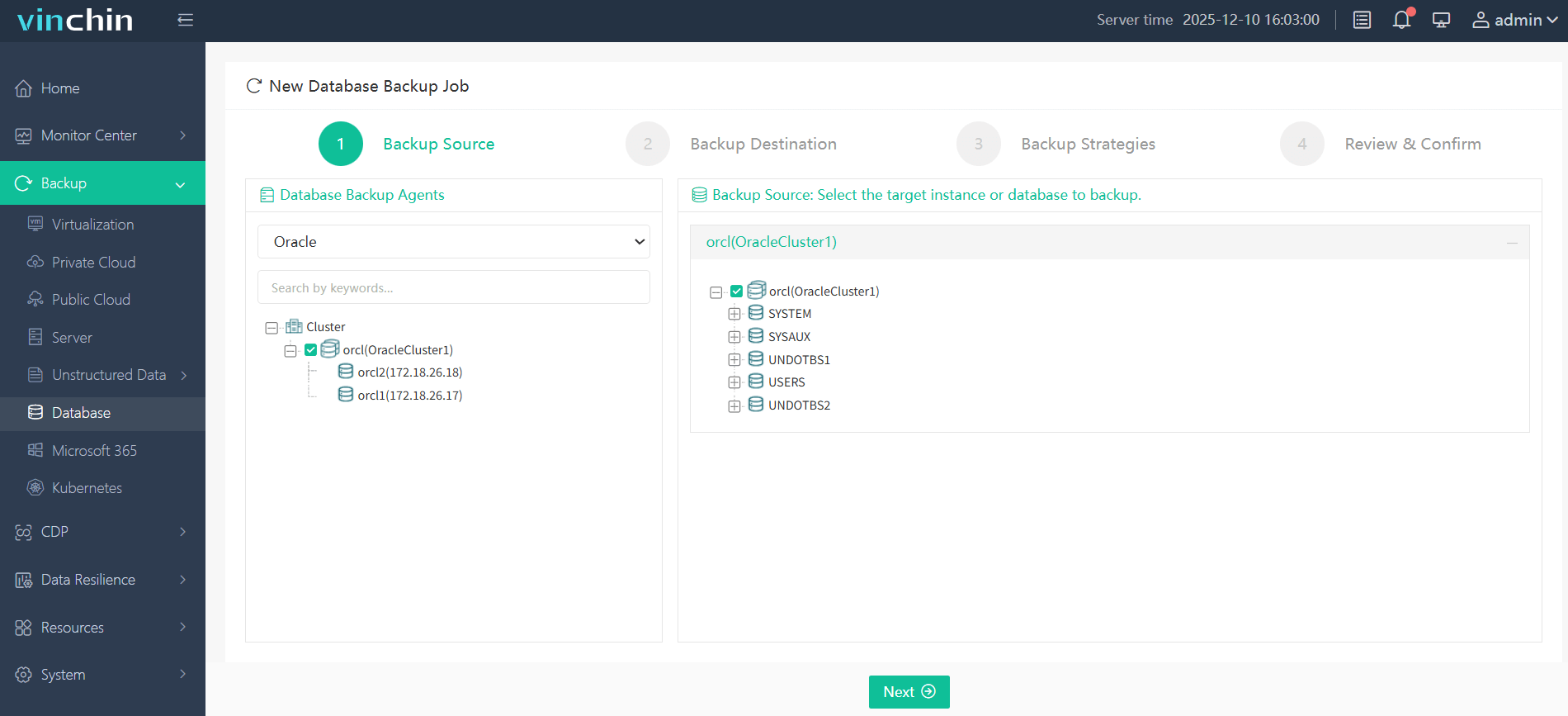
Step 1 – Select the Oracle database to back up;
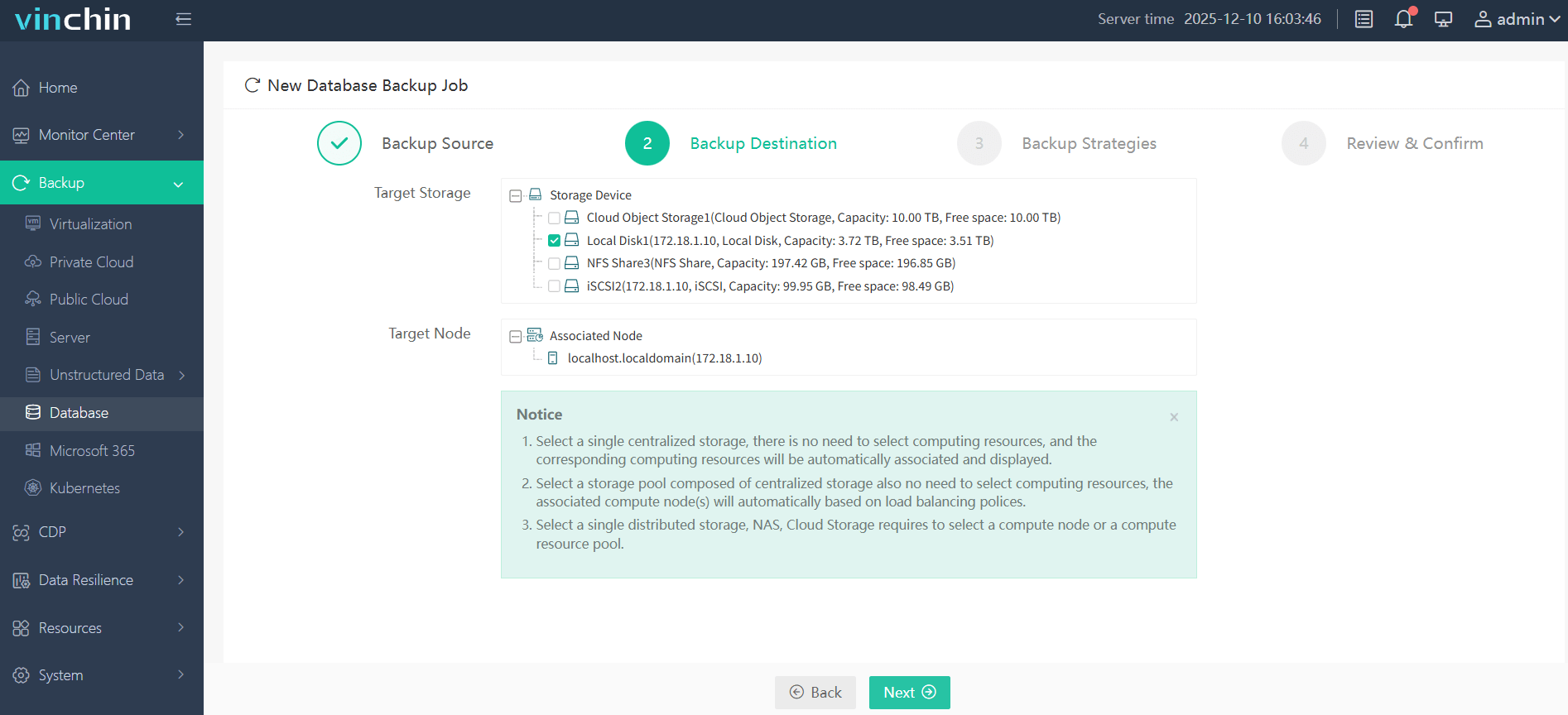
Step 2 – Choose backup storage;
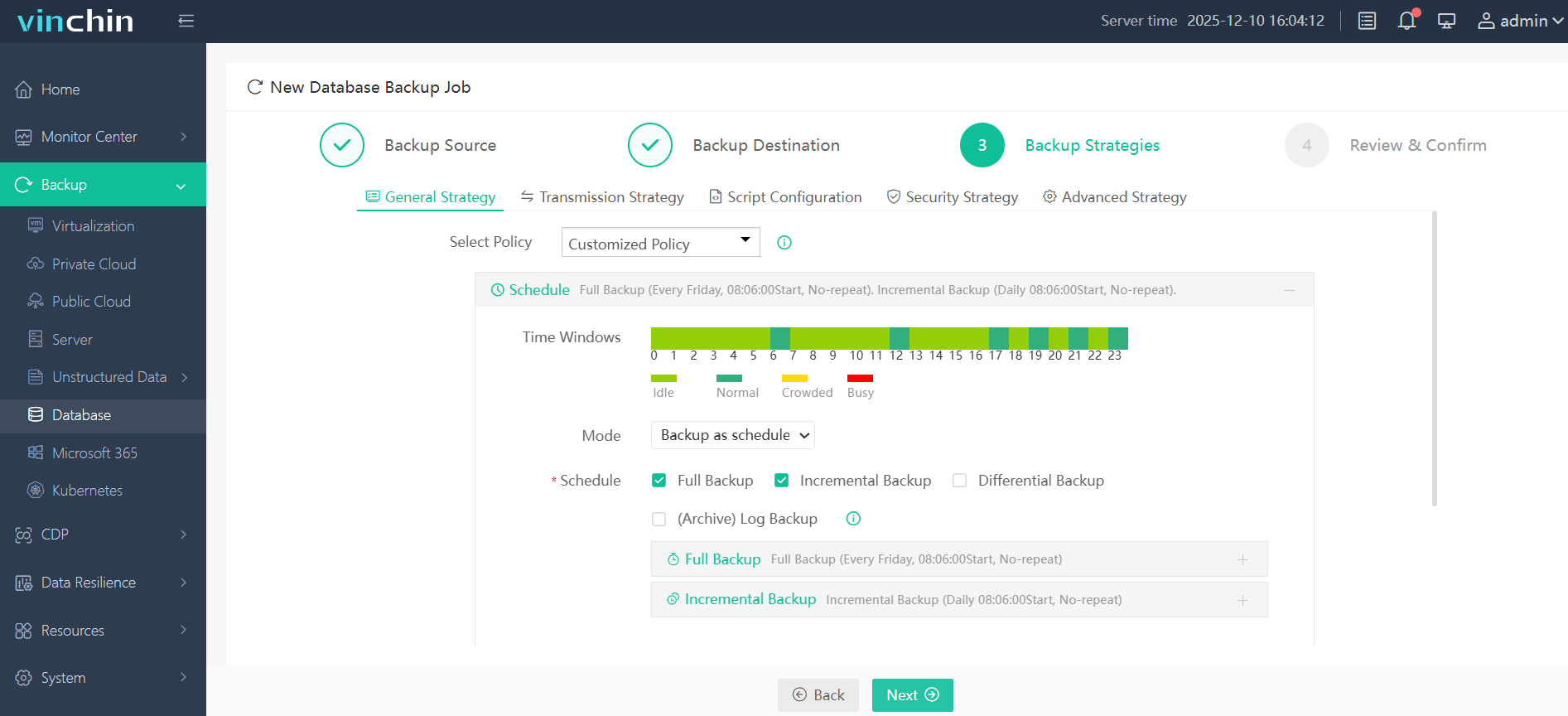
Step 3 – Define your preferred backup strategy;
Step 4 – Submit the job—all within minutes through a unified interface.
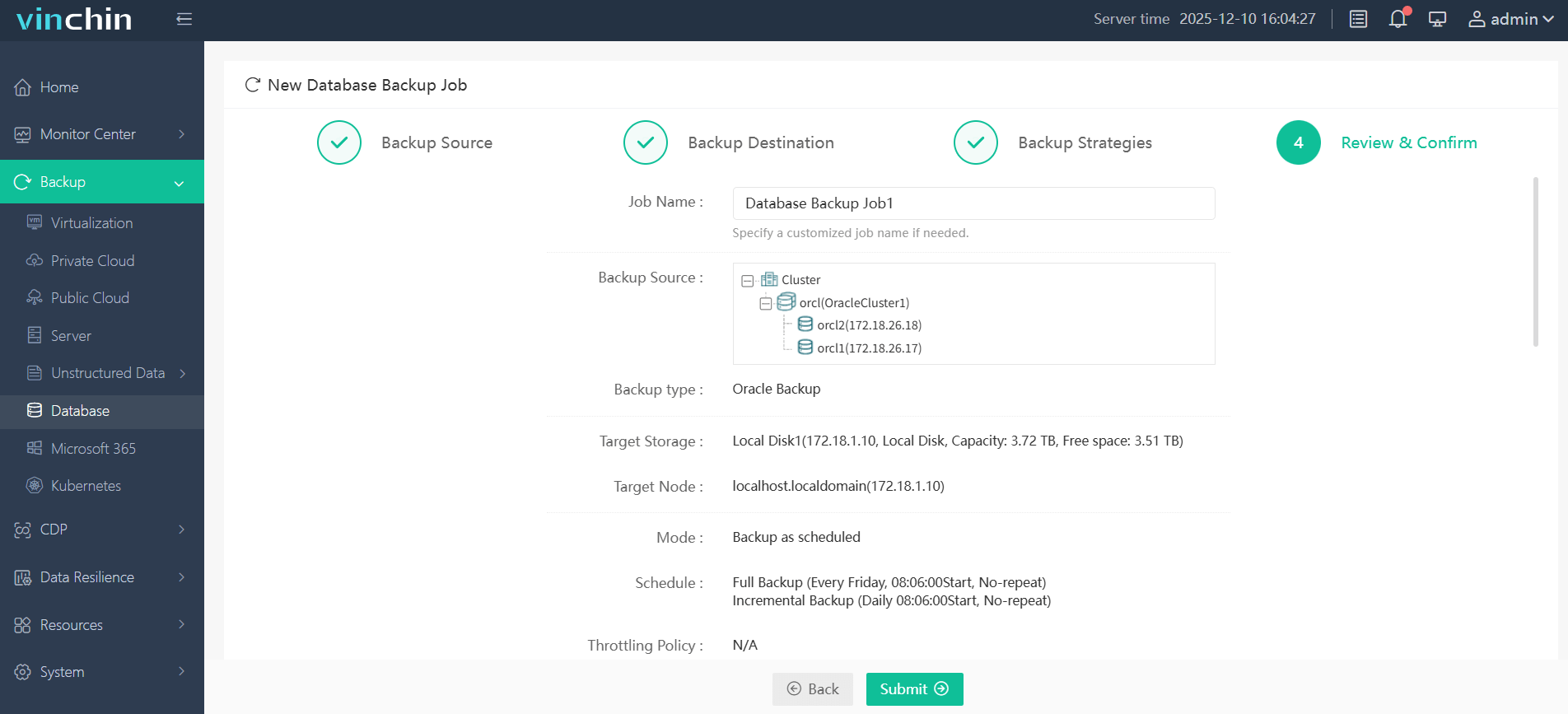
Recognized globally by enterprises large and small—with top ratings for reliability—you can experience every feature free for 60 days by clicking below and downloading Vinchin Backup & Recovery today!
Oracle RMAN Duplicate FAQs
Q1: Can I use oracle rman duplicate across different platforms?
A1: No—the source and destination must run on compatible operating systems with identical endianness.
Q2: What should I do if my duplicated database has invalid objects?
A2: Run $ORACLE_HOME/rdbms/admin/utlrp.sql as SYSDBA after duplication completes; this script recompiles invalid PL/SQL objects automatically.
Q3: How do I monitor progress during long-running duplications?
A3: Query v$session_longops view while duplication runs—or watch detailed progress directly within ongoing RMAN session output window itself .
Q4: What common errors occur during oracle rman duplicate operations?
A4: Frequent issues include ORA‑19505 ("file not found"), ORA‑17629 ("connection failed"),and ORA‑19870 ("archive log missing");check path conversions,passwords,and archive log availability respectively .
Q5 : Can I compress transferred data during active duplication?
A5: Yes —use compression-enabled channels within RUN block(e.g., ALLOCATE CHANNEL ch1 TYPE DISK FORMAT ... COMPRESSED )to reduce transfer size.
Conclusion
Oracle rman duplicate gives DBAs powerful options for fast reliable cloning—from live sources or existing backups—with built-in flexibility for complex environments. For even easier management consider Vinchin’s enterprise-grade solution. Download their free trial today!