Protecting your Oracle database is essential for any business that values its data. Data loss or corruption can strike without warning—hardware failure, human error, or software bugs can all put your information at risk. Manual backup processes are time-consuming and prone to mistakes. That’s why most DBAs turn to Oracle Recovery Manager (RMAN) scripts to automate backups. With RMAN backup scripts in Oracle, you reduce errors and save time while ensuring reliable recovery options.
This guide starts with the basics of RMAN scripting before moving into full and incremental backup strategies. We’ll then cover how to schedule these scripts for hands-off operation and finish with tips on validation and restoration—plus a look at how Vinchin makes Oracle database protection even easier.
What Is RMAN Backup Script in Oracle?
An RMAN backup script in Oracle is a set of commands—often stored as a .rman command file—that automates database backups using Recovery Manager (RMAN). These scripts may be called directly from the command line or wrapped inside shell scripts for further automation.
You can use an RMAN script to back up everything: datafiles, control files, archived logs—even parameter files like SPFILEs. By scripting these tasks instead of running them manually each time, you gain consistency across your backup routines while reducing manual effort.
A typical setup involves two parts:
This approach lets you automate complex workflows—including retention management—and easily document your disaster recovery plan.
Why Use RMAN Backup Script in Oracle?
Automating backups with an RMAN backup script in Oracle brings many benefits beyond saving time:
First, it reduces human error by removing repetitive manual steps from daily operations—a single typo during manual entry could compromise your entire backup set! Second, scheduled scripts run during off-peak hours so they don’t disrupt business activity or slow down production systems.
Third, scripted logic allows you to enforce retention policies automatically using commands like DELETE OBSOLETE, which removes outdated backups based on rules you define with CONFIGURE RETENTION POLICY. This keeps storage usage under control without constant oversight.
Fourth—and perhaps most important—scripts make documentation easy: every step is recorded for audits or troubleshooting later on. If disaster strikes or compliance questions arise, you have clear records showing exactly what was backed up when.
Finally, scripting enables repeatability across environments; once tested on one server or instance type, your process scales out smoothly as needs grow.
Method 1: Full RMAN Backup Script in Oracle
A full RMAN backup captures every datafile needed to restore your entire database—including control files and archived logs if desired. This forms the backbone of any robust recovery strategy because it provides a complete snapshot at a point in time.
Before running any script:
Set environment variables such as ORACLE_SID (your database identifier) and ORACLE_HOME (the path where Oracle is installed).
Make sure both your shell script (backup_rman.sh) and corresponding .rman command file exist.
Confirm there’s enough disk space available for new backups; lack of space is a common cause of failed jobs!
Here’s an example backup_level0.rman command file that performs an incremental level 0 backup—which acts as a full baseline for future incrementals:
RUN {
  ALLOCATE CHANNEL CH1 DEVICE TYPE DISK;
  ALLOCATE CHANNEL CH2 DEVICE TYPE DISK;
  BACKUP tag 'INCR0_DB' AS COMPRESSED BACKUPSET INCREMENTAL LEVEL 0 DATABASE PLUS ARCHIVELOG DELETE INPUT;
  BACKUP CURRENT CONTROLFILE TAG 'INCR0_CTL';
  BACKUP SPFILE TAG 'INCR0_SPFILE';
  RELEASE CHANNEL CH1;
  RELEASE CHANNEL CH2;
}
Why “incremental level 0” instead of just “full”? In RMAN terminology, an incremental level 0 includes all blocks—it’s functionally identical to a traditional full backup but serves as the base layer if you later want faster incremental (“level 1”) jobs.
If you prefer an even simpler non-incremental full backup—for example during initial setup—you could use:
BACKUP DATABASE PLUS ARCHIVELOG DELETE INPUT;
But most modern strategies rely on incremental levels for efficiency over time.
To automate this process safely:
Check that backup_level${level}.rman exists before calling it
Monitor exit codes after each major step
Log output for later review
Here’s an improved shell script (backup_rman.sh) that incorporates these checks:
#!/bin/bash
SCRIPT_DIR="$( cd "$( dirname "${BASH_SOURCE[0]}" )" &> /dev/null && pwd )"
ORATAB="/etc/oratab"

if [ $# -eq 0 ]; then
    echo "Usage: $0 -d ORACLE_SID -l BACKUP_LEVEL"
    exit 1
fi

DB_SID=""
LEVEL=""

while getopts ":d:l:" opt; do
    case $opt in
        d) DB_SID="$OPTARG" ;;
        l) LEVEL="$OPTARG" ;;
        \?) echo "Invalid option -$OPTARG" >&2; exit 1 ;;
    esac
done

if [ -z "$LEVEL" ]; then
    echo "Warning: Backup level not specified."
    exit 1
fi

perform_backup() {
    local sid=$1
    local level=$2
    local cmdfile="${SCRIPT_DIR}/backup_level${level}.rman"
    if [ ! -f "$cmdfile" ]; then
        echo "Command file $cmdfile does not exist!"
        exit 2
    fi

    LOG_FILE="${SCRIPT_DIR}/rman_backup_${sid}_L${level}_$(date '+%Y%m%d_%H%M%S').log"
    ORACLE_HOME=$(grep ^$sid: $ORATAB | cut -d: -f2)

    export ORACLE_HOME ORACLE_SID PATH=$PATH:$ORACLE_HOME/bin

    rman target / log=$LOG_FILE cmdfile=$cmdfile
    status=$?

    if [ $status -ne 0 ]; then
        echo "Backup failed with status $status"
        exit $status
    fi

}

if [ "$DB_SID" = "A" ]; then
   grep -v '^#' $ORATAB | grep -v '^\*' | cut -d: -f1 | while read sid; do
      if [ -n "$sid" ]; then perform_backup "$sid" "$LEVEL"; fi
   done
else
   if grep -q "^$DB_SID:" $ORATAB; then
      perform_backup "$DB_SID" "$LEVEL"
   else
      echo "The Oracle SID provided does not exist."
      exit 3
   fi
fi
To run a full baseline backup:
./backup_rman.sh -d {SID} -l 0This creates compressed sets tagged by date/time—making audits easy—and deletes input archive logs after successful capture to save disk space. Always check generated log files after each run for errors or warnings!
For advanced users: consider adding parameters like MAXPIECESIZE, custom FORMAT, or parallelism tuning within ALLOCATE CHANNEL statements depending on storage hardware.
Method 2: Incremental RMAN Backup Script in Oracle
Incremental backups are ideal when you need frequent protection but want to minimize resource usage—they only copy changed blocks since the last baseline (level 0) or previous incrementals (level 1).
The structure closely matches Method 1 but uses INCREMENTAL LEVEL 1. Here’s what goes into backup_level1.rman:
RUN {
 ALLOCATE CHANNEL CH1 DEVICE TYPE DISK;
 ALLOCATE CHANNEL CH2 DEVICE TYPE DISK;
 BACKUP tag 'INCR_L1_DB' AS COMPRESSED BACKUPSET INCREMENTAL LEVEL 1 DATABASE PLUS ARCHIVELOG DELETE INPUT;
 BACKUP CURRENT CONTROLFILE TAG 'INCR_L1_CTL';
 BACKUP SPFILE TAG 'INCR_L1_SPFILE';
 RELEASE CHANNEL CH1;
 RELEASE CHANNEL CH2;
}
Run this job by specifying level 1:
./backup_rman.sh -d {SID} -l 1Incremental jobs are typically scheduled daily—or even multiple times per day—in high-change environments because they’re fast yet comprehensive when combined with regular weekly baselines (“level 0”).
Want more speed? You can increase parallel channels or adjust compression settings within each channel allocation—but always test changes first on non-production systems!
Scheduling Backups Automatically
Automation ensures no critical window gets missed due to forgetfulness or staff turnover—a must-have feature for enterprise reliability!
On Linux servers:
For example,
# Full every Sunday at 2AM:
0 2 * * 0 /path/to/backup_rman.sh –d {SID} –l 0
# Incrementals Monday–Saturday at 2AM:
0 2 * * 1–6 /path/to/backup_rman.sh –d {SID} –l 1
When setting cron jobs:
Example crontab line sourcing profile:
SHELL=/bin/bash
BASH_ENV=/home/oracle/.bash_profile
...
Monitor log growth over time—rotate old logs regularly so they don’t fill up disk partitions unexpectedly! Many admins use tools like logrotate for this purpose.
Set up alerts via email/SMS through cron wrappers whenever non-zero exit codes occur—this helps catch silent failures early before they become disasters!
Restoring From Backup
Restoration procedures vary depending on what needs recovering—a single table versus an entire instance—but here’s a basic workflow using validated sets:
At the OS prompt,
export ORACLE_SID={YourSID}
rman target /
RMAN> SHUTDOWN IMMEDIATE;
RMAN> STARTUP MOUNT;
RMAN> RESTORE DATABASE;
RMAN> RECOVER DATABASE;
RMAN> ALTER DATABASE OPEN RESETLOGS;
Always test restores periodically against development clones—not just production—to ensure both skills and procedures stay sharp.
How Vinchin Backup & Recovery Simplifies Oracle Database Protection
Beyond traditional scripting methods, organizations seeking streamlined enterprise-level protection should consider Vinchin Backup & Recovery. As a professional solution supporting today’s mainstream databases—including Oracle, MySQL, SQL Server, MariaDB, PostgreSQL, PostgresPro, and TiDB—it delivers robust features tailored specifically for platforms like Oracle. For example, advanced source-side compression reduces storage needs; incremental backups optimize performance; batch database operations simplify large-scale management; multi-level data compression enhances efficiency; and flexible retention policies help meet compliance requirements—all contributing to safer and more manageable data protection workflows overall.
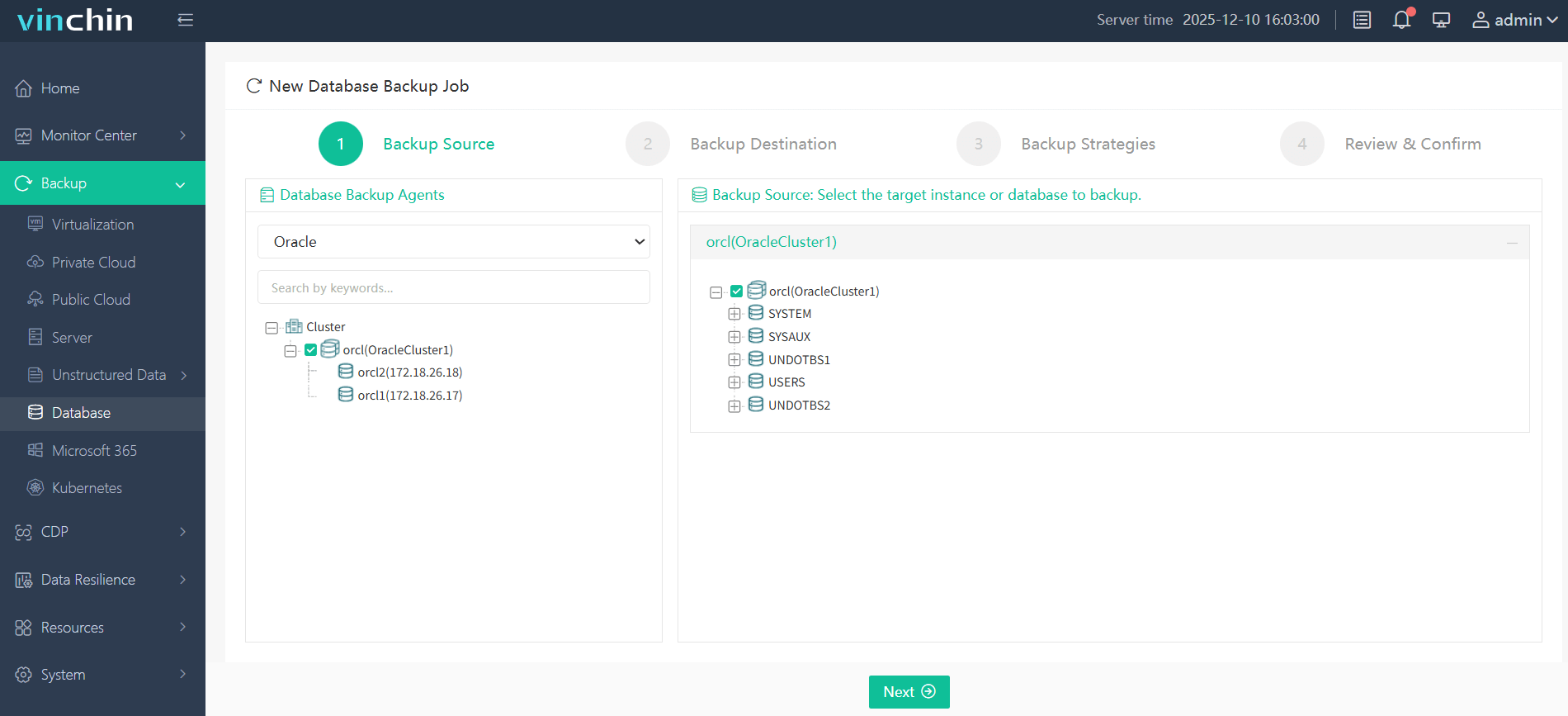
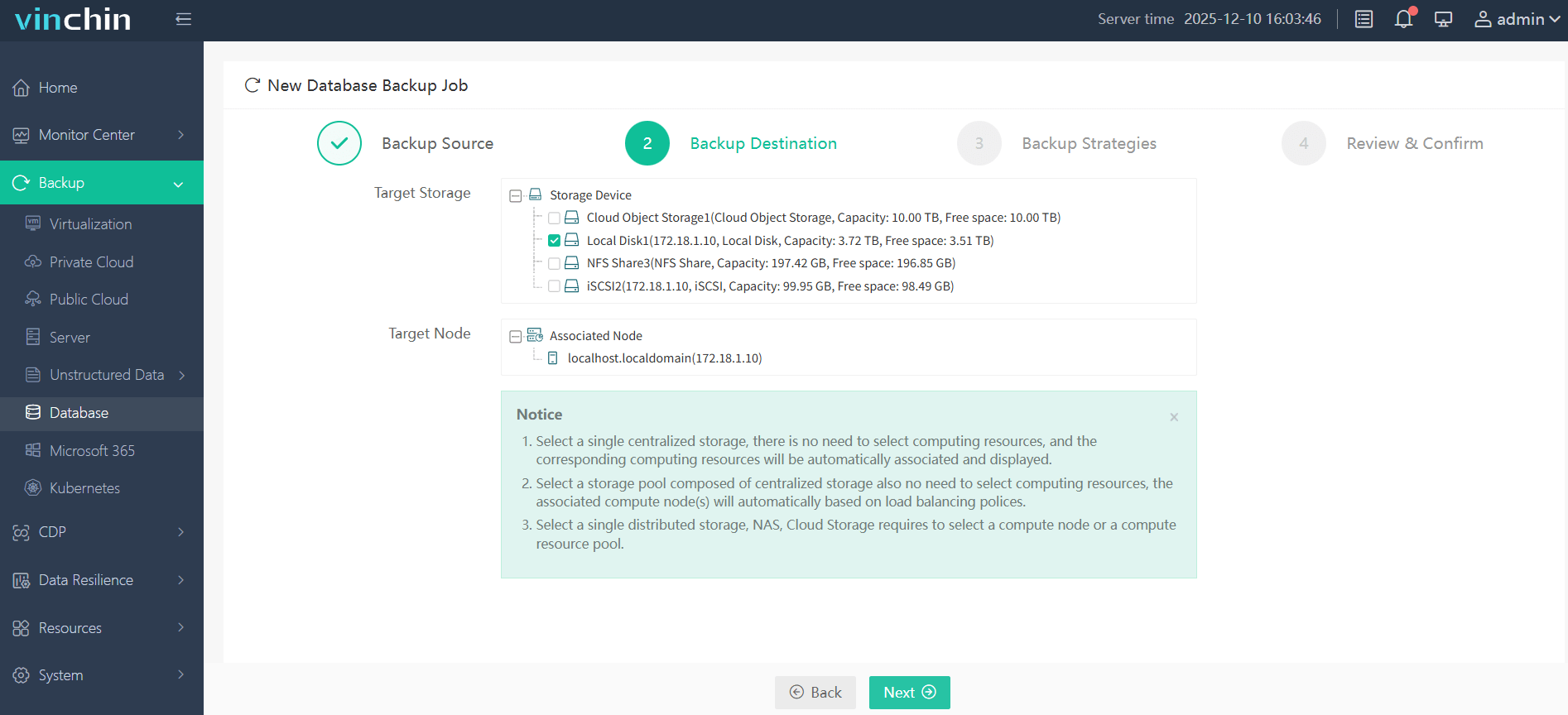
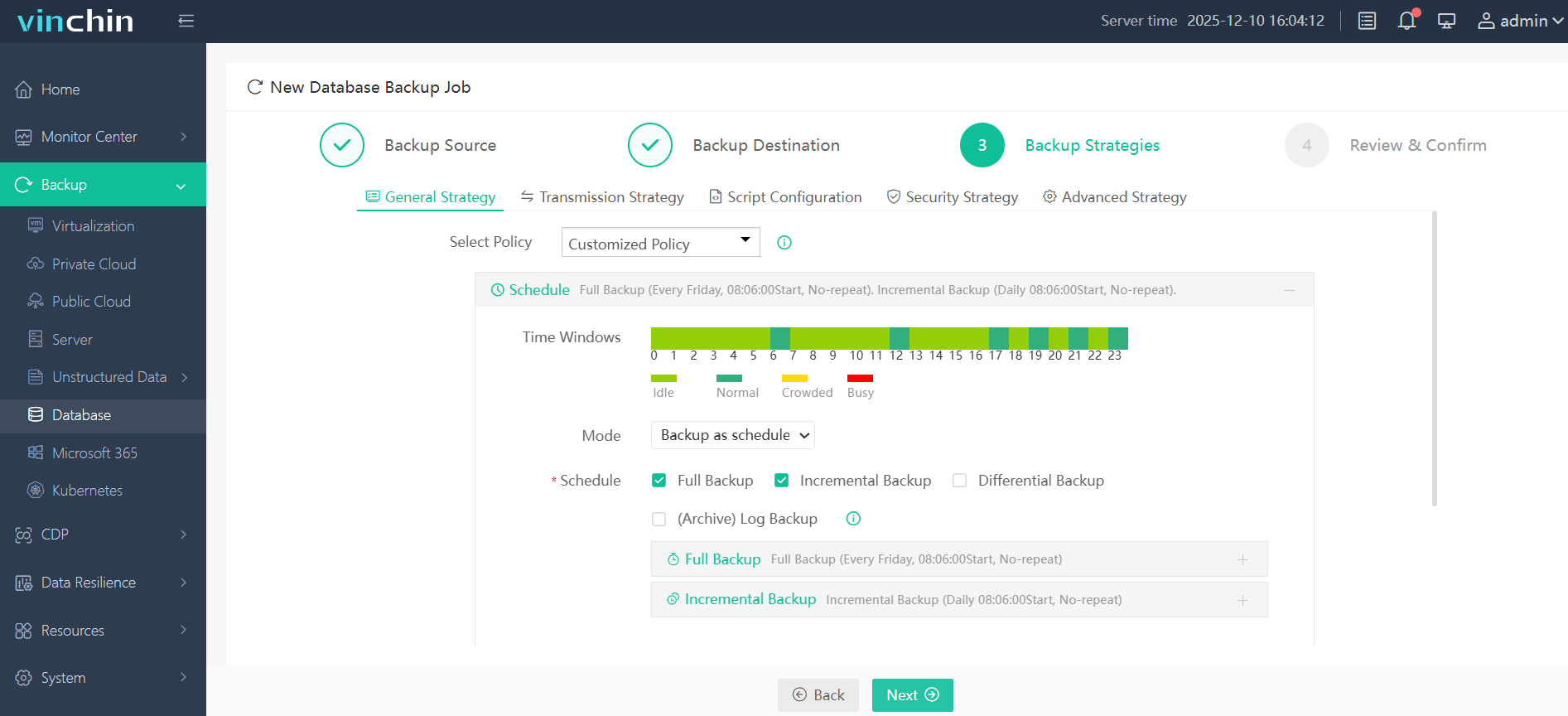
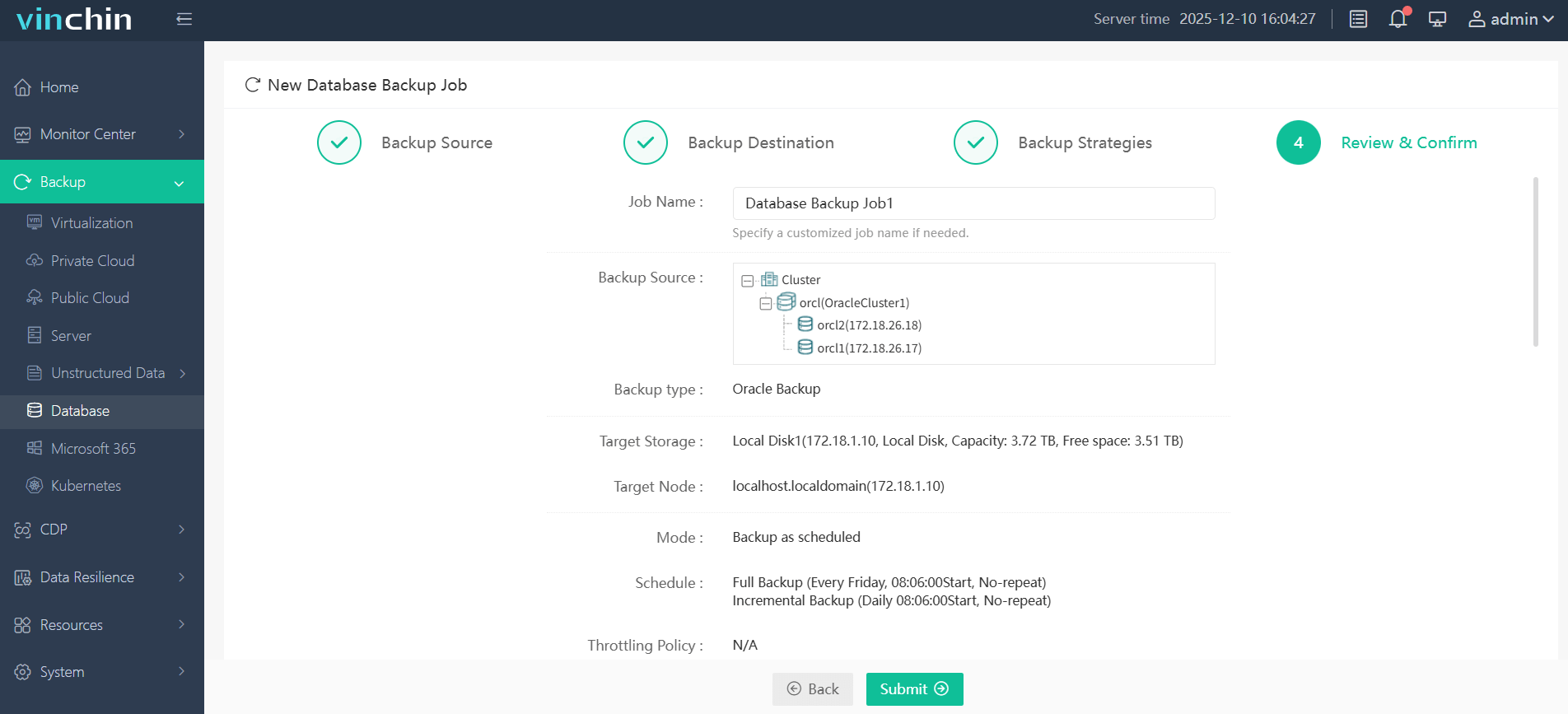
Vinchin Backup & Recovery offers an intuitive web console designed for simplicity. To back up your Oracle database takes just four steps:
Step1. Select the Oracle database to back up
Step2. Choose the backup storage
Step3. Define the backup strategy
Step4. Submit the job
Recognized globally by thousands of enterprises and rated highly by industry experts,Vinchin Backup & Recovery offers a fully featured free trial valid for sixty days. Click below to experience effortless enterprise-grade data protection firsthand.
RMAN Backup Script in Oracle FAQs
Q1: Can I schedule my RMAN scripts outside standard maintenance windows?
Yes; simply adjust crontab timing so jobs run during periods of low activity relevant to your business needs.
Q2: How do I monitor my automated backups remotely?
Configure email notifications within cron wrappers or use centralized monitoring tools that parse log outputs from each job run.
Q3: What should I do if my archive log destination fills up mid-backup?
Increase destination size temporarily; remove unneeded old logs after confirming recent ones were backed up successfully; rerun affected jobs promptly.
Conclusion
Automating backups with an RMAN backup script in Oracle keeps databases safe around-the-clock—with less manual work required from busy IT teams. Full and incremental strategies ensure you can recover quickly from almost any failure. For an even more streamlined experience, Vinchin offers enterprise-grade protection with just a few clicks. Try it now to see how simple secure data management can be!