When you back up or restore an Oracle database with RMAN (Recovery Manager), you want control over how data moves between your database and storage. The rman allocate channel disk command is central to this process. It lets you manage backup speed, resource use, and where your backups go. But what does it really do? Why should you care about channels? In this guide, we’ll walk through everything from basic concepts to advanced techniques—so you can get the most out of your Oracle backups.
What Is RMAN Allocate Channel Disk?
The rman allocate channel disk command tells RMAN to create a dedicated server process—a channel—that connects RMAN to your Oracle database using disk as the storage device. Each channel handles backup or restore work by reading data files or writing backup pieces directly to local disks or directories.
Channels are not just connections; they are active server sessions that perform physical input/output (I/O) tasks during backup or recovery jobs. You can allocate one or more channels at once, giving each its own destination path if needed.
When you use allocate channel with device type disk, you instruct RMAN to use local disk storage instead of other options like tape devices (SBT_TAPE). This command must run inside a RUN block in your RMAN script.
It’s important to know that manually allocated channels inside a RUN block always take priority over any automatic channels configured earlier—they override those settings for that job only.
If you skip manual allocation, RMAN uses automatic channel allocation based on your persistent configuration settings.
Why Use Allocate Channel Disk in RMAN?
Allocating channels to disk gives you direct control over how RMAN performs backup and restore operations—and helps optimize both performance and reliability.
By specifying channels yourself:
You can increase backup speed by running several channels in parallel.
You decide exactly where each backup file goes—spreading them across different disks or directories balances I/O load.
You set limits on backup piece size or bandwidth per channel.
You customize file naming formats for easier management later on.
For example: If your server has four fast disks available for backups, allocating four separate channels—each targeting a different directory—lets all disks work at once. This reduces bottlenecks and shortens total backup time.
Parallelism isn’t just about speed; it also helps control resource consumption by limiting how many concurrent processes run during heavy jobs. Directing specific channels to different filesystems prevents one volume from becoming overloaded—a common cause of slowdowns during large backups.
Manual allocation also makes troubleshooting easier: If something fails on one path but not another, unique FORMAT paths help pinpoint which stream had trouble.
Method 1: Manual Channel Allocation Example
Manual channel allocation gives you maximum flexibility when controlling how RMAN works with disk storage during backups or restores. Here’s how it works:
First, decide how many channels fit your hardware setup—a good starting point is matching the number of physical disks used for backups (or CPU cores), but never exceed what your system can handle without testing first.
Suppose you want two separate disk channels writing backups into different directories:
RUN {
  ALLOCATE CHANNEL ch_disk01 DEVICE TYPE DISK FORMAT '/disk1/backup/%U';
  ALLOCATE CHANNEL ch_disk02 DEVICE TYPE DISK FORMAT '/disk2/backup/%U';
  BACKUP DATABASE;
}
Here’s what happens:
Each ALLOCATE CHANNEL line creates a named server session (ch_disk01, ch_disk02) that writes files using the specified FORMAT path.
The %U variable ensures every file name is unique.
At the end of the RUN block, all manually allocated channels release automatically—you don’t need explicit RELEASE commands unless scripting complex workflows.
You can further fine-tune each channel’s behavior using options like MAXPIECESIZE (to limit individual file size) or RATE (to throttle write speed):
RUN {
  ALLOCATE CHANNEL ch_fast_ssd DEVICE TYPE DISK MAXPIECESIZE 100M RATE 5M FORMAT '/ssd_backup/%U';
  ALLOCATE CHANNEL ch_slow_hdd DEVICE TYPE DISK MAXPIECESIZE 50M RATE 1M FORMAT '/hdd_backup/%U';
  BACKUP DATABASE;
}
Use MAXPIECESIZE if your filesystem has size limits—or if copying files offsite later requires smaller chunks. Use RATE if production workloads share storage with backups; throttling avoids saturating shared resources during business hours.
Remember: Manually allocated channels always override automatic ones within their RUN block scope—giving you full control when needed most.
Method 2: Automatic Channel Allocation Example
If manual setup feels too complex for daily jobs—or if consistency matters more than customization—you can let RMAN handle channel allocation automatically using persistent configuration commands.
To configure automatic parallelism for disk-based jobs:
CONFIGURE DEVICE TYPE DISK PARALLELISM 2;
CONFIGURE CHANNEL DEVICE TYPE DISK FORMAT '/backup/%U';
This tells RMAN:
Now when you run:
BACKUP DATABASE;
RMAN allocates two default-named channels (ORA_DISK_1, ORA_DISK_2) behind the scenes—no need for a RUN block unless overriding defaults temporarily.
You can check current settings anytime:
SHOW DEVICE TYPE;
SHOW CHANNEL;
Want to reset everything back to factory defaults?
CONFIGURE DEVICE TYPE DISK CLEAR;
CONFIGURE CHANNEL DEVICE TYPE DISK CLEAR;
Automatic allocation is ideal for routine scheduled jobs where simplicity matters most—and where consistent results reduce risk of human error over time. For single-job overrides without changing global config, specify parallelism directly in a RUN block like this:
RUN {
   BACKUP DATABASE PARALLELISM 4;
}
This temporarily increases concurrency just for that job—handy when catching up after missed runs or handling unusually large data volumes without changing baseline policies.
How to Back Up Oracle Database with Vinchin Backup & Recovery?
For organizations seeking streamlined protection beyond native tools, Vinchin Backup & Recovery delivers enterprise-level database backup tailored for today’s leading platforms—including Oracle, MySQL, SQL Server, MariaDB, PostgreSQL, PostgresPro, and TiDB—with robust support specifically designed around Oracle environments. Key features such as batch database backup, multiple level data compression, GFS retention policy, recovery verification via SQL scripts, and WORM protection empower administrators to automate processes efficiently while ensuring compliance and rapid recoverability across diverse scenarios—all through a unified solution built for scalability and security needs alike.
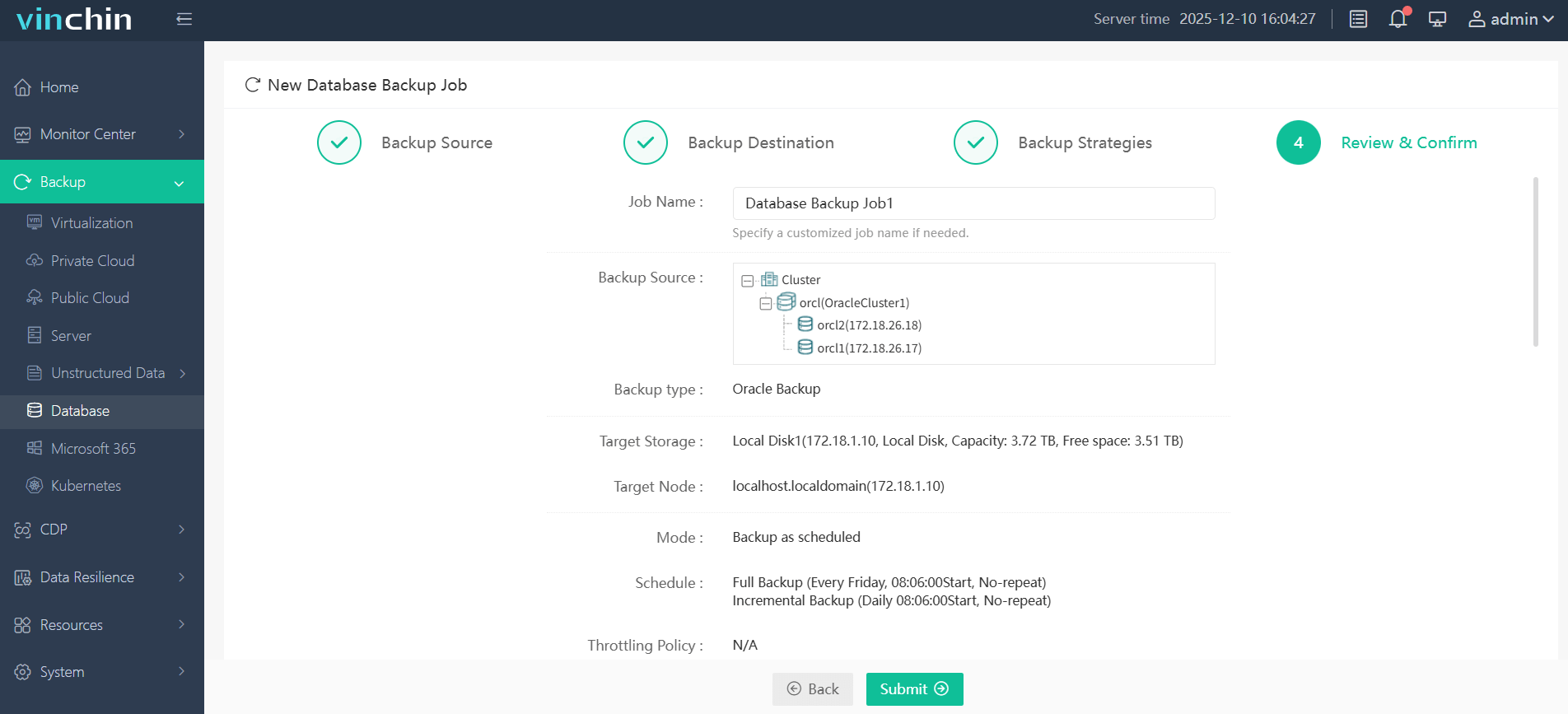
The intuitive web console makes safeguarding Oracle databases straightforward:
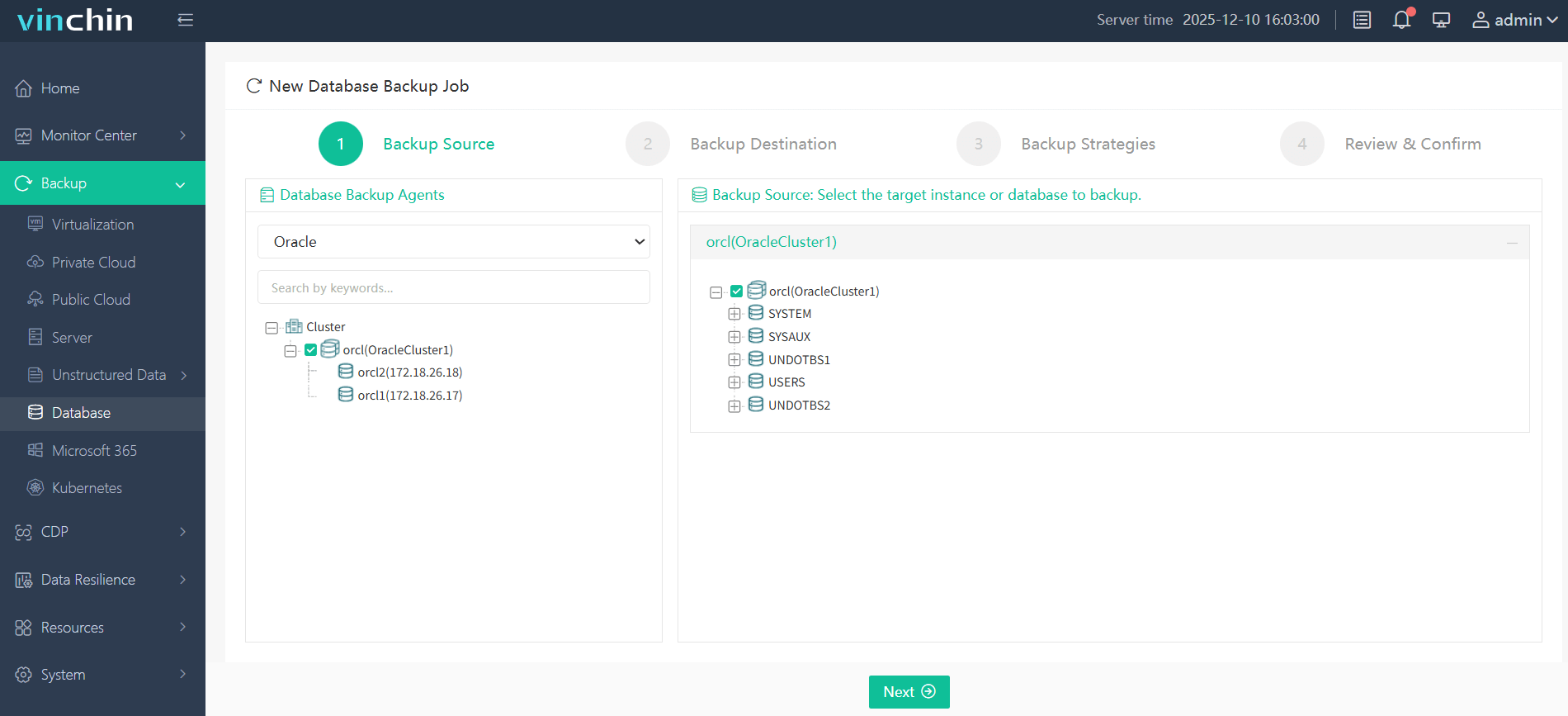
Step 1. Select the Oracle database to back up
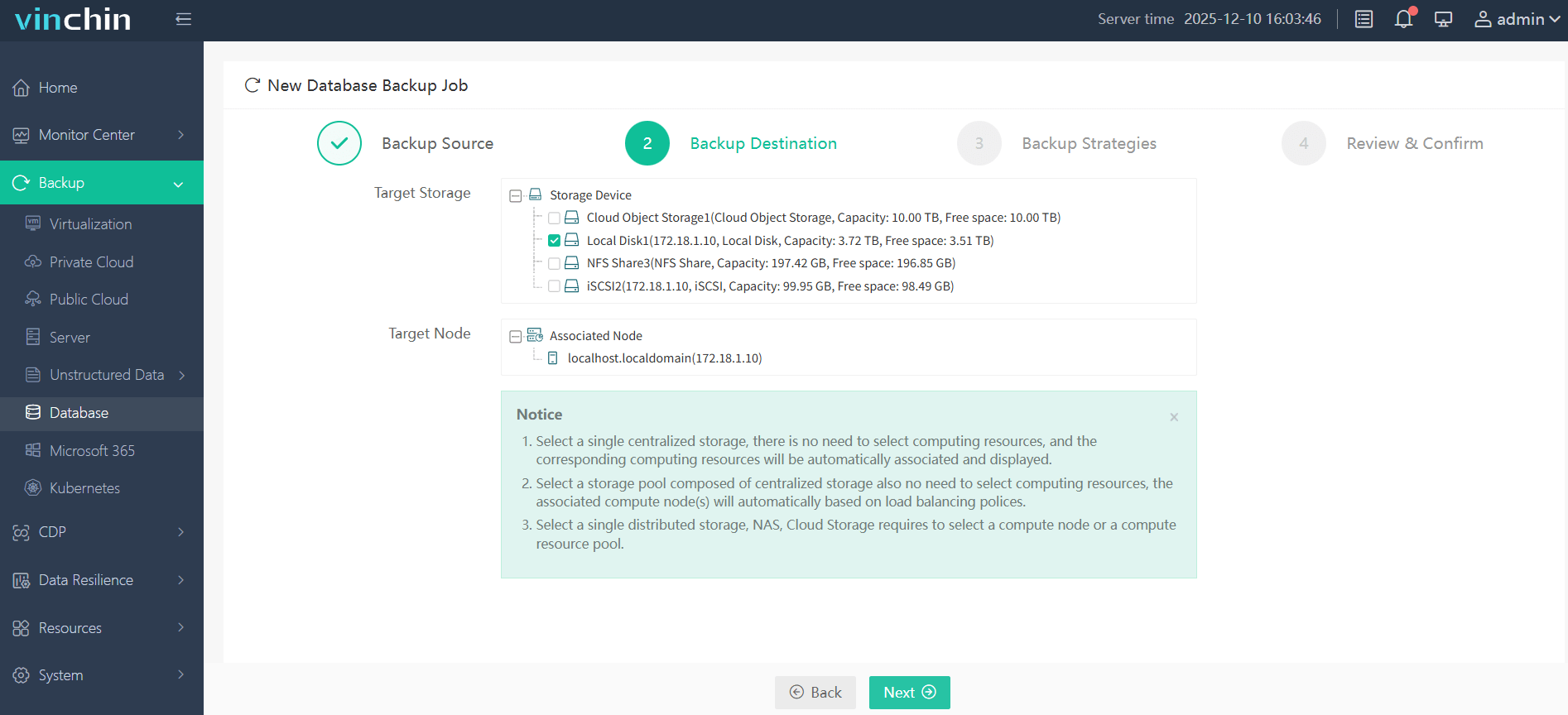
Step 2. Choose the backup storage
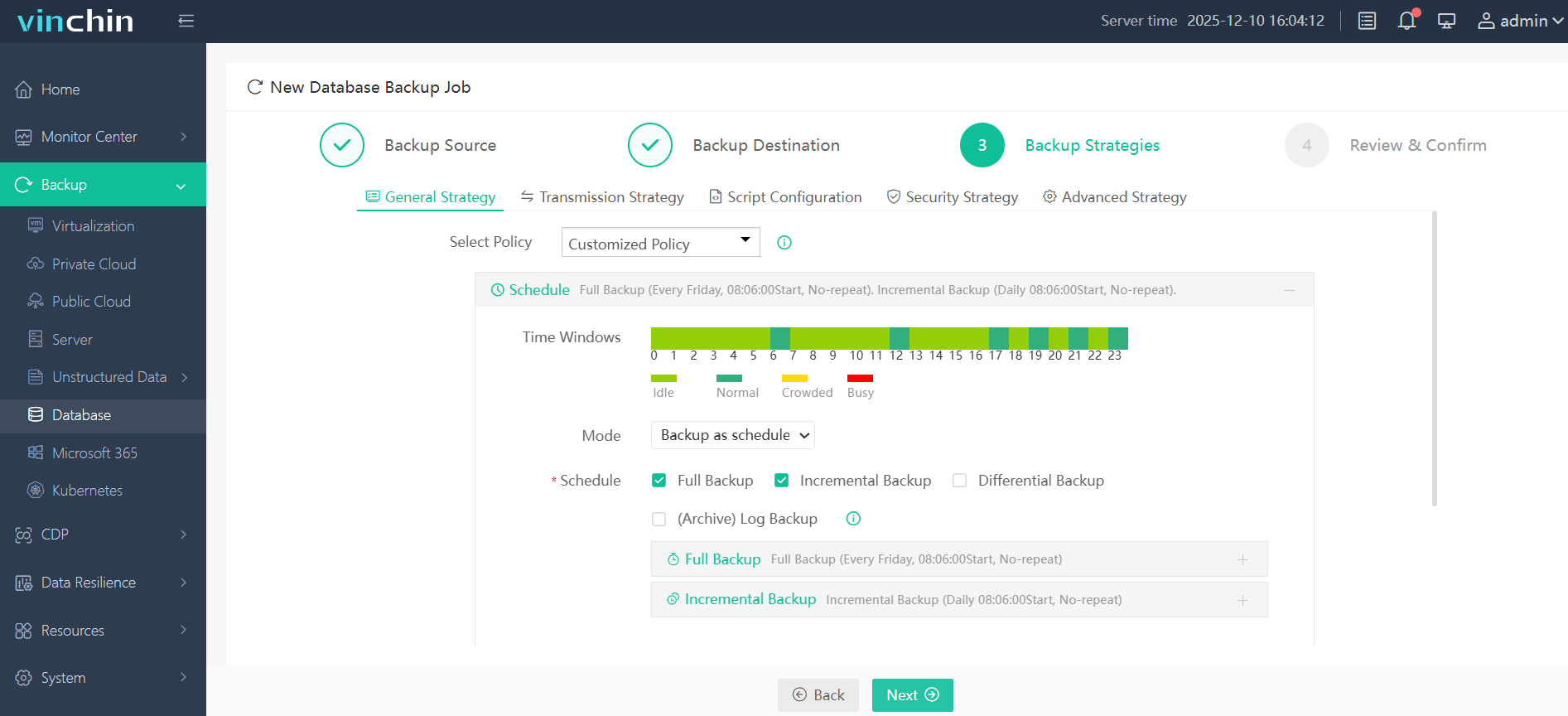
Step 3. Define the backup strategy
Step 4. Submit the job
Recognized globally among enterprise users—with high ratings and widespread adoption—Vinchin Backup & Recovery offers a fully featured free trial valid for sixty days; click below now to experience comprehensive data protection firsthand!
RMAN Allocate Channel Disk FAQs
Q1: Can I change rman allocate channel disk settings mid-backup if my system slows down?
No; once started each job keeps its initial configuration until finished—you must stop then restart with new settings if changes are needed midstream.
Q2: How do I troubleshoot “channel ORA_DISK_1 terminated” errors during automated runs?
Check OS logs first; then review free space at target location; finally inspect permissions on destination folders before rerunning job from scratch if needed.
Q3: Can rman allocate channel disk be used alongside tape devices in hybrid strategies?
Yes—as long as each ALLOCATE CHANNEL specifies its own device type (DISK vs SBT_TAPE); mixed-device strategies require careful planning but offer flexible disaster recovery options.
Conclusion
Mastering rman allocate channel disk puts powerful tools in every DBA’s hands—from boosting performance through smart parallelism choices to fine-tuning reliability under pressure. Whether customizing scripts yourself or relying on automation day-to-day—the right approach means safer data every time backups run smoothly! For streamlined protection across platforms—including Oracle—consider trying Vinchin’s robust solution today.