In the realm of Oracle database administration, ensuring data integrity and recoverability is paramount. The Oracle RMAN backup command stands as a cornerstone tool for achieving this, offering robust mechanisms to safeguard critical data against loss, corruption, or disaster. Recovery Manager (RMAN) is Oracle's built-in utility designed specifically for backup, restore, and recovery operations, providing a more efficient and integrated alternative to traditional user-managed backups. By leveraging the oracle rman backup command, database administrators (DBAs) can automate complex tasks, minimize downtime, and comply with stringent data protection standards.
RMAN integrates seamlessly with Oracle's architecture, allowing backups without interrupting normal operations in many cases. It supports various backup types, from full database snapshots to incremental changes, and can target specific components like tablespaces or archivelogs. This guide delves into the essentials of the oracle rman backup command, exploring its functionalities, and practical examples.
What Is Oracle Recovery Manager?
Oracle Recovery Manager, commonly abbreviated as RMAN, is a powerful command-line and graphical tool provided by Oracle Corporation for managing database backups and recoveries. Introduced in Oracle 8, RMAN has evolved into a sophisticated utility that interacts directly with the Oracle server, bypassing the need for operating system-level file manipulations. At its core, the oracle rman backup command is executed within the RMAN environment to create, manage, and validate backups.
RMAN operates as a client that connects to the target database, where it issues commands to perform operations. It can use a recovery catalog—a separate schema in another database—to store metadata about backups, or it can rely on the control file of the target database for this information. This flexibility makes RMAN suitable for both small-scale and enterprise-level deployments. Unlike traditional methods that require manual scripting, RMAN automates many aspects, such as tracking backup sets and optimizing storage.
Key to RMAN's functionality is its ability to perform block-level backups, ensuring only changed data is captured in incremental scenarios. This efficiency reduces backup windows and storage requirements. RMAN also supports integration with third-party media managers for tape storage and cloud providers, extending its utility beyond disk-based backups. In essence, Oracle Recovery Manager is the go-to tool for any DBA looking to streamline backup processes using the oracle rman backup command.
How Oracle RMAN Works
Understanding how Oracle RMAN works begins with its architecture. RMAN connects to the target database via a session, often using the SYSDBA privilege. Once connected, you enter the RMAN prompt and issue commands like the oracle rman backup command. RMAN communicates with the database server processes to read data blocks directly, creating backup pieces that are stored on disk or tape.
Channels are a fundamental concept in RMAN operations. A channel represents a server session that performs the actual I/O operations. By default, RMAN allocates one channel, but you can configure multiple for parallelism, speeding up backups on multi-CPU systems. For instance, the command "ALLOCATE CHANNEL c1 TYPE DISK;" sets up a disk channel before running a backup.
RMAN maintains metadata about backups in the control file or a recovery catalog. This includes details like backup timestamps, locations, and statuses. During a backup, RMAN scans the database files, applies any necessary multiplexing (combining multiple files into one backup set), and writes the output. It also supports encryption, compression, and validation to ensure data integrity.
In recovery scenarios, RMAN uses this metadata to automate restores, applying redo logs as needed. Overall, RMAN's workflow—from connection to execution—ensures reliable, efficient operations tailored to Oracle's ecosystem.
Consistent vs. Inconsistent Backups
Backups in Oracle can be classified as consistent or inconsistent, each with implications for recovery. A consistent backup requires the database to be shut down cleanly using commands like SHUTDOWN NORMAL or SHUTDOWN IMMEDIATE. This ensures all data files are synchronized, with no uncommitted transactions or pending redo. Once mounted (but not opened), you can issue the oracle rman backup command to create a backup that can be restored without media recovery, though you'll lose post-backup changes.
In contrast, inconsistent backups are taken while the database is open and active, in ARCHIVELOG mode. These capture the database in a "fuzzy" state, where some transactions might be incomplete. To make them usable, media recovery is necessary, applying archived redo logs to roll forward changes. The advantage is zero downtime for backups, making them ideal for 24/7 environments.
Choosing between them depends on your recovery point objective (RPO). Consistent backups are simpler for point-in-time recovery to the backup moment, while inconsistent ones offer flexibility with minimal impact on operations.
Full vs. Incremental Backups
Full backups, as the name suggests, capture the entire database or specified components at a given time. Using the oracle rman backup command like "BACKUP DATABASE;", RMAN creates a complete copy, including all data files, control files, and optionally archivelogs. These are baseline backups, essential for establishing a recovery foundation, but they can be time- and space-intensive for large databases.
Incremental backups, on the other hand, only back up changes since the last backup. They come in levels: Level 0 is equivalent to a full backup, serving as the base for subsequent increments. Level 1 captures blocks changed since the last Level 0 or 1. For example, "BACKUP INCREMENTAL LEVEL 1 DATABASE;" efficiently reduces backup size and time. Cumulative increments back up all changes since the last Level 0, while differential ones since the last increment of any level.
Incrementals shine in reducing storage needs and speeding up daily operations, but recovery might require applying multiple sets. A hybrid strategy—full weekly, incremental daily—balances completeness and efficiency.
Benefits of Oracle RMAN
The oracle rman backup command offers numerous benefits that make RMAN a preferred choice over manual methods. First, it provides block-level corruption detection during backups, ensuring data integrity without extra steps. Automation features, like configurable retention policies and automatic channel allocation, simplify management.
RMAN's integration with Oracle features, such as Flash Recovery Area (FRA), optimizes space usage by automatically purging obsolete backups. It supports compression and encryption natively, reducing storage costs and enhancing security. Parallelism improves performance on large systems, and its catalog tracks backups across multiple databases.
Moreover, RMAN minimizes downtime with online backups and fast incremental options. It's extensible with scripts and integrates with tools like Oracle Enterprise Manager for GUI-based operations. Overall, these advantages lead to reliable, scalable data protection.
Disadvantages of Oracle RMAN
Despite its strengths, RMAN has drawbacks. The learning curve is steep for beginners, requiring familiarity with its syntax and concepts like channels and catalogs. Misconfigurations can lead to failed backups or excessive resource use.
Dependency on the control file or catalog means corruption there could complicate recovery. RMAN backups are not human-readable, unlike OS copies, making manual inspection challenging. It also consumes more CPU for features like compression.
In small environments, the overhead of setting up RMAN might outweigh benefits compared to simple scripts. Integration with non-Oracle media managers can be complex and costly. While powerful, RMAN demands careful planning to avoid these pitfalls.
Most Common RMAN Backup Commands
The oracle rman backup command forms the backbone of RMAN operations, with a syntax that allows flexibility in specifying what to back up and how. Basic structure: "BACKUP [options] [object];". Options include tags for identification, device types (DISK or SBT for tape), and duration limits. Common objects are DATABASE, TABLESPACE, DATAFILE, ARCHIVELOG, and more.
RMAN commands can be scripted for automation, run in batches, or integrated into cron jobs. Validation commands like "BACKUP VALIDATE;" check for issues without creating backups. Below, we explore common backup types with examples.
Full Backup (FULL / DATABASE)
A full database backup captures all data files, making it a complete snapshot. It's ideal for baselines or migrations. Use it when starting a new backup strategy or after major changes.
Example:
RMAN> BACKUP DATABASE;
This creates a backup set on the default device, typically disk. Add tags for easy reference: "BACKUP DATABASE TAG 'weekly_full';".
Backup with Archivelogs
Including archivelogs ensures recoverability to any point after the backup. This is crucial for inconsistent backups in ARCHIVELOG mode.
Example:
RMAN> BACKUP DATABASE PLUS ARCHIVELOG;
This backs up the database and all archivelogs not yet backed up, then deletes input if specified. It's perfect for daily routines to minimize data loss.
Incremental Backups (LEVEL 0 / LEVEL 1)
Incremental backups save time by capturing only changes. Level 0 is the starting point.
Example for Level 0:
RMAN> BACKUP INCREMENTAL LEVEL 0 DATABASE;
For Level 1:
RMAN> BACKUP INCREMENTAL LEVEL 1 DATABASE;
Use Level 1 after a Level 0 for daily changes; cumulative with "CUMULATIVE" for all since Level 0.
Backup Sets vs. Copies (AS BACKUPSET / AS COPY)
Backup sets multiplex files into pieces, optimizing storage but requiring RMAN for restore. Copies are exact file duplicates.
Example for set:
RMAN> BACKUP AS BACKUPSET DATABASE;
For copy:
RMAN> BACKUP AS COPY DATABASE;
Sets are compact and support compression; copies are faster to restore but use more space.
Archivelog Backups
Archivelogs are essential for recovery; back them up separately for space management.
Example:
RMAN> BACKUP ARCHIVELOG ALL;
Or delete after: "BACKUP ARCHIVELOG ALL DELETE INPUT;".
Tablespace Backups
Target specific tablespaces for partial backups, useful in large databases.
Example:
RMAN> BACKUP TABLESPACE users;
Include control file: "BACKUP TABLESPACE users INCLUDE CURRENT CONTROLFILE;".
Datafile Backups
Back up individual data files for targeted protection.
Example:
RMAN> BACKUP DATAFILE 1;
Or by path: "BACKUP DATAFILE '/path/to/datafile.dbf';".
Control File and SPFILE Backups
Control files and SPFILE are critical; enable autobackup or manual.
Example for control file:
RMAN> BACKUP CURRENT CONTROLFILE;
For SPFILE:
RMAN> BACKUP SPFILE;
Compressed Backups
Compression reduces size, using algorithms like ZLIB.
Example:
RMAN> BACKUP AS COMPRESSED BACKUPSET DATABASE;
Configure default: "CONFIGURE COMPRESSION ALGORITHM 'ZLIB';".
Safely Backing Up Oracle Database with Vinchin
With replication in place, backups remain essential. Replication handles availability but not all failures. You still need regular, consistent backups. Vinchin Backup & Recovery is a professional, enterprise-level database backup solution that supports most mainstream databases—Oracle, MySQL, SQL Server, MariaDB, PostgreSQL, and PostgresPro.
It offers many capabilities; key highlights include cloud backup and tape archiving, full and incremental backups with archived log support for Oracle, scheduled backup with data compression and deduplication, restore to a new server with point-in-time recovery, and ransomware protection, among other features. For Oracle specifically, it adds Oracle compression, block change tracking support, skipping accessible files, and skipping offline files to optimize backup jobs.
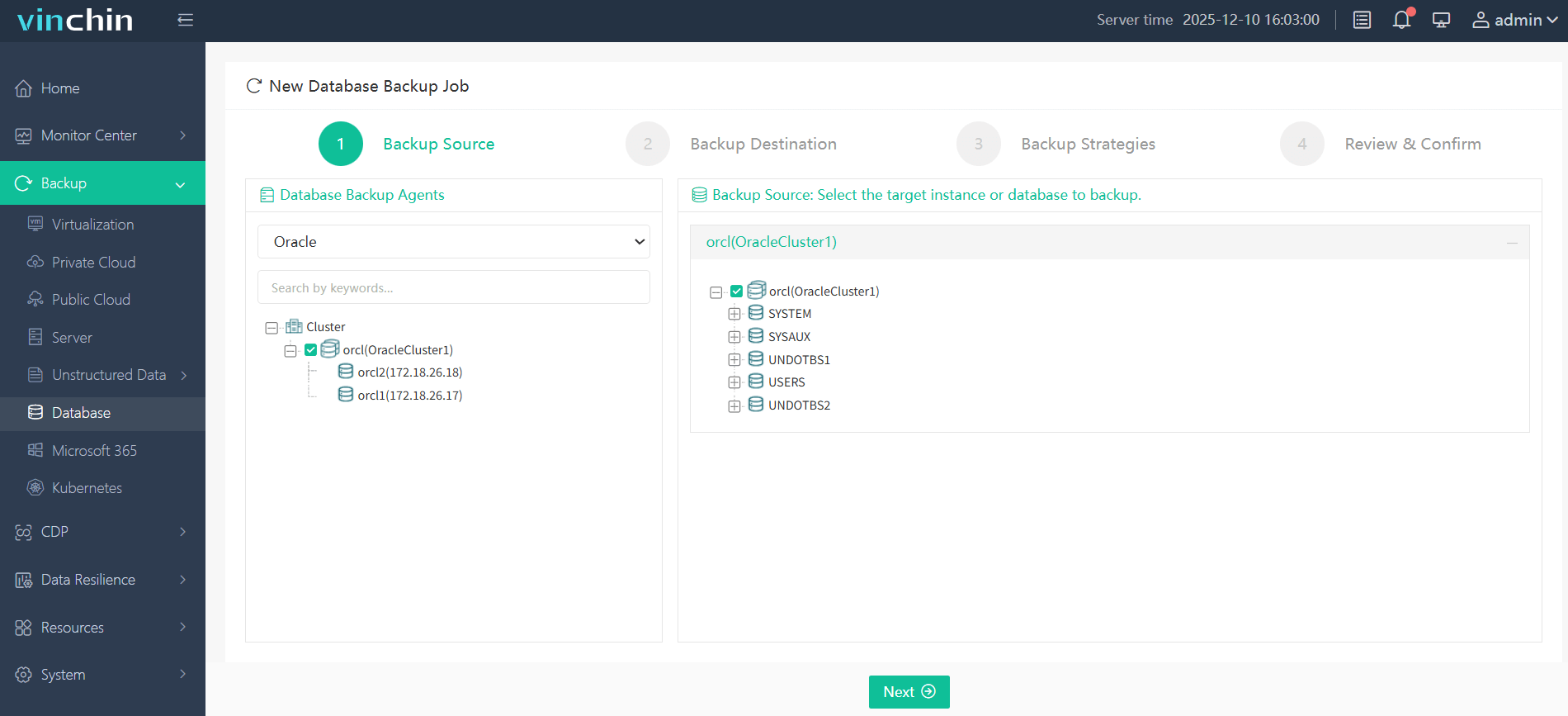
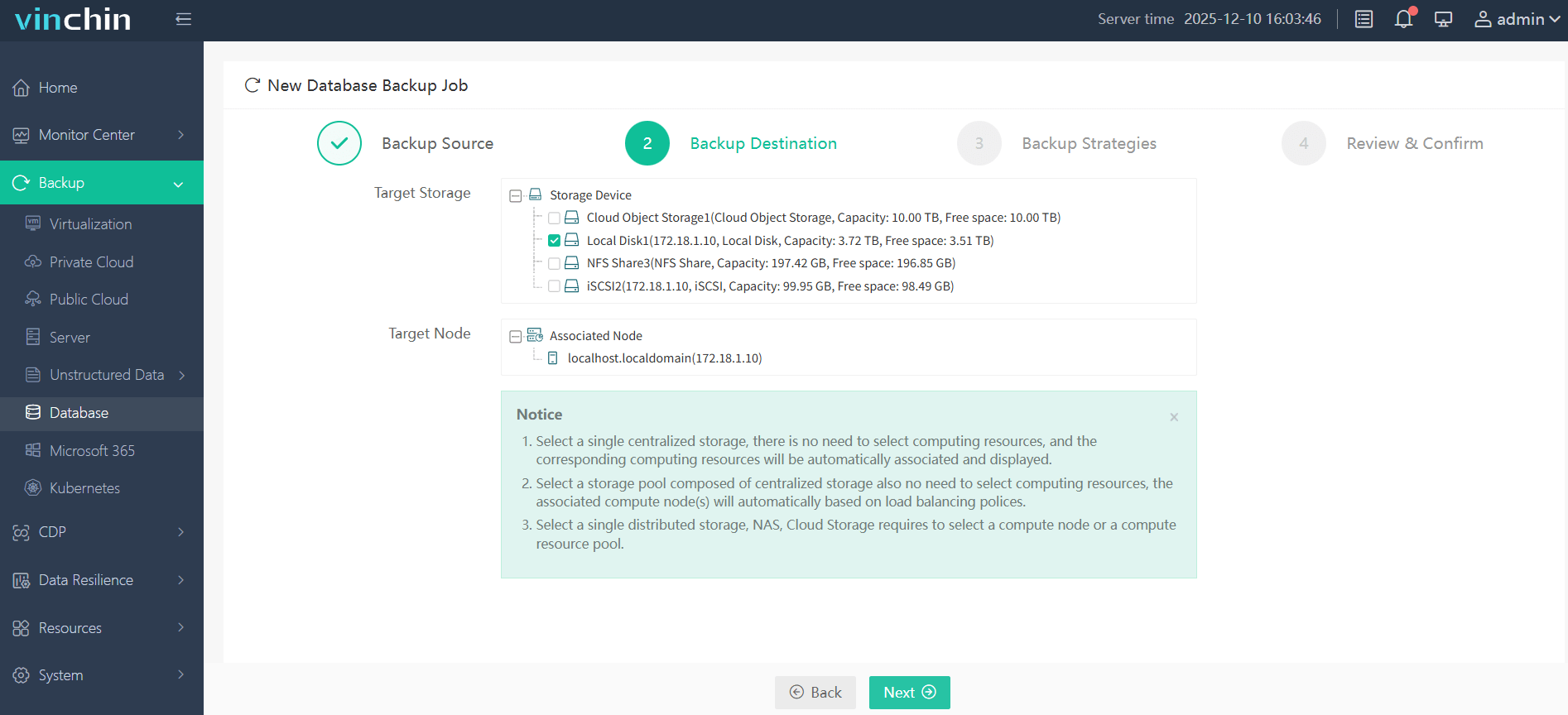
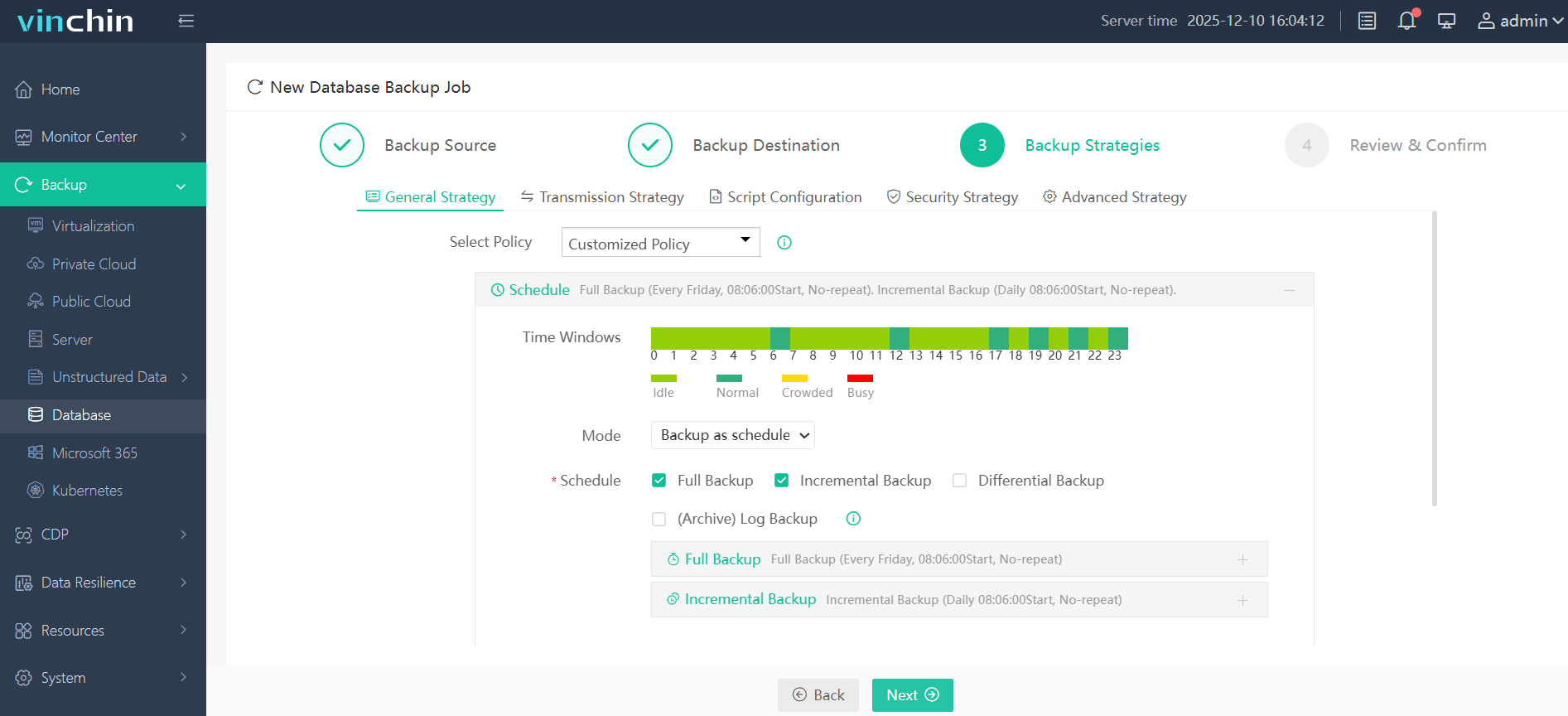
The Vinchin web console is simple and intuitive. Backing up Oracle involves four clear steps:
1. Select the database to back up,
2. Choose the backup storage,
3. Define the backup strategy,
4. Submit the job.
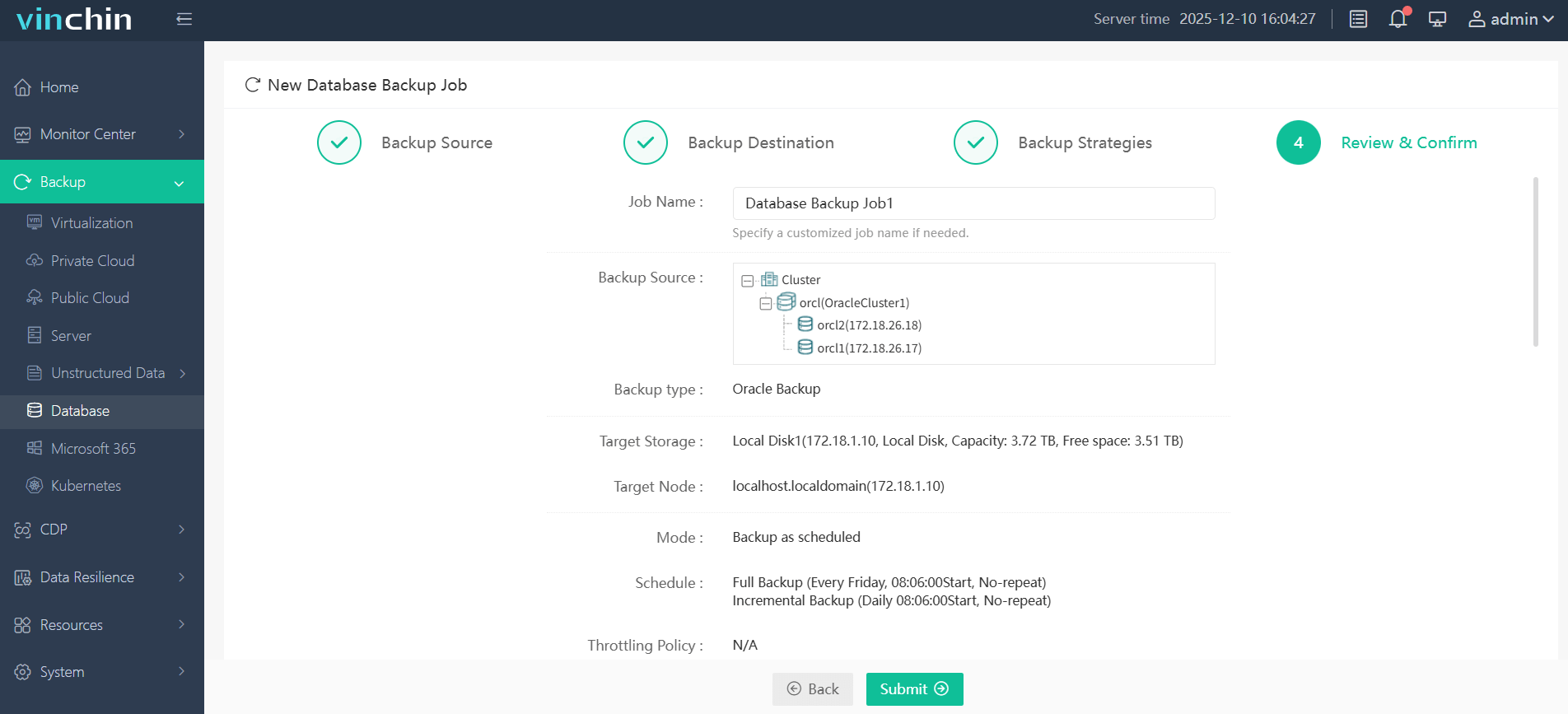
The interface guides you with clear labels and prompts. You can monitor job progress, view logs, and adjust schedules in the console without complex commands.
With a global customer base and high product ratings, Vinchin offers a 60-day full-featured free trial—click the button to download the installer and deploy easily.
Oracle RMAN Backup Command FAQs
Q1: How do I start using the oracle rman backup command?
A: Connect via "rman target /" for local, or with credentials for remote. Then issue commands like "BACKUP DATABASE;". Ensure the database is in ARCHIVELOG mode for online backups.
Q2: What if my backup fails due to errors?
A: Check logs for ORA errors. Use "LIST BACKUP;" to verify, or "BACKUP VALIDATE;" preemptively. Common issues include insufficient space or channel failures.
Q3: Can RMAN back up to cloud storage?
A: Yes, via SBT channels with cloud media managers like Oracle Cloud Infrastructure.
Q4: How to schedule RMAN backups?
A: Use OS schedulers like cron with RMAN scripts (.rcv files) containing the oracle rman backup command.
Q5: What's the difference between backup sets and image copies?
A: Sets are RMAN-specific, multiplexed files; copies are OS-level duplicates usable without RMAN.
Conclusion
Mastering the oracle rman backup command empowers DBAs to protect Oracle databases effectively. From full and incremental backups to advanced features like compression and tagging, RMAN offers a comprehensive toolkit. While it has a learning curve, its benefits in efficiency and reliability far outweigh the disadvantages. Implement regular testing of restores to ensure your strategy works when needed. Stay updated with Oracle's evolving features for optimal performance.