Tracking your Oracle database backups is vital for every operations administrator. Without clear visibility into what backups exist or when they were created, you risk data loss or failed restores during emergencies. Oracle Recovery Manager (RMAN) offers robust commands that let you list and review all backup activity in detail. This article will guide you through using the LIST BACKUP command in RMAN—from basic usage to advanced filtering—so you can audit your backup landscape confidently and troubleshoot common issues along the way.
What Is Oracle RMAN List Backup?
The LIST BACKUP command in Oracle RMAN displays information about all backups stored in your RMAN repository. This repository may reside in the control file of your target database or within a separate recovery catalog database. The command helps you view backup sets, image copies, proxy copies, archived redo logs, control files, server parameter files (SPFILEs), and more.
You can filter output by file type, date range, tag name, device type (disk or tape), or other attributes depending on your needs. Understanding these details is essential for monitoring backup health and planning reliable restores.
When reviewing output from LIST BACKUP, pay close attention to these columns:
BS Key: Unique identifier for each backup set
Type: Full or Incremental
LV: Backup level (0 = full; 1 = incremental; A = archived log)
Size: Size of the backup
Device Type: DISK or SBT (tape)
Completion Time: When the backup finished
Tag: User-defined or system-generated label
Status (S): 'A' means Available; 'X' means Expired; 'U' means Unavailable
These fields help you quickly assess which backups are valid and ready for restore operations.
How to Use the Basic List Backup Command in Oracle RMAN?
To start listing backups with RMAN:
First connect to your target database using OS authentication:
rman target /
This connects you directly if you're running as an authorized user on the server.
At the RMAN prompt:
LIST BACKUP;
This command shows all known backup sets and proxy copies—including datafiles, archived redo logs, control files, and SPFILEs—along with their status codes.
For a quick overview across many records:
LIST BACKUP SUMMARY;
This summary gives one line per backup set so you can scan large histories easily.
Want details about specific objects? Try these commands at the prompt:
LIST BACKUP OF DATABASE;
Shows all database-level backups.
LIST BACKUP OF DATAFILE 4;
Displays only backups of datafile number 4.
LIST BACKUP OF ARCHIVELOG ALL;
Lists all archived redo log backups tracked by RMAN.
LIST BACKUP OF CONTROLFILE;
Shows only control file backups.
LIST BACKUP OF SPFILE;
Displays only SPFILE backups.
Each result includes key metadata such as completion time and availability status so you know exactly what’s protected—and what isn’t—at any moment.
If you're connected to a recovery catalog instead of just a control file repository, you'll see longer retention histories because catalogs store metadata beyond what's kept by default in control files (CONTROL_FILE_RECORD_KEEP_TIME). The same commands work regardless of repository type but may show different results based on available history.
How to List Backups by File Type in Oracle RMAN?
Sometimes it's helpful to group your view by file type—datafiles versus logs versus configuration files—to verify coverage across critical assets. The BY FILE option makes this easy:
At the prompt:
LIST BACKUP BY FILE;
This organizes output into sections like:
List of Datafile Backups:
File BS Key Type LV S Completion Time      #Pieces #Copies Compressed Tag
---- ------ ---- -- - ------------------- ------- ------- ---------- ----------
1    12     B    F  A 2023-11-01 14:00:00   1       1      YES        WEEKLY_FULL
2    13     B    F  A 2023-11-02 03:15:22   1       1      NO         DAILY_INC
...
List of Archived Log Backups:
Thrd Seq BS Key S Completion Time      #Pieces Tag
---- --- ------ - ------------------- ------- ----------
1    101   14   A 2023-11-01 16:10:45   1     LOG_BACKUP
...
Control File Backups appear under their own heading with similar columns showing checkpoint SCN/time and tag info. SPFILEs are listed separately too so nothing gets overlooked during audits or disaster recovery planning.
You can also focus further using object-specific commands such as:
LIST BACKUP OF TABLESPACE USERS;
or list image copies directly:
LIST DATAFILECOPY ALL;
Need just control file copies?
LIST COPY OF CONTROLFILE;
Grouping this way helps ensure every important part of your environment has recent protection—and lets you spot gaps before they become problems.
Using Advanced Filters with LIST BACKUP
As environments grow larger—or compliance requirements get stricter—you often need more precise ways to sift through hundreds or thousands of records quickly. That’s where advanced filters come into play within LIST BACKUP.
For example:
To find all backups created after a certain date:
LIST BACKUP COMPLETED AFTER 'SYSDATE-7';
This lists everything completed within the last seven days—a common audit request after patch cycles or major changes.
Looking for tape-based (SBT) media only?
LIST BACKUP DEVICE TYPE SBT_TAPE;
Want just disk-based sets?
LIST BACKUP DEVICE TYPE DISK;
Filter by tag name if you've labeled jobs for easier tracking:
LIST BACKUP TAG = 'WEEKLY_FULL';
Combine filters for even finer targeting—for instance,
to see only full database disk-based sets from last week:
LIST BACKUP OF DATABASE COMPLETED AFTER 'SYSDATE-7' DEVICE TYPE DISK LEVEL=0;
Or use explicit dates/times with TO_DATE function when timezone ambiguity matters:
LIST BACKUP COMPLETED AFTER "TO_DATE('2023-11-01 14:00:00', 'YYYY-MM-DD HH24:MI:SS')";These options make it possible to answer questions like “Which tapes do I need offsite?” or “What was our most recent full backup before last weekend’s incident?” without wading through irrelevant entries.
Simplify Oracle Database Protection with Vinchin Backup & Recovery
Beyond manual management with native tools like RMAN, organizations seeking streamlined enterprise-grade protection should consider Vinchin Backup & Recovery. As a professional solution supporting leading platforms—including Oracle, MySQL, SQL Server, MariaDB, PostgreSQL, PostgresPro, and TiDB—it delivers broad compatibility across modern environments.
For Oracle users specifically, Vinchin Backup & Recovery enables batch database backup, supports incremental strategies, multiple levels of data compression, data retention policy management, and cloud/tape archiving—all designed to automate routine tasks while ensuring fast recoveries and regulatory compliance. Its intuitive web console makes safeguarding your databases straightforward—in four steps:
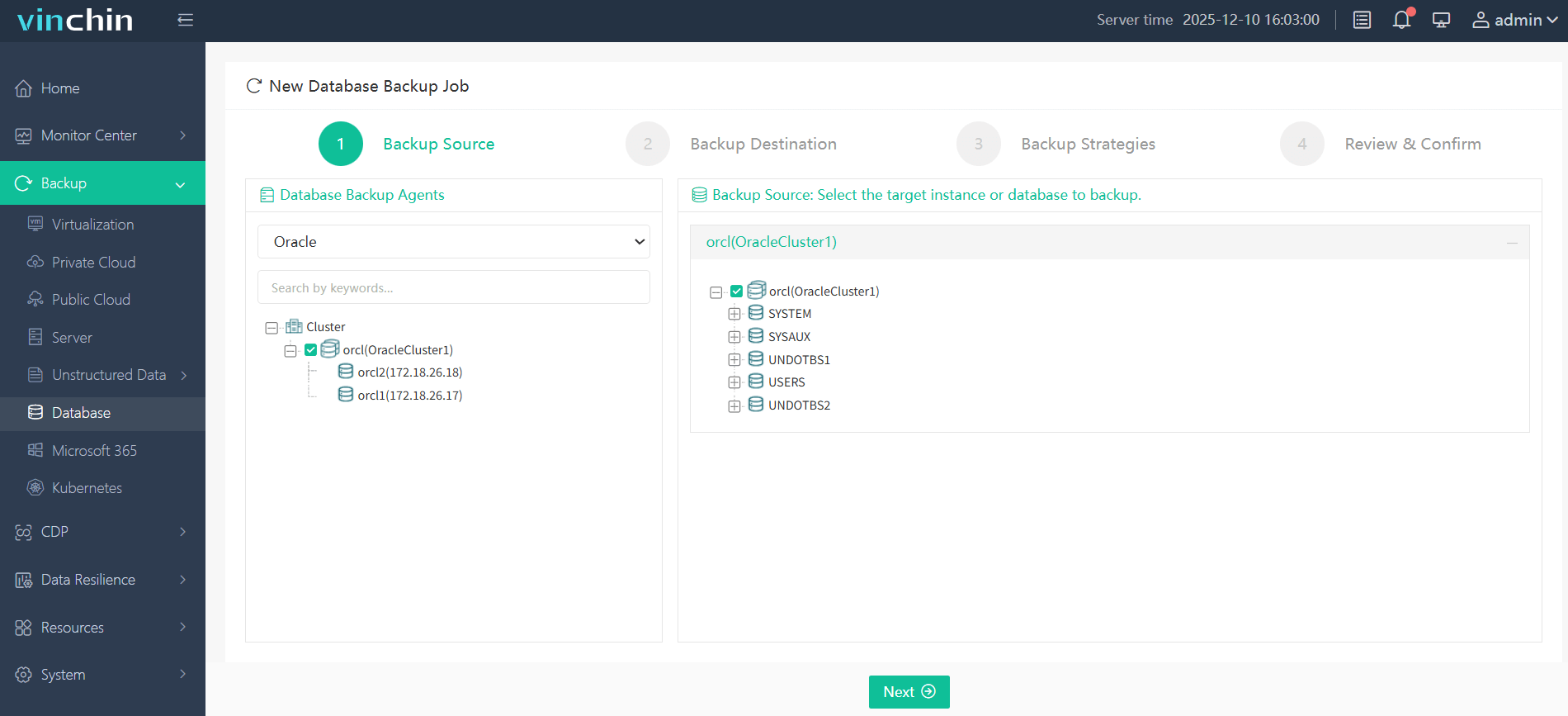
Step 1. Select the Oracle database to back up;
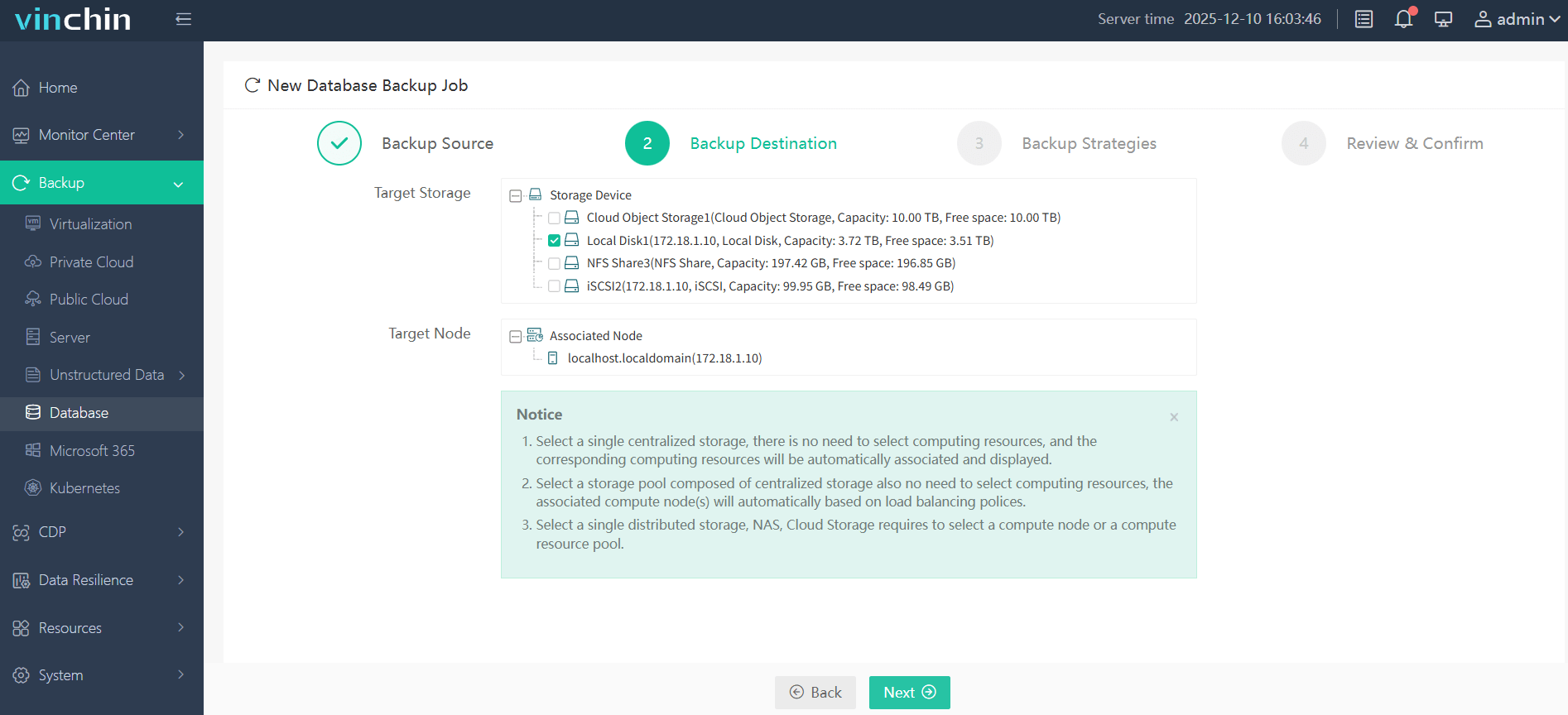
Step 2. Choose the backup storage;
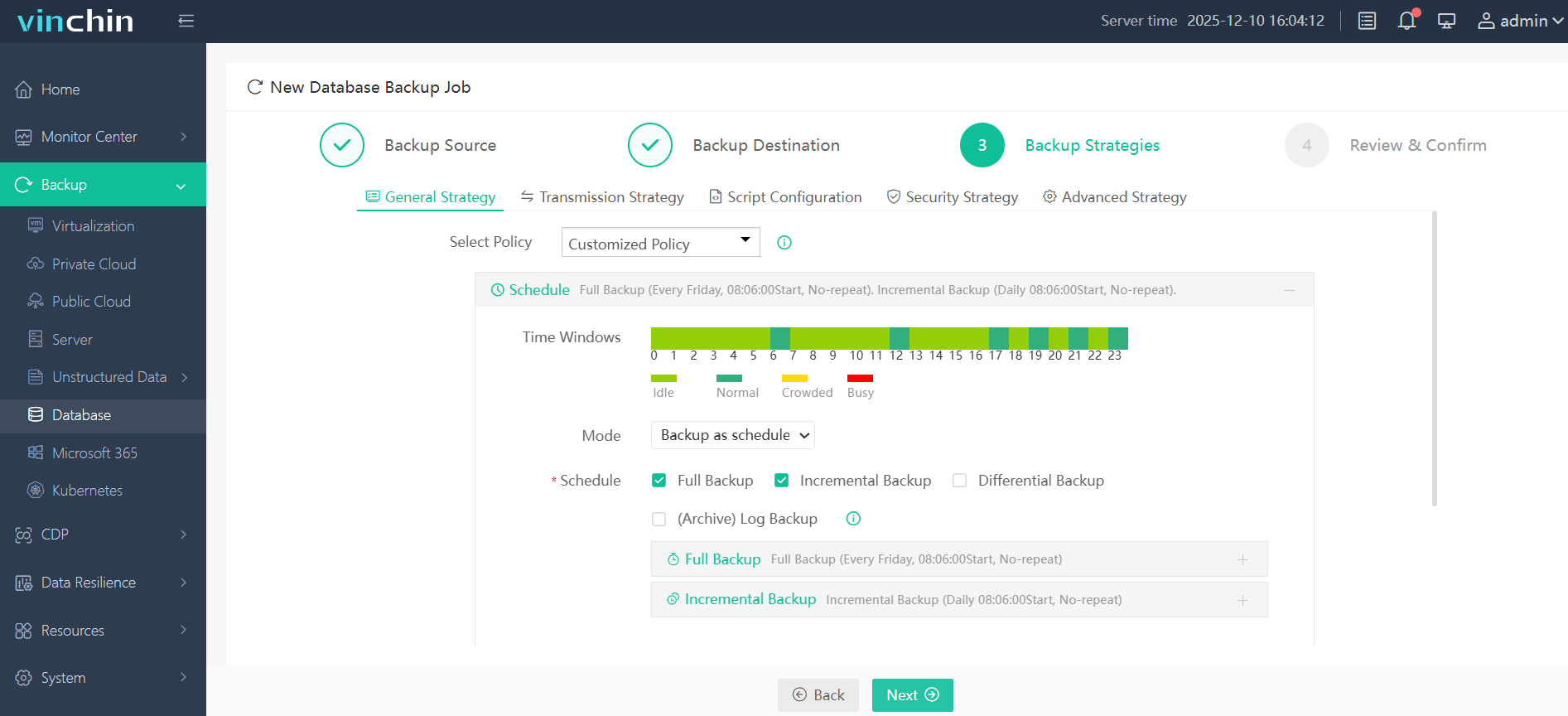
Step 3. Define your strategy;
Step 4. Submit the job.
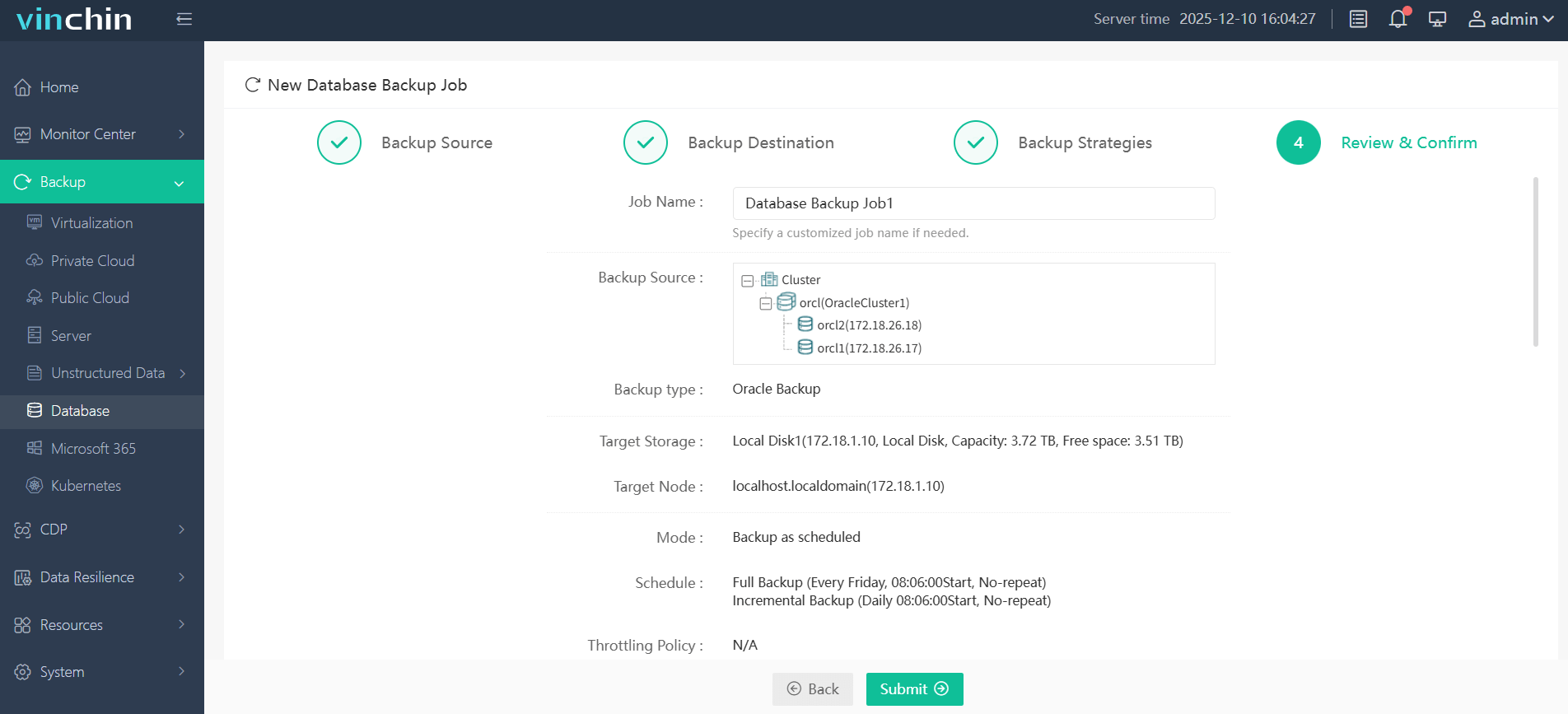
Recognized globally for reliability, Vinchin Backup & Recovery offers a fully featured free trial for sixty days—discover why IT professionals worldwide rate it among today’s top enterprise data-protection solutions!
Oracle RMAN List Backup FAQs
Q1: How do I list only the backups created after a certain date?
A1: Use LIST BACKUP COMPLETED AFTER 'YYYY-MM-DD' at the RMAN prompt.
Q2: Can I see which backups are expired or unavailable?
A2: Yes; run CROSSCHECK BACKUP, then check status column ('X' = expired,'U'= unavailable) in output.
Q3: How do I list most recent full backup per datafile?
A3: Run LIST BACKUP OF DATABASE SUMMARY; then look for highest BS Key per file.
Q4: What should I do if my filtered LIST returns no results?
A4: Check date format; use TO_DATE function explicitly if unsure about timezone.
Q5: How do I remove references to missing physical files?
A5: Run DELETE EXPIRED BACKUPS; after CROSSCHECK completes.
Conclusion
The `LIST BACKUP` command gives operations administrators deep insight into their Oracle environment's protection state—from basic summaries up through advanced filtered audits. For streamlined management, Vinchin delivers an automated solution trusted worldwide. Try Vinchin's free trial today!