When a backup job fails or you need to audit your disaster recovery plan, where do you start? For most operations administrators managing Oracle databases, the answer is clear: check your current RMAN setup. Oracle Recovery Manager (RMAN) provides powerful tools for configuring, monitoring, and automating backups. One essential tool in this kit is the ability to display your backup configuration using the SHOW command family—often referred to as "oracle rman show configuration." This guide explains what these commands do, how to use them effectively at every skill level, and how their output shapes your backup strategy.
What Is Oracle RMAN?
Oracle RMAN (Recovery Manager) is Oracle’s built-in utility for database backup and recovery. It automates many tasks that would otherwise require manual scripting or third-party tools. With RMAN, you can schedule regular backups, manage storage locations for those backups, validate data integrity after each run, and recover lost data quickly after failures.
RMAN works closely with the Oracle database engine itself. This tight integration allows advanced features like block-level recovery—restoring only damaged parts of a file—in addition to full or incremental backup. You can also verify backups without restoring them by running validation jobs.
Most importantly for operations teams: RMAN uses a straightforward command-line interface that supports both interactive sessions and automated scripts.. Its commands are well-documented by Oracle so you can always find help when needed.
What Does Show Configuration Do in RMAN?
The core purpose of "oracle rman show configuration" is visibility into your current backup environment settings. In practice, there isn’t a single command called SHOW CONFIGURATION; instead, you use SHOW ALL; at the RMAN prompt to list all persistent configuration parameters set for your database instance.
These parameters control key aspects such as where backups are stored (disk or tape), how many copies are kept before old ones become obsolete (retention policy), whether encryption or compression is used by default—and much more.
By running these SHOW commands regularly:
You confirm if defaults have been changed.
You spot risky settings before they cause problems.
You document configurations during audits or troubleshooting sessions.
You can also check individual parameters using targeted commands like SHOW RETENTION POLICY; or SHOW DEFAULT DEVICE TYPE;. Each reveals only its own setting rather than the entire list.
How to Use Oracle RMAN Show Configuration?
Before displaying any configuration information in RMAN:
Here’s how an operations administrator would proceed:
1. Open a terminal window on your server.
2. Connect to your local database as a privileged user by typing:
rman target /
This connects directly without needing extra credentials if run as an authorized OS user.
3. At the RMAN prompt type:
SHOW ALL;
This displays all persistent configuration parameters—including both customized values and those still set at their defaults.
4. To view just one parameter—for example retention policy—type:
SHOW RETENTION POLICY;
5. If you want details about another setting such as device type or encryption status:
   SHOW DEFAULT DEVICE TYPE;
   SHOW ENCRYPTION FOR DATABASE;
Each output line tells you not only what value is set but whether it’s still at its default (# default) or has been changed by an administrator.
Interpreting Show Configuration Output
After running SHOW ALL;, you'll see lines like these:
CONFIGURE RETENTION POLICY TO REDUNDANCY 1; # default
CONFIGURE BACKUP OPTIMIZATION OFF; # default
CONFIGURE DEFAULT DEVICE TYPE TO DISK; # default
CONFIGURE CONTROLFILE AUTOBACKUP ON;
...
Let’s break down what some of these mean:
Only one backup set per datafile/control file is retained—the rest are marked obsolete after newer ones complete successfully. While simple for test systems, this setting may be risky in production because losing that single copy could prevent full recovery.
When off (the default), every eligible file gets backed up even if unchanged since last time—which may waste space but ensures completeness.
All new backups go straight to disk unless specified otherwise—a good fit for most modern environments unless tape archives are required.
Ensures automatic protection of critical metadata files after each backup operation—a best practice often overlooked until disaster strikes!
By default no encryption occurs—leaving sensitive data exposed unless explicitly enabled.
If a line ends with # default, it means no one has changed it since installation—it matches Oracle's out-of-the-box recommendation for that version/platform combination.
If there’s no comment at all—or if it lacks "# default"—then someone has customized this parameter locally via a previous CONFIGURE command session.
How to Protect Oracle Databases with Vinchin Backup & Recovery
To further strengthen your Oracle database protection beyond native tools, consider integrating an enterprise-grade solution tailored for complex environments. Vinchin Backup & Recovery stands out as a professional platform supporting today’s mainstream databases—including Oracle, MySQL, SQL Server, MariaDB, PostgreSQL, PostgresPro, and TiDB—with robust features designed specifically for operational reliability and efficiency in large-scale deployments.
For organizations managing Oracle databases specifically, Vinchin Backup & Recovery delivers batch database backup capabilities alongside multiple level data compression options and flexible data retention policy including GFS support—all complemented by integrity checks that ensure recoverability under real-world conditions. These features collectively streamline automation while optimizing storage usage and guaranteeing compliance-ready protection across diverse workloads.
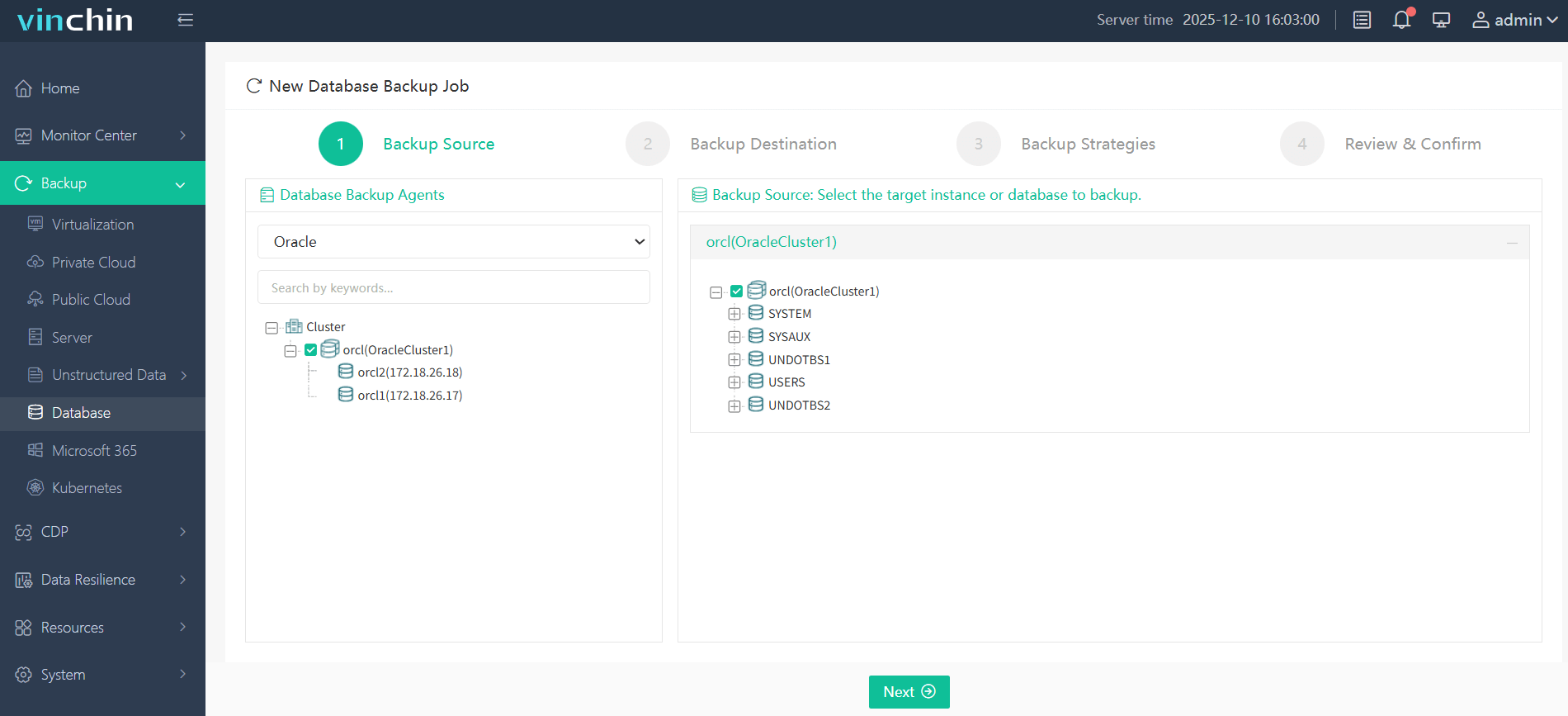
The intuitive web console makes safeguarding your Oracle environment remarkably straightforward:
Step 1. Select the Oracle database to back up
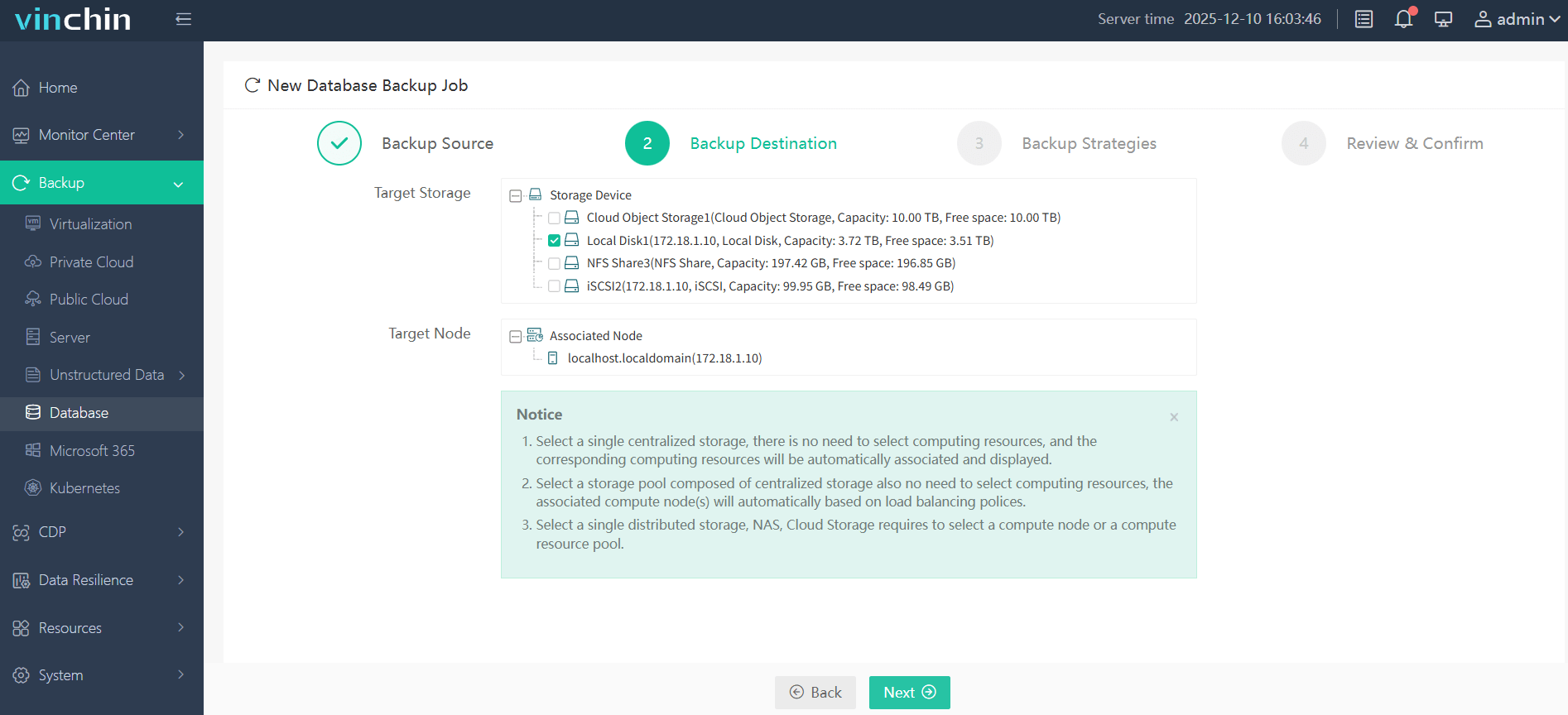
Step 2. Choose backup storage
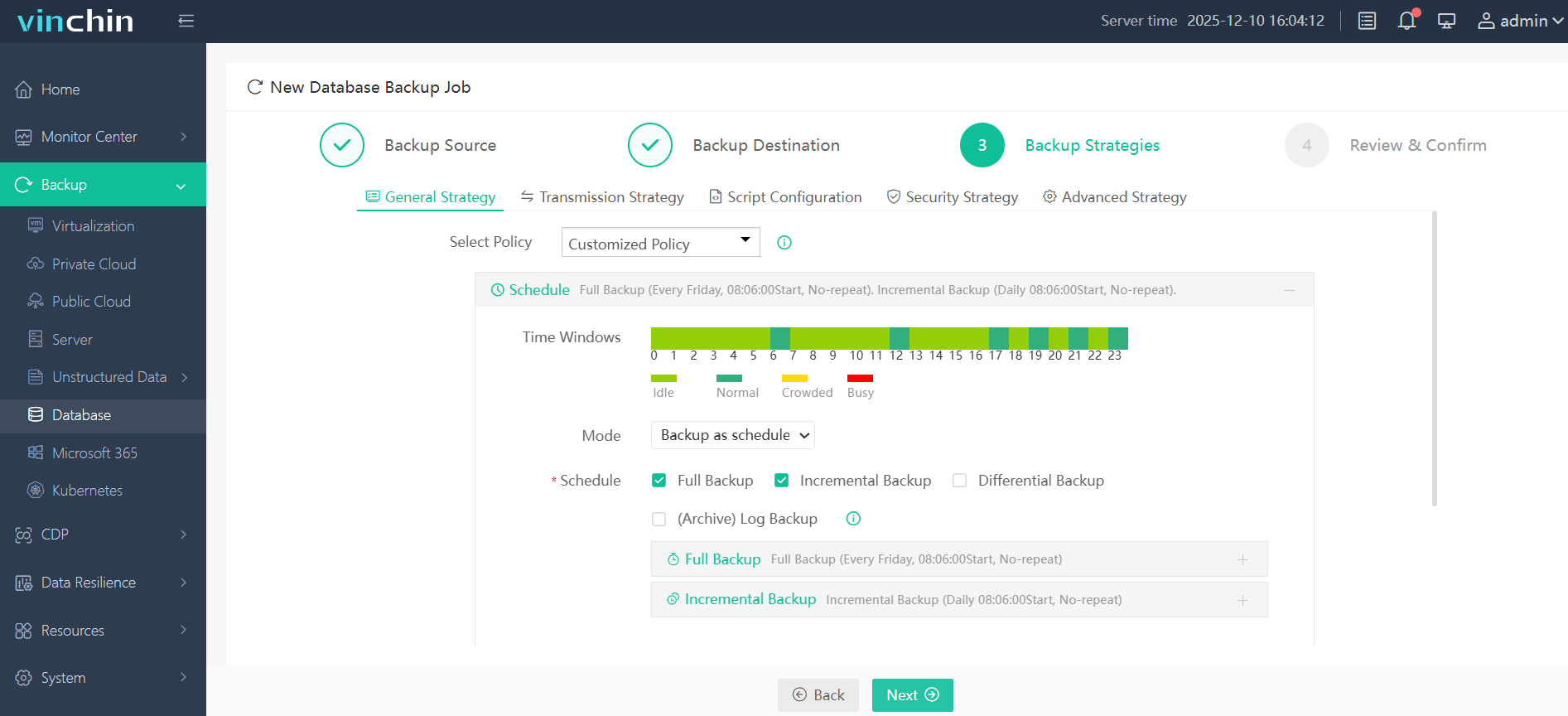
Step 3. Define your backup strategy
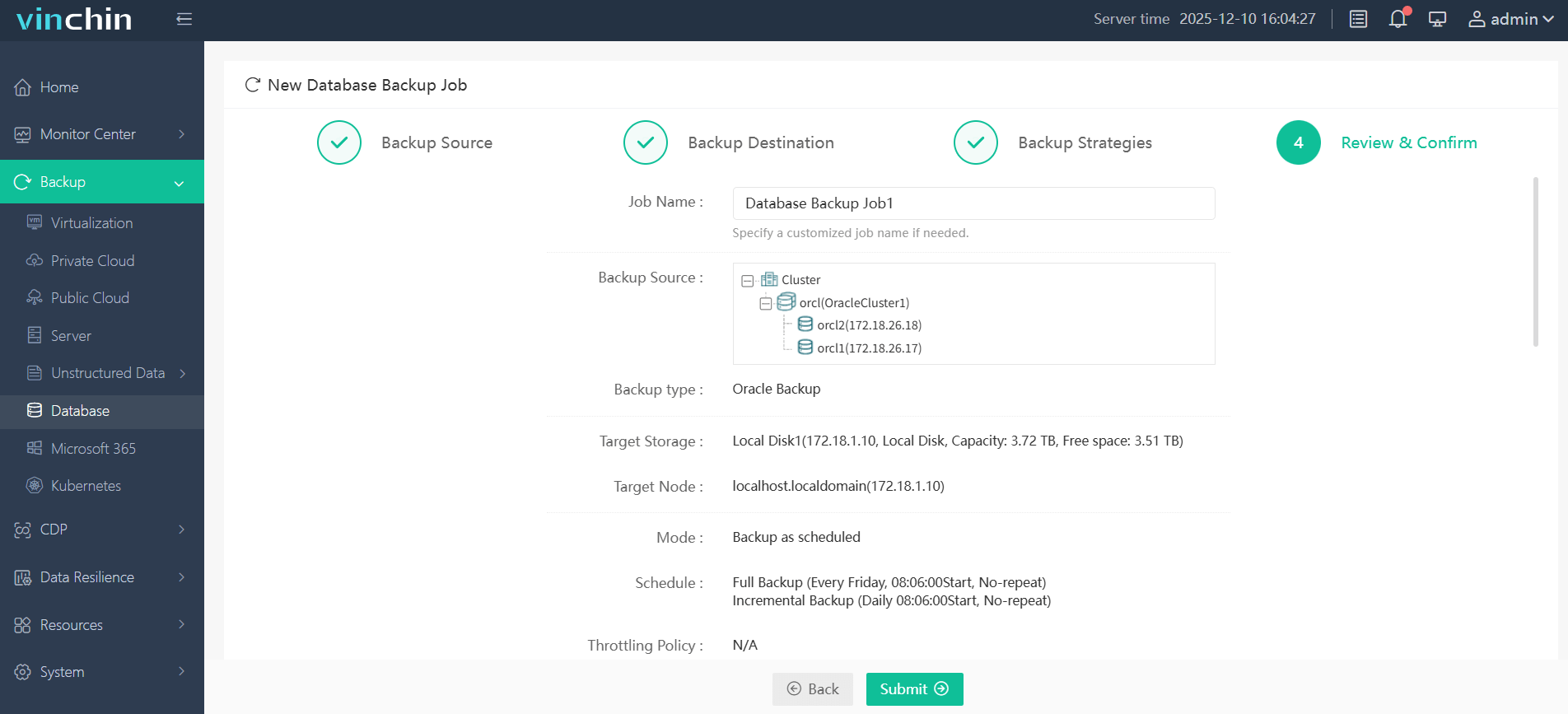
Step 4. Submit the job
Recognized globally among enterprise users—with top ratings and thousands of satisfied customers—Vinchin Backup & Recovery offers a risk-free 60-day full-featured trial so you can experience its power firsthand; click download now to get started.
Oracle RMAN Show Configuration FAQs
Q1: Can I see only non-default parameters in my current setup?
A1: Querying V$RMAN_CONFIGURATION in SQL*Plus lists only those parameters changed from defaults—not every possible option shown by SHOW ALL;
Q2: How does using a recovery catalog affect my displayed configurations?
A2: When connected through a recovery catalog server via RMAN both local instance settings plus centrally stored configurations appear together under SHOW outputs;
Q3: What should I do if my archive logs fill up disk space unexpectedly?
A3: Set an appropriate deletion policy (ARCHIVELOG DELETION POLICY) then rerun maintenance jobs regularly so old logs clear automatically;
Conclusion
The oracle rman show configuration process gives vital insight into how safe—and recoverable—your databases really are day-to-day. Regular reviews keep surprises away while helping meet compliance goals efficiently! For advanced automation across complex environments consider Vinchin’s robust platform—with free trials available now worldwide!