Setting up Oracle RMAN (Recovery Manager) is essential for any database administrator who wants reliable backups and fast recovery. RMAN is Oracle’s built-in tool for backup and restore tasks. When you configure it well, your data stays safe—even if disaster strikes. This guide explains how to perform an effective Oracle RMAN setup from start to finish. We’ll cover basic concepts first, then move on to intermediate settings like retention policies and catalogs, finishing with advanced options such as parallelism and encryption. Whether you’re just starting out or looking to fine-tune your backup strategy, you’ll find clear instructions here.
What Is Oracle RMAN?
Oracle RMAN is both a command-line utility and a graphical tool for backing up, restoring, and recovering Oracle databases. It automates many routine backup jobs so you don’t have to remember every detail yourself. With features like incremental backup, block-level recovery, validation checks, and metadata tracking built in, it’s far more reliable than manual scripts or OS-level copies.
RMAN can back up data directly to disk or tape devices while managing retention policies automatically. It even repairs some types of corruption during restore operations—all without extra licensing costs since it comes standard with every Oracle Database installation.
Prerequisites for Oracle RMAN Setup
Before setting up RMAN backups, make sure your environment meets these requirements:
First, your database must run in ARCHIVELOG mode so you can back up while the database is open—and recover right up to the point of failure if needed. To do this safely:
Check that you have administrative privileges—either SYSDBA (the default) or SYSBACKUP (a least-privilege alternative introduced in 12c). You can grant SYSBACKUP by running GRANT SYSBACKUP TO <user>;.
Confirm there’s enough space not only on disk but also in your Fast Recovery Area (FRA) or wherever you store backups; estimate based on your retention policy plus daily change rates.
If you want centralized management across several databases—or need long-term history beyond what control files keep—set up a separate recovery catalog database.
Double-check that all required environment variables are set: ORACLE_HOME, ORACLE_SID, plus any TNS entries if connecting remotely.
Make sure archive log destinations (LOG_ARCHIVE_DEST_1) are configured correctly so logs aren’t lost due to full disks.
How to Set Up Oracle RMAN Manually
Manual setup gives you maximum flexibility—and scripting power—for automation later on.
Enabling ARCHIVELOG Mode and Verifying Configuration
Start by connecting as a privileged user:
$ sqlplus "/ as sysdba"
Check current log mode:
SQL> select log_mode from v$database;
If output shows NOARCHIVELOG, enable ARCHIVELOG mode:
1. Shut down the database:
SQL> shutdown immediate;
2. Start it in mount state:
SQL> startup mount;
3. Enable archiving:
SQL> alter database archivelog;
4. Open the database:
SQL> alter database open;
After switching modes, always take an immediate full backup—otherwise point-in-time recovery won’t work before this baseline!
Also check where archive logs go:
SQL> show parameter log_archive_dest_1;
Adjust if needed so logs write somewhere with plenty of space.
Connecting to RMAN and Configuring Persistent Settings
Connect using:
$ rman target /
Set key configurations:
RMAN> configure controlfile autobackup on;
Optionally specify location:
RMAN> configure controlfile autobackup format for device type disk to '/u01/backup/ctrl_%F';
RMAN> configure backup optimization on;
RMAN> configure retention policy to recovery window of 7 days;
This keeps enough backups so you can recover any time within seven days.
RMAN> configure retention policy to redundancy 2;
This keeps at least two complete sets regardless of age.
Integrating a Recovery Catalog
A recovery catalog stores historical metadata outside the main database—ideal when managing multiple systems or needing longer history than control files allow.
Steps:
1. In your catalog DB create tablespace/user:
    SQL> create tablespace catalogtbs datafile '/path/to/catalogtbs1.dbf' size 100M autoextend on maxsize unlimited;
    SQL> create user recoveryman identified by recoveryman;
    SQL> alter user recoveryman default tablespace catalogtbs temporary tablespace temp;
    SQL> grant recovery_catalog_owner, connect, resource to recoveryman;
2. Register target DB from server where backups run:
    $ rman target / catalog recoveryman/recoveryman@catalogdb
    RMAN> create catalog;
    RMAN> register database;
If registration fails due to connection errors (“ORA-12154”), check that tnsnames.ora has correct entries pointing at your catalog instance.
How to Set Up Oracle RMAN Using Enterprise Manager
Prefer working visually? Enterprise Manager Cloud Control provides an intuitive web interface for configuring all major aspects of Oracle backups through guided wizards.
Log into Enterprise Manager as DBA-level user.
Navigate via Availability, then choose Backup & Recovery under your target DB’s menu.
To adjust defaults click Configure Backup Settings—here set device types (disk/tape), enable control file autobackup with one click (Enable Control File Autobackup), pick destinations like FRA paths or NFS shares.
To schedule jobs use Schedule Backup, then select objects (whole DB/tablespaces/datafiles), choose between full/incremental/custom strategies—and define where results go.
Retention policies plus compression options are available right from this GUI too!
Once satisfied review summary details then hit Submit—OEM generates matching scripts behind-the-scenes.
Curious about learning CLI equivalents? After scheduling jobs look at job details—the generated script appears there ready-made for automation elsewhere!
Monitor status via OEM dashboards showing job progress/history/errors at-a-glance—a big help when juggling multiple environments daily.
Why Use Oracle RMAN for Backup?
Why trust anything less than what comes built into every modern version of Oracle? With automated scheduling support plus deep integration into security/encryption features, using native tools means fewer surprises during audits—or emergencies! Features like block-level restores save hours compared with old-school exports/imports while detailed metadata makes troubleshooting much easier if something goes wrong mid-recovery.
In short: less risk + less manual labor = more uptime!
Enhance Your Protection with Vinchin Backup & Recovery
Beyond native tools like RMAN, organizations often require broader enterprise-grade protection across diverse environments. Vinchin Backup & Recovery is a professional solution designed specifically for robust Oracle database protection alongside MySQL, SQL Server, MariaDB, PostgreSQL, PostgresPro, and TiDB platforms. For Oracle users especially, it delivers advanced source-side compression and incremental backup capabilities as well as batch processing and flexible multi-level data compression—all supported by customizable data retention policy that streamline compliance management while optimizing storage usage and operational efficiency.
Vinchin Backup & Recovery features an intuitive web console that simplifies the process into four straightforward steps:
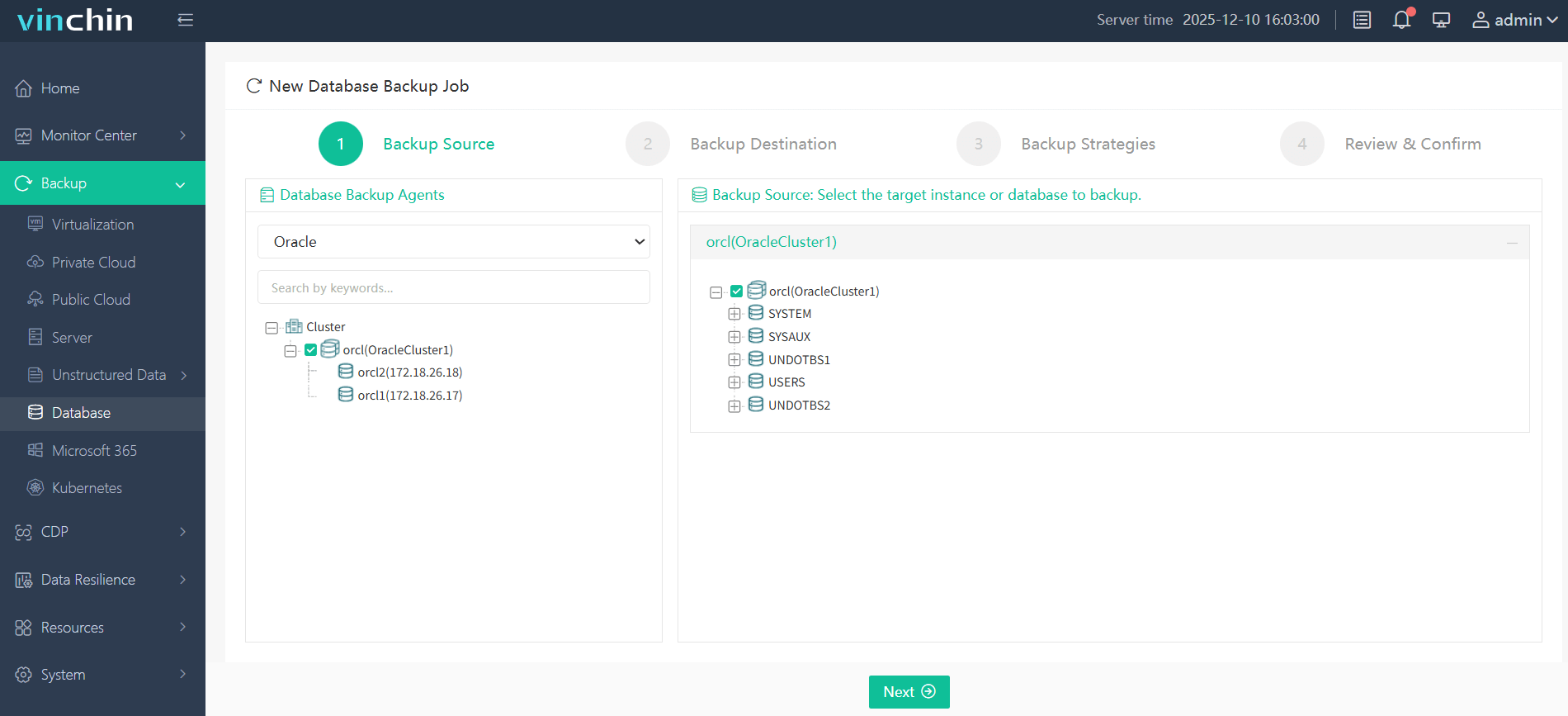
Step 1. Select the Oracle database to back up
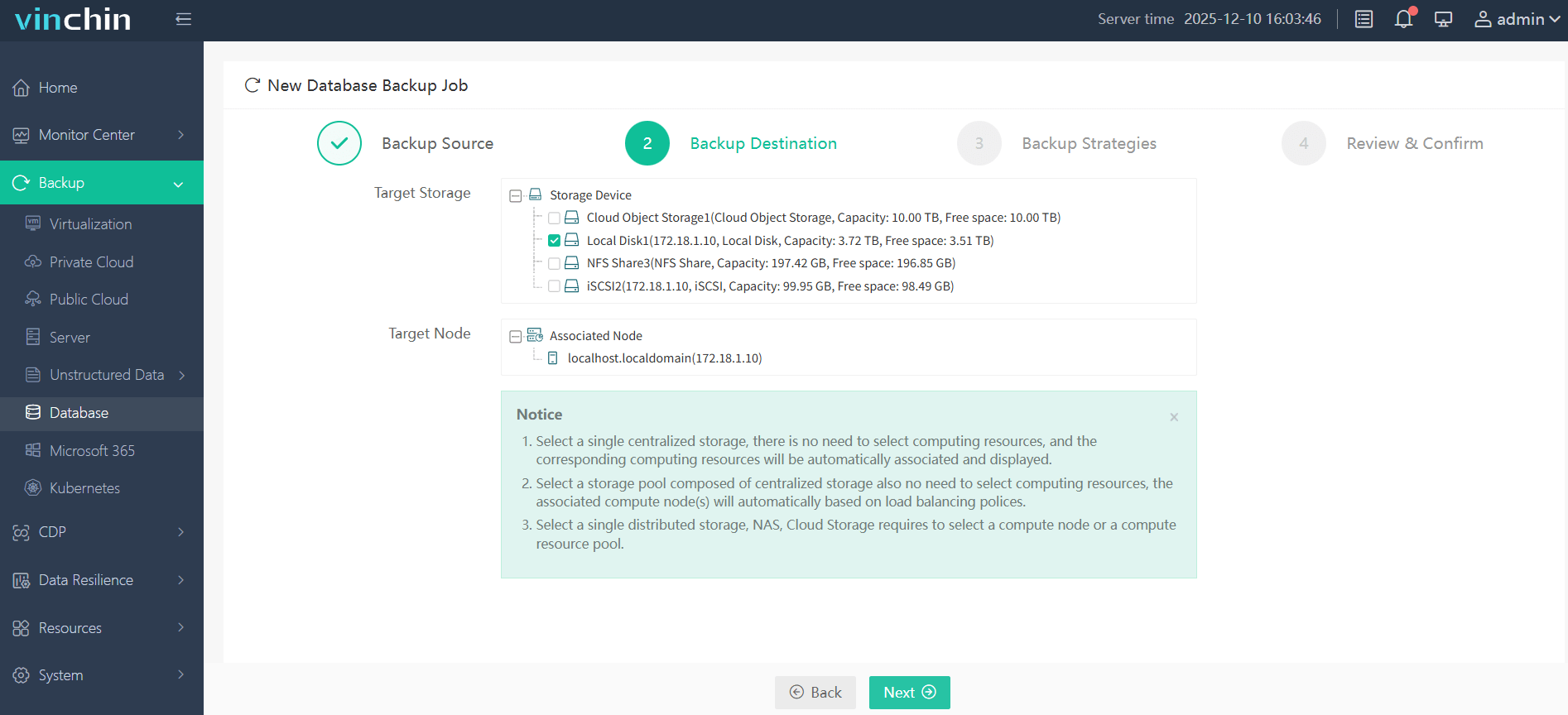
Step 2. Choose backup storage
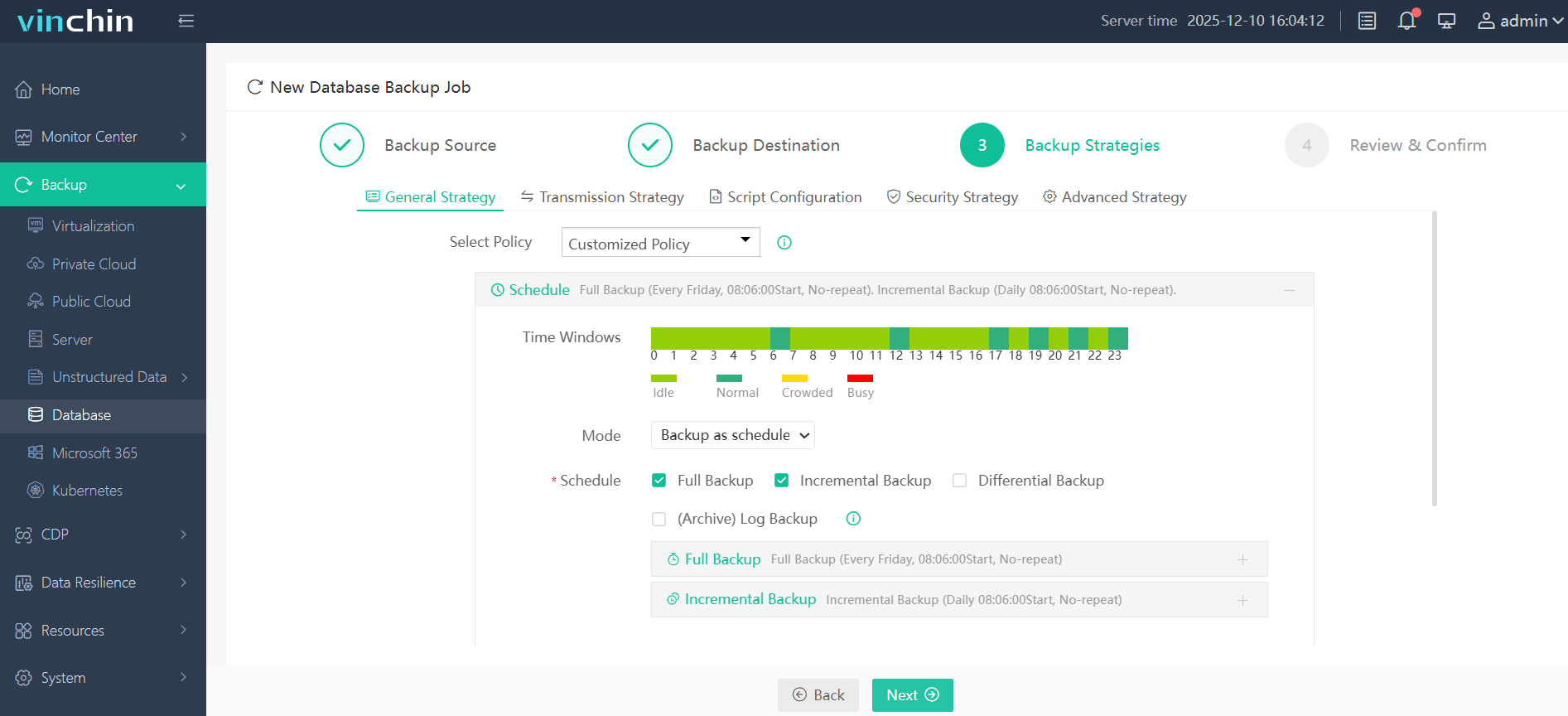
Step 3. Define your backup strategy
Step 4. Submit the job
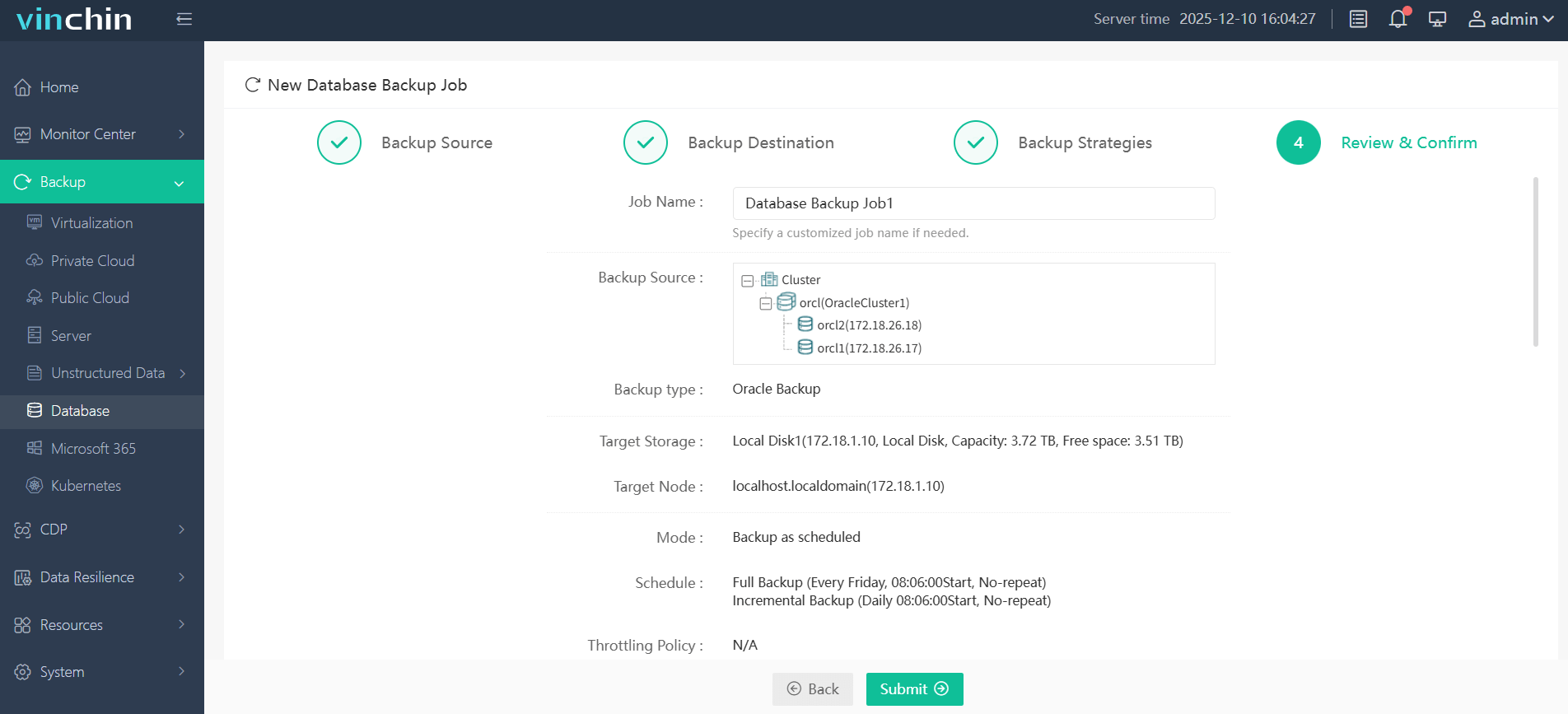
Recognized globally with top ratings from thousands of enterprises,Vinchin Backup & Recovery offers a fully featured free trial for 60 days—click download now and experience leading-edge enterprise data protection firsthand.
Oracle RMAN Setup FAQs
Q1: How do I monitor my Fast Recovery Area usage?
Query V$RECOVERY_AREA_USAGE in SQL*Plus—it shows space used by each component including archived logs/backups/control files.
Q2: Can I automate nightly full/incremental backups?
Yes—write an .rman script containing commands like BACKUP DATABASE PLUS ARCHIVELOG; then schedule it using cron (Linux) or Task Scheduler (Windows).
Q3: What should I do if my control file autobackup fails?
Check permissions/space at its configured destination path; try manually backing up via BACKUP CURRENT CONTROLFILE FORMAT '/tmp/test.bkp'; fix issues before retrying automated jobs.
Conclusion
A solid oracle rman setup protects critical business data against loss or corruption—from basic configuration through advanced tuning options covered here.Following best practices ensures fast reliable restores.Vinchin further streamlines protection workflows.Try it today risk-free!