Mistakes happen—even in well-managed environments. Maybe someone dropped a table or ran a script at the wrong moment. When disaster strikes your Oracle database, you need a way to get back to safety—fast. That’s where the oracle rman restore until time feature comes in handy.
This guide explains what this feature is, why it matters for data protection, how to use it with both command line tools and Oracle Enterprise Manager (OEM), plus best practices for success.
What Is Oracle RMAN Restore Until Time?
The oracle rman restore until time operation is an example of point-in-time recovery (PITR). It lets you rewind your Oracle database to a specific moment using Recovery Manager (RMAN). Instead of restoring everything up to the most recent backup or redo log—which might include unwanted changes—you can roll back only as far as needed.
This process is called incomplete recovery. Afterward, you must open your database with RESETLOGS, which starts a new incarnation of your database history. You cannot recover past that point unless you have newer backups.
Why does this matter? Logical errors—like accidental data deletion or corruption—often require undoing just recent changes rather than rolling back everything since your last full backup.
Before running any PITR operation on production systems:
Test first on a clone or standby environment if possible
Understand that opening with RESETLOGS creates a new branch in your backup history
Know that all backups taken after your chosen point become invalid for future restores beyond that time
Why Use Restore Until Time in Oracle?
Point-in-time recovery saves you from major headaches when unwanted changes hit your data. Suppose someone drops an important table at 10:00 AM; with restore until time, you can bring things back to 9:59 AM—as if nothing happened.
This method also helps after failed upgrades or when facing data corruption from software bugs or user mistakes. By choosing exactly when to stop recovering changes, you minimize both data loss and downtime.
But remember: PITR is not suitable for every scenario! If hardware fails or media becomes corrupt before your target time—or if required backups are missing—you may not be able to recover as planned.
Always check:
Your backups cover all files needed up through your target timestamp
All archived redo logs between backup creation and target time are available
The database runs in ARCHIVELOG mode so redo logs exist for replay
Testing these requirements ahead of time prevents surprises during real emergencies.
Method 1: Using RMAN Command Line
The RMAN command line gives you full control over point-in-time restores—and works everywhere Oracle runs.
Prerequisites Before Starting
Before beginning any restore operation:
1. Confirm that all required backups exist from before your desired point-in-time.
2. Make sure all archived redo logs covering every change up through that moment are available.
3. Verify that ARCHIVELOG mode was enabled during those periods; otherwise PITR won’t work.
4. Check disk space on both source storage (for reading old files) and destination storage (for writing restored files).
You can check available backups by connecting to RMAN:
LIST BACKUP OF DATABASE COMPLETED BEFORE "to_date('2024-07-10 09:59:00','YYYY-MM-DD HH24:MI:SS')";
LIST ARCHIVELOG FROM TIME "sysdate-1";
If anything is missing here—stop! Fix gaps before proceeding further.
Performing Restore Until Time
Here’s how the process works step by step:
First, shut down the database cleanly if it’s running:
SHUTDOWN IMMEDIATE;
Then start it in mount mode:
STARTUP MOUNT;
Next connect with RMAN as an administrator:
rman TARGET /
Now run these commands inside an RMAN block—replace date/time with yours:
RUN {
  SET UNTIL TIME "to_date('2024-07-10 09:59:00','YYYY-MM-DD HH24:MI:SS')";
  RESTORE DATABASE;
  RECOVER DATABASE;
  ALTER DATABASE OPEN RESETLOGS;
}
What do these commands do?
SET UNTIL TIME tells RMAN where to stop applying changes.
RESTORE DATABASE brings back all datafiles from backup sets valid at that moment.
RECOVER DATABASE applies archived redo logs up through—but not past—the specified timestamp.
ALTER DATABASE OPEN RESETLOGS opens the recovered state as a new incarnation; previous archive chains end here.
Handling Database Incarnations
If restoring across multiple incarnations—for example after earlier resets using RESETLOGS—you must reset the current incarnation pointer first:
1. List known incarnations:
LIST INCARNATION OF DATABASE;
2. Identify which one matches your target period (look at SCN/timestamps).
3. Reset pointer:
RESET DATABASE TO INCARNATION <incarnation_key>;
Only then should you proceed with SET UNTIL TIME as shown above!
Method 2: Using Oracle Enterprise Manager
Not everyone prefers command lines—especially under pressure! Oracle Enterprise Manager (OEM) offers graphical tools for managing PITR operations behind-the-scenes using RMAN logic.
Most organizations today use OEM Cloud Control version 13c/19c+; older Database Control interfaces look different but offer similar features under other menu names.
Navigating Point-In-Time Recovery in OEM
To perform oracle rman restore until time via OEM:
1. Log into OEM web console as DBA user.
2. Navigate left sidebar tree > find target database instance > click its name.
3. Open top menu bar > select Availability > choose Perform Recovery option from dropdown list.
4. On next screen pick Database Point-In-Time Recovery radio button—not tablespace-level unless partial restore needed!
5. Enter exact date/time desired under “Target Time” field; double-check format matches system locale settings!
6. Review summary page showing which backups/logs will be used; confirm none are missing/unavailable per warnings shown here.
7. Click Next/Finish buttons as prompted; OEM generates equivalent RMAN scripts automatically then executes them server-side while displaying progress bars/logs onscreen.
8.When prompted post-recovery open with RESETLOGS by clicking confirmation dialog box (“Open Database With Resetlogs”).
Back Up and Recover Oracle Databases Easily with Vinchin Backup & Recovery
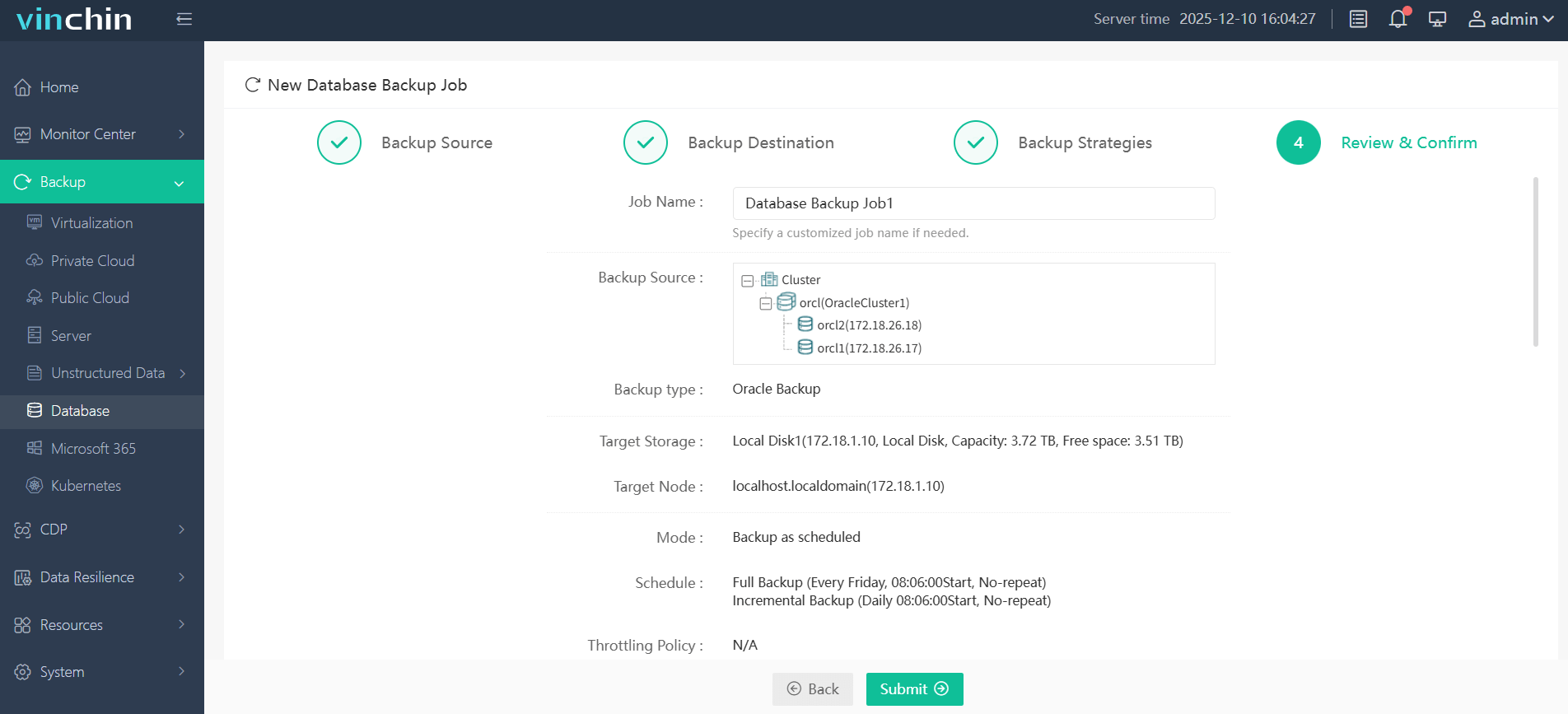
For organizations seeking streamlined management beyond native tools, Vinchin Backup & Recovery delivers robust enterprise-level protection tailored for modern databases—including comprehensive support for Oracle alongside MySQL, SQL Server, MariaDB, PostgreSQL, PostgresPro, and TiDB environments. With features such as incremental backup, batch database backup, flexible retention policy including GFS retention policy, cloud backup and tape archivin capabilities, plus reliable any-point-in-time recovery options, Vinchin Backup & Recovery ensures critical business data remains secure and rapidly restorable while reducing administrative overhead through automation and policy-driven controls.
The intuitive web console makes safeguarding your Oracle environment straightforward—simply follow four guided steps:
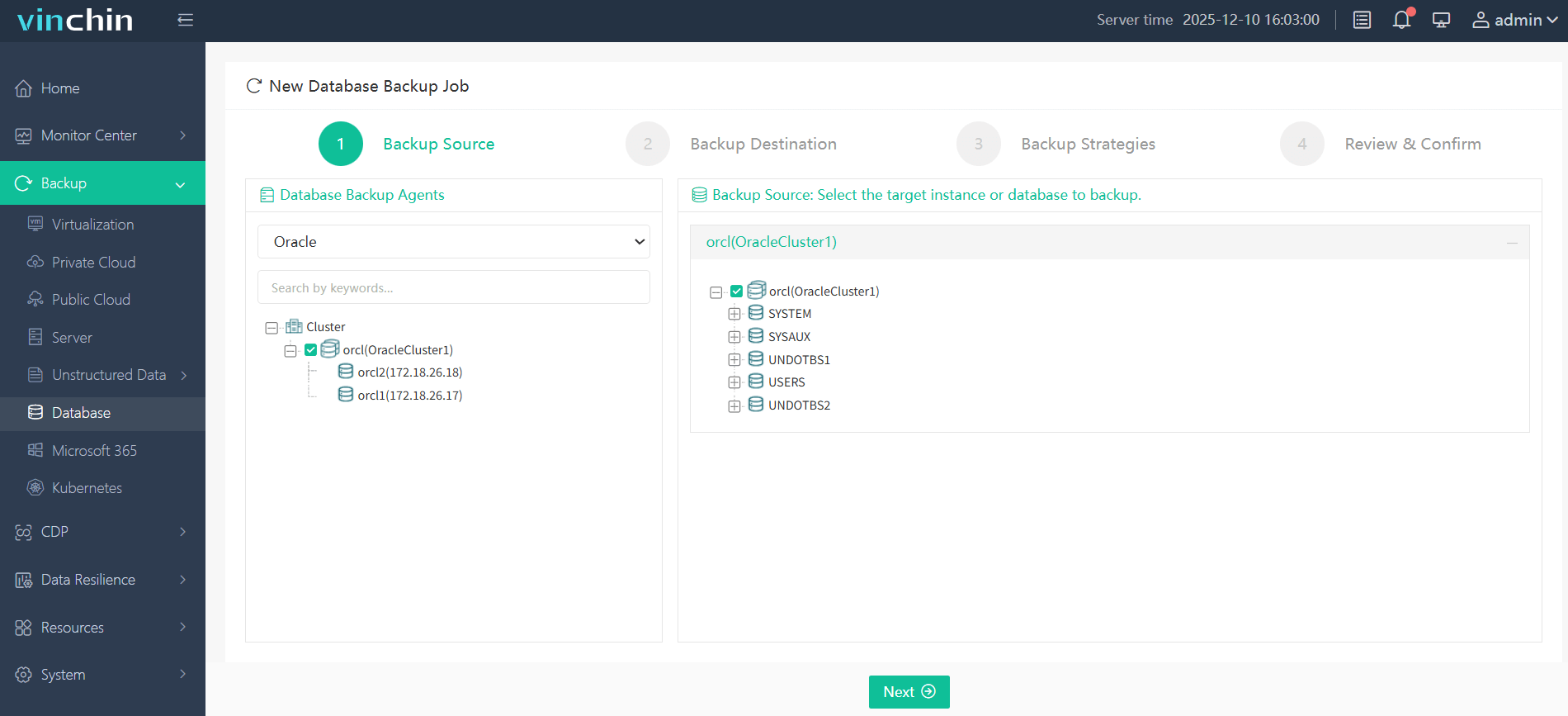
Step 1. Select the Oracle database to back up
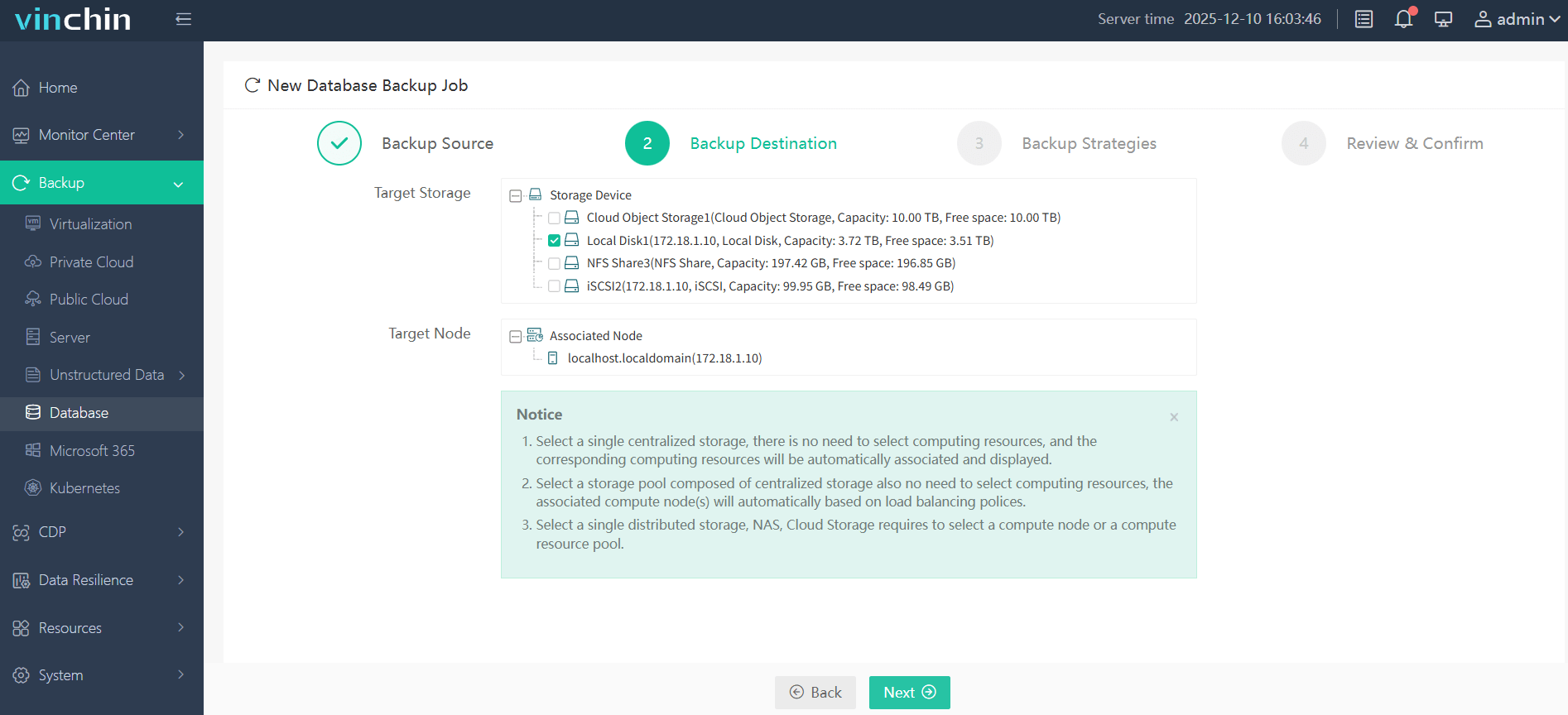
Step 2. Choose backup storage
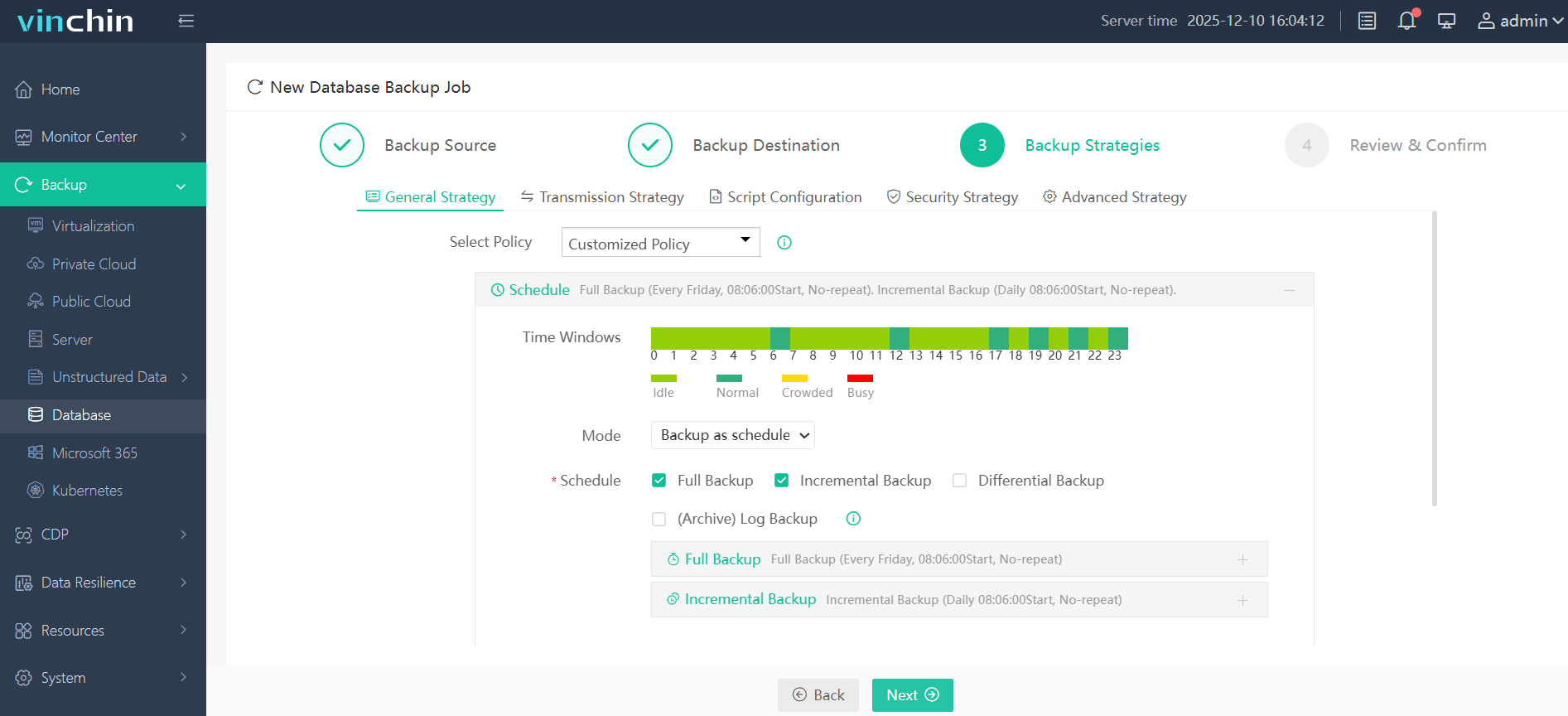
Step 3. Define your backup strategy
Step 4. Submit the job
Recognized worldwide by thousands of enterprises and highly rated by industry experts, Vinchin Backup & Recovery offers a fully featured free trial lasting 60 days—click below to experience effortless enterprise-grade protection firsthand.
Oracle RMAN Restore Until Time FAQs
Q1: Can I perform oracle rman restore until time if my archive log sequence has gaps?
No—you must have a continuous set of archived redo logs covering every change between last good backup and chosen target timestamp for successful PITR recovery.
Q2: What should I do if my restored state shows unexpected objects missing after PITR?
Check whether correct incarnation was selected/reset during setup—and verify no critical transactions occurred after chosen cutoff date/time needing manual re-entry/reconciliation now.
Q3: How do I estimate how long an oracle rman restore until time job will take?
Estimate based on size of restored datafiles plus total volume of archived redo logs applied—I/O speed often limits performance so monitor V$SESSION_LONGOPS view during execution.
Conclusion
The oracle rman restore until time feature gives administrators precise control over recovering lost or corrupted data fast.Whether using command line tools,OEM GUI workflows ,or Vinchin's streamlined platform,your business stays protected against logical disasters.Vinchin makes enterprise-grade protection simple—try it free today!