Backing up large Oracle database can be slow if you use only one process. Oracle Recovery Manager (RMAN) offers a way to speed up backups by using parallelism. This means RMAN can run several backup operations at the same time across multiple channels. Parallelism is especially helpful when working with big data files or high-performance storage systems. But how do you set this up? What are the best practices? Let’s walk through the details step by step.
What Is Oracle RMAN Parallelism?
Oracle RMAN parallelism is the ability to run multiple backup or restore operations at once by using several channels. Each channel acts as a separate stream of data between RMAN and your storage device—such as disk or tape—allowing simultaneous reading from or writing to different files.
Parallelism mainly benefits data file backups because control file and SPFILE backups are usually single-threaded due to their small size and critical nature. When you set parallelism, RMAN allocates more than one channel so it can handle multiple files at once. This approach greatly reduces backup times for large databases or when fast storage is available.
Each channel works independently but under RMAN’s control. For example, if you have three channels open during a backup job, each will process part of the workload in parallel—speeding up both backups and restores.
Why Use Parallelism in RMAN Backups?
Using parallelism in RMAN backups helps you make better use of your hardware resources. If your server has several disks or tape drives, running backups in parallel keeps all devices busy instead of letting some sit idle.
Effective use of parallelism depends not just on how many devices you have but also on your system’s overall throughput—the combined speed of all disks or network links involved. Setting PARALLELISM too high on slow hardware may actually slow down your backup due to resource contention.
Parallel processing balances load across your system so no single device becomes a bottleneck. However, matching the number of channels to available hardware is crucial; otherwise, too many channels can overload CPU or saturate disk bandwidth rather than speeding things up.
How to Configure Basic Parallelism Settings in Oracle RMAN?
Configuring basic parallelism starts with understanding that each channel represents an independent stream between Oracle and its storage target. You control this by setting how many channels are allocated per device type—either automatically or manually.
To configure automatic channel allocation for disk-based backups:
First, tell RMAN how many channels you want for a specific device type using CONFIGURE DEVICE TYPE:
RMAN> CONFIGURE DEVICE TYPE DISK PARALLELISM 3;
This command tells RMAN to use three channels whenever backing up to disk. When you start a backup job like:
RMAN> BACKUP DATABASE;
RMAN will automatically allocate three disk channels named ORA_DISK_1, ORA_DISK_2, and ORA_DISK_3—each handling part of the database in parallel.
To check current settings at any time:
RMAN> SHOW DEVICE TYPE;
If you need to change the number of channels later, simply re-run CONFIGURE DEVICE TYPE DISK PARALLELISM n with your desired value.
If you want to reset all settings for disk devices—including parallelism—to defaults:
RMAN> CONFIGURE DEVICE TYPE DISK CLEAR;
Note: This command resets all settings related to DISK devices—not just parallelism but also other options like backup copies.
During an active backup job, you can monitor which sessions are handling work by querying session progress from another SQL*Plus window:
SELECT sid, serial#, context, sofar, totalwork,
       ROUND(sofar/totalwork*100,2) "%_COMPLETE"
FROM v$session_longops
WHERE opname LIKE 'RMAN%'
AND totalwork != 0 AND sofar <> totalwork;
How to Optimize Oracle RMAN Backup Performance Using Advanced Parallelism Techniques?
Once basic setup is complete, fine-tuning can yield even better results—especially for very large databases or complex environments like clustered servers.
Advanced techniques let you control exactly how work is divided among channels and where output goes:
You might want each channel writing its own output file on separate disks—for example:
RMAN> CONFIGURE CHANNEL 1 DEVICE TYPE DISK FORMAT '/disk1/%U';
RMAN> CONFIGURE CHANNEL 2 DEVICE TYPE DISK FORMAT '/disk2/%U';
RMAN> CONFIGURE DEVICE TYPE DISK PARALLELISM 2;
Now when running BACKUP DATABASE, two streams write simultaneously—one per disk path—which maximizes throughput if both disks are fast enough.
For more granular control over what each channel processes during a job (useful if some datafiles are much larger than others), adjust parameters like FILESPERSET (how many input files go into one output piece):
RMAN> BACKUP DATABASE FILESPERSET 2;
This groups two input files per set—a useful way to balance workloads across available streams—but does not directly increase concurrency beyond what PARALLELISM allows.
Another lever is MAXOPENFILES, which limits how many files each channel reads at once; tuning this helps avoid overwhelming memory resources during heavy jobs:
RUN {
  ALLOCATE CHANNEL c1 DEVICE TYPE DISK FORMAT '/disk1/%U';
  ALLOCATE CHANNEL c2 DEVICE TYPE DISK FORMAT '/disk2/%U';
  BACKUP DATABASE MAXOPENFILES 4;
}
When manually allocating channels inside a RUN block like above:
Make sure that CONFIGURE DEVICE TYPE DISK PARALLELISM matches the number of manual allocations.
If left higher than needed—or unset—automatic extra channels may be created unexpectedly.
Set PARALLELISM equal to zero (or match manual count) before starting such jobs.
In clustered environments such as Oracle Real Application Clusters (RAC), spread load across nodes by connecting each channel explicitly:
CONFIGURE CHANNEL 1 DEVICE TYPE DISK CONNECT 'sys/password@node1';
CONFIGURE CHANNEL 2 DEVICE TYPE DISK CONNECT 'sys/password@node2';
CONFIGURE DEVICE TYPE DISK PARALLELISM 2;
Security tip: Avoid embedding passwords directly in scripts; instead use secure credential stores like Oracle Wallets wherever possible.
Always monitor CPU usage and I/O wait times during tests; if either spikes sharply after raising PARALLELISM, scale back until performance stabilizes.
Vinchin Backup & Recovery: Enterprise-Level Protection for Your Oracle Database
For organizations seeking streamlined management beyond native tools alone, Vinchin Backup & Recovery delivers robust enterprise-level database protection tailored for mainstream platforms—including full support for Oracle alongside MySQL, SQL Server, MariaDB, PostgreSQL, PostgresPro, and TiDB environments. With features such as advanced source-side compression (for Oracle), incremental backup capabilities (for Oracle), batch database backup management, flexible retention policies including GFS retention policy options, plus comprehensive integrity checks—all designed around maximizing efficiency while minimizing risk—you gain reliable automation without complexity. These functions collectively help optimize storage usage while ensuring rapid recovery readiness under demanding enterprise conditions.
The intuitive web console simplifies every step of protecting your Oracle workloads
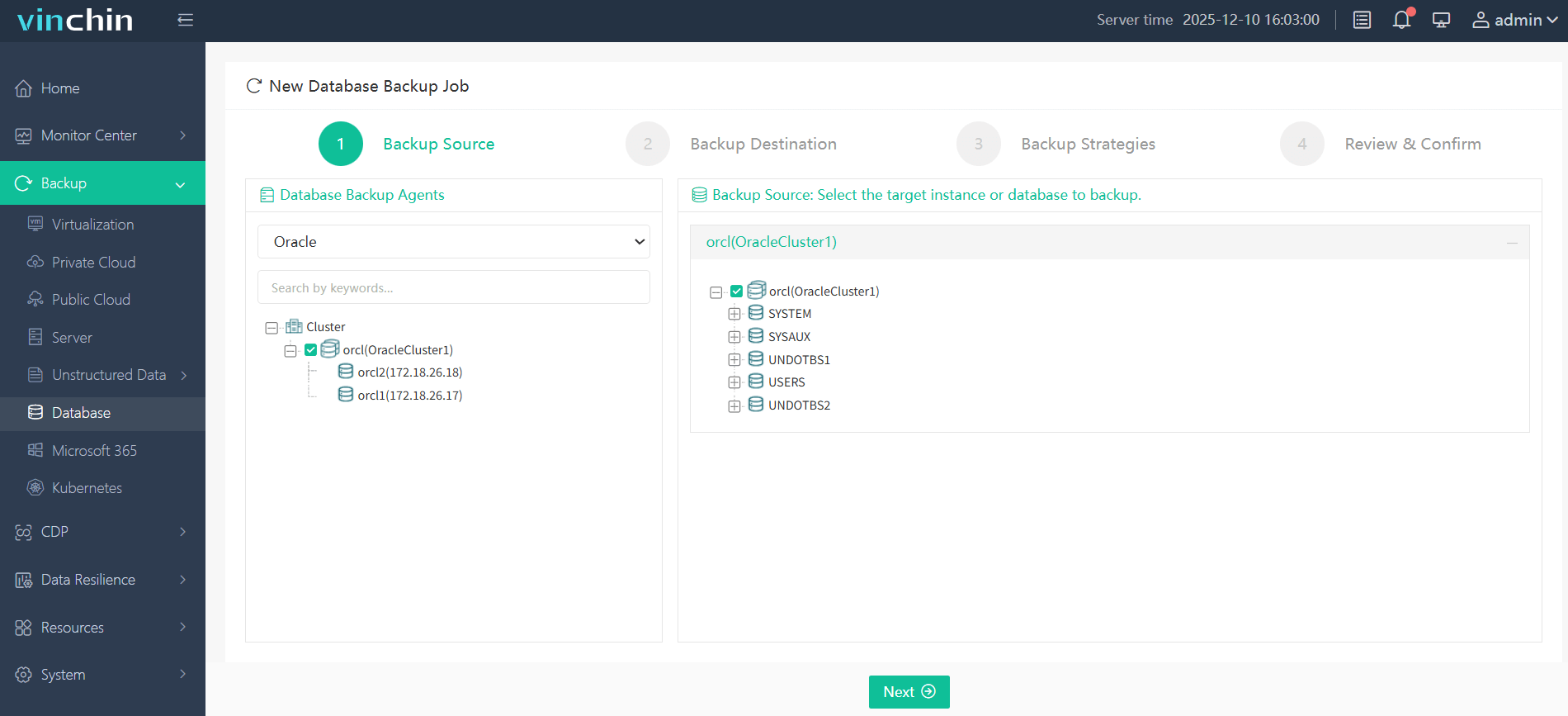
Step 1. Select the Oracle database to back up
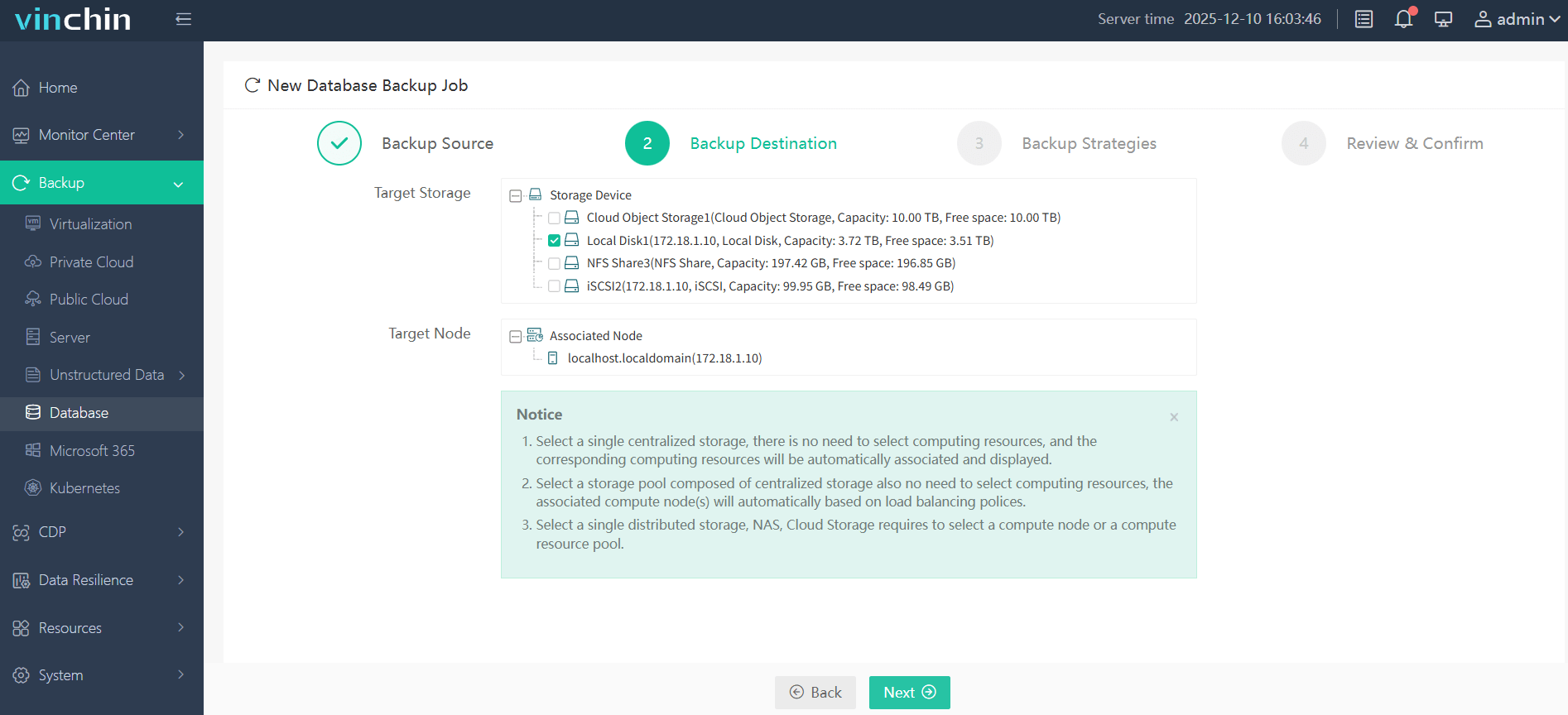
Step 2. Choose the backup storage
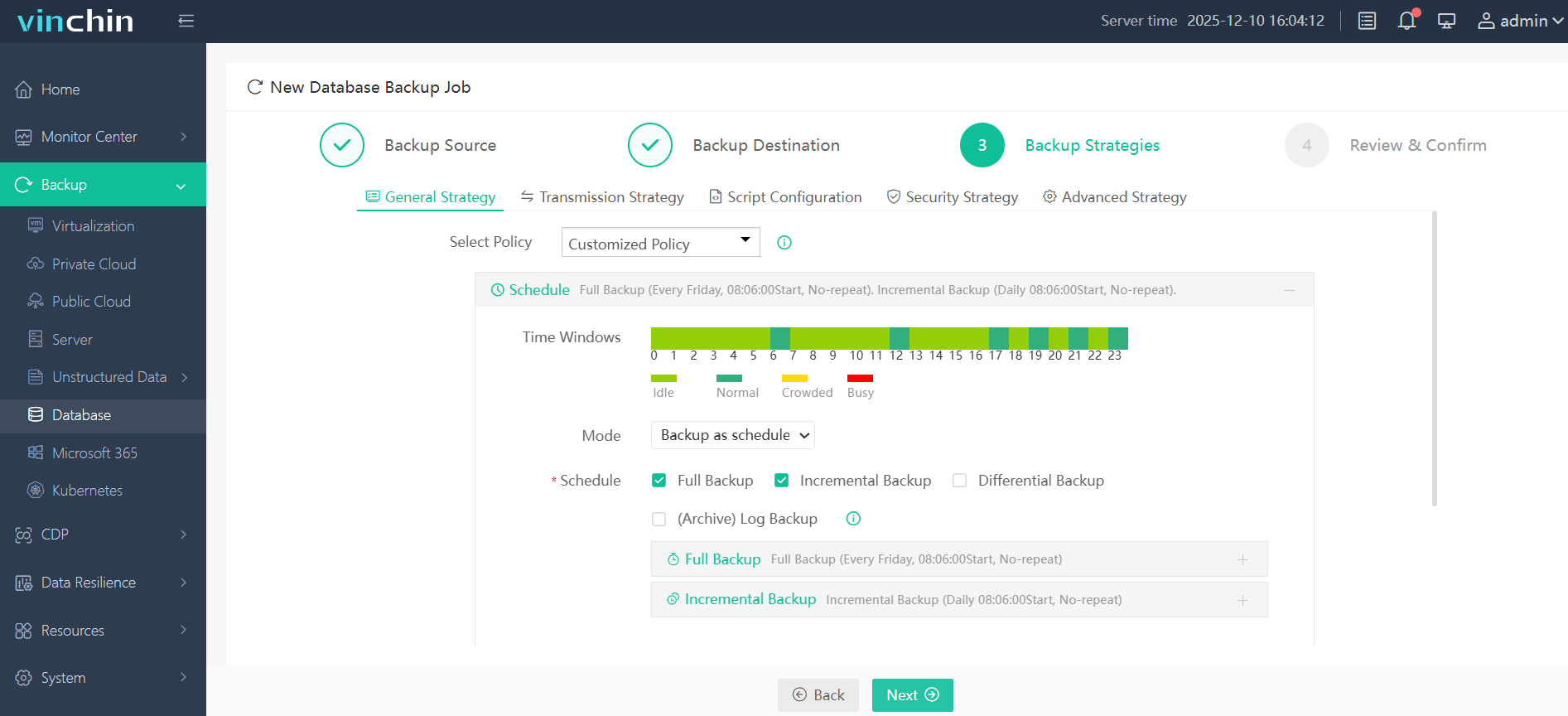
Step 3. Define the backup strategy
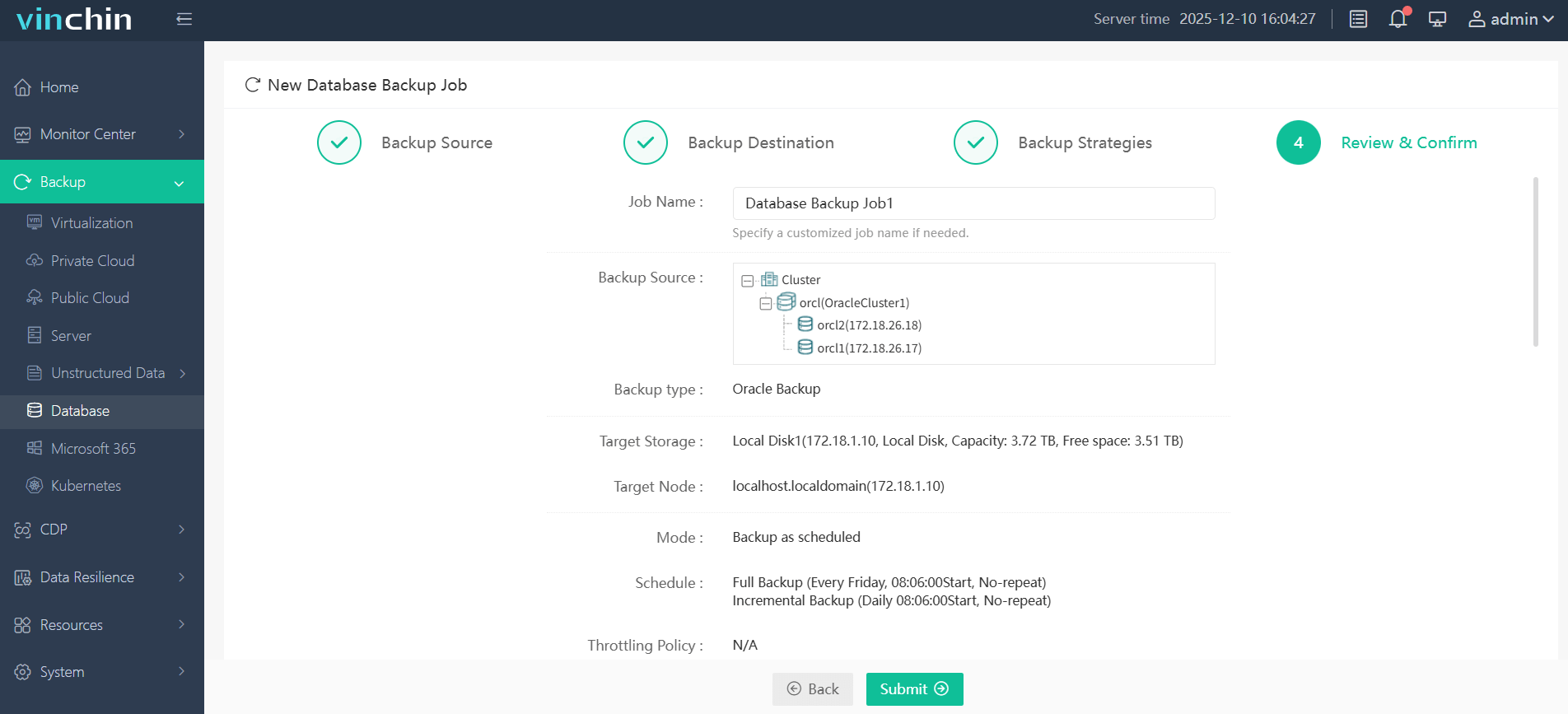
Step 4. Submit the job
Recognized worldwide with top ratings from thousands of customers across industries,Vinchin Backup & Recovery offers a fully featured free trial valid for sixty days—click below now to experience trusted enterprise-grade protection firsthand!
Oracle RMAN Parallelism FAQs
Q1: What happens if my configured oracle rman parallelism exceeds my actual hardware capacity?
A1: Too much parallelism causes resource contention; check views like v$backup_sync_io for long waits indicating overloaded disks or CPUs.
Q2: Does enabling compression affect how well oracle rman parallelization works?
A2: Yes; since compression uses extra CPU per channel process it may shift bottlenecks from storage toward processor limits—monitor accordingly!
Q3: How do I see which sessions/channels are active during an ongoing backup?
A3: Query v$session_longops filtering where opname includes ‘RMAN’.
Conclusion
Oracle rman parallelism speeds up database protection by splitting work across multiple streams—but always tune settings based on real-world hardware limits rather than theory alone! For streamlined enterprise-grade protection with advanced automation features try Vinchin free today—you’ll notice faster results right away!