Running Oracle database on Azure gives you flexibility and scalability. But it also brings a new set of challenges: how do you protect your data against corruption, accidental deletion, or application-level errors? While Azure provides infrastructure resilience through features like managed disks and availability sets, these cannot replace database-aware backup strategies. That’s where Oracle Recovery Manager (RMAN) comes in. Even in cloud environments like Azure, RMAN remains the trusted tool for reliable Oracle database protection. In this article, we’ll explore what makes RMAN valuable on Azure and walk step by step through several proven methods to back up Oracle databases using RMAN in an Azure environment.
What Is Oracle RMAN?
Oracle Recovery Manager (RMAN) is a built-in utility designed specifically for backing up, restoring, and recovering Oracle databases. It automates many routine backup tasks so you can focus on other priorities. With support for both incremental and full backups as well as point-in-time recovery options, RMAN helps ensure that your data remains safe even if something goes wrong. Its deep integration with Oracle Database makes it the standard choice whether your deployment is on-premises or in the cloud.
Why Use Oracle RMAN on Azure?
Azure offers its own backup services at the VM level. However, these solutions may not guarantee transactionally consistent recovery unless you script pre-backup actions yourself. In contrast, RMAN understands how to create consistent backups of active databases without downtime or risk of corruption. It supports incremental backups to save space and time; compression to reduce storage costs; encryption for security; and flexible restore options tailored to database workloads. On Azure, combining these strengths with scalable cloud storage lets you build a robust backup strategy that meets enterprise needs.
Method 1: Native Backup with RMAN
The simplest way to back up an Oracle database running on an Azure VM is by using native RMAN commands that write directly to attached disks.
Before starting any backup process in production environments—especially those hosted in the cloud—ensure your database runs in ARCHIVELOG mode. This mode allows online backups while users remain connected and enables point-in-time recovery if needed.
You can check or enable ARCHIVELOG mode using SQL*Plus:
SQL> SELECT log_mode FROM v$database;
SQL> SHUTDOWN IMMEDIATE;
SQL> STARTUP MOUNT;
SQL> ALTER DATABASE ARCHIVELOG;
SQL> ALTER DATABASE OPEN;
Next, configure a dedicated directory for storing backups—ideally located on a managed disk separate from your OS disk (such as Premium SSD). Avoid placing backups on temporary disks since they are wiped during maintenance events.
mkdir /u02/oracle_backups
Now use RMAN to perform a basic backup:
rman target /
RMAN> BACKUP DATABASE FORMAT '/u02/oracle_backups/%d_%U.bkp';
For better recoverability—and especially when managing operational databases—it’s wise to include archived logs and control files:
RMAN> BACKUP DATABASE PLUS ARCHIVELOG DELETE INPUT;
This command ensures all changes are captured while freeing up archive log space after successful backup.
Native disk-based backups work well for small-to-medium-sized databases or short-term retention needs. For larger deployments or longer retention periods—or if you want offsite protection—you’ll want to leverage cloud storage options available within Azure.
Method 2: Integrating Azure Blob Storage
Azure Blob Storage offers cost-effective scalability ideal for storing large volumes of backup data offsite from your VM’s local disks. With recent versions of Oracle Database (19c RU27+), you can use the built-in “Oracle Database Backup Cloud Service module for Azure” without extra downloads; earlier versions require downloading this module from Oracle Support.
Here’s how you can set up direct integration between RMAN and Blob Storage:
1. Obtain Your Storage Credentials:
Create an account/container via the Azure Portal under Storage Accounts > Containers; note down both account name and access key.
2. Install & Configure Cloud Backup Module:
On your server hosting Oracle Database:
java -jar az_setup.jar --accountname <your_account> --accountkey <your_key> --container <your_container>
This creates a config file (like azure.conf) plus required libraries (libopc.so).
3. Configure SBT Channel in RMAN:
Set up an SBT_TAPE channel referencing libopc.so:
RMAN> CONFIGURE CHANNEL DEVICE TYPE 'SBT_TAPE' PARMS 'SBT_LIBRARY=libopc.so,SBT_PARMS=(CONFIG_FILE=path/to/azure.conf)';
4. Test Your Setup:
Before launching full-scale jobs:
RMAN> BACKUP CURRENT CONTROLFILE;
5. Run Full Backups:
Once verified,
RMAN> BACKUP DATABASE;
For frequent restores or rapid access needs choose Blob Storage’s Hot tier; move older sets into Cool or Archive tiers later using lifecycle management policies—this helps control costs over time.
This approach supports all core features such as compression/encryption natively within RMAN while ensuring offsite disaster recovery readiness—even supporting “incremental forever” strategies where only changed blocks are uploaded after initial full backup.
Method 3: Backing Up to Azure Files via NFS
Azure Files delivers fully managed file shares accessible over SMB or NFS protocols—a handy option when sharing backups across multiple VMs or needing quick restores without moving large files across regions.
Creating & Mounting File Shares
First create a file share inside your chosen storage account:
Go into Storage Accounts, select yours,
Click File shares, then click + File share
Set name/quota as desired
For Linux VMs Using SMB:
Install cifs-utils if not present then mount using version 3.1.1 (for better security/performance):
sudo mkdir /mnt/orabackup
sudo mount -t cifs //<storage_account>.file.core.windows.net/<share_name> /mnt/orabackup -o vers=3.1.1,username=<storage_account>,password=<account_key>,dir_mode=0777,file_mode=0777,serverino,cache=none,uid=oracle,gid=oinstall
For Linux VMs Using NFS:
NFS support is only available with Premium FileShares enabled explicitly through portal settings. After enabling NFS, mount like this:
sudo mkdir /mnt/nfs_orabackup
sudo mount -t nfs <storage_account>.file.core.windows.net:/<share_name> /mnt/nfs_orabackup
Configuring Backups
Point your backup format at this mounted directory:
RMAN> CONFIGURE CHANNEL DEVICE TYPE DISK FORMAT '/mnt/orabackup/%d_%U.bkp';
or /mnt/nfs_orabackup/%d_%U.bkp if using NFS.
Start regular backups including archivelogs:
RMAN> BACKUP DATABASE PLUS ARCHIVELOG;
Keep in mind that network latency impacts performance—especially with large datasets—and premium tiers offer higher throughput but come at increased cost compared to standard shares.
If ultra-high performance is required—for example during massive restores—consider alternatives like presenting volumes via third-party solutions such as NetApp Files within Azure (though these incur additional licensing/costs).
Integration with Azure Backup for RPO/RTO Optimization
Many organizations combine native database-aware protection from RMAN with broader VM-level snapshots provided by native tools like Azure Backup service.
Why do this? While frequent local/incremental backups via RMAN provide fast operational recovery (low RTO), periodic snapshot-based VM-level images give bare-metal restore capability should entire systems be lost due to ransomware or catastrophic failure.
A typical hybrid strategy looks like this: schedule daily/hourly incremental/differential jobs via RMAN writing either locally or directly into Blob/Azure Files; then run less-frequent full image-based snapshots using Azure Backup, which captures OS state plus any locally stored backup sets/binaries/configuration files needed during disaster recovery scenarios.
Coordinate schedules so heavy I/O operations don’t overlap unnecessarily—which could degrade application performance—and always test both types of restore regularly so there are no surprises during emergencies.
Combining both approaches builds redundancy into your business continuity plan while keeping compliance teams happy thanks to independent chains of recoverability.
Introducing Vinchin Backup & Recovery: Enterprise-Level Protection for Oracle Databases on Azure
Beyond manual scripting and native tools, organizations seeking streamlined enterprise-grade protection should consider Vinchin Backup & Recovery—a professional solution purpose-built for comprehensive database safeguarding across today’s mainstream platforms including Oracle, MySQL, SQL Server, MariaDB, PostgreSQL, PostgresPro, and TiDB (with particular emphasis here on robust support for Oracle). Vinchin Backup & Recovery empowers IT teams with features such as advanced source-side compression (for supported platforms), incremental backup capabilities tailored specifically for Oracle environments, batch database operations at scale, granular data retention policy enforcement including GFS retention schemes, and multi-level data compression—all working together to optimize efficiency while maintaining compliance standards.
With its intuitive web console interface designed around simplicity:
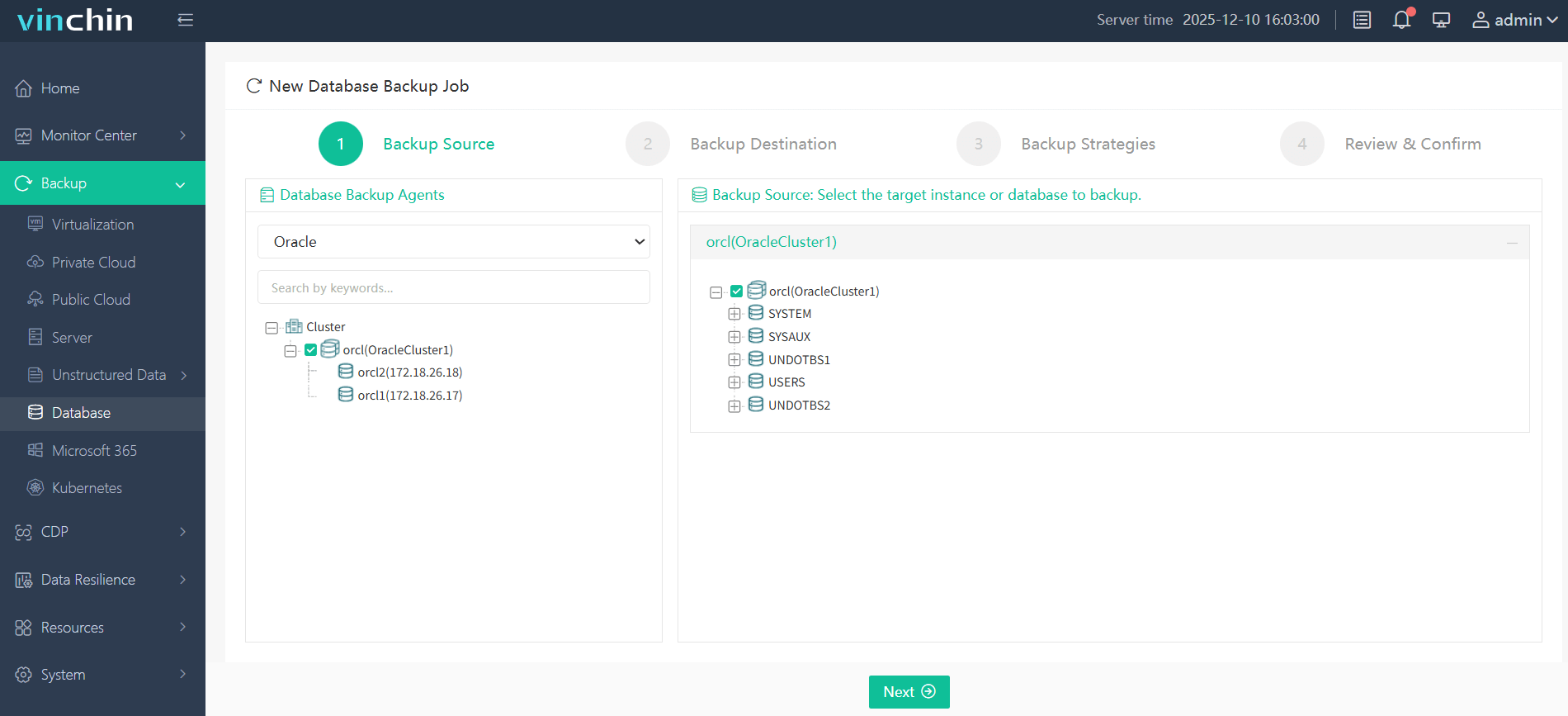
Step 1. Select the Oracle database to back up
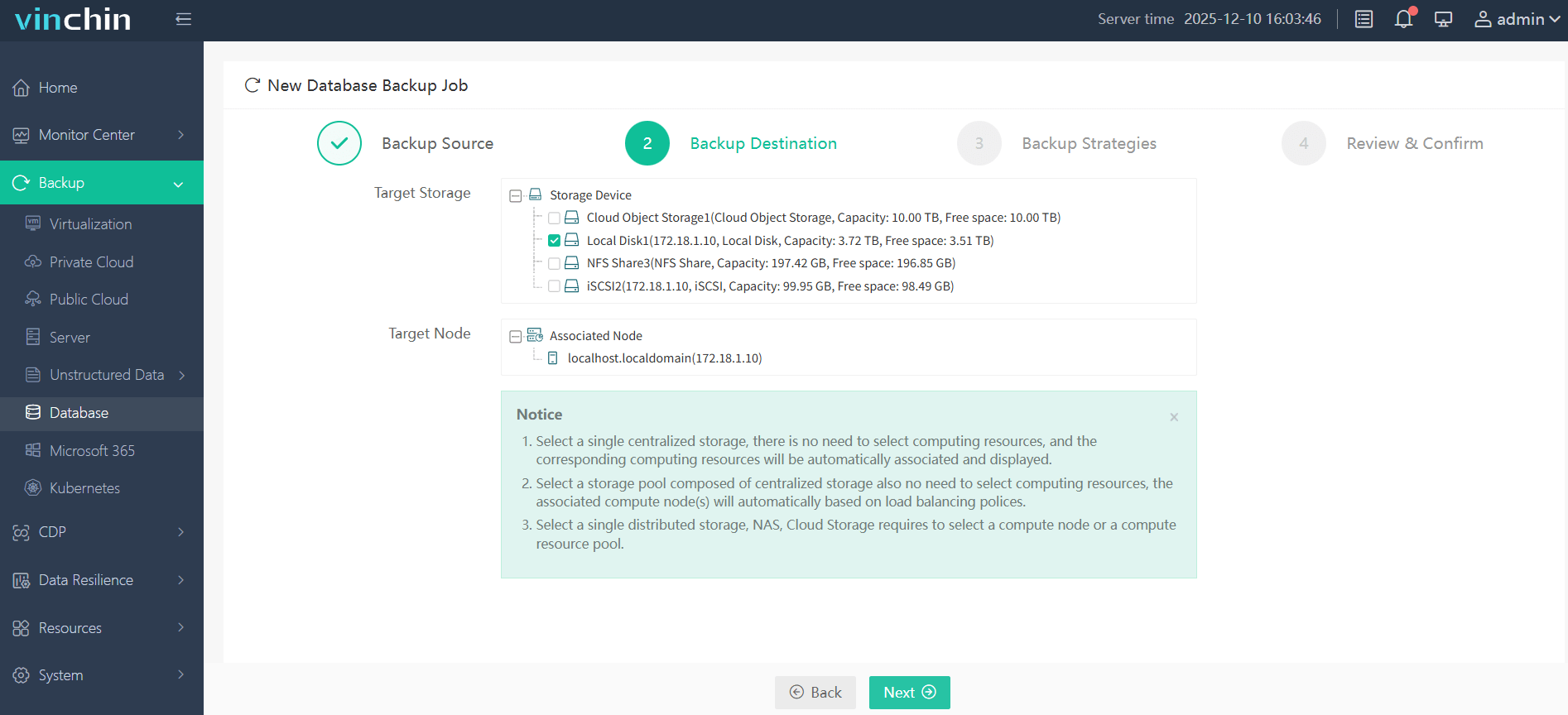
Step 2. Choose the backup storage
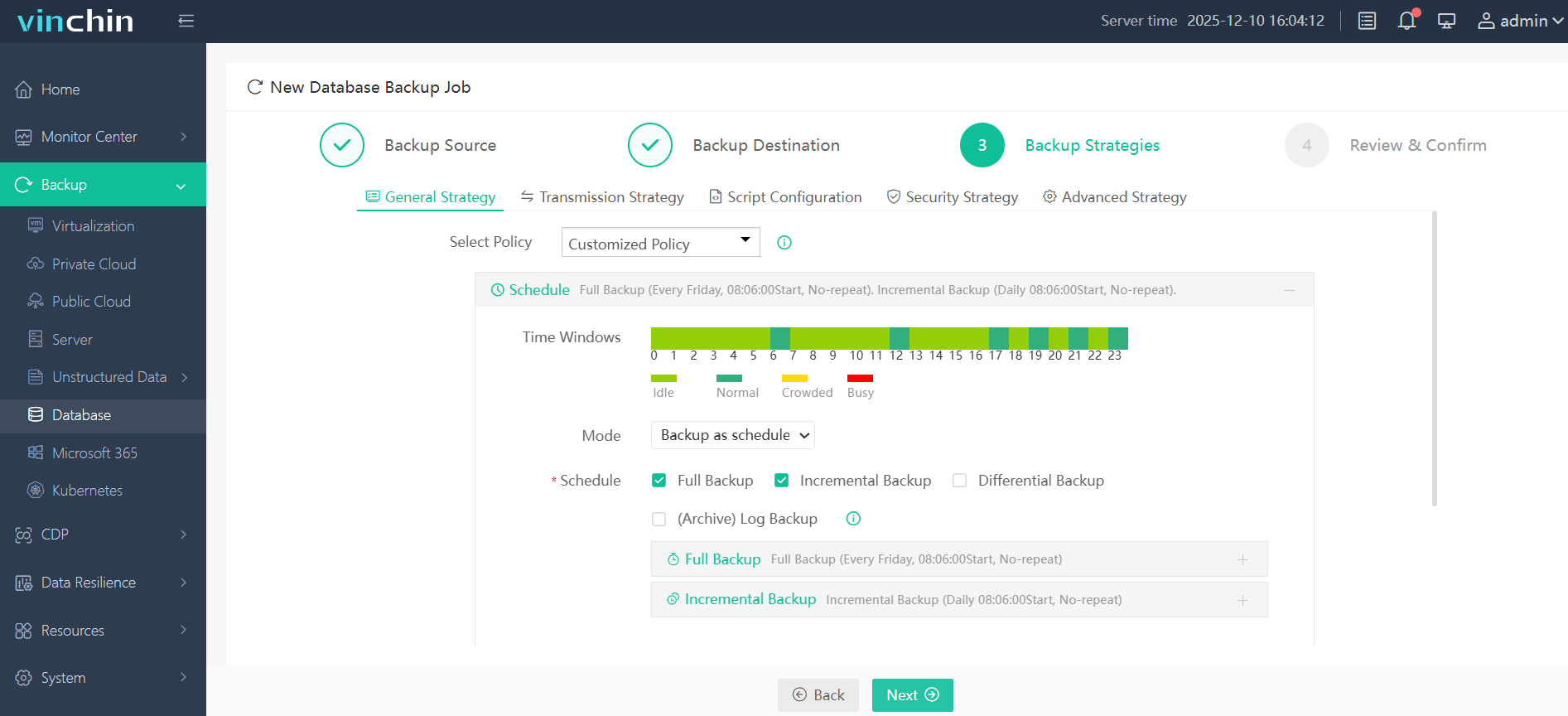
Step 3. Define the backup strategy
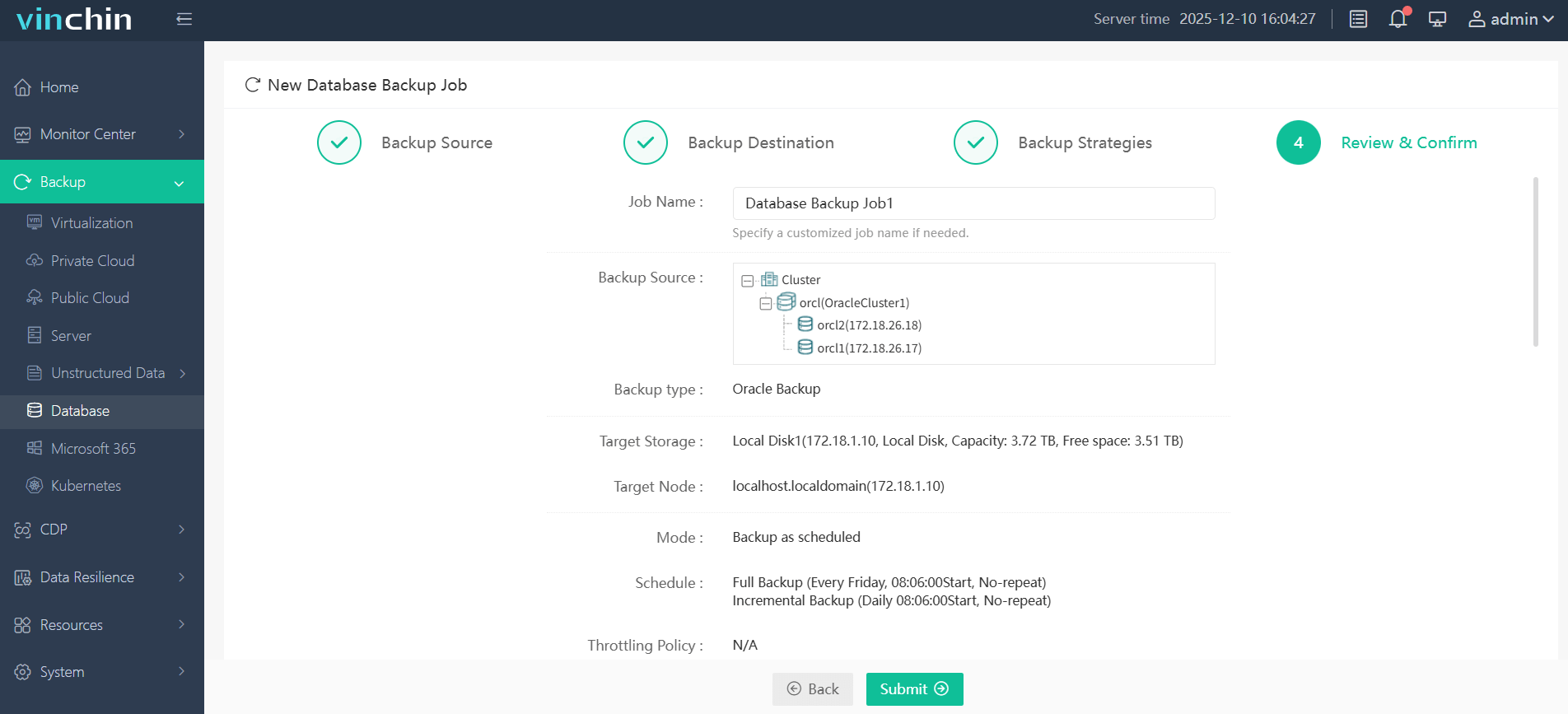
Step 4. Submit the job
Recognized globally by enterprises large and small—with top ratings from customers worldwide—Vinchin Backup & Recovery offers a fully featured 60-day free trial so you can experience best-in-class data protection firsthand before making any commitment.
Oracle RMAN on Azure FAQs
Q1: Can I use different storage accounts across regions when backing up my database?
A1: Yes—you can configure separate channels targeting different accounts/blobs but ensure network connectivity exists between source VM(s) & destination region(s).
Q2: How do I automate notifications after successful or failed scheduled backups?
A2: Integrate post-job hooks/scripts within cron jobs that call REST APIs/webhooks tied into services like Microsoft Teams/Azure Monitor alerts/email gateways immediately following job completion status codes returned by rman executable itself.
Q3: What are network egress cost implications when backing up/restoring between regions?
A3: Data transfers within same region incur no egress charges—but cross-region replication/migration does generate outbound traffic fees per current Microsoft pricing guidelines.
Conclusion
Oracle Recovery Manager remains essential even when running mission-critical workloads inside Microsoft’s public cloud platform—with multiple ways available depending upon budget/performance/compliance requirements involved per project phase encountered along journey toward digital transformation success! Vinchin further streamlines enterprise-grade protection workflows so every administrator sleeps easier knowing their most valuable assets remain secure day/night alike!