Protecting your Oracle database is a top priority for any operations administrator. Backups are your safety net against data loss, corruption, or disaster. On Linux, scripting Oracle RMAN (Recovery Manager) backups is a proven way to automate this critical task. But how do you write, schedule, and manage these scripts effectively? Let’s break it down step by step.
What is Oracle RMAN Backup?
Oracle RMAN (Recovery Manager) is Oracle’s built-in tool for database backup and recovery. It lets you back up datafiles, control files, archived logs, and more. RMAN can perform full and incremental backups, validate data integrity, and automate many recovery tasks. By using scripts, you can standardize and automate your backup process—reducing manual errors while ensuring consistency across environments. RMAN remains the industry standard for Oracle database protection.
Why Use RMAN Scripts on Linux?
Automating RMAN backups with scripts on Linux brings several advantages. First, it saves time by running backups without manual intervention. Second, scripts reduce the risk of human error—no more missed steps or typos. Third, you can schedule backups during off-peak hours to minimize impact on users. Fourth, scripts make it easy to enforce retention policies and manage storage efficiently. Finally, clear logs support auditing and troubleshooting efforts. This automation provides peace of mind—your backups run consistently without constant oversight.
Essential Pre-Script Checks and Best Practices
Before writing your first script or scheduling automated jobs in production environments, take time to prepare your system properly.
Start by confirming that all environment variables are set correctly for the Oracle user account—especially ORACLE_SID, ORACLE_HOME, ORACLE_BASE, and PATH values that match your installation paths. Make sure all directories used in your script exist; create them if needed using mkdir -p /u02/backup or similar commands.
Check disk space before every backup run using df -h. Running out of space during a backup can cause failures or even corrupt existing files.
Verify that the user running the script has write permissions on both backup directories and log file locations.
If you're working in an environment with multiple databases (RAC or multitenant), additional configuration may be required beyond what’s shown here; this guide assumes a single-instance setup with local disk storage as the target device type.
Finally—and most importantly—test both backup and restore procedures regularly in a non-production environment so you know exactly how recovery works when it matters most.
Method 1: Basic RMAN Backup Script Example
A basic yet reliable approach involves two files: one shell script sets up your environment; one command file contains actual RMAN commands.
First create an RMAN command file such as backup_level0.rman:
run {
  allocate channel ch1 device type disk;   # Allocate four channels for parallelism
  allocate channel ch2 device type disk;
  allocate channel ch3 device type disk;
  allocate channel ch4 device type disk;
  sql 'ALTER SYSTEM ARCHIVE LOG CURRENT';  # Force log switch before backup
  configure retention policy to recovery window of 5 days; # Set retention
  configure device type disk backup type to compressed backupset parallelism 4;
  crosscheck backup device type disk;      # Check status of existing backups
  crosscheck archivelog all;
  delete noprompt archivelog all backed up 1 times to device type disk; # Clean old archive logs
  backup incremental level 0 as compressed backupset database archivelog all tag weekly_Full_backup delete input; # Full DB + archive logs
  delete noprompt obsolete;                # Remove obsolete backups per policy
  delete noprompt expired backup;
  release channel ch1;
  release channel ch2;
  release channel ch3;
  release channel ch4;
}
Add comments like above so anyone reviewing knows what each block does at a glance.
Next create a shell script named rman_bkp.sh:
#!/bin/bash
export ORACLE_SID=orcl                      # Set correct SID here
export ORACLE_BASE=/u02/app/oracle          # Adjust path if needed
export ORACLE_HOME=$ORACLE_BASE/product/19.0.0/dbhome_1
export PATH=$ORACLE_HOME/bin:$PATH

rman target / nocatalog log=/u02/backup/RMAN_backup.log cmdfile=/u02/backup/backup_level0.rman
Make sure this script is executable:
chmod 744 rman_bkp.sh
Run it manually from the terminal:
./rman_bkp.sh
This example uses nocatalog, which means metadata about backups stays within each database's control file rather than being centralized elsewhere—a simple approach suitable for smaller environments or where only one instance needs managing at a time. For larger setups or those needing centralized management across many databases (such as Data Guard deployments), consider configuring an external Recovery Catalog instead.
Always review /u02/backup/RMAN_backup.log after each run for errors or warnings before assuming success!
Method 2: Advanced Scheduling with Cron Jobs
Once your script works reliably by hand it's time to automate regular execution using cron—the classic Unix/Linux scheduler service built into every distribution.
Cron jobs execute based on server local time zone settings so always confirm system clock accuracy (date command). Test new schedules in non-production first whenever possible!
Edit crontab entries under the same user who owns Oracle processes:
crontab -e
To schedule daily full backups at precisely ten o’clock PM add this line:
00 22 * * * /u02/backup/rman_bkp.sh > /dev/null 2>&1
This runs every day at "22:00" server time regardless of weekends or holidays—adjust hour/minute fields as needed for your business requirements.
If you want incremental level-one backups other days (for example Monday through Saturday), first create another command file called backup_level1.rman:
run {
   backup incremental level 1 as compressed backupset database tag daily_Incremental_backup;
}
Then add another cron entry like:
00 01 * * MON-SAT /u02/backup/rman_bkp_incremental.sh > /dev/null 2>&1
Be sure every referenced path is absolute—not relative—to avoid confusion when cron executes outside interactive shells! If necessary source profile settings at start of each shell script (source ~/.bash_profile) so environment variables load correctly even under cron context.
Monitor log growth over time since repeated runs may fill disks quickly unless rotated out periodically via tools like logrotate.
Vinchin Backup & Recovery: Enterprise-Grade Protection for Your Oracle Database
For organizations seeking streamlined management alongside advanced features beyond native scripting alone, Vinchin Backup & Recovery delivers comprehensive enterprise-level protection tailored specifically for mainstream databases—including Oracle (as well as MySQL, SQL Server, MariaDB, PostgreSQL, PostgresPro, TiDB). With support for advanced source-side compression and incremental backup on Oracle databases plus batch processing capabilities and multi-level data compression options across platforms—all governed by flexible retention policies—you gain efficient storage use while simplifying large-scale administration without sacrificing compliance or recoverability needs.
Among its many strengths are features like any-point-in-time recovery support (so you can restore exactly what’s needed), cloud/tape archiving integration for offsite safety nets, scheduled automated jobs with granular strategy controls per instance/database groupings—even robust storage protection mechanisms against ransomware threats—all managed through an intuitive web console.
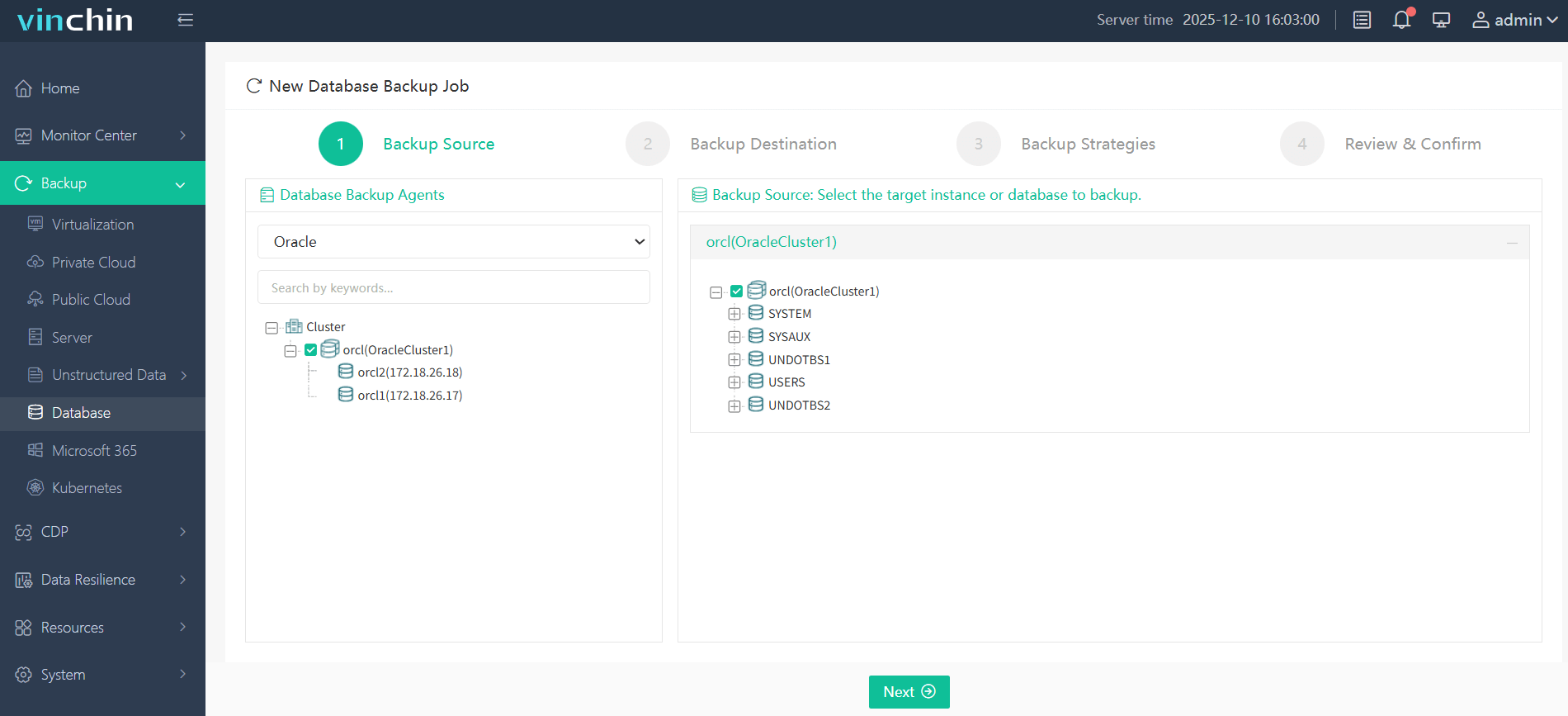
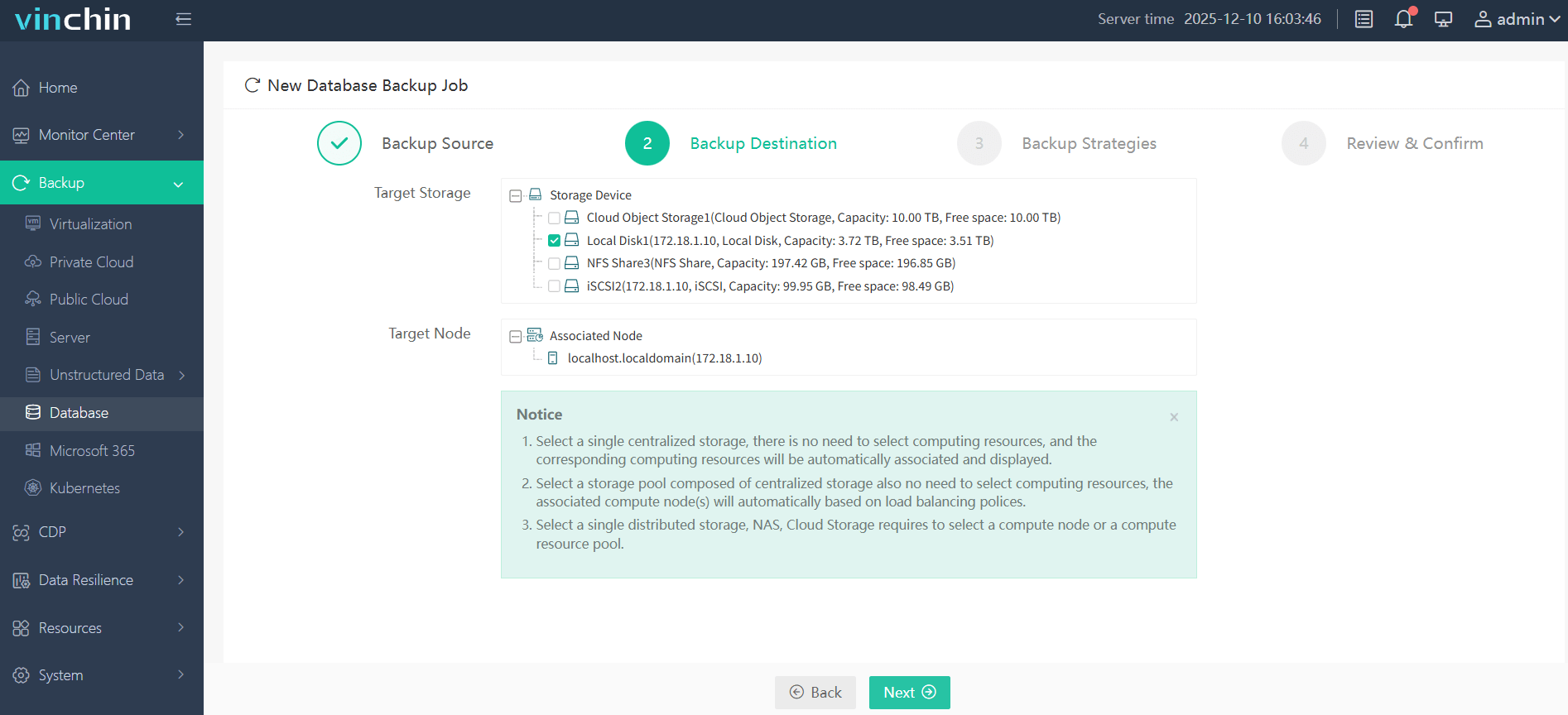
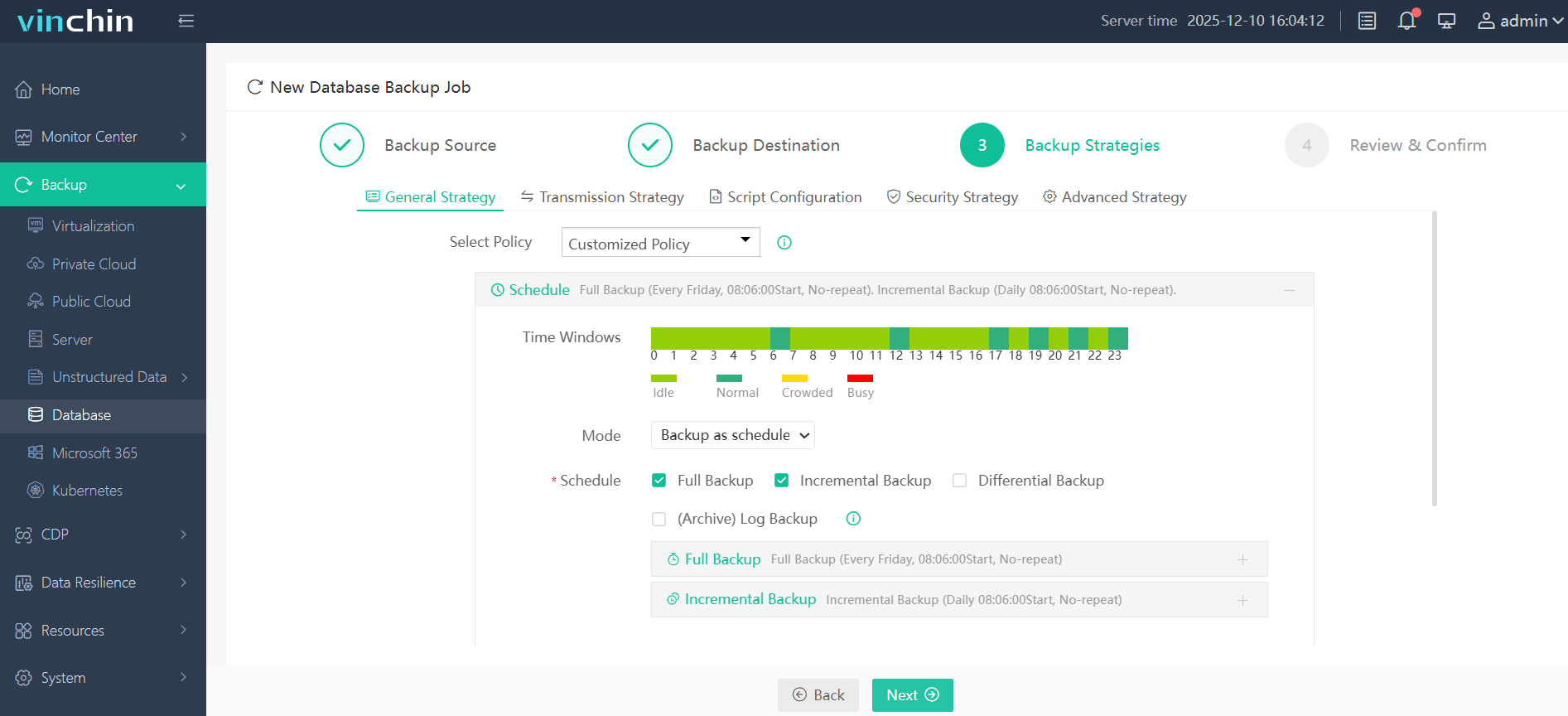
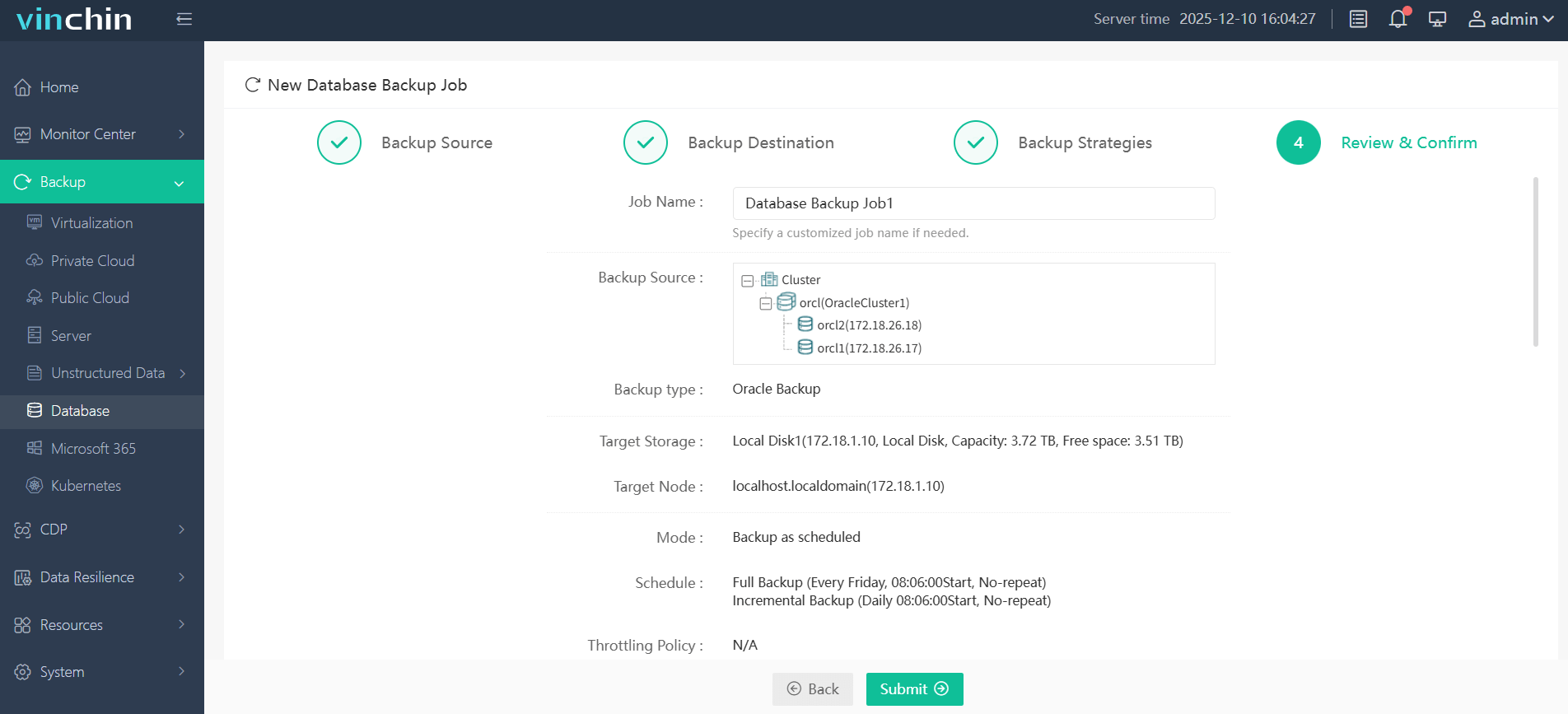
Backing up an Oracle database with Vinchin Backup & Recovery takes just four straightforward steps:
Step 1. Select the Oracle database to back up
Step 2. Choose the backup storage
Step 3. Define the backup strategy
Step 4. Submit the job
Recognized globally among IT professionals—with thousands of satisfied customers worldwide—Vinchin Backup & Recovery offers a fully featured free trial lasting sixty days so you can experience effortless enterprise-grade data protection firsthand.
Oracle RMAN Backup Script Linux FAQs
Q1: Can I run an RMAN script against multiple databases hosted on one server?
Yes—set ORACLE_SID appropriately before each run then execute scripts separately per instance.
Q2: How do I verify my latest RMAN backup worked?
Open its log file then search near end for “Finished” lines plus absence of “ORA-“ errors indicating failure conditions were encountered during operation.
Q3: How can I validate my existing RMAN backups?
Use VALIDATE BACKUPSET inside an interactive rman session targeting specific sets needing verification.
Conclusion
Automating Oracle RMAN backups on Linux keeps critical business data protected around-the-clock—with full/incremental strategies ensuring reliable recovery no matter what happens next! For greater simplicity plus advanced features try Vinchin’s complete enterprise solution free today—it makes effortless protection possible even across complex hybrid cloud landscapes!