Backing up your Oracle databases is not just a best practice—it is essential for business continuity. RMAN (Recovery Manager) is Oracle’s built-in tool for backup and recovery. But how do you create a reliable RMAN backup script? In this article, we will walk through clear, real-world RMAN backup script examples. You will learn how to write, schedule, automate, validate, and troubleshoot these scripts for both full and incremental backups. Ready to make your Oracle backups bulletproof?
What is an RMAN Backup Script?
An RMAN backup script is a text file containing a sequence of RMAN commands that automate database backups. These scripts help ensure consistency across backups while reducing manual errors that can occur during interactive sessions. By using scripts instead of ad-hoc commands, you standardize your process—making it easier to manage large environments or hand off tasks between team members.
You can run these scripts interactively or schedule them to execute at regular intervals using system tools like cron or Task Scheduler. With scripting, you can handle full database backups, incremental backups at different levels (level 0 or level 1), archived logs management, control file protection, SPFILE protection, retention policies—and more advanced options as needed.
RMAN scripts are especially useful in production because they allow repeatable processes that are easy to audit and troubleshoot if something goes wrong.
Method 1: Full Database Backup Script Example
A full database backup captures all datafiles along with control files—and optionally archived logs—to provide a complete snapshot of your Oracle environment at one point in time. This type of backup forms the foundation of any robust recovery plan.
Let’s look at a simple yet effective example:
First, create a file named full_backup.rman with the following content:
RUN {
  ALLOCATE CHANNEL ch1 DEVICE TYPE DISK; -- Allocate first channel
  ALLOCATE CHANNEL ch2 DEVICE TYPE DISK; -- Allocate second channel
  BACKUP AS COMPRESSED BACKUPSET DATABASE PLUS ARCHIVELOG DELETE INPUT; -- Backup DB & logs; delete logs after
  BACKUP CURRENT CONTROLFILE; -- Protect current control file
  BACKUP SPFILE; -- Protect server parameter file
  CROSSCHECK BACKUP; -- Update status of existing backups
  DELETE NOPROMPT OBSOLETE; -- Remove old/expired backups per retention policy
  RELEASE CHANNEL ch1;
  RELEASE CHANNEL ch2;
}
This script allocates two channels so that multiple streams can run in parallel—speeding up the process on larger databases or multi-core servers. It compresses output to save disk space (especially helpful if storage is tight). The command PLUS ARCHIVELOG DELETE INPUT ensures all archived redo logs are included in the backup set before being deleted from disk—helping free up space while maintaining recoverability.
The inclusion of CROSSCHECK BACKUP helps keep catalog metadata accurate by verifying which physical files still exist on disk or tape storage. Afterward, DELETE NOPROMPT OBSOLETE removes expired files according to your configured retention policy—a key step in managing long-term storage costs.
To run this script from your operating system shell:
rman target / @full_backup.rman log=full_backup.log
This command connects you directly to the target database using OS authentication (target /), runs all commands inside full_backup.rman, and writes detailed output into full_backup.log. Always check that directories used for storing both backups and logs exist beforehand—and have correct permissions set so Oracle can write there without issue.
For better security in production environments where jobs are scheduled unattended (for example via cron), consider creating a dedicated Oracle user account just for running automated jobs—and store credentials securely using tools like Oracle Wallet rather than relying only on OS authentication.
Method 2: Incremental Backup Script Example
Incremental backups capture only changes since the last baseline (level 0) or previous incremental (level 1) backup—saving both time and storage compared to repeated fulls. This approach works well when dealing with large databases where daily fulls would be impractical.
There are two main types:
Here’s an example differential level one script (incr_level1_backup.rman):
RUN {
  ALLOCATE CHANNEL ch1 DEVICE TYPE DISK;
  ALLOCATE CHANNEL ch2 DEVICE TYPE DISK;
  BACKUP AS COMPRESSED BACKUPSET INCREMENTAL LEVEL 1 DATABASE PLUS ARCHIVELOG DELETE INPUT;
    -- Only changed blocks + archive logs since last L0/L1
  BACKUP CURRENT CONTROLFILE;
    -- Control file protection
  BACKUP SPFILE;
    -- Server parameter file protection
  CROSSCHECK BACKUP;
    -- Verify catalog matches reality
  DELETE NOPROMPT OBSOLETE;
    -- Clean out expired sets per policy
  RELEASE CHANNEL ch1;
    -- Free resources promptly
  RELEASE CHANNEL ch2;
}
If you want cumulative behavior instead—for faster restores but potentially larger incrementals—simply add CUMULATIVE after INCREMENTAL LEVEL 1.
Before running any incremental level one job above (LEVEL = 1), ensure you’ve already taken at least one baseline (LEVEL = 0) using nearly identical syntax:
BACKUP AS COMPRESSED BACKUPSET INCREMENTAL LEVEL 0 DATABASE PLUS ARCHIVELOG DELETE INPUT;
To execute an incremental job:
rman target / @incr_level1_backup.rman log=incr_level1_backup.log
Incremental strategies reduce overall impact on busy systems by shrinking both window length and required storage footprint over time—but always monitor performance closely during initial runs until baselines stabilize.
How to Automate RMAN Backup Scripts?
Manual execution leaves room for error—what if someone forgets? Automation guarantees regularity so no critical window ever gets missed due to human oversight.
On Linux/UNIX platforms:
Write your .rman script as shown above.
Create a shell wrapper such as run_full_backup.sh, including environment setup:
   #!/bin/bash
   export ORACLE_SID=yourdb         # Set instance name here!
   export ORACLE_HOME=/u01/app/oracle/product/19.0.0/dbhome_1
   export PATH=$ORACLE_HOME/bin:$PATH
   rman target / @/path/to/full_backup.rman log=/path/to/logs/full_backup_$(date +%F).log

   # Check exit code & alert if failure detected:
   if [ $? -ne 0 ]; then
     echo "RMAN failed! See log." | mail -s "RMAN Failure" dba-team@example.com
   fi
Make sure /path/to/logs/ exists and is writable by the user running this job—or else logging will silently fail!
Set executable permission:
chmod 750 run_full_backup.sh
Schedule it via crontab:
0 2 * * * /path/to/run_full_backup.sh
This schedules daily execution at precisely 2:00 AM server time—but adjust frequency/timing based on business needs.
On Windows:
   set ORACLE_SID=yourdb
   set ORACLE_HOME=C:\app\oracle\product\19.0.0\dbhome_1
   set PATH=%ORACLE_HOME%\bin;%PATH%
   rman target / @C:\scripts\full_backup.rman log=C:\scripts\logs\full_backup_%DATE%.log

   REM Optional: Add error checking/reporting here too!
Open Task Scheduler, create new task:
Always review generated logs after each run—not just looking for “Recovery Manager complete,” but scanning also for any lines starting with “RMAN-“ or “ORA-“ indicating warnings/errors needing attention!
For extra reliability in enterprise setups: integrate notification hooks into wrapper scripts so failures trigger alerts via email/SMS/chat ops tools immediately when detected—not hours later during routine checks.
Introducing Vinchin Backup & Recovery
Beyond native scripting solutions, organizations seeking streamlined enterprise-grade protection should consider Vinchin Backup & Recovery—a professional solution supporting today’s leading databases including Oracle, MySQL, SQL Server, MariaDB, PostgreSQL, PostgresPro, and TiDB. For Oracle users specifically, Vinchin Backup & Recovery delivers features such as advanced source-side compression and incremental backup alongside batch database operations and flexible GFS/data retention policies—all designed to optimize efficiency while ensuring compliance and rapid recovery readiness. With capabilities like integrity check verification via SQL scripts and WORM-protected storage combined under one intuitive platform, businesses benefit from simplified management without sacrificing reliability or security standards.
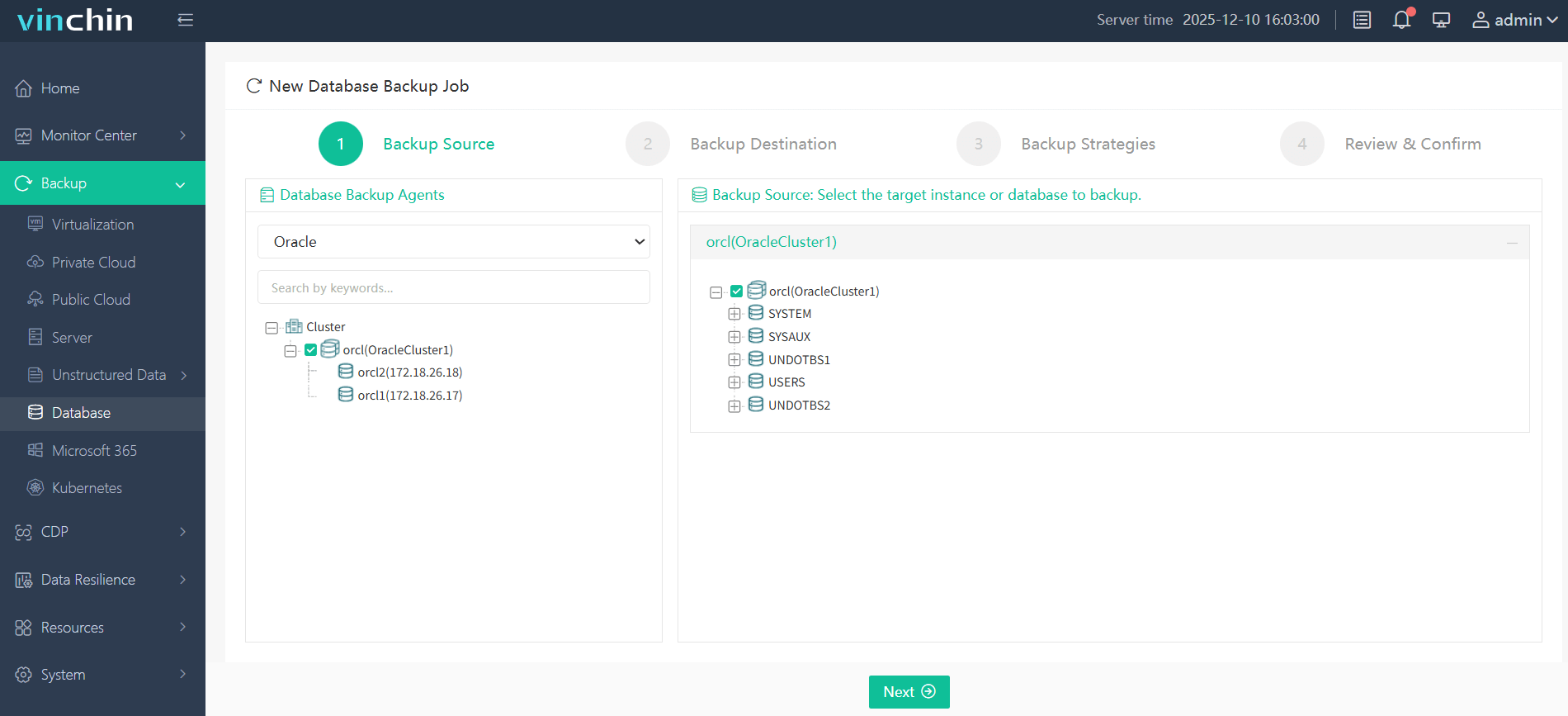
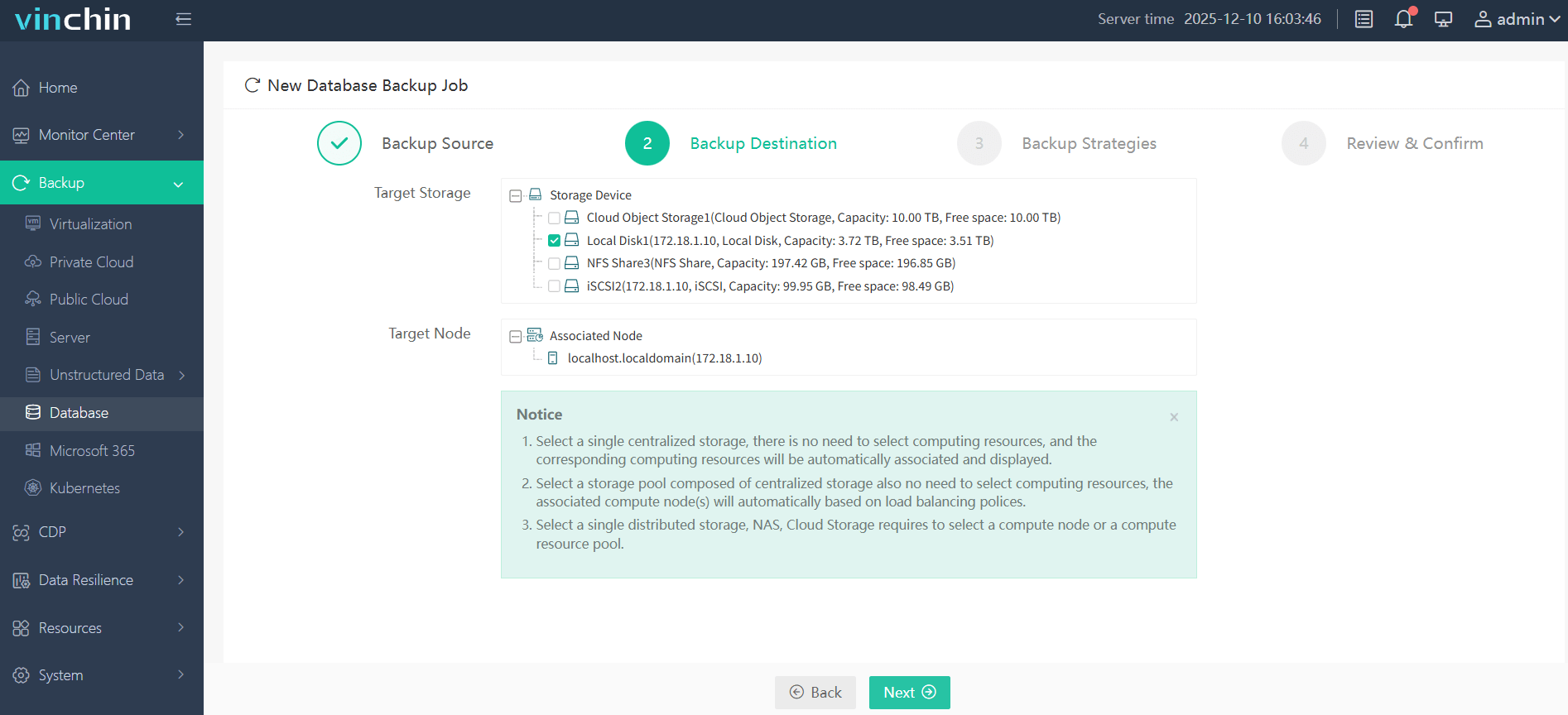
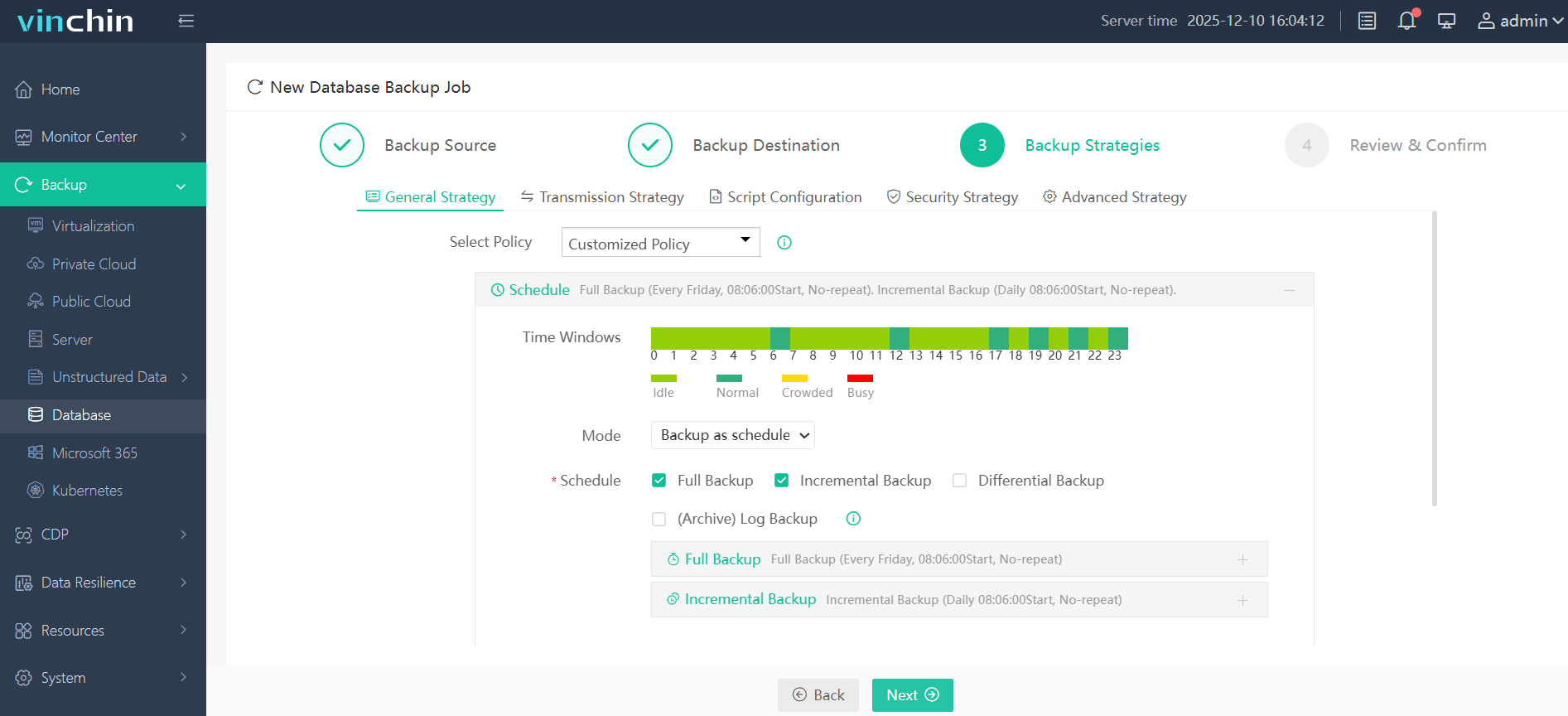
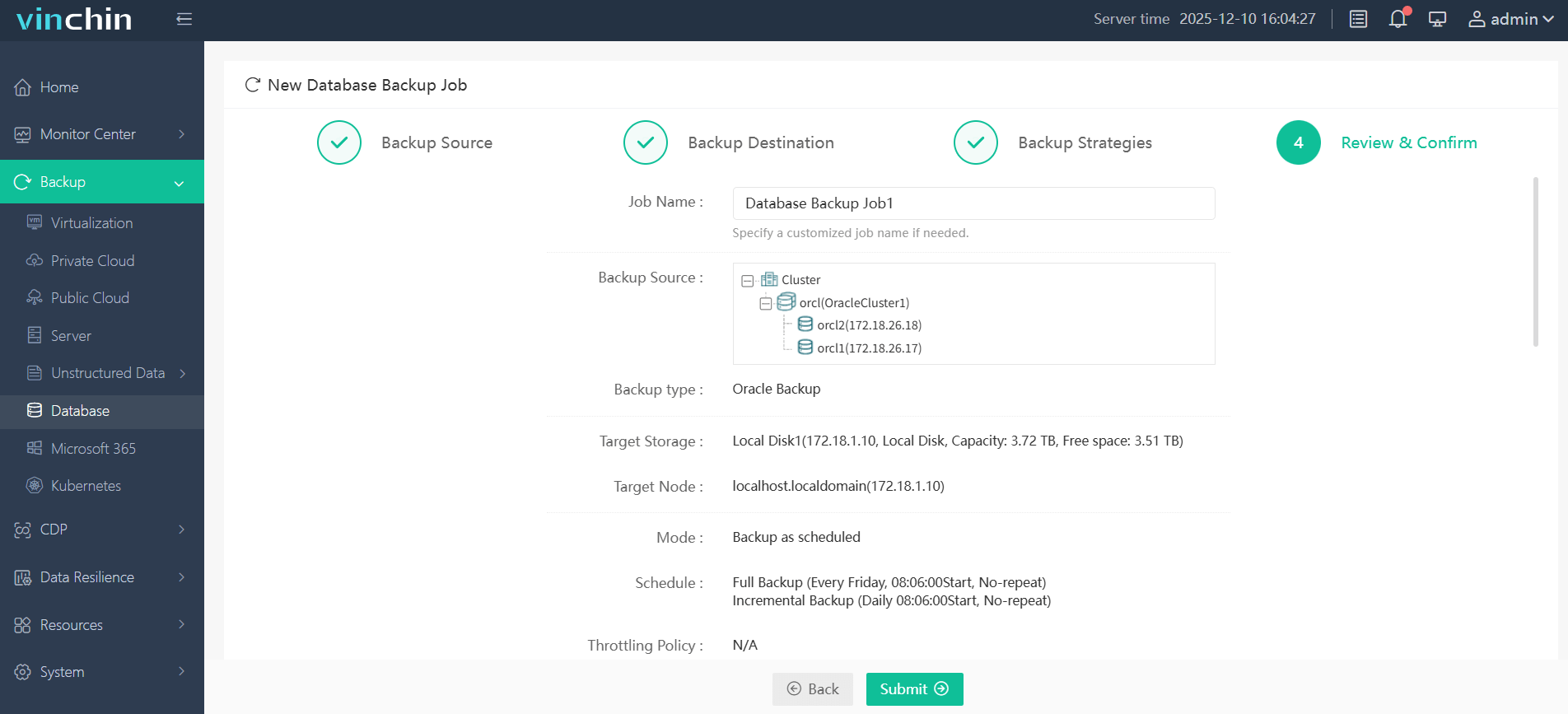
The web console makes safeguarding your Oracle environment straightforward:
Step 1. Select the Oracle database to back up
Step 2. Choose the backup storage
Step 3. Define the backup strategy
Step 4. Submit the job
Vinchin Backup & Recovery enjoys global recognition among enterprises—with top ratings from thousands of satisfied customers worldwide—and offers a risk-free sixty-day trial packed with all features available via download.
RMAN Backup Script Example FAQs
Q1: How do I encrypt my RMAN backups?
Add ENCRYPTION clause inside your RUN block before issuing any BACKUP command—for example: ENCRYPTION ON IDENTIFIED BY 'password'.
Q2: What should I do if my scheduled job fails unexpectedly?
Check both operating system event/error logs plus contents of generated .log files immediately after failure occurs—to identify root cause quickly.
Q3: Can I back up specific tablespaces instead of entire databases?
Yes—replace DATABASE keyword with TABLESPACE tablespace_name(s) inside any relevant BACKUP command.
Conclusion
Creating reliable RMAN backup scripts protects critical data assets efficiently when paired with automation and routine validation checks throughout their lifecycle management process. For even greater ease-of-use plus advanced features beyond scripting alone try Vinchin’s enterprise-grade solution risk-free today!