Protecting your Oracle database is not just a best practice—it is essential. But how do you balance backup speed, storage use, and fast recovery? Many administrators turn to Oracle RMAN incremental level 1 cumulative backups for this reason. In this guide, you will learn what these backups are, why they matter, and how to run them both manually and automatically. Ready to make your backup strategy more efficient?
What Is Oracle RMAN Incremental Level 1 Cumulative Backup?
Oracle Recovery Manager (RMAN) offers flexible ways to back up your data efficiently. An incremental backup copies only the data blocks that have changed since a previous backup. This approach saves time and reduces storage compared to full backups.
There are two main types of level 1 incremental backups: differential and cumulative. A level 1 cumulative backup backs up all blocks changed since the most recent level 0 backup—regardless of any other level 1 backups taken in between. With this method, you need only the last level 0 backup plus the latest cumulative level 1 backup to restore your database to a specific point. This design makes restores simpler because it avoids chaining together multiple incrementals.
For example, if you take a weekly level 0 full backup on Sunday and daily cumulative backups from Monday through Saturday, restoring after a failure on Friday requires only Sunday’s full (level 0) plus Friday’s cumulative (level 1). All changes since Sunday are included in that one file.
Why Choose Incremental Level 1 Cumulative Backups?
Choosing cumulative incremental backups can simplify recovery operations while balancing performance needs. With this method, you avoid applying many small incremental files during restore—just apply the latest cumulative after restoring your base image.
This approach reduces restore time because there is no need to process several differential incrementals in sequence. It also lowers risk; missing one link in an incremental chain can prevent successful recovery with differential methods. However, keep in mind that each cumulative contains all changes since the last level 0—so these files grow larger over time until another full is taken.
It's important for administrators to align their retention policy with their schedule of fulls and cumulatives. If old cumulatives are not deleted regularly using commands like DELETE OBSOLETE, disk space can fill up quickly due to overlapping data sets. Setting an appropriate CONFIGURE RETENTION POLICY ensures obsolete backups are removed according to business requirements while keeping enough history for safe restores.
Many organizations accept slightly larger individual files as a fair trade-off for faster disaster recovery processes—and less complexity when every minute counts.
Method 1 Running Incremental Level 1 Cumulative Backup Manually
Manual control over your Oracle RMAN backups gives flexibility but requires careful attention to prerequisites and verification steps. Before starting any manual incremental process, always confirm that you have a recent valid level 0 baseline available; otherwise, restoration may fail or be incomplete.
To run an Oracle RMAN incremental level 1 cumulative backup manually:
First, verify that at least one valid level 0 exists:
LIST BACKUP SUMMARY;
Look for entries labeled "LEVEL=0" under "TYPE" or "LVL".
Next:
1. Open a terminal window on your database server
2. Connect as an authorized user by typing:
rman target /
3. Start the cumulative backup process with:
BACKUP INCREMENTAL LEVEL 1 CUMULATIVE DATABASE;
This command instructs RMAN to back up all blocks changed since your last successful level 0 across the entire database.
If you want more granular control—for example backing up just one tablespace or datafile—replace DATABASE with TABLESPACE users or DATAFILE n, such as:
BACKUP INCREMENTAL LEVEL 1 CUMULATIVE TABLESPACE users;
After completion, check status using:
LIST BACKUP OF DATABASE;
This displays details about completed jobs so you can confirm success before moving on.
Manual runs work well for ad-hoc protection or special maintenance windows but require discipline around scheduling and monitoring so nothing gets missed.
Method 2 Automating Oracle RMAN Incremental Backups Using DBMS_SCHEDULER
Automating regular Oracle RMAN backups helps ensure consistent protection without relying on human memory or manual intervention—a key advantage in busy production environments.
Oracle provides DBMS_SCHEDULER, which lets you schedule scripts at fixed times using built-in job management features found within SQL*Plus or Enterprise Manager tools.
Here’s how you can set up automated daily cumulative incrementals:
First create a shell script (for example /u01/scripts/rman_cum_backup.sh) containing:
#!/bin/bash
set -o errexit
LOGFILE="/u01/scripts/logs/rman_cum_backup_$(date +%F_%H-%M-%S).log"
rman target / <<EOF > $LOGFILE 2>&1
BACKUP INCREMENTAL LEVEL 1 CUMULATIVE DATABASE;
EXIT
EOF
This script uses set -o errexit so it stops if any command fails; output goes into timestamped log files under /u01/scripts/logs/ for easy troubleshooting later.
Make sure it’s executable by running:
chmod +x /u01/scripts/rman_cum_backup.sh
Now schedule it inside SQL*Plus using DBMS_SCHEDULER:
BEGIN
 DBMS_SCHEDULER.create_job (
   job_name        => 'RMAN_CUM_BACKUP_JOB',
   job_type        => 'EXECUTABLE',
   job_action      => '/u01/scripts/rman_cum_backup.sh',
   start_date      => SYSTIMESTAMP,
   repeat_interval => 'FREQ=DAILY;BYHOUR=2', -- runs daily at 2 AM
   enabled         => TRUE
 );
END;
/
You can adjust repeat_interval as needed—for instance running twice per day or only weekdays depending on business needs.
To monitor scheduled jobs’ status run:
SELECT job_name, state, last_start_date, last_run_duration FROM dba_scheduler_jobs WHERE job_name = 'RMAN_CUM_BACKUP_JOB';
Check generated log files after each run for errors or warnings—these logs provide vital clues if something fails unexpectedly overnight!
Automated scheduling means even if staff forgets—or is unavailable due to holidays—the system remains protected against accidental loss or corruption events.
Restoring from an Incremental Level 1 Cumulative Backup
The main benefit of using Oracle RMAN incremental level 1 cumulative backups appears during disaster recovery—they streamline restores by reducing steps required compared with differential chains.
When restoring after failure:
Restore begins by loading your most recent valid level 0 (full) image first:
RESTORE DATABASE;
Then apply changes captured in your latest available cumulative:
RECOVER DATABASE;
RMAN automatically selects correct pieces based on timestamps—no need for complex scripting unless custom point-in-time objectives exist.
If restoring just part of the environment (such as one tablespace), substitute relevant object names accordingly:
RESTORE TABLESPACE users; RECOVER TABLESPACE users;
Always validate restored objects before returning systems fully online!
This simplicity makes cumulatives attractive where downtime must be minimized—even though individual files may be larger than differentials taken more frequently.
Vinchin: Professional Solution for Oracle Database Backup
Beyond native tools like RMAN, enterprise environments often require advanced capabilities and streamlined management interfaces for comprehensive protection of critical databases such as Oracle. Vinchin Backup & Recovery stands out as a professional-grade solution supporting today’s mainstream platforms—including Oracle, MySQL, SQL Server, MariaDB, PostgreSQL, PostgresPro, and TiDB—to meet diverse organizational needs at scale.
Key features include batch database backup operations for efficiency across large estates; robust retention policy management ensuring compliance and optimized storage usage; cloud backup with tape archiving options enabling hybrid strategies; WORM protection safeguarding against ransomware alteration attempts; and integrity check functions verifying recoverability of stored data sets—all designed to maximize security while simplifying administration.
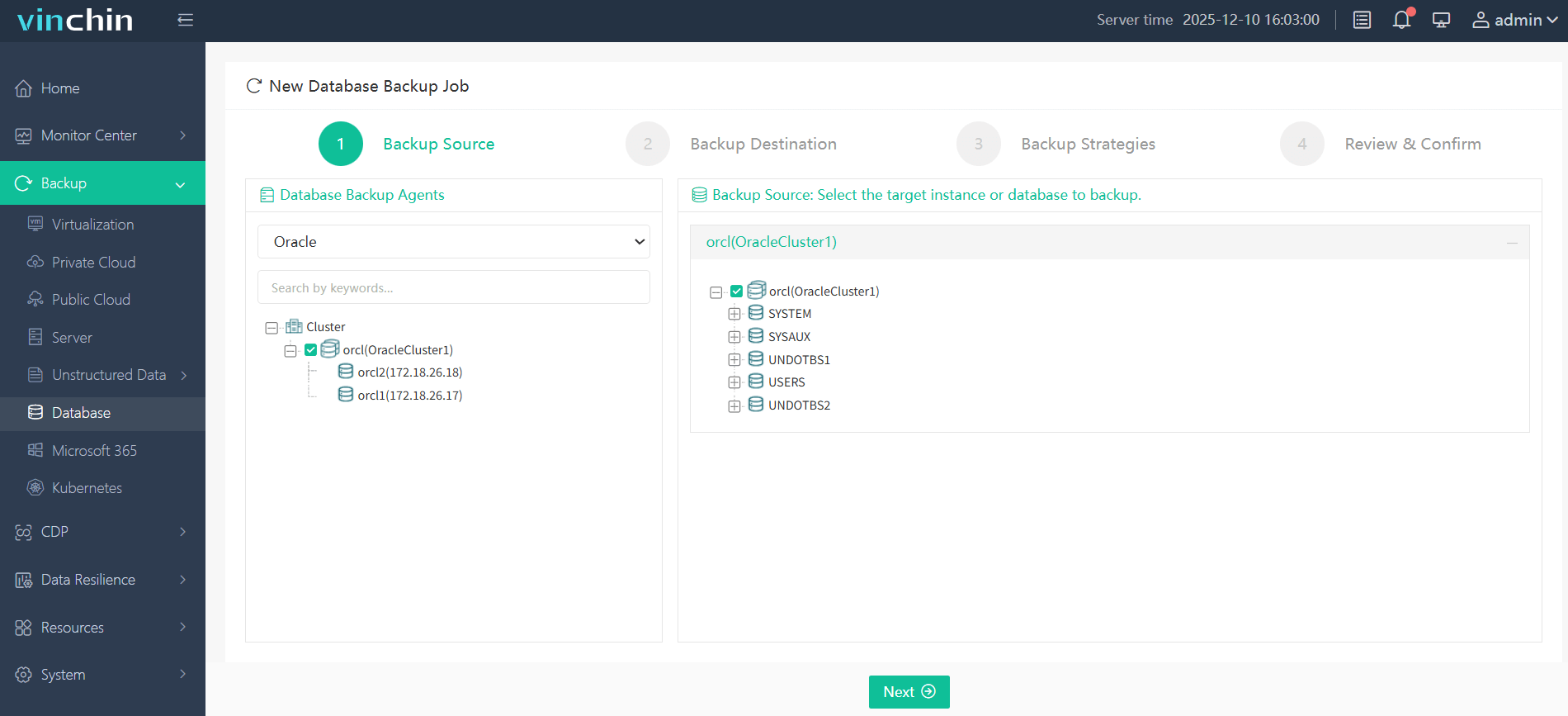
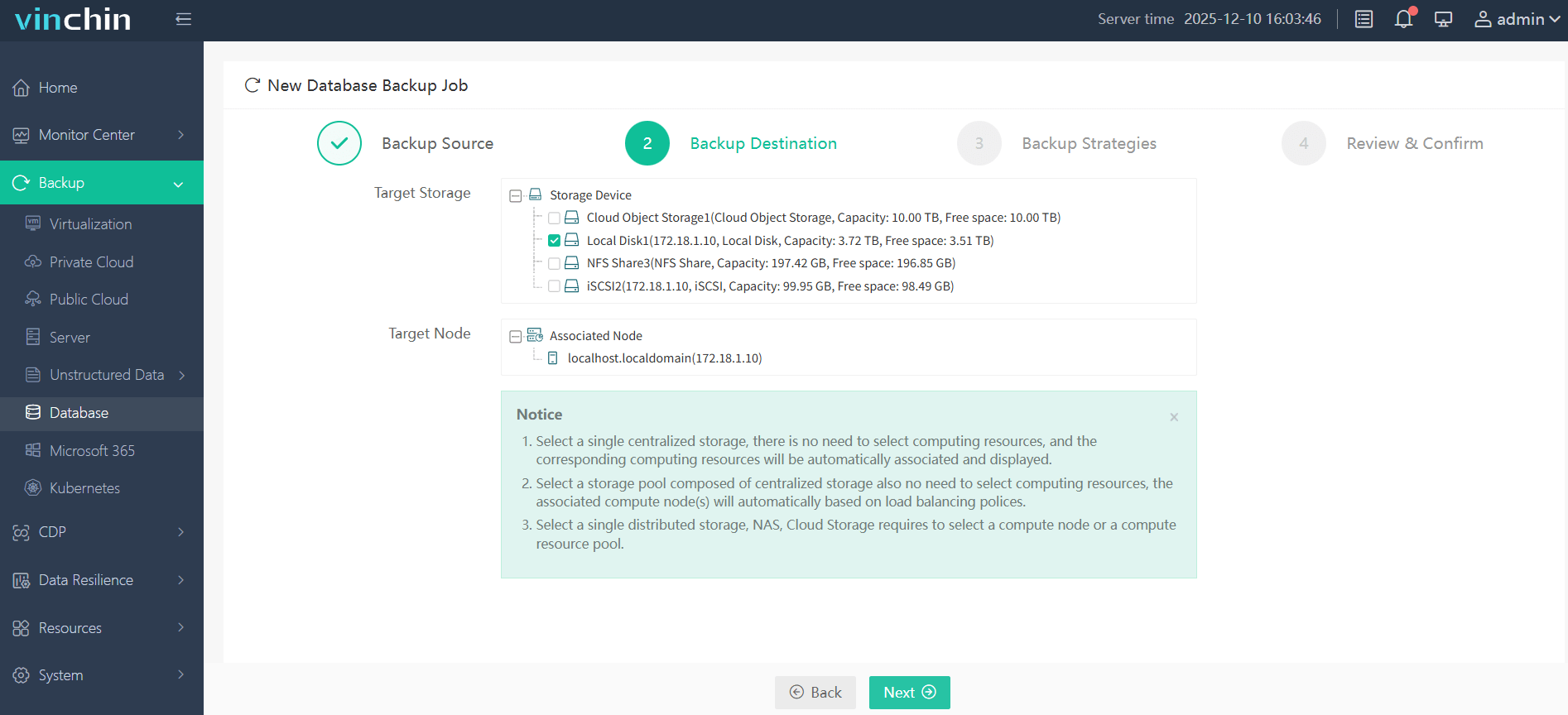
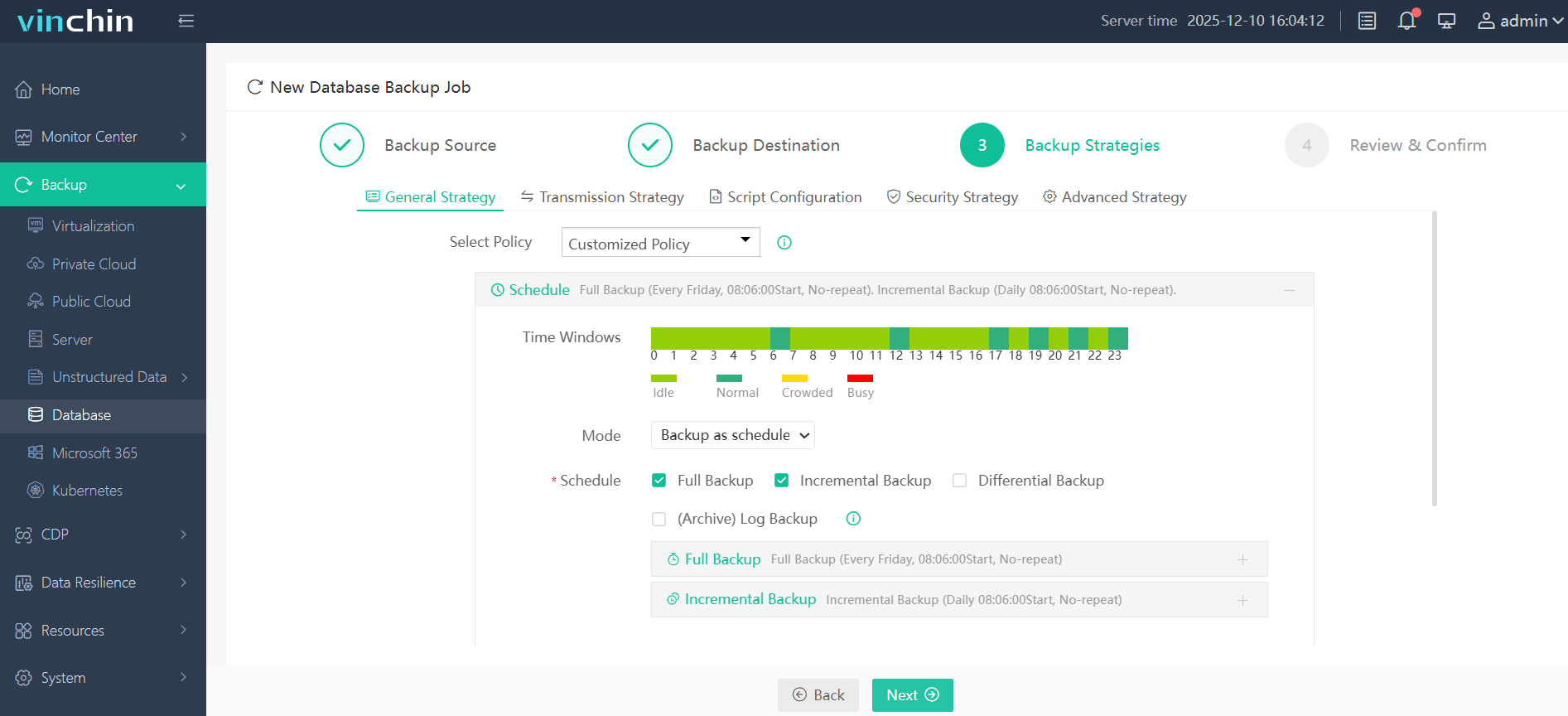
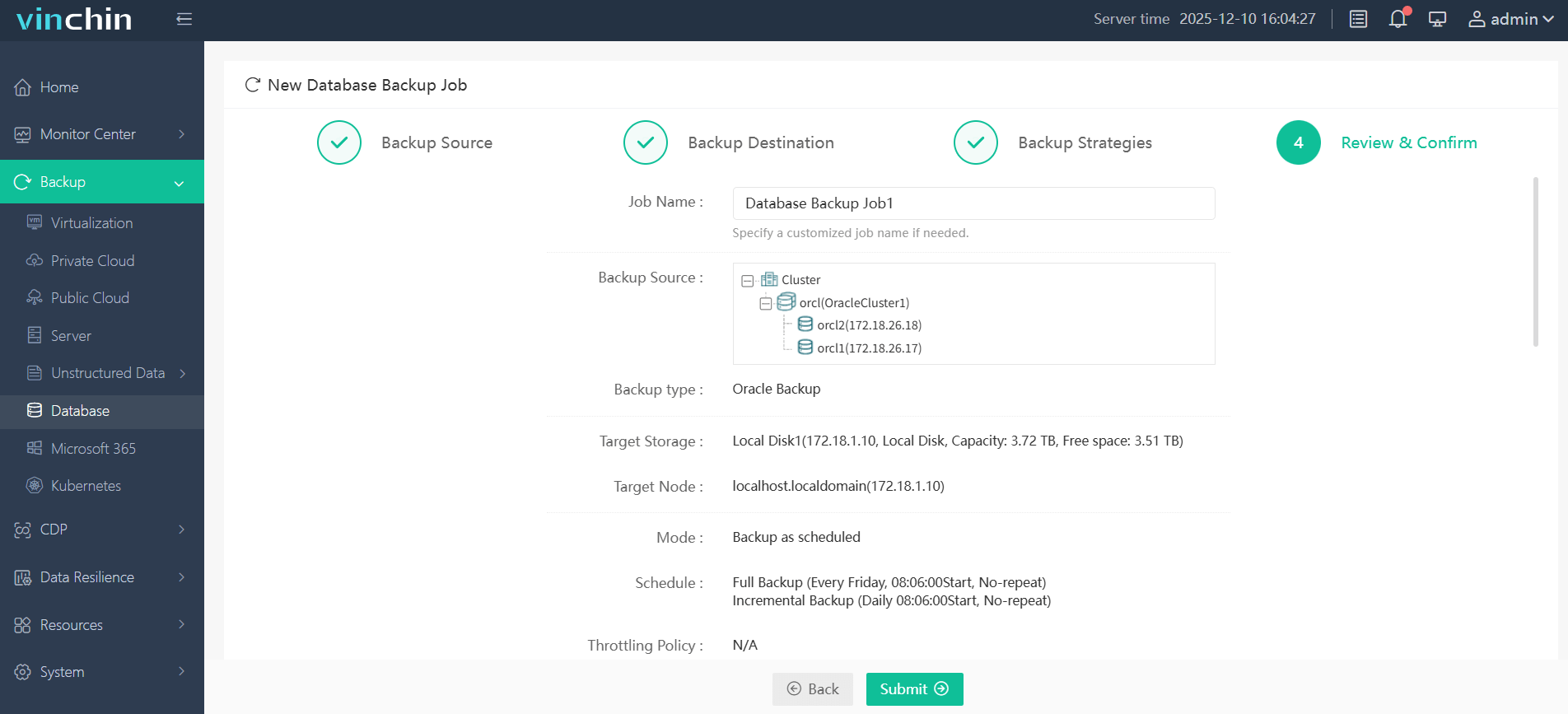
With its intuitive web console interface tailored specifically for enterprise workflows:
Step 1. Select the Oracle database to back up
Step 2. Choose the backup storage
Step 3. Define the backup strategy
Step 4. Submit the job
Recognized globally among top-rated enterprise data-protection solutions—with thousands of customers worldwide—you can experience every feature free for sixty days by clicking below to download Vinchin Backup & Recovery now!
Oracle RMAN Backup Incremental Level 1 Cumulative FAQs
Q1: Can I run an incremental level 1 cumulative backup without having taken a prior level 0?
A1: No—a pre-existing valid level 0 backup must exist first; otherwise RMAN returns an error instead of creating one automatically.
Q2: What should I do if my scheduled automated job fails overnight?
A2: Check both scheduler logs via DBA_SCHEDULER_JOBS view AND review output/error logs created by your shell script immediately after failure occurs.
Q3: How often should I delete obsolete cumulatives?
A3: Regularly remove obsolete increments according to retention policy using DELETE OBSOLETE after confirming newer full/cumulatives exist safely stored elsewhere.
Conclusion
Oracle RMAN incremental level 1 cumulative backups offer reliable protection while simplifying restore procedures compared with traditional differentials. Whether managed manually or through automation tools like DBMS_SCHEDULER—you gain peace of mind knowing recoveries remain straightforward even under stress. For even greater ease-of-use consider trying Vinchin’s intuitive platform today!