Losing an Oracle table can disrupt business operations. Maybe someone dropped it by accident or data corruption occurred during routine work. When this happens, you want to restore just that table—without rolling back your entire database. If you searched “oracle rman backup table,” you’re likely seeking a clear solution. This guide explains what Oracle RMAN can—and cannot—do for table-level backup and recovery. We’ll walk through practical methods so you can protect and restore tables efficiently.
What Oracle RMAN Can and Cannot Do for Table Backups?
Oracle Recovery Manager (RMAN) is Oracle’s main tool for backing up databases. But does it let you back up individual tables? Not directly. RMAN works at the physical level: it backs up whole databases, tablespaces, or datafiles—not single tables. However, since Oracle 12c, RMAN offers “table point-in-time recovery” (PITR). This feature lets you recover one or more tables to a specific moment using existing full backups.
Here’s how PITR works: RMAN creates a temporary auxiliary database from your backups, recovers target tables to your chosen point in time, then uses Data Pump to export those recovered tables so they can be imported back into production. The process is automated but doesn’t create standalone “table backup” files; instead, it leverages regular database backups.
If you need quick restores of individual tables, consider these three options: use Data Pump for logical exports; use Flashback Table if enabled; or use RMAN’s table recovery feature when other methods aren’t possible.
Method 1: Using Data Pump for Table Backup
Data Pump is Oracle’s built-in utility for exporting and importing database objects—including single tables. It provides an easy way to create logical backups of important data.
Before starting, make sure you have enough disk space where dump files will be stored. You also need privileges such as DATAPUMP_EXP_FULL_DATABASE or EXP_FULL_DATABASE roles.
To back up a table using Data Pump:
1. Open a terminal window on your server.
2. Connect as a privileged user—for example:
sqlplus sys/password@ORCL AS SYSDBA
3. Run the following command to export your target table:
expdp "sys/password@ORCL as sysdba" DIRECTORY=DPUMP_DIR DUMPFILE=my_table_%U.dmp LOGFILE=exp_mytable.log TABLES=HR.MY_TABLE PARALLEL=2 COMPRESSION=ALL EXCLUDE=STATISTICS
Replace sys/password@ORCL with your credentials and service name.
Set DPUMP_DIR as an existing directory object pointing to an OS path with write access.
Change HR.MY_TABLE to match your schema and table name.
This command splits large dumps across multiple files (%U), speeds up export (PARALLEL), compresses output (COMPRESSION), and skips statistics (which can be re-gathered later).
For advanced automation inside PL/SQL scripts or jobs, consider using the DBMS_DATAPUMP package instead of command-line tools.
When needed later, import the dump file like this:
impdp "sys/password@ORCL as sysdba" DIRECTORY=DPUMP_DIR DUMPFILE=my_table_01.dmp LOGFILE=imp_mytable.log TABLES=HR.MY_TABLE
Data Pump exports are fast and flexible but are logical backups—they don’t capture uncommitted transactions or some complex object types like certain LOBs in older versions.
Method 2: Flashback Table Approach
Flashback Table allows rapid restoration of a table’s previous state without restoring from backup media—a lifesaver if mistakes happen recently.
Flashback Table relies on sufficient UNDO retention in your database rather than ARCHIVELOG mode alone. Make sure UNDO_RETENTION is set high enough so changes remain available long enough for flashbacks when needed.
Before running Flashback Table:
1. Confirm that ROW MOVEMENT is enabled on your target table:
ALTER TABLE HR.MY_TABLE ENABLE ROW MOVEMENT;
2. Identify when you want to restore—either by timestamp or SCN (System Change Number). To check data before restoring:
SELECT * FROM HR.MY_TABLE AS OF TIMESTAMP TO_TIMESTAMP('2024-06-01 10:00:00', 'YYYY-MM-DD HH24:MI:SS');3. If satisfied with what you see at that time point, run:
FLASHBACK TABLE HR.MY_TABLE TO TIMESTAMP TO_TIMESTAMP('2024-06-01 10:00:00', 'YYYY-MM-DD HH24:MI:SS');Or use SCN if known:
FLASHBACK TABLE HR.MY_TABLE TO SCN 123456789;
4. Commit changes after successful flashback:
COMMIT;
Flashback Table is quick because it operates online—but there are limits:
It won’t work if required UNDO information has aged out due to low retention settings or heavy activity.
It cannot reverse DROP/TRUNCATE commands; only recent updates/deletes/inserts are reversible within retention windows.
Always test flashbacks on non-production systems first if possible!
Method 3: Point-in-Time Recovery for Tables (RMAN Table Recovery)
If neither Data Pump nor Flashback fits—perhaps because someone dropped/purged the table days ago—use RMAN’s powerful point-in-time recovery feature introduced in Oracle 12c onward.
This approach requires careful setup but delivers granular results even after catastrophic loss events.
First steps before starting:
1. Ensure ARCHIVELOG mode is enabled so all changes are logged continuously.
2. Confirm valid full/incremental RMAN backups exist covering your desired recovery window; check with LIST BACKUP.
3. Prepare plenty of free disk space at your chosen auxiliary destination—it must hold restored copies of affected datafiles plus temporary files created during processing (often several times larger than just one table).
4. Have SYSDBA/SYSBACKUP privileges ready; password file authentication may be required depending on configuration.
5. Verify memory/process limits allow launching another instance temporarily during recovery tasks.
Now let’s walk through actual steps:
1. Identify which schema/table needs restoring along with exact timestamp/SCN/log sequence number representing when things were still correct.
2. Start RMAN from shell prompt:
rman target /
3. At the RMAN prompt enter something like this—with REMAP included if renaming recovered object:
    RECOVER TABLE HR.MY_TABLE
      UNTIL TIME "TO_DATE('2024-06-01 10:00:00', 'YYYY-MM-DD HH24:MI:SS')"
      AUXILIARY DESTINATION '/u01/app/oracle/aux'
      DATAPUMP DESTINATION '/u01/app/oracle/dpump'
      REMAP TABLE 'HR.MY_TABLE':'MY_TABLE_RECOVERED'
      NOTABLEIMPORT;
Adjust paths according to available storage locations on your system!
The REMAP TABLE clause lets you bring back lost data under a different name while preserving current production objects intact until verification/testing completes safely.
4. After completion review logs carefully—if no errors reported proceed importing exported dump file manually via Data Pump Import just like earlier examples show:
impdp "sys/password@ORCL as sysdba" DIRECTORY=DPUMP_DIR DUMPFILE=my_table_recovered.dmp LOGFILE=imp_mytable_recovered.log
5. Query restored rows/data immediately after import finishes—compare against expected values before allowing end-users access again!
Introducing Vinchin Backup & Recovery for Enterprise-Level Oracle Database Protection
Beyond native tools like RMAN and Data Pump, organizations often require comprehensive solutions that streamline policy-driven protection and enable efficient granular recovery across diverse environments—including Oracle databases specifically targeted in this article's context alongside MySQL, SQL Server, MariaDB, PostgreSQL, PostgresPro, and TiDB platforms supported by Vinchin Backup & Recovery as well.
Vinchin Backup & Recovery empowers enterprises managing Oracle workloads with features such as incremental backup support (for Oracle), batch database backup operations, advanced source-side compression (for Oracle), robust GFS retention policies, integrity checks, cloud/tape archiving capabilities, WORM protection against ransomware threats, scheduled jobs management, instant any-point-in-time recovery options—even direct restores onto new servers—all managed through one intuitive web console interface designed for simplicity at scale while ensuring compliance and operational resilience throughout every stage of data lifecycle management.
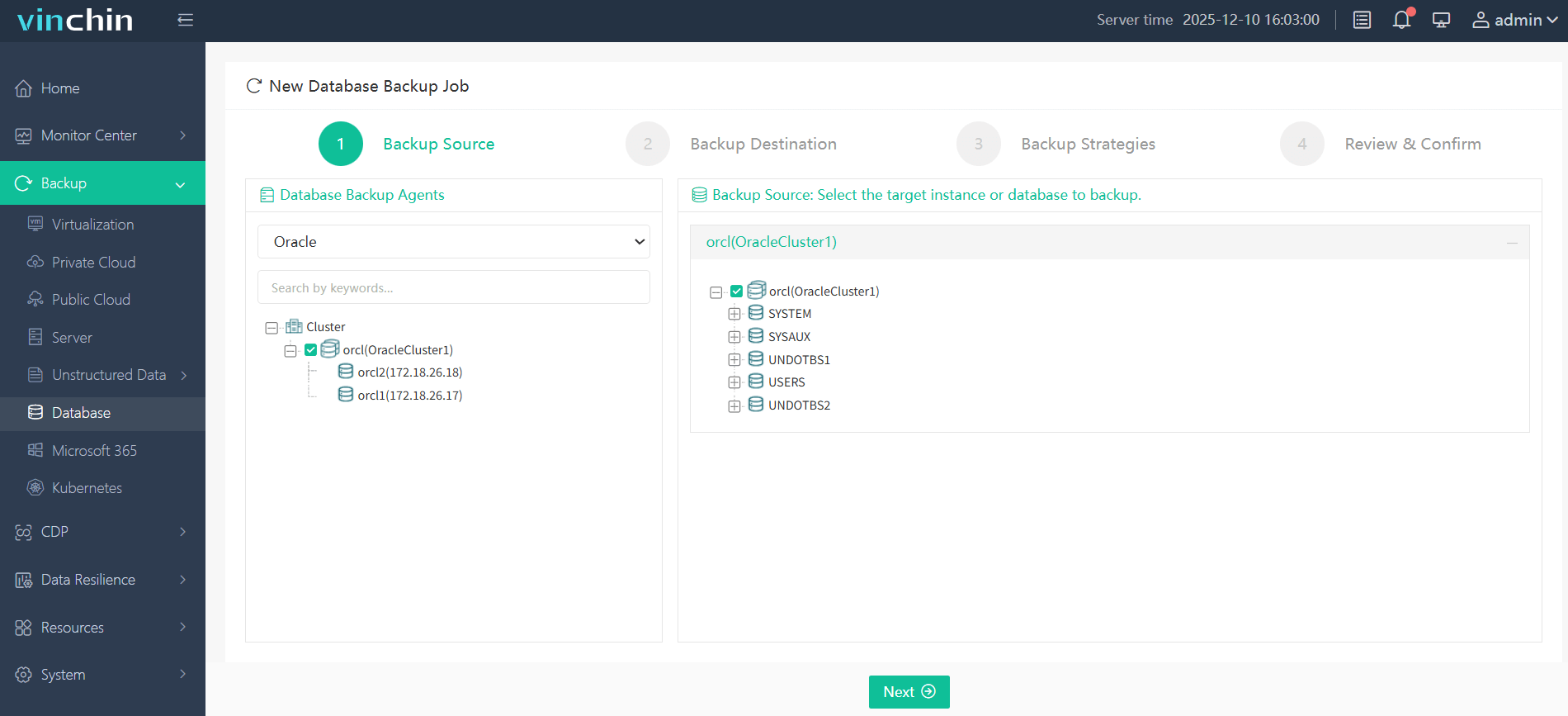
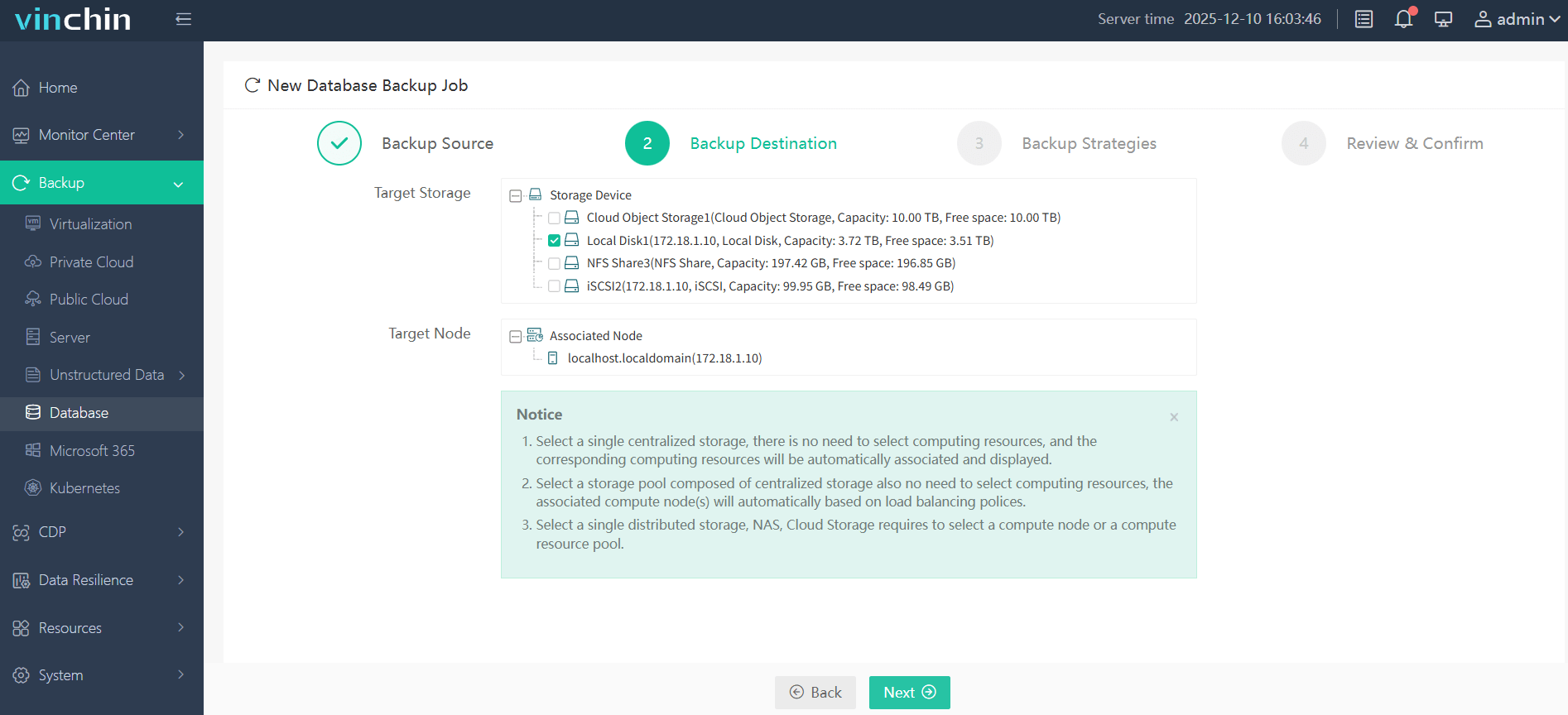
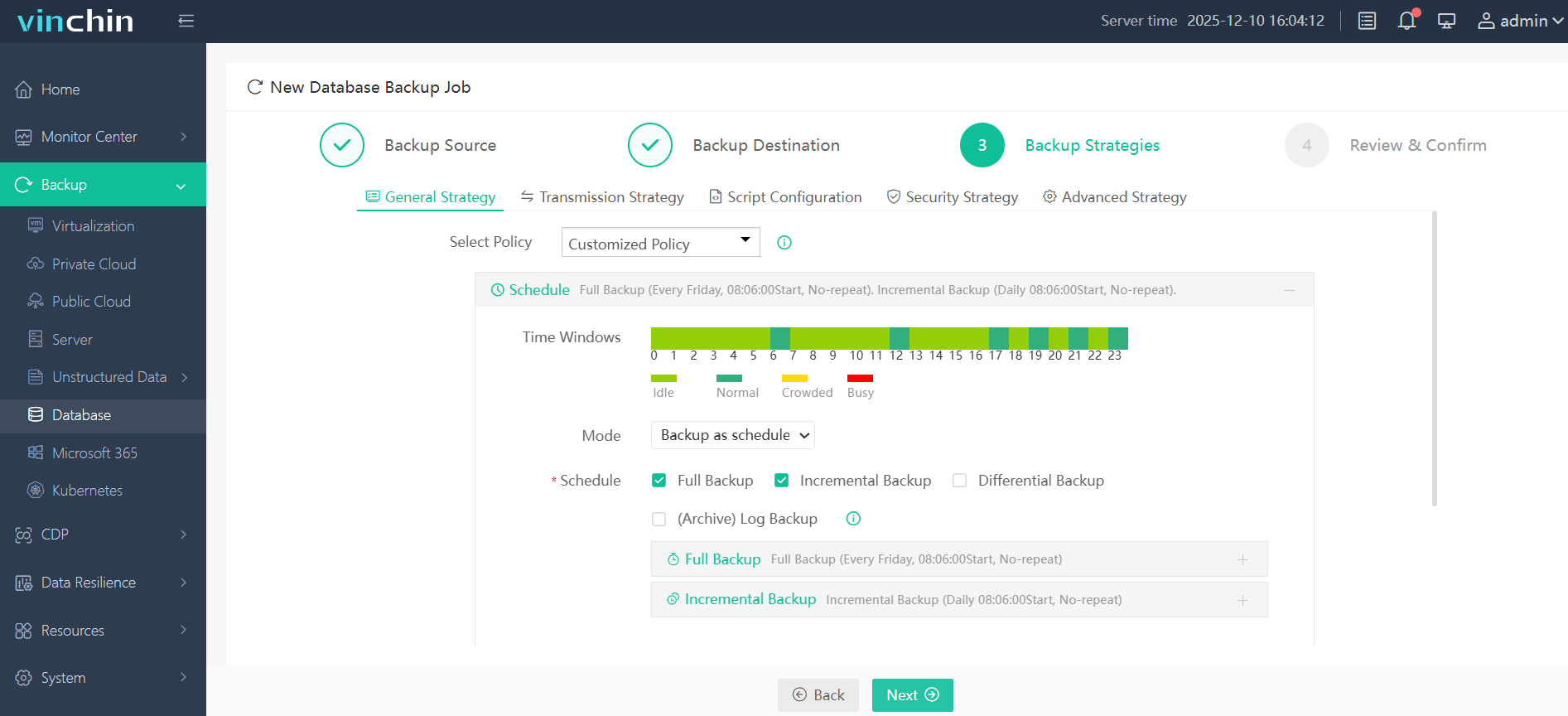
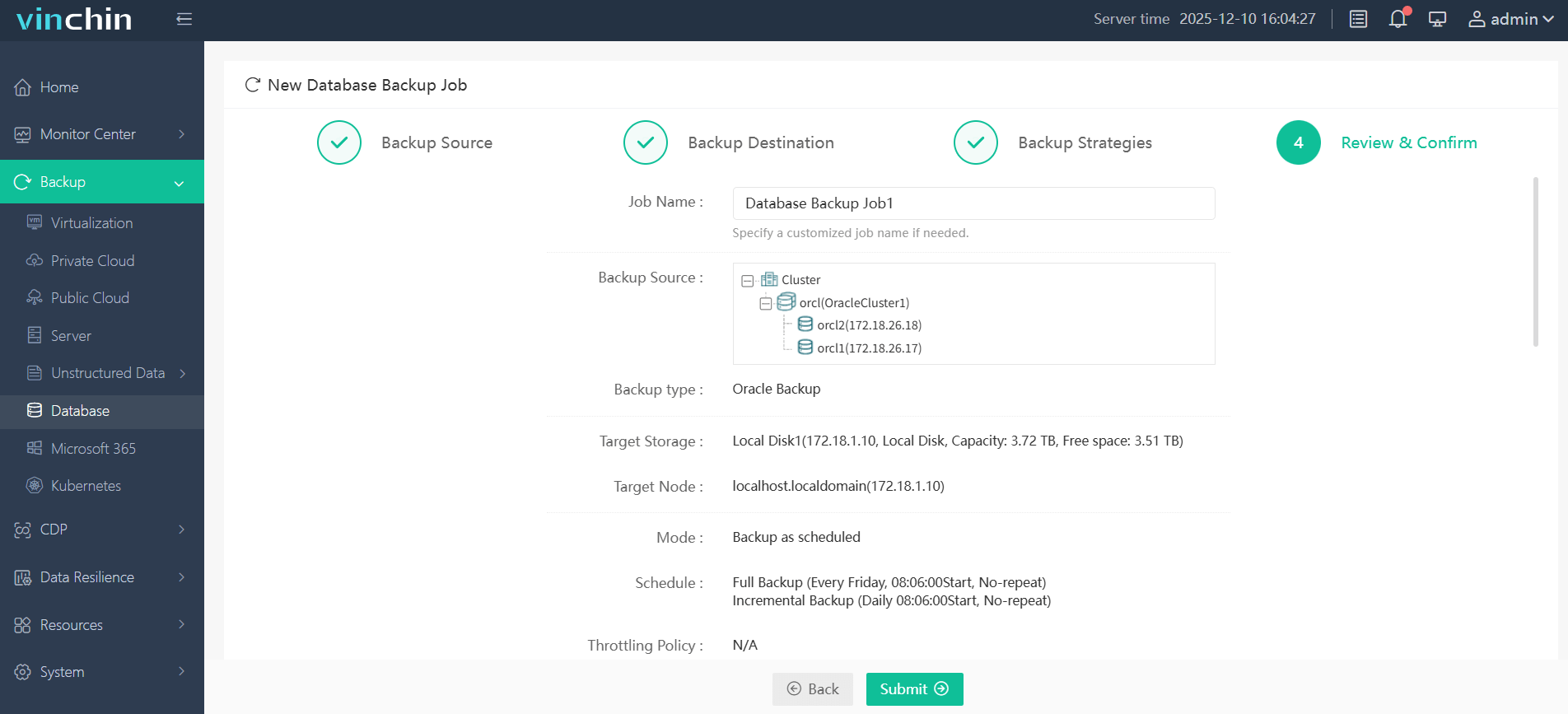
The streamlined workflow makes protecting critical Oracle assets straightforward in four steps:
Step 1. Select the Oracle database to back up
Step 2. Choose the backup storage
Step 3. Define the backup strategy
Step 4. Submit the job
Recognized globally among enterprise users for reliability and ease-of-use—and backed by top industry ratings—you can experience every feature risk-free with Vinchin Backup & Recovery's fully functional 60-day trial today; click below to get started!
Oracle RMAN Backup Table FAQs
Q1: What should I do if I get an error about missing archived logs during RECOVER TABLE?
Check that all necessary archive log files exist in accessible locations; restore them from external storage if needed before retrying RECOVER TABLE.
Q2: How much free space do I need at AUXILIARY DESTINATION?
Plan several times more than total size of involved datafiles—the auxiliary instance temporarily holds restored copies plus working files during processing.
Q3: Can I automate regular single-table exports without manual intervention?
Yes; schedule recurring jobs using DBMS_DATAPUMP PL/SQL API combined with DBMS_SCHEDULER tasks inside your production environment.
Conclusion
Oracle RMAN does not support direct single-table backups but enables precise restores through point-in-time recovery features combined with Data Pump integration.For fully automated protection—including granular restores—consider Vinchin's robust enterprise solutions.Try Vinchin today risk-free!