Protecting your Oracle database is not just a best practice—it’s essential. Data loss or corruption can happen at any time, and a reliable backup is your safety net. Oracle Recovery Manager (RMAN) is the built-in tool for this job. In this article, you’ll learn what RMAN is, why it’s the preferred choice, and how to use it for full, incremental, and tablespace-level backups.
What is RMAN in Oracle Backup?
RMAN stands for Recovery Manager. It is Oracle’s native utility designed specifically for database backup and recovery tasks. Unlike manual methods that require scripting or third-party tools, RMAN automates much of the work involved in protecting your data.
With RMAN, you can manage backup files easily—no need to track them by hand. The tool keeps a record of all backups taken so you always know what you have available for restore operations. It also ensures data consistency during both backup and recovery processes by working directly with Oracle’s internal mechanisms.
You can access RMAN through command-line interface or via Oracle Enterprise Manager web console. This flexibility makes it suitable for different environments—from small test systems to large enterprise deployments.
Why Use RMAN for Oracle Backup?
Why do most administrators choose RMAN over manual methods? The answer lies in its reliability and advanced features that simplify complex tasks.
First, RMAN supports online (hot) backups when your database runs in ARCHIVELOG mode. This means users can keep working while backups run—no downtime required. Second, it offers incremental backups that only save changed blocks since your last backup; this saves both time and storage space.
RMAN also manages retention policies automatically so old backups are deleted according to rules you set—reducing clutter on disk without risking data loss. Built-in compression shrinks backup sizes further; encryption protects sensitive information from unauthorized access.
Perhaps most important: because RMAN is part of Oracle Database itself—and fully supported—you get peace of mind knowing your mission-critical data protection follows best practices recommended by Oracle engineers worldwide.
Understanding ARCHIVELOG vs NOARCHIVELOG Mode
Before diving into specific backup methods with RMAN, it’s vital to understand two key modes: ARCHIVELOG and NOARCHIVELOG.
When an Oracle database runs in ARCHIVELOG mode, every change made gets written out as archived redo logs after being committed to disk. This allows you to perform point-in-time recovery—even if users continue working during backups—because all changes are captured safely outside the main datafiles.
In contrast, NOARCHIVELOG mode does not save these changes once they’re applied; only cold (offline) consistent backups are possible here because there’s no way to recover transactions made after a backup completes but before failure occurs. Most production databases use ARCHIVELOG mode due to its superior protection options—but some development or test systems may stick with NOARCHIVELOG for simplicity or performance reasons.
Always check which mode your environment uses before planning any backup strategy!
Method 1. Oracle Full Database Backup with RMAN
A full database backup captures everything: all data files containing user information; control files that describe database structure; even archived redo logs if running in ARCHIVELOG mode. This type of backup forms the foundation of any robust disaster recovery plan because it lets you restore an entire system from scratch if needed.
For databases running in ARCHIVELOG mode—which most production systems do—you can take full online (hot) backups while users remain connected:
1. Start RMAN and connect:
rman target /
2. Run:
BACKUP DATABASE PLUS ARCHIVELOG;
This command backs up every file plus all archived redo logs generated so far—ensuring complete coverage up until now.
If your system uses NOARCHIVELOG mode (common in non-production setups), only offline (cold) full backups are possible:
1. Shut down cleanly:
SHUTDOWN IMMEDIATE;
2. Mount without opening:
STARTUP MOUNT;
3. Back up:
BACKUP DATABASE;
4. Open again:
ALTER DATABASE OPEN;
Remember: In NOARCHIVELOG mode you cannot recover transactions made after this point unless another cold backup exists!
It’s wise to schedule regular full database backups—weekly or monthly depending on how often your data changes—to ensure a solid fallback position.
Method 2. Oracle Database Incremental Backup Using RMAN
Incremental backups help reduce both time spent backing up large databases and storage used over weeks or months—a big win for busy IT teams managing many systems at once!
There are two main types:
Level 0: Acts as a baseline snapshot—the same as a full backup—but serves as “parent” for future incrementals.
Level 1: Saves only blocks changed since either last Level 0 (cumulative) or last Level 1 (differential) depending on which option you choose next time around.
Here’s how they work:
To create a Level 0 baseline:
BACKUP INCREMENTAL LEVEL 0 DATABASE;
For daily differential incrementals (only changes since previous incremental):
BACKUP INCREMENTAL LEVEL 1 DATABASE;
Or cumulative incrementals (all changes since last Level 0):
BACKUP INCREMENTAL LEVEL 1 CUMULATIVE DATABASE;
Which should you pick? Differential saves more space but may slow down restores if many increments must be applied one after another; cumulative uses more space but speeds up restores because fewer steps are needed.
Incremental strategies shine when combined with frequent scheduling—for example: weekly Level 0 plus daily Level 1s keeps windows short yet ensures fast recovery options if disaster strikes mid-week!
Enabling Block Change Tracking
Want even faster incremental jobs? Enable block change tracking—a feature that records which blocks have changed between each run so only those need scanning next time:
ALTER DATABASE ENABLE BLOCK CHANGE TRACKING;
This creates a small file managed by Oracle itself (usually stored near other database files). Note: Block change tracking requires Enterprise Edition licensing. With this enabled, incremental jobs finish much faster because they skip scanning unchanged parts entirely—a huge benefit on very large databases!
Always monitor disk usage where block change tracking files reside—they grow slowly but should never fill up their partition unexpectedly.
Method 3. Oracle Database Tablespace-Level Backup with RMAN
Sometimes backing up everything isn’t necessary—or efficient! Maybe only certain tablespaces hold critical business data updated hourly while others rarely change at all; perhaps developers want quick refreshes of just one schema instead of restoring whole environments from scratch?
Tablespace-level backups let you focus protection efforts exactly where needed:
To back up one tablespace called users:
BACKUP TABLESPACE users;
Or several at once:
BACKUP TABLESPACE users, tools;
You can run these jobs online—as long as ARCHIVELOG mode remains enabled—and still capture every transaction thanks to archived redo log integration behind-the-scenes.
If disaster ever hits just one area—for example accidental table drop inside users—you don’t need hours restoring unrelated parts! Instead:
1. Take affected tablespace offline immediately:
SQL 'ALTER TABLESPACE users OFFLINE IMMEDIATE';
2. Restore from latest valid tablespace-level backup:
    RESTORE TABLESPACE users;
    RECOVER TABLESPACE users;
    SQL 'ALTER TABLESPACE users ONLINE';
This targeted approach minimizes downtime while maximizing resource efficiency across busy environments.
How to Protect Oracle Database with Vinchin?
While traditional approaches like RMAN offer granular control over Oracle database protection, organizations seeking streamlined management often turn to enterprise solutions such as Vinchin Backup & Recovery. As a professional-grade platform supporting today’s mainstream databases—including first-class support for Oracle alongside MySQL, SQL Server, MariaDB, PostgreSQL, PostgresPro, and TiDB—it delivers comprehensive coverage across diverse IT landscapes.
Vinchin Backup & Recovery brings together features highly relevant to enterprise needs: advanced source-side compression and incremental backup tailored specifically for Oracle workloads; batch processing capabilities; flexible multi-level retention policies including GFS schemes; robust integrity checks; plus cloud/tape archiving options—all designed to maximize efficiency while minimizing risk and administrative burden across large-scale deployments.
The intuitive web console makes safeguarding an Oracle environment remarkably simple:
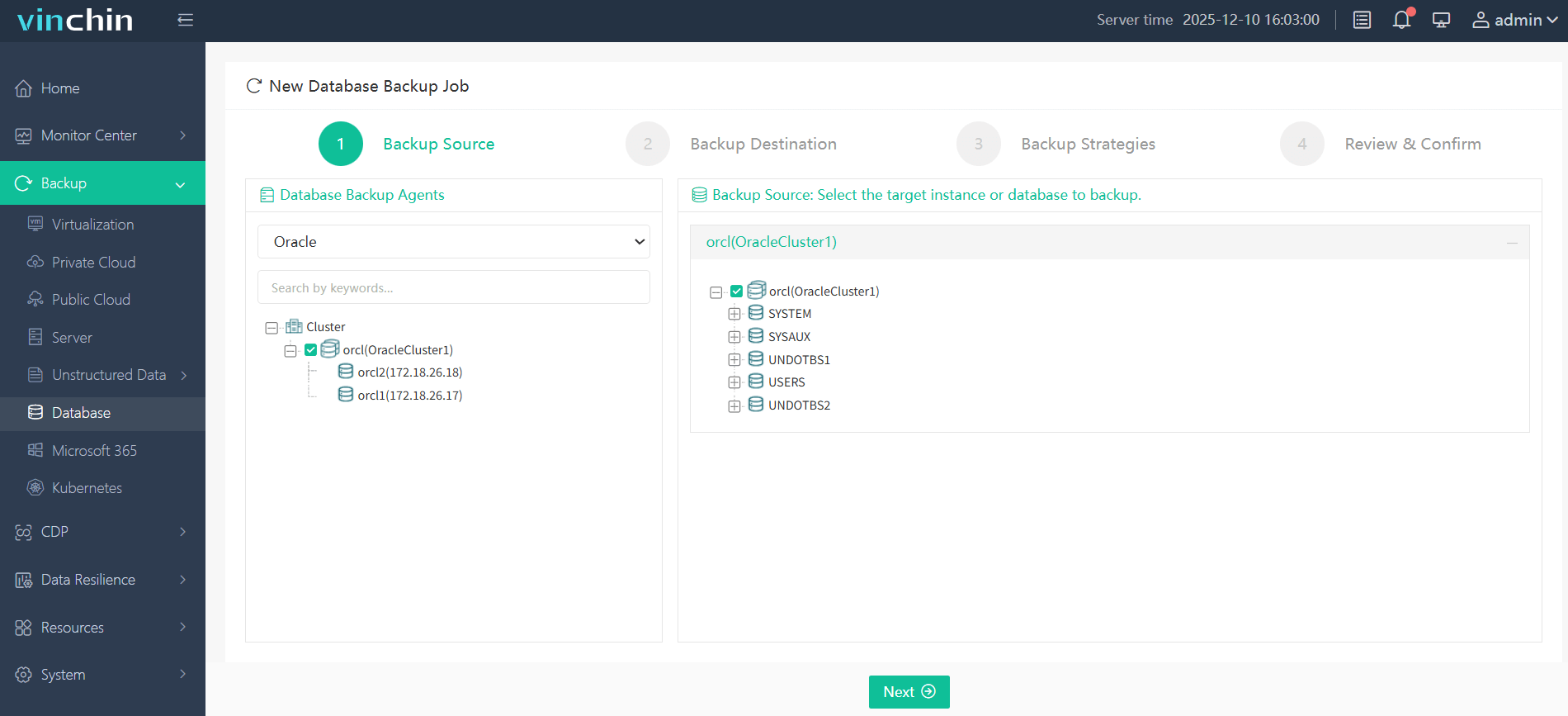
Step 1: Select the Oracle database to back up
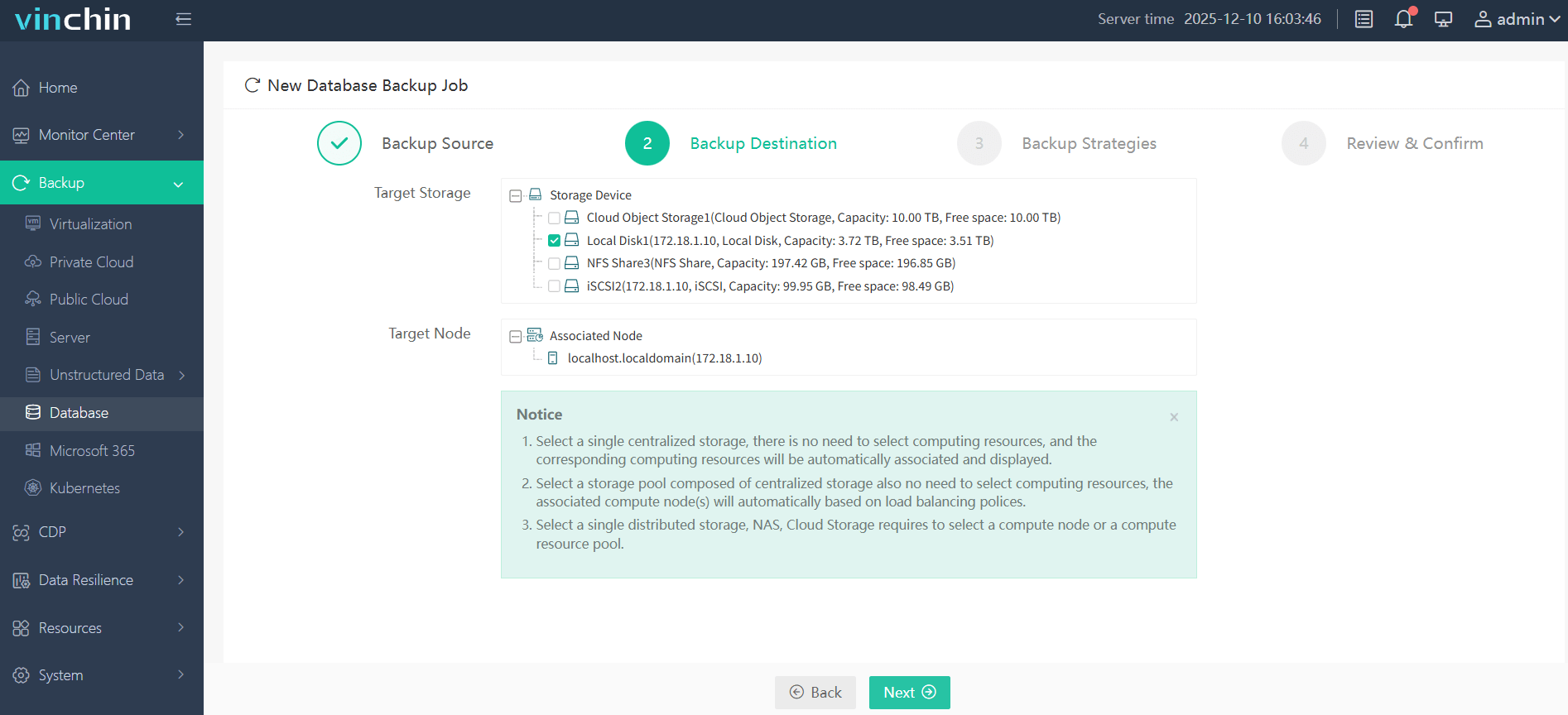
Step 2: Choose the desired storage location
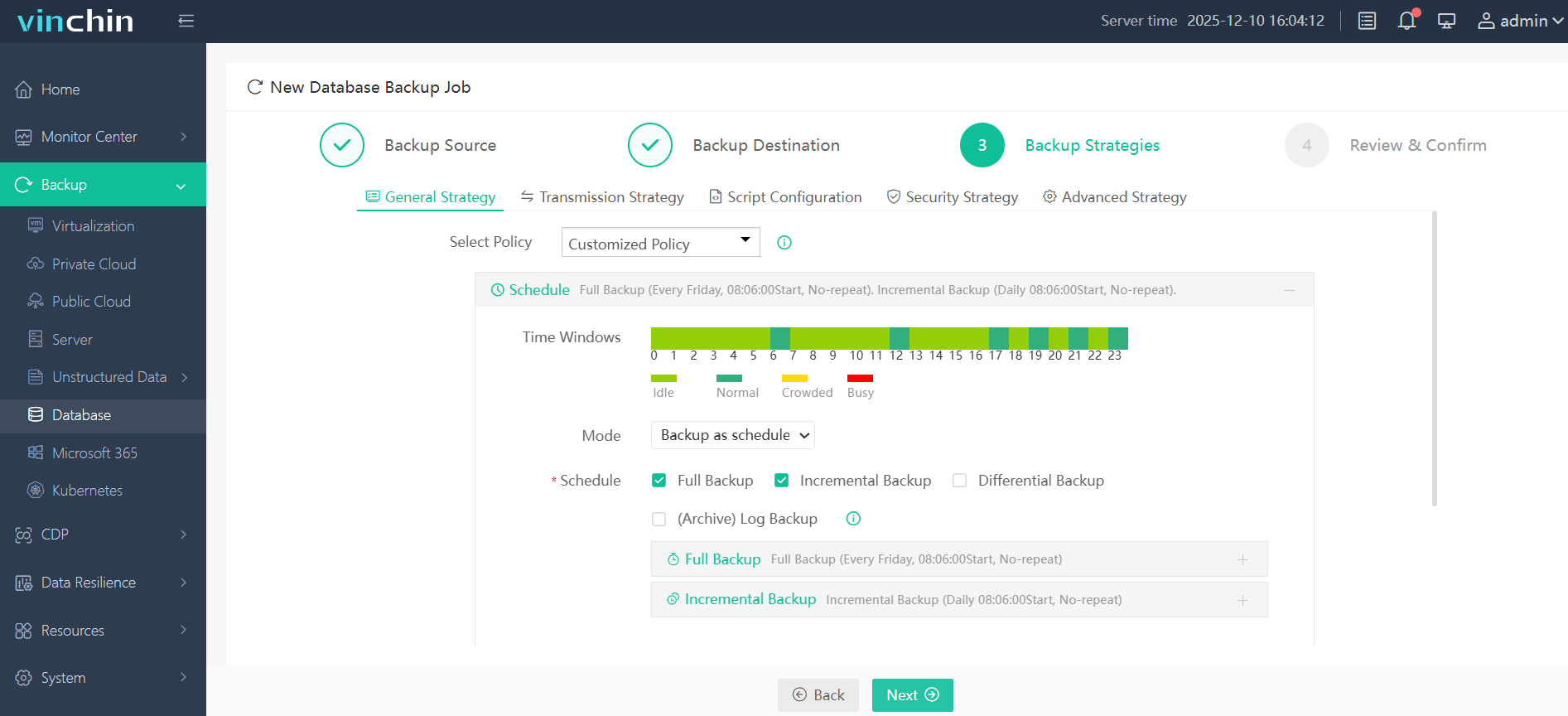
Step 3: Define your preferred strategy
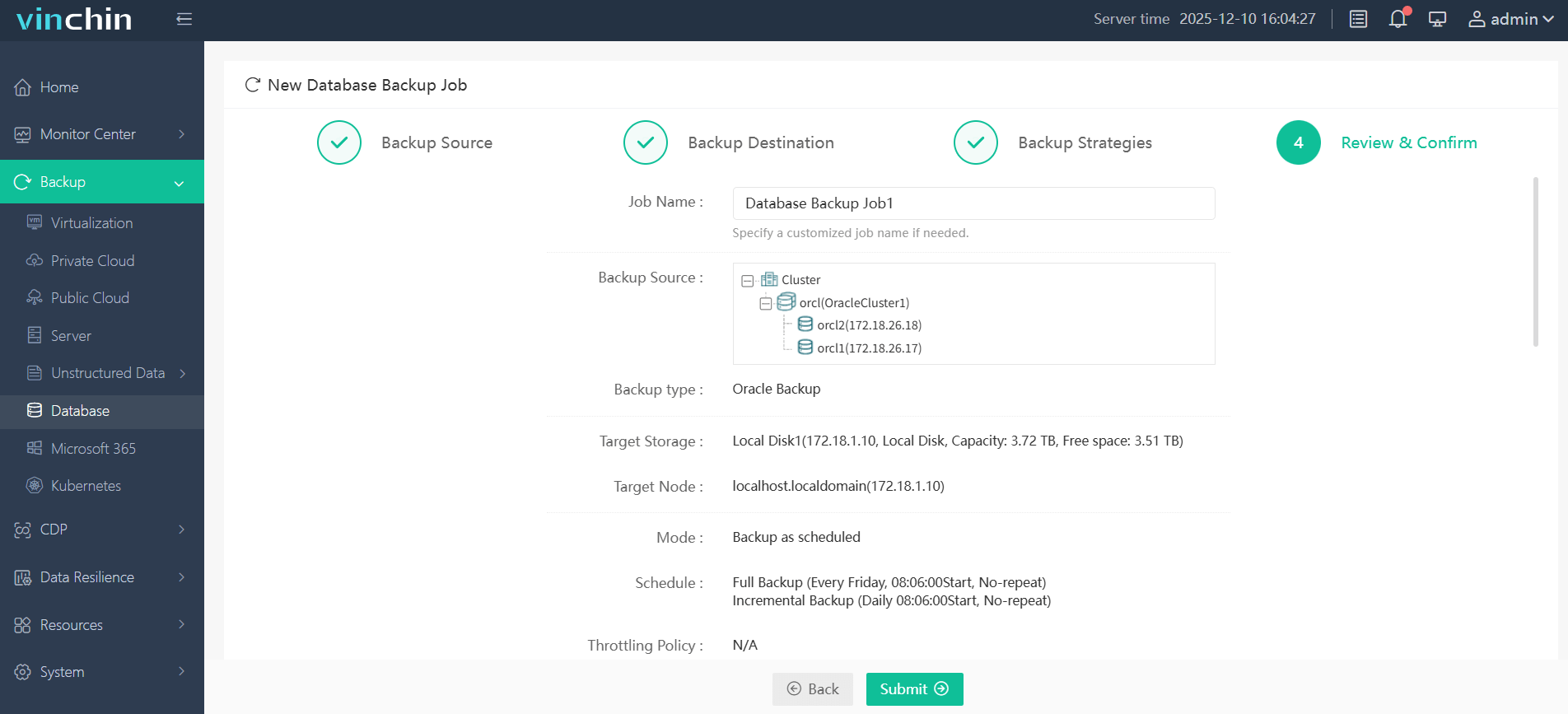
Step 4: Submit the job
Recognized globally among enterprise customers—with top ratings and proven reliability—Vinchin Backup & Recovery offers a fully featured free trial lasting sixty days so you can experience effortless data protection firsthand; click below to download now.
Oracle Backup with RMAN FAQs
Q1: How do I automate daily differential incremental backups?
Write an .rman script using BACKUP INCREMENTAL LEVEL 1 DATABASE, then schedule it using cron or Task Scheduler based on your platform's conventions.
Q2: What should I check if my scheduled nightly job fails?
Review both OS scheduler logs and generated .log output from each run; confirm free disk space exists where both archive logs and destination directories reside before retrying manually via rman.
Q3: Can I validate my latest archive log-only set without restoring?
Yes—use VALIDATE ARCHIVELOG ALL within an active rman session after connecting successfully.
Conclusion
RMAN gives administrators powerful tools for comprehensive protection—including full, differential, cumulative, and targeted tablespace-level options. For streamlined management, Vinchin delivers intuitive enterprise-grade solutions. Try Vinchin's free trial today—and safeguard critical business information confidently!