Duplicating an Oracle 10g database using RMAN and existing backups is a routine task for many administrators. This method is vital when you need to create test environments, refresh development databases, or set up standby systems. If you want to clone a database without affecting your production system’s uptime or performance, RMAN’s backup-based duplication is both safe and reliable. Let’s break down what this means—and how you can do it step by step.
What Is RMAN Duplicate in Oracle 10g?
RMAN Duplicate is a feature in Oracle Recovery Manager (RMAN) that lets you create an independent copy of an existing database. This duplicate exists separately from its source and can be used for testing, development work, or disaster recovery drills. In Oracle 10g, you have two main ways to duplicate: active duplication (from live data) or—more commonly—from pre-existing RMAN backups. The backup-based approach is especially useful if your source and target servers are separate or if you want zero downtime on production. RMAN automates restoring datafiles, applying archived logs, and ensures your new database is consistent and ready.
Preparing for RMAN Duplicate
Before starting duplication, careful preparation prevents headaches later. Both your source (original) environment and auxiliary (duplicate) environment must be set up correctly.
Verify Prerequisites and Environment
First things first: make sure Oracle 10g software is installed on both servers—the source holds your original data; the auxiliary will host the clone. On the auxiliary server, only install binaries; don’t create a new database yet.
Check network connectivity between both machines using ping or tnsping:
ping <source_host>
tnsping <auxiliary_service>
This ensures that connections work smoothly during duplication.
You’ll need enough disk space on the auxiliary server to hold all datafiles, control files, redo logs, plus archived logs needed for recovery. Confirm that recent full RMAN backups exist along with all required archived logs—and that these are accessible from the auxiliary host.
Matching character sets between source and auxiliary environments helps avoid subtle errors during recovery. Also verify time zones match if possible.
Both servers should have their listener processes running:
lsnrctl status
Check that tnsnames.ora entries allow each server to reach both service names over the network.
If backups reside on shared storage such as NFS or SAN volumes mounted on both hosts, ensure read permissions are correct so Oracle can access them directly from either side. If not using shared storage, plan to copy all necessary backup pieces—including archived logs—to local directories accessible by the auxiliary instance before starting duplication.
Configure the Auxiliary Instance
On your auxiliary server:
1. Create a password file for SYS using orapwd:
orapwd file=$ORACLE_HOME/dbs/orapw<auxdb> password=<password>
2. Copy your parameter file (PFILE) from source to auxiliary host.
3. Edit key parameters in this PFILE:
Change DB_NAME to match your new database name.
Set CONTROL_FILES, adjusting paths as needed.
Use DB_FILE_NAME_CONVERT/LOG_FILE_NAME_CONVERT to map old file paths to new ones.
Adjust memory settings like SGA_TARGET, PGA_AGGREGATE_TARGET, if hardware differs.
4. Build directory structures where datafiles/control files/redo logs will reside.
5. Start the auxiliary instance in NOMOUNT mode with:
SQL> startup nomount pfile='/path/to/initauxdb.ora';
If you prefer an SPFILE instead of PFILE: after editing PFILE as above,
SQL> create spfile from pfile='/path/to/initauxdb.ora';
SQL> shutdown immediate;
SQL> startup nomount;
How to Perform oracle 10g rman duplicate database from backup
Duplicating an Oracle 10g database from backup involves several precise steps—each critical for success at any experience level.
Step 1: Ensure Valid Backups Are Available
You need a complete set of valid backups before duplicating—this includes full datafile backups plus all necessary archived redo logs since that last full backup was taken.
If creating fresh backups:
RMAN> backup database plus archivelog;
But often you'll use scheduled nightly backups already available—just confirm they’re intact before proceeding.
Step 2: Make Backups Accessible on Auxiliary Host
If using shared storage (NFS/SAN), mount it identically on both hosts so paths remain consistent; otherwise copy all relevant files locally onto your auxiliary machine while preserving directory structure.
Once copied/mounted locally but outside standard locations? Catalog them in RMAN so they’re recognized:
RMAN> CATALOG START WITH '/path/to/backup/pieces/';
Step 3: Verify Network Connectivity Again
Update each server’s tnsnames.ora so both databases’ services resolve properly across hosts—for example:
AUXDB =
  (DESCRIPTION =
    (ADDRESS = (PROTOCOL = TCP)(HOST = auxhost)(PORT = 1521))
    (CONNECT_DATA =
      (SERVER = DEDICATED)
      (SERVICE_NAME = auxdb)
    )
)
Test connection via SQL*Plus:
sqlplus "sys/<password>@<auxiliary_service> as sysdba"
sqlplus "sys/<password>@<source_service> as sysdba"
Make sure listeners are running everywhere:
lsnrctl start
lsnrctl status
Step 4: Connect With RMAN From Auxiliary Server
From your auxiliary host’s command line:
Connect simultaneously to target/source DB (target) AND new/auxiliary DB (auxiliary) via TNS aliases created above:
rman target sys/<password>@<source_service> auxiliary sys/<password>@<auxiliary_service>
This dual connection allows RMAN orchestration between original data location (“target”) and destination (“auxiliary”).
Step 5: Run DUPLICATE Command With Proper Options
Inside RMAN prompt after connecting:
For most cases where you want automatic restoration/opening of DB:
RUN {
 ALLOCATE AUXILIARY CHANNEL ch1 DEVICE TYPE DISK;
 ALLOCATE AUXILIARY CHANNEL ch2 DEVICE TYPE DISK;
 DUPLICATE TARGET DATABASE TO <auxdb>
   DB_FILE_NAME_CONVERT=('/oradata/source/', '/oradata/auxdb/')
   LOG_FILE_NAME_CONVERT=('/oradata/source/', '/oradata/auxdb/');
}
Replace <auxdb> with actual name; adjust path conversions per environment needs; allocate more channels if faster restore desired—especially helpful with large databases!
Want more control? Use USING BACKUPSET explicitly if only restoring from existing sets—not live copies—and add NOOPEN if planning further manual recovery steps before opening resetlogs:
DUPLICATE TARGET DATABASE TO <auxdb>
 USING BACKUPSET
 NOOPEN
 DB_FILE_NAME_CONVERT=('/old/path/', '/new/path/')
 LOG_FILE_NAME_CONVERT=('/old/path/', '/new/path/');
Need selective cloning? Exclude tablespaces by adding SKIP TABLESPACE users etc., right inside DUPLICATE command line above!
RMAN now restores files/logs automatically based on available cataloged pieces—it applies redo until consistent state reached then opens DB unless NOOPEN specified earlier.
Step 6: Monitor Progress & Troubleshoot Issues Early
Watch output closely! For deeper insight during long restores check alert log (alert_auxdb.log) regularly—it records every major event/error encountered by Oracle background processes during restore/recovery phases.
Advanced users may monitor session activity via V$SESSION_LONGOPS view within SQL*Plus connected as SYSDBA—a handy way to estimate remaining time when working with very large datasets over slow networks!
Step 7: Post-Duplication Checks & Finalization
After successful completion connect directly into newly cloned instance:
SQL> select name, open_mode from v$database;
Confirm open_mode shows READ WRITE under correct db_name value matching intended clone identity! Review alert log once more for warnings/errors missed earlier—especially around control file creation/resetlogs phase which can sometimes surface late issues due permissions/timezone mismatches/etc.
Why RMAN Duplicate May Fail
Even well-prepared duplications sometimes fail—but knowing common pitfalls helps fix problems fast!
Listener/TNS errors (“RMAN–06054”): Quick Check—run lsnrctl status on both hosts; confirm services registered under expected names; double-check tnsnames entries match listener config exactly!
Insufficient disk space (“ORA–19809”): Quick Check—query V$RECOVERY_FILE_DEST view beforehand (select * from v$recovery_file_dest;) so free space matches estimated restore size including archive logs!
File path issues (“ORA–27038”): Quick Check—verify directory existence/write permissions everywhere referenced by CONVERT parameters; run simple OS-level touch/copy tests under oracle user account!
Character set mismatch: Always compare NLS_CHARACTERSET/NLS_NCHAR_CHARACTERSET values between source/clone (select * from nls_database_parameters where parameter like 'NLS%CHARACTERSET';)
Missing/corrupt backups/logs: Confirm every piece listed in catalog actually exists at expected location/readable by oracle user (rman crosscheck backup helps here!)
Version mismatch/incompatibility: Never attempt cloning where target binary version is older than original—even minor patch differences matter! Always upgrade destination binaries first if needed.
Vinchin Backup & Recovery: Enterprise-Level Protection for Your Oracle Database
While manual methods offer flexibility, organizations seeking streamlined protection should consider Vinchin Backup & Recovery—a professional enterprise-grade solution supporting today’s leading databases including Oracle 10g, 11g/11g R2, 12c, 18c, 19c, 21c, Oracle RAC, MySQL, SQL Server, MariaDB, PostgreSQL, PostgresPro, and TiDB.
Vinchin Backup & Recovery delivers advanced features such as incremental backup support and advanced source-side compression alongside batch scheduling capabilities and robust cloud/tape archiving options—all designed for efficiency at scale while ensuring comprehensive integrity checks throughout every process cycle.
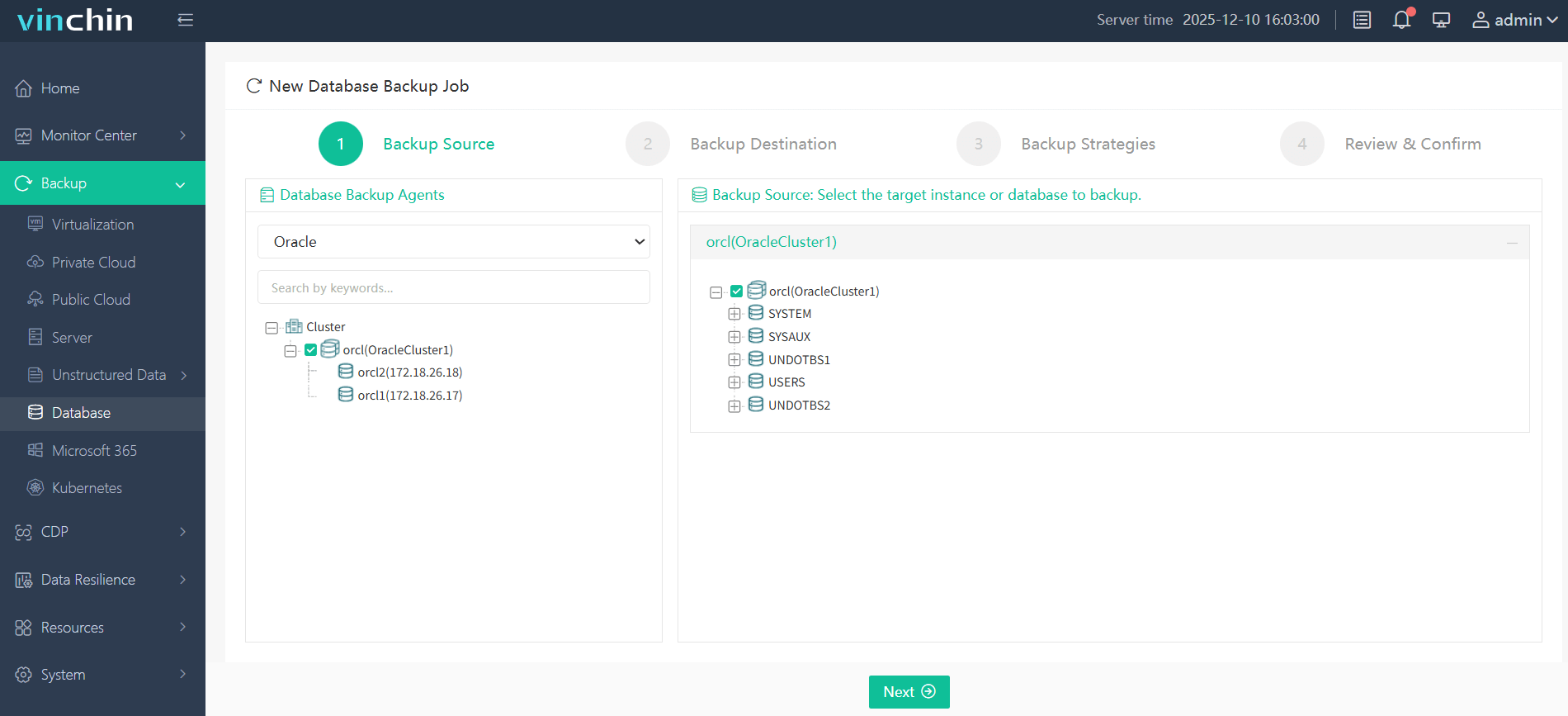
The intuitive web console makes safeguarding your Oracle workloads straightforward:
Step 1. Select the Oracle database to backup
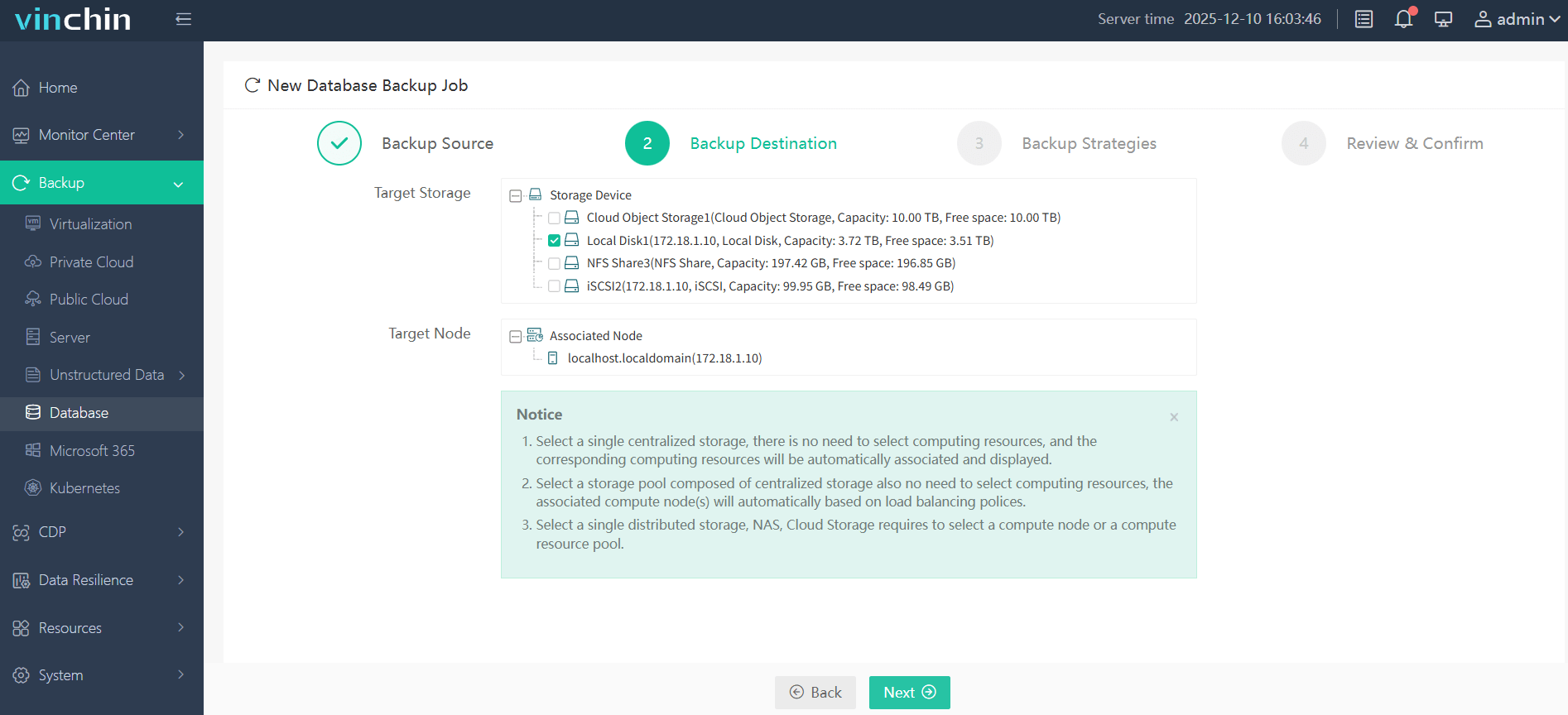
Step 2. Choose the backup storage
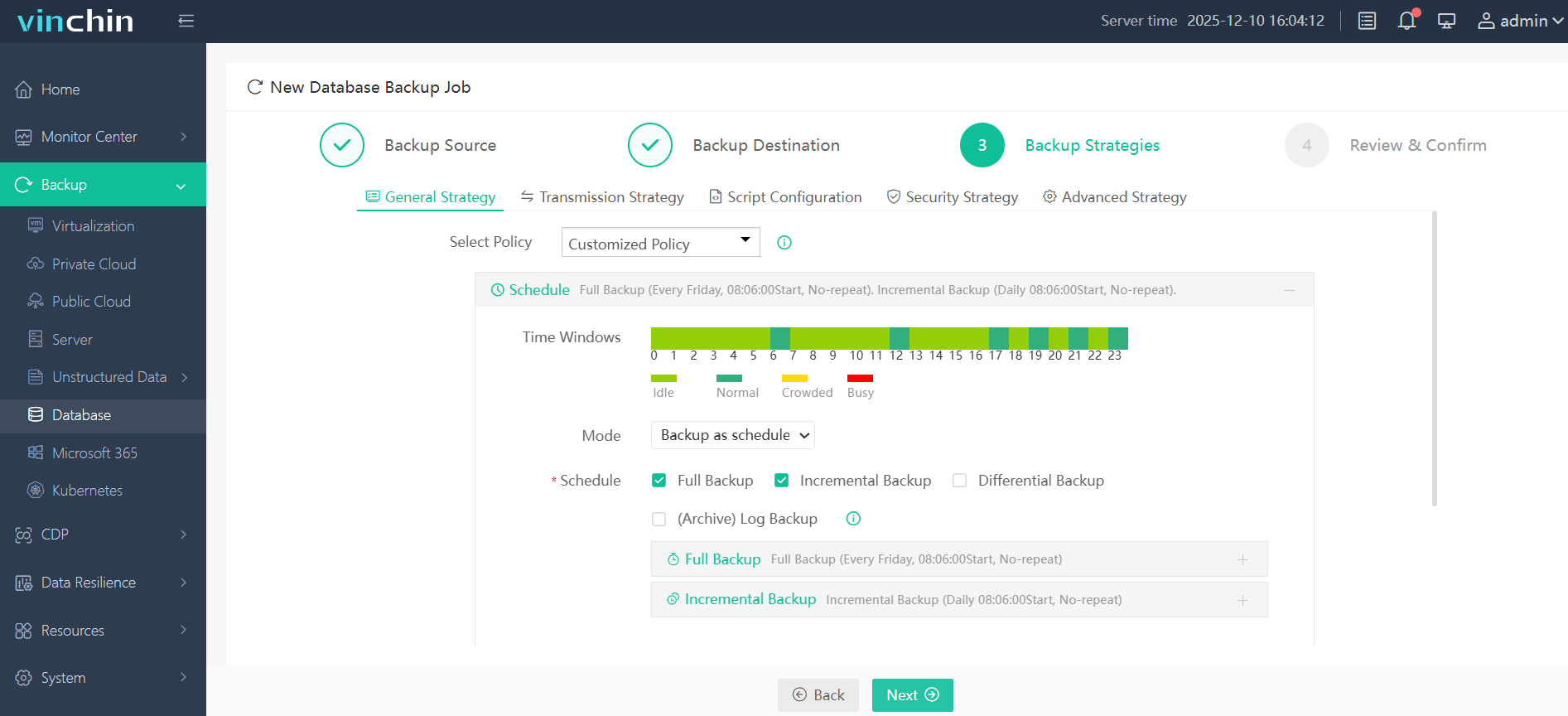
Step 3. Define the backup strategy
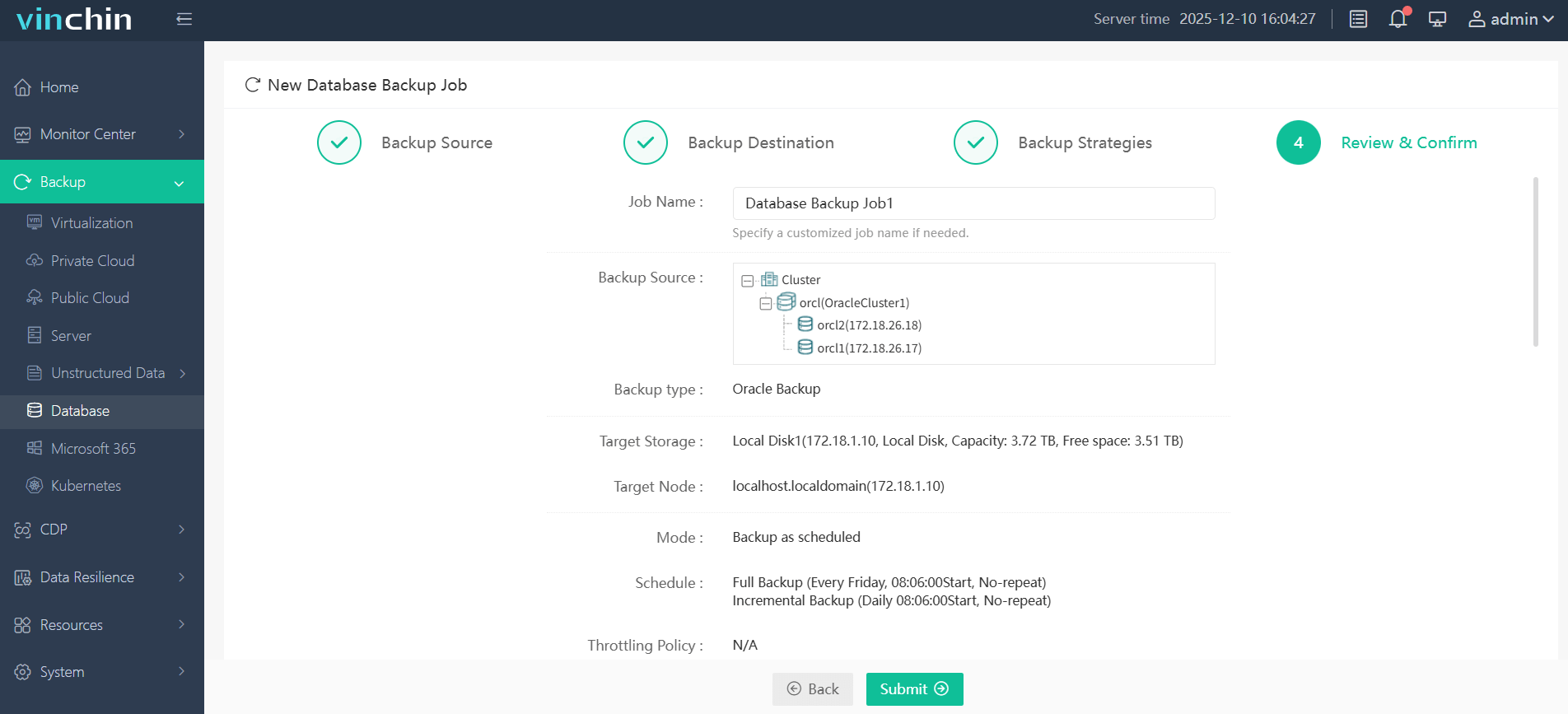
Step 4. Submit the job
Vinchin Backup & Recovery has earned global recognition among enterprises thanks to its reliability and top-rated customer satisfaction scores—start exploring its full capabilities free for 60 days by clicking download below.
Oracle 10g rman duplicate database from backup FAQs
Q1: Can I monitor progress during large duplications?
Yes; check progress in V$SESSION_LONGOPS view or review ALERT_AUXDB.LOG while duplication runs.
Q2: Can I use an SPFILE instead of PFILE when configuring my auxiliary instance?
Yes; edit/create PFILE first then generate SPFILE using CREATE SPFILE FROM PFILE command before starting NOMOUNT mode startup.
Q3: What should I do if my duplicated environment has slower disks than production?
Adjust SGA_TARGET/PGA_AGGREGATE_TARGET lower in PFILE/SPFILE before startup reduce resource contention improve stability.
Conclusion
Duplicating an Oracle 10g database with RMAN gives administrators safe ways to build test or standby systems without risking production uptime or consistency errors. With careful setup this process works reliably every time—and solutions like Vinchin make protecting any enterprise-grade workload even easier than ever before!