Managing Oracle database backups in a Real Application Clusters (RAC) environment is not always straightforward. If you do not allocate RMAN channels properly across your cluster nodes, you may end up overloading one node while others sit idle. This can slow down backup jobs or even create a single point of failure if that node goes offline. To get the most out of your RAC setup—speed, reliability, and high availability—you need to understand how RMAN distributes its workload using allocated channels. In this article, we’ll explain what RMAN channels are, why they matter in RAC environments, how to allocate them both manually and automatically, what checks you should perform before starting, and how to monitor their performance.
What Is RMAN Allocate Channel?
RMAN (Recovery Manager) uses channels as connections between itself and your Oracle database instances. Each channel acts as a server session responsible for moving data during backup or restore operations. When you run the ALLOCATE CHANNEL command in an RMAN script or session, you instruct RMAN to open a dedicated connection for transferring data. You can allocate these channels manually inside a RUN block or let RMAN handle it automatically based on your configuration settings.
Allocating multiple channels allows parallel processing of backup tasks. This means several files can be read or written at once instead of one after another—a big boost for performance when dealing with large databases. The number of channels you use directly affects how quickly backups complete.
What Is Oracle RAC?
Oracle Real Application Clusters (RAC) is an architecture that lets multiple servers—or nodes—work together as one logical database system. Each node runs its own Oracle instance but shares access to the same set of data files stored on shared storage like ASM or NFS. RAC provides high availability: if one node fails unexpectedly, other nodes continue serving users without interruption.
For backup administrators, this means you have more hardware resources available—but only if you configure tools like RMAN correctly. By spreading backup operations across all available nodes using allocated channels, you maximize throughput while reducing risk from any single point of failure.
Why Allocate Channels When Connecting RAC?
If left unconfigured, RMAN might allocate all its backup channels on just one node within your cluster by default. This creates an obvious bottleneck: CPU load spikes on that node while others remain underused; network traffic concentrates there; disk I/O becomes unevenly distributed; and if that node crashes mid-backup, your job could fail entirely.
By explicitly allocating channels across different RAC nodes—either manually or through careful configuration—you distribute workload evenly throughout the cluster. This approach leads to faster backups and restores because every participating server contributes its share of compute power and bandwidth. It also balances resource usage so no single machine gets overloaded during critical maintenance windows.
Prerequisites and Configuration Checks
Before allocating channels in a RAC environment with RMAN, some groundwork is essential to avoid errors later:
First off: make sure each RAC node has access to an up-to-date password file (orapwd). The SYS password must match across all nodes; otherwise authentication failures will occur when connecting remotely from RMAN scripts.
Next: verify connectivity using TNS aliases defined in tnsnames.ora files on every participating server. Test each connect string with tnsping (for basic reachability) or try logging in via SQL*Plus (sqlplus sys/password@xyz1bkp as sysdba) from wherever you'll launch your backup jobs.
Also check service status before running any scripts—use srvctl status service -d xyz -s xyz_bkup1 (and similar commands for other services) to confirm that required services are online on their intended instances.
Finally: ensure network firewalls allow traffic between all involved hosts over relevant ports (usually TCP 1521), especially if some nodes reside in different subnets or datacenters.
Taking these steps upfront saves time troubleshooting failed allocations later—and helps guarantee smooth operation during scheduled backups or urgent restores.
Method 1: Manual Channel Allocation with Connect String
Manual allocation gives precise control over which cluster node handles each part of your backup job—a must-have feature when predictability matters most.
Start by creating dedicated services for each instance using srvctl add service, then start those services so they're ready for incoming connections:
srvctl add service -d xyz -s xyz_bkup1 -r xyz1
srvctl add service -d xyz -s xyz_bkup2 -r xyz2
srvctl start service -d xyz -s xyz_bkup1
srvctl start service -d xyz -s xyz_bkup2
Update tnsnames.ora entries so each alias points directly at its respective host/service combination:
xyz1bkp =
  (DESCRIPTION =
    (ADDRESS=(PROTOCOL=tcp)(HOST=host1.domain.com)(PORT=1521))
    (CONNECT_DATA =
      (SERVICE_NAME=xyz_bkup1.domain.com)
      (INSTANCE_NAME=xyz1)
    )
  )

xyz2bkp =
  (DESCRIPTION =
    (ADDRESS=(PROTOCOL=tcp)(HOST=host2.domain.com)(PORT=1521))
    (CONNECT_DATA =
      (SERVICE_NAME=xyz_bkup2.domain.com)
      (INSTANCE_NAME=xyz2)
    )
  )
Now you're ready for manual channel allocation inside an RMAN script:
run {
  ALLOCATE CHANNEL t1 TYPE DISK CONNECT sys/password@xyz1bkp;
  ALLOCATE CHANNEL t2 TYPE DISK CONNECT sys/password@xyz2bkp;
  BACKUP DATABASE SECTION SIZE 4G;
  RELEASE CHANNEL t1;
  RELEASE CHANNEL t2;
}
Here’s what happens: Each ALLOCATE CHANNEL ... CONNECT ... line tells RMAN exactly which instance should handle that channel’s work—even though you're running this script from just one client machine anywhere in the cluster! The SECTION SIZE clause further splits large datafiles into manageable chunks processed independently by each channel—ideal for maximizing parallelism across multiple servers.
You don’t strictly need explicit RELEASE CHANNEL statements at the end since they’re released automatically when exiting the RUN block—but including them makes intent clear when reading logs later.
If any specified instance is unreachable due to network issues or incorrect credentials—or if its password file isn’t synchronized—the affected channel will fail immediately rather than causing silent delays mid-job.
For clusters larger than two nodes simply repeat these steps: define additional services per instance; update TNS aliases accordingly; then allocate more named channels targeting those endpoints within your script block.
Method 2: Automatic Channel Allocation in RAC
Automatic allocation simplifies management by letting Oracle decide where work gets done based on current load-balancing policies—but it offers less granular control compared with manual assignment.
Set up parallelism first using:
CONFIGURE DEVICE TYPE DISK PARALLELISM 2;
This tells RMAN how many disk-based streams it should attempt simultaneously during future jobs—not just backups but also restores!
Define a load-balanced TNS alias covering all target hosts/services within tnsnames.ora:
RAC_SERVICE =
  (DESCRIPTION =
    (ADDRESS_LIST =
      (ADDRESS=(PROTOCOL=TCP)(HOST=host1.domain.com)(PORT=1521))
      (ADDRESS=(PROTOCOL=TCP)(HOST=host2.domain.com)(PORT=1521))
    )
    (CONNECT_DATA =
      (SERVICE_NAME=your_service)
    )
    (LOAD_BALANCE = yes)
  )
Connect through this alias before launching any job:
BACKUP DATABASE;
With this setup—and assuming load balancing is enabled—each new channel request triggers Oracle Net’s algorithm to pick among available listeners/nodes at connection time based on current session counts or round-robin logic. However: For small numbers of parallel streams it's possible both land on one host anyway! For predictable distribution every time—even at low concurrency levels—manual allocation remains best practice.
Vinchin Backup & Recovery: Enterprise-Level Database Protection Made Simple
While manual scripting offers flexibility for advanced users managing Oracle RAC environments, organizations seeking streamlined protection often turn toward automated solutions designed specifically for enterprise needs. Vinchin Backup & Recovery stands out as a professional-grade platform supporting today’s leading databases—including Oracle first and foremost—as well as MySQL, SQL Server, MariaDB, PostgreSQL, PostgresPro, and TiDB. Its robust feature set includes batch database backup capabilities, comprehensive data retention policies including GFS support, cloud backup and tape archiving options for offsite safety, integrity checks ensuring recoverable copies every time, and seamless restore-to-new-server functionality—all engineered to simplify complex multi-instance scenarios while maintaining security and compliance standards.
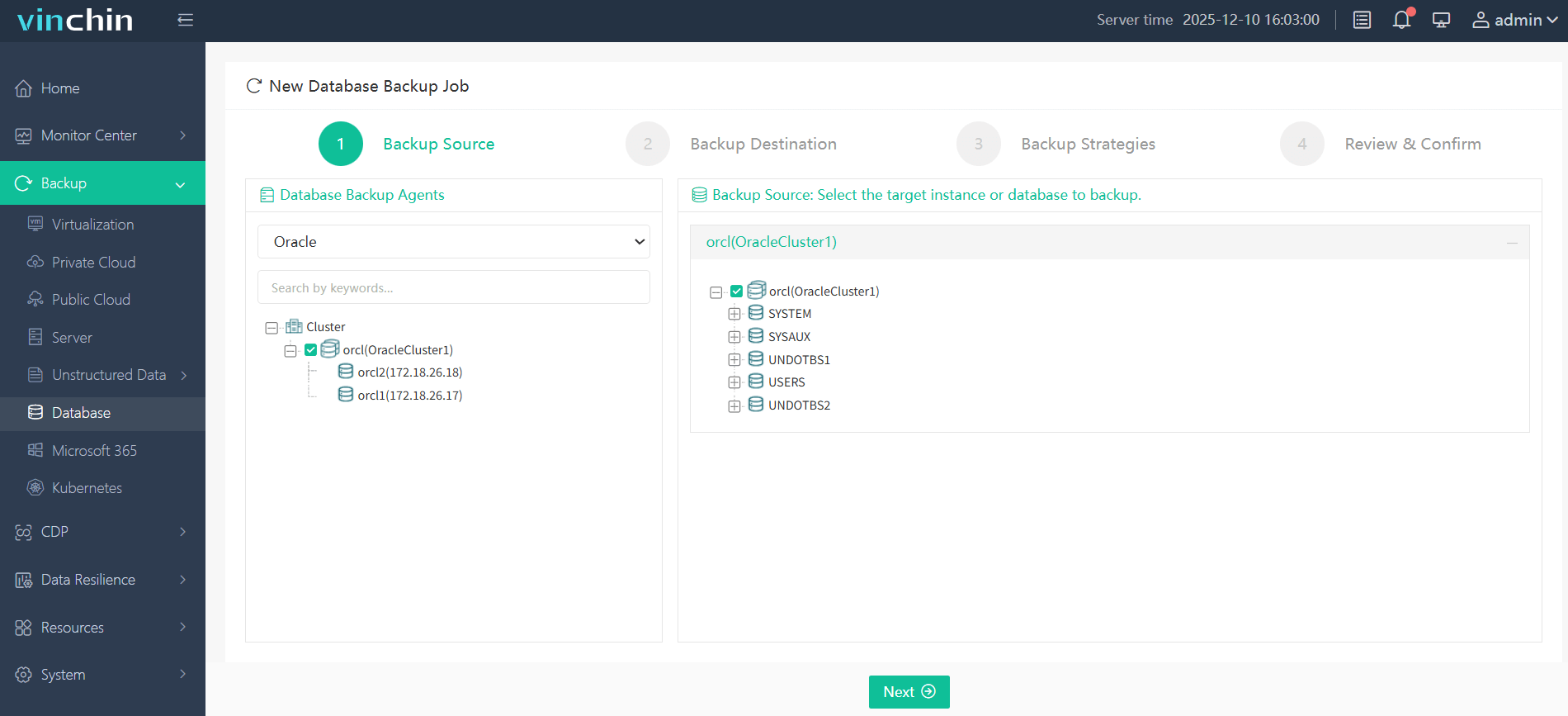
The intuitive web console makes safeguarding Oracle databases remarkably easy:
Step 1. Select the Oracle database to back up
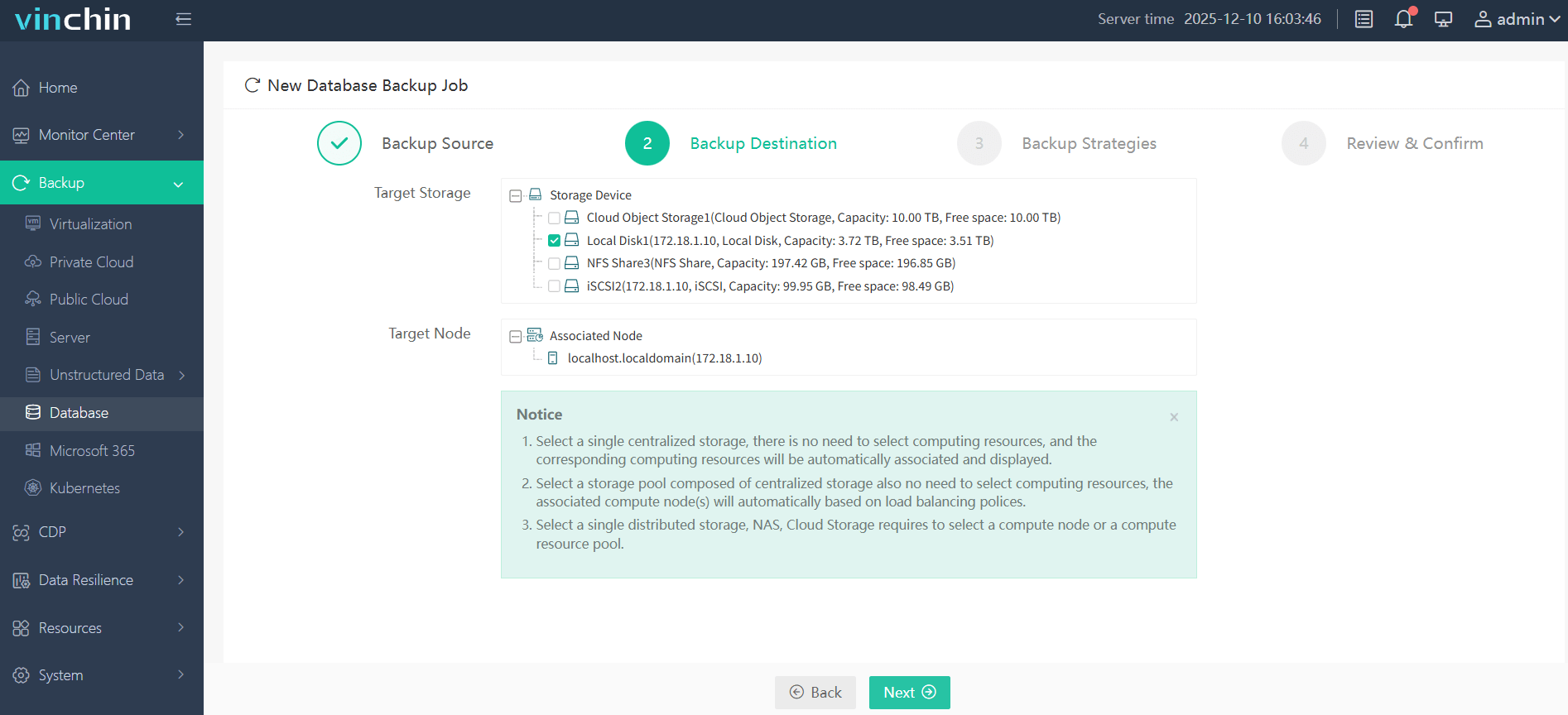
Step 2. Choose the backup storage
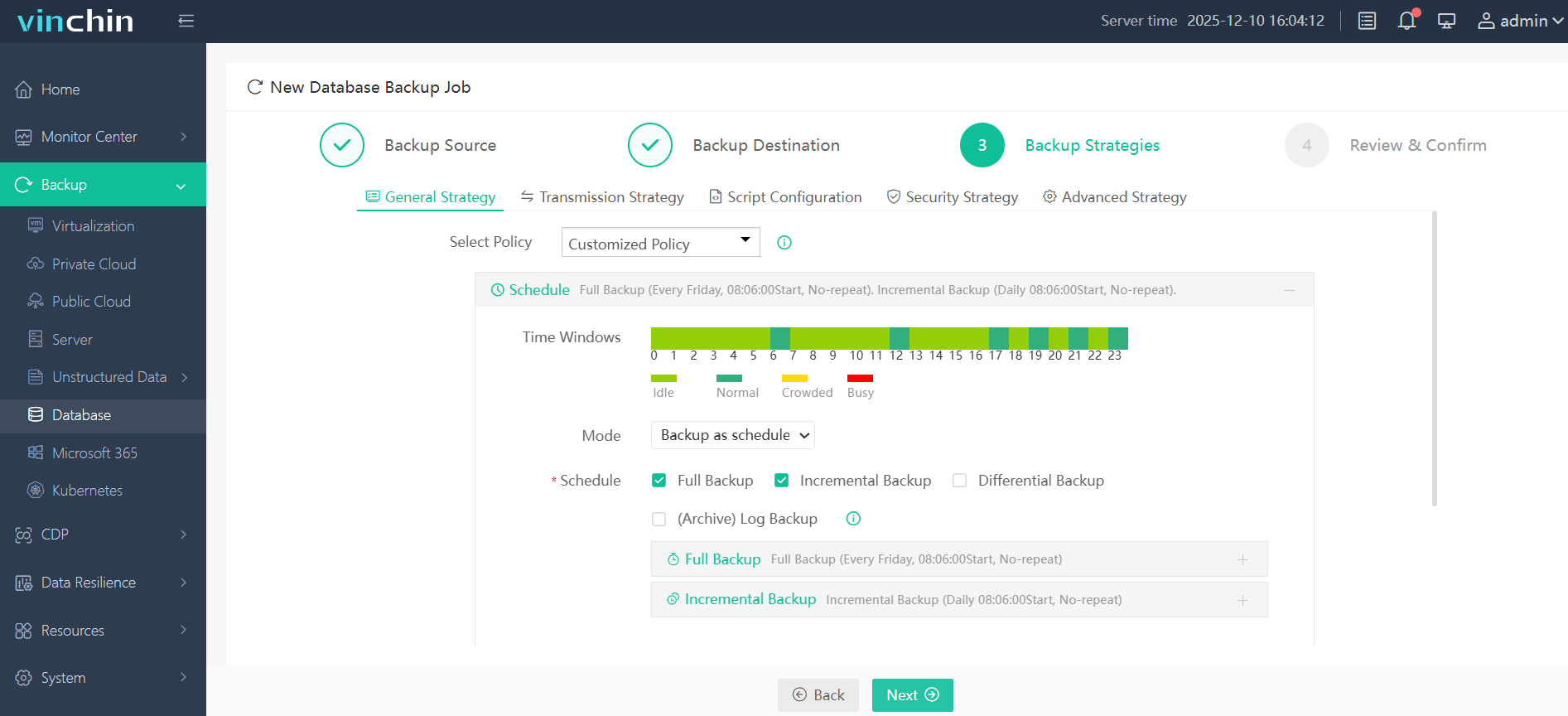
Step 3. Define the backup strategy
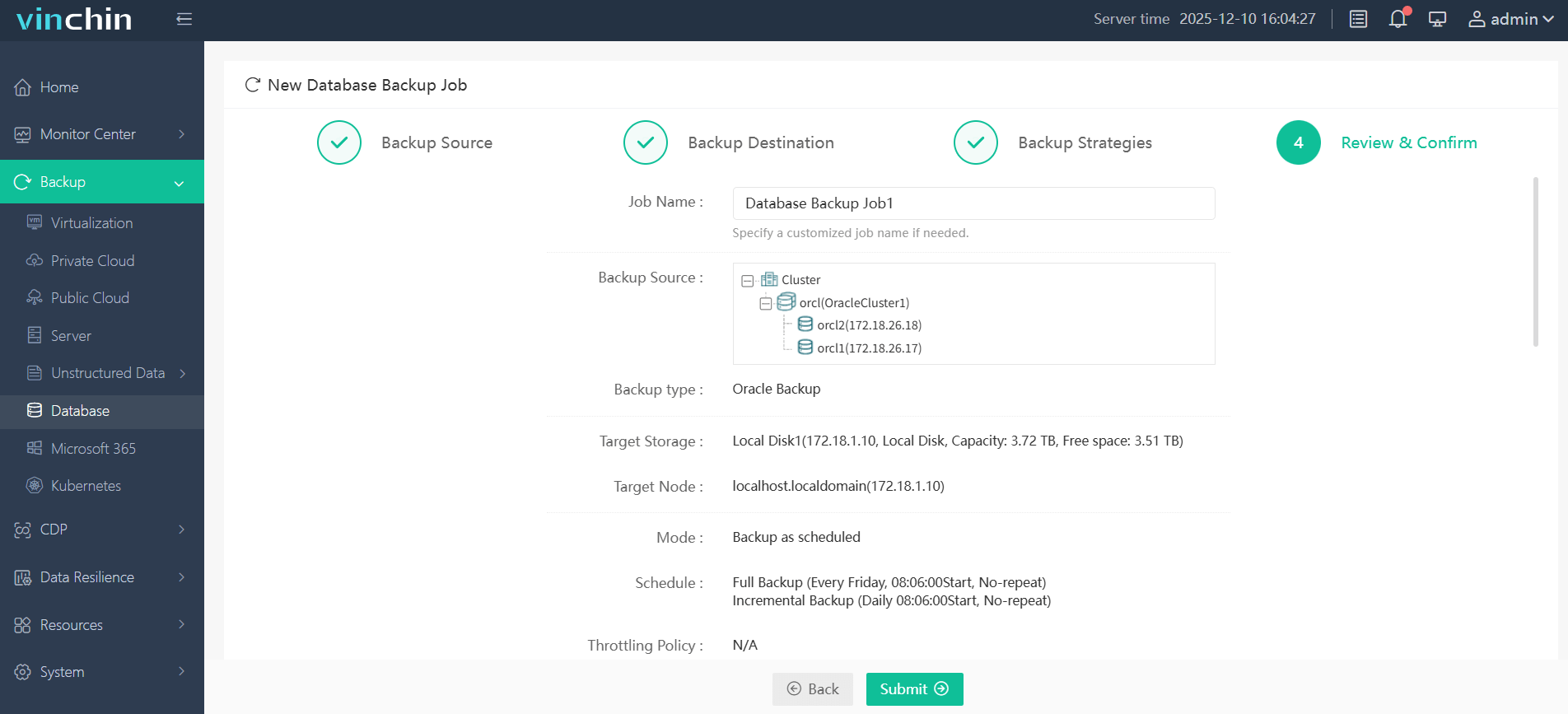
Step 4. Submit the job
Vinchin Backup & Recovery is trusted globally by thousands of enterprises who value reliability and ease-of-use—it consistently earns top ratings worldwide! Experience full features free for 60 days—click download now to get started.
RMAN Allocate Channel Connect RAC FAQs
Q1: Can I assign specific workloads only to selected instances without creating extra services?
A1: Yes; define direct connect strings per instance in tnsnames.ora, then specify them using CONNECT clauses when allocating each channel manually.
Q2: What happens if my chosen target node goes offline mid-backup?
A2: That particular channel fails immediately with an error message; rerun jobs after updating scripts/configuration so only healthy nodes are targeted next time.
Q3: How do I monitor which physical servers are handling my current live backups?
A3: Query GV$SESSION filtering by program name "RMAN" while jobs run—it shows SID plus hosting INSTANCE_ID instantly.
Conclusion
Allocating RMAN channels across multiple RAC nodes unlocks true scalability speed resilience—and avoids hidden bottlenecks lurking behind default settings! Manual assignment delivers full control while automatic methods suit simpler setups needing less oversight. Vinchin streamlines complex multi-instance protection even further—all through an easy web interface anyone can master fast!