Oracle RMAN (Recovery Manager) is the standard tool for backing up and restoring Oracle databases. As your database grows or business demands change, you might notice backup windows stretching beyond maintenance periods or see high CPU wait times during backups—sometimes even tape drives fail to stream efficiently. These are clear signs that it’s time to look at Oracle RMAN performance tuning.
In this article, we break down what impacts Oracle RMAN performance and guide you through step-by-step methods to optimize your backup and restore jobs—from basic checks to advanced strategies.
What Impacts Oracle RMAN Performance?
Several factors can slow down RMAN operations: disk input/output speed, network throughput, parallelism settings, channel configuration, and buffer management all play key roles. Each backup or restore job has three main phases: reading data from disk; processing (copying, compressing, encrypting); then writing data to the backup destination.
The slowest phase becomes your bottleneck—limiting overall speed. Identifying where this bottleneck occurs helps you focus your tuning efforts for maximum impact.
Establishing a Performance Baseline and Monitoring
Before making changes to improve performance, it’s vital to know where you stand today. Tuning without a baseline is guesswork—you need facts.
Start by measuring current backup durations and throughput in MB/sec. Use system tools or SQL queries against V$BACKUP_SYNC_IO and V$BACKUP_ASYNC_IO views to capture metrics like EFFECTIVE_BYTES_PER_SECOND, LONG_WAITS, and TOTAL_WAITS ratios for each file involved in backups.
For example:
SELECT FILE#, EFFECTIVE_BYTES_PER_SECOND FROM V$BACKUP_ASYNC_IO;
Files with low throughput or high wait ratios may indicate an I/O bottleneck worth investigating further.
Also monitor system-level stats such as disk utilization rates (using OS tools), network bandwidth usage if backups go off-host or off-site, CPU load during compression tasks, and memory consumption when increasing buffers or parallelism.
By capturing these metrics before any changes—and again after—you can measure exactly how much each tuning step improves performance.
Method 1: Improving Disk I/O Throughput for Oracle RMAN Performance Tuning
Disk input/output is often the first place experts check when tuning RMAN jobs because slow disks will drag down even well-configured environments.
Begin by checking raw disk throughput using tools like Oracle Orion or vendor-specific utilities; compare results against expected hardware specs. Make sure datafiles and backup destinations reside on separate disks or disk groups so they don’t compete for bandwidth during heavy operations.
If you use ASM (Automatic Storage Management), confirm that disk groups are balanced across available spindles/LUNs—and striped properly—to maximize read/write speeds. For non-ASM setups, stripe datafiles across multiple disks with a stripe size around 1 MB for best results.
When configuring RMAN itself:
Allocate multiple channels—ideally one per physical disk/LUN—to allow true parallel reads/writes.
Adjust MAXOPENFILES (number of files each channel opens at once) based on storage type: set it low (1–2) if using striped/ASM storage so more memory goes into buffering each file; leave at default (8) otherwise.
Set FILESPERSET low if you want more—but smaller—backup pieces written in parallel; this can help balance loads across disks.
Use SHOW CHANNEL within RMAN prompt to review current buffer allocations (disk_bufcnt, disk_bufsz) before considering manual adjustments via ALLOCATE CHANNEL ... PARMS. Only tune these under guidance from support teams since improper values may cause instability.
Remember: More channels/buffers mean higher memory usage—monitor system RAM closely as you scale up!
Maximize hardware throughput via careful striping choices plus smart channel allocation—that’s the heart of Method 1.
Method 2: Optimizing Network Configuration for Oracle RMAN Performance Tuning
Network speed becomes critical whenever backups involve remote storage devices or cloud repositories—a common scenario today.
First steps include isolating backup traffic onto dedicated networks where possible so other workloads don’t interfere with transfer speeds. If sharing infrastructure is unavoidable due to cost constraints or legacy design decisions, schedule large backups during off-hours when network congestion is lowest.
Within your RMAN scripts:
ALLOCATE CHANNEL c1 DEVICE TYPE DISK RATE 1500K;
This limits that channel’s bandwidth usage so other applications aren’t starved.
If writing directly to tape over network links—or using third-party media managers—ensure both block sizes (BLKSIZE) match device capabilities AND streaming parameters (PARMS) are tuned per vendor guidelines.
Always test actual end-to-end transfer rates after making changes; sometimes theoretical improvements don’t translate due to hidden switch/router limitations upstream!
Optimizing network paths ensures that fast disks aren’t held back by slow wires—a crucial point in modern hybrid environments.
Method 3: Tuning Parallelism Settings in RMAN
Parallelism lets you process multiple files at once—but too much can overload servers while too little wastes resources already paid for!
Set parallelism using either:
CONFIGURE DEVICE TYPE DISK PARALLELISM N;
or explicit
ALLOCATE CHANNEL chN DEVICE TYPE DISK;
commands within scripts/jobs where N matches available physical resources—not just total CPUs but also number of LUNs/disks dedicated solely for backup tasks. Start conservatively: one channel per spindle/LUN usually works well; increase gradually while monitoring server health indicators like CPU load averages/memory pressure/disk queue lengths after every adjustment round.
Note that database parameters such as DBWR_IO_SLAVES (for asynchronous writes) may cap effective parallelism even if more channels are configured! Over-subscribing leads only to contention—not faster jobs—so always test incrementally rather than guessing high numbers upfront.
For very large bigfile tablespaces—or multi-terabyte objects—use
BACKUP SECTION SIZE XG DATAFILE Y;
to split work among several channels simultaneously; requires COMPATIBLE parameter set at least 11.0.0+. This approach dramatically reduces elapsed time on massive datasets compared with single-threaded reads/writes alone!
Method 3 boils down simply: Match parallelism settings carefully against real-world hardware limits—and always validate gains through repeated testing cycles rather than theory alone!
How Can Vinchin Backup & Recovery Improve Oracle Database Backup and Recovery?
Beyond manual optimization techniques discussed above, organizations seeking streamlined enterprise-grade protection should consider Vinchin Backup & Recovery—a professional solution designed specifically for robust database environments like Oracle as well as MySQL, SQL Server, MariaDB, PostgreSQL, PostgresPro, and TiDB. Supporting features such as advanced source-side compression, incremental backup capability tailored for Oracle workloads, batch database backup management, granular retention policies including GFS retention policy options, and comprehensive storage protection measures ensure efficient operations while safeguarding critical data assets from threats like ransomware—all within a unified platform built for scalability and reliability.
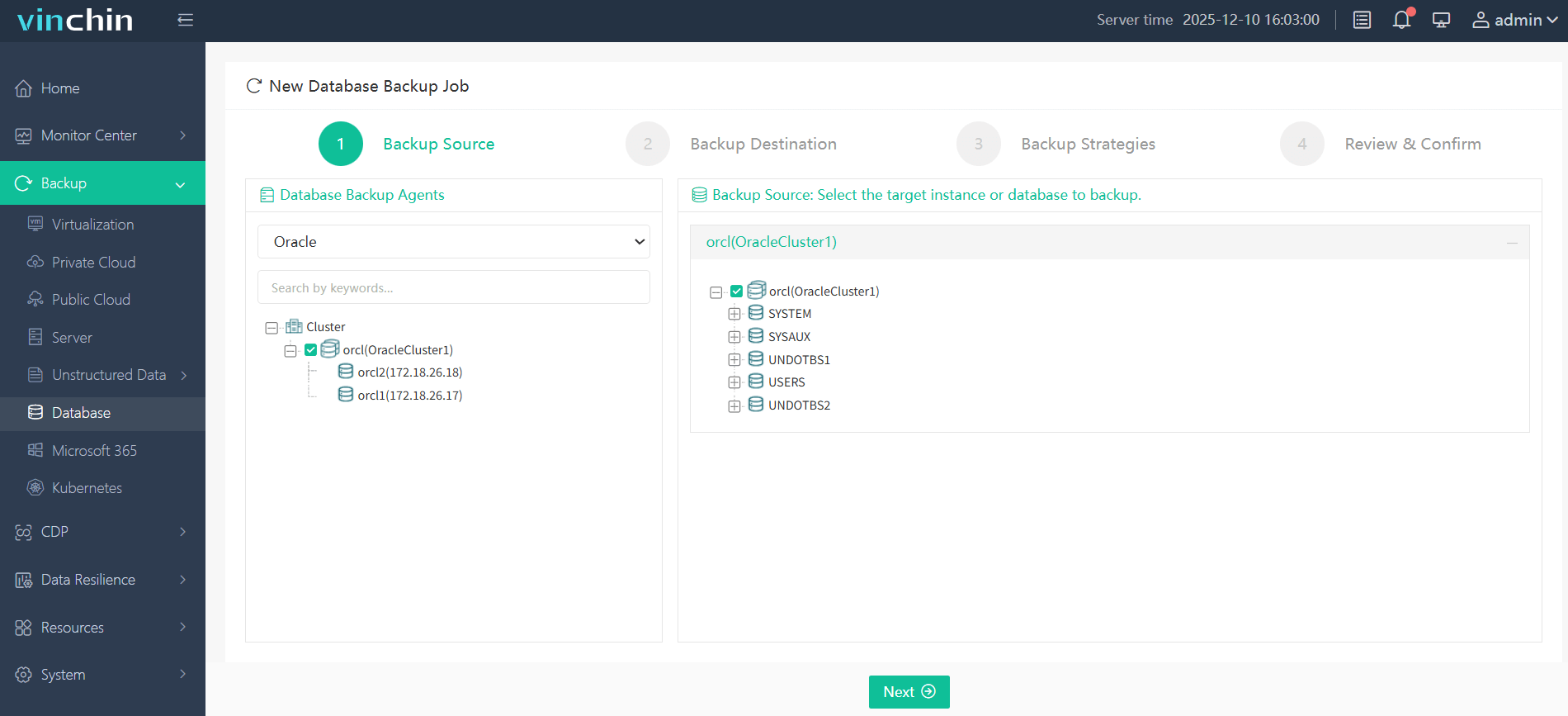
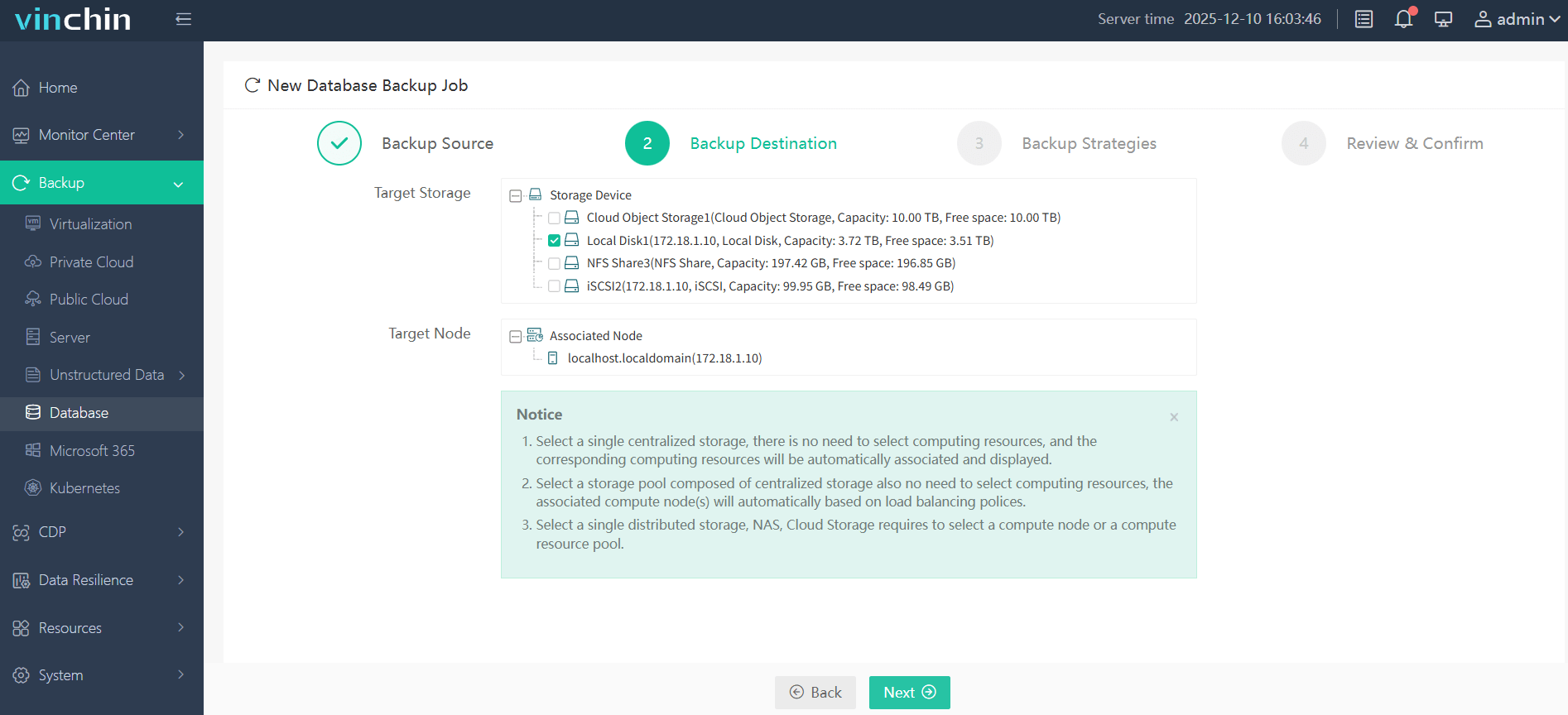
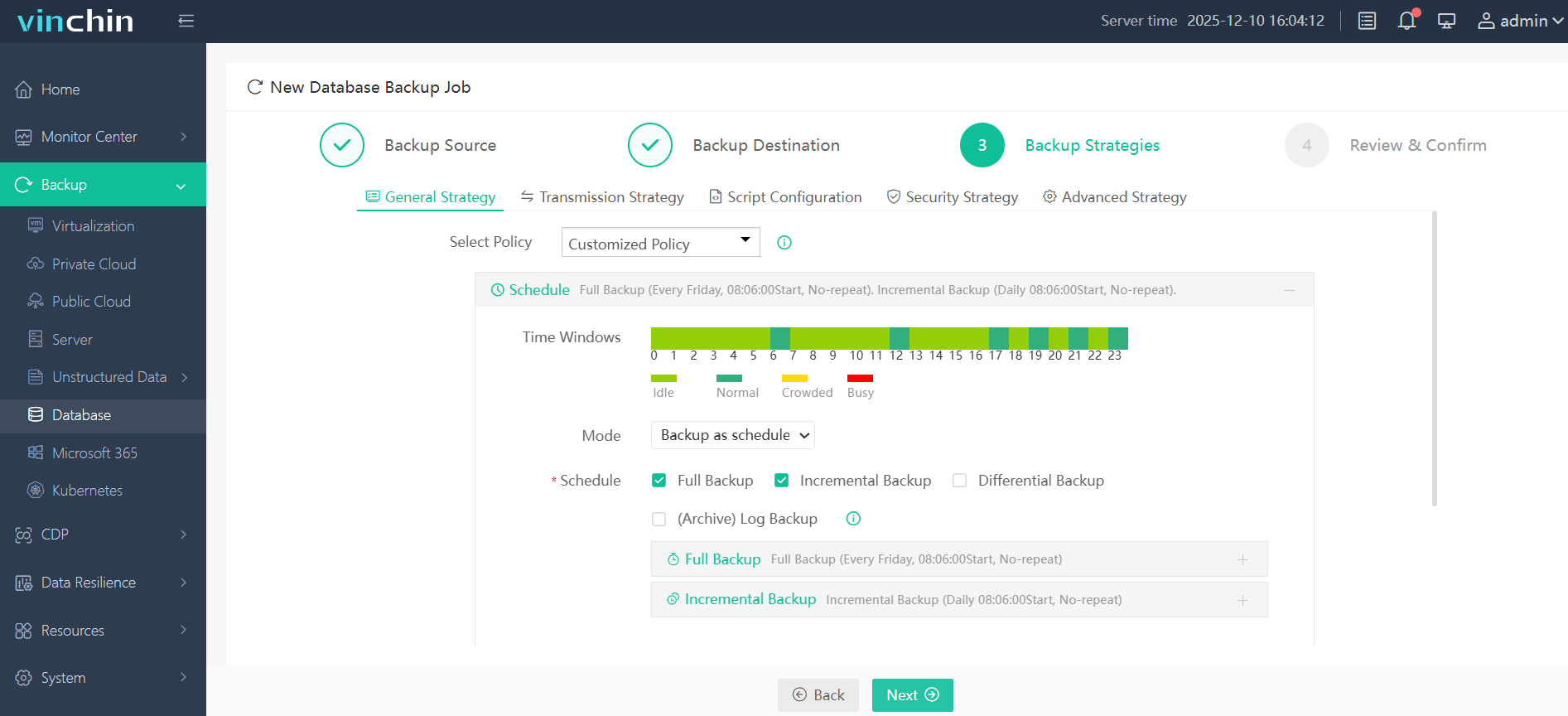
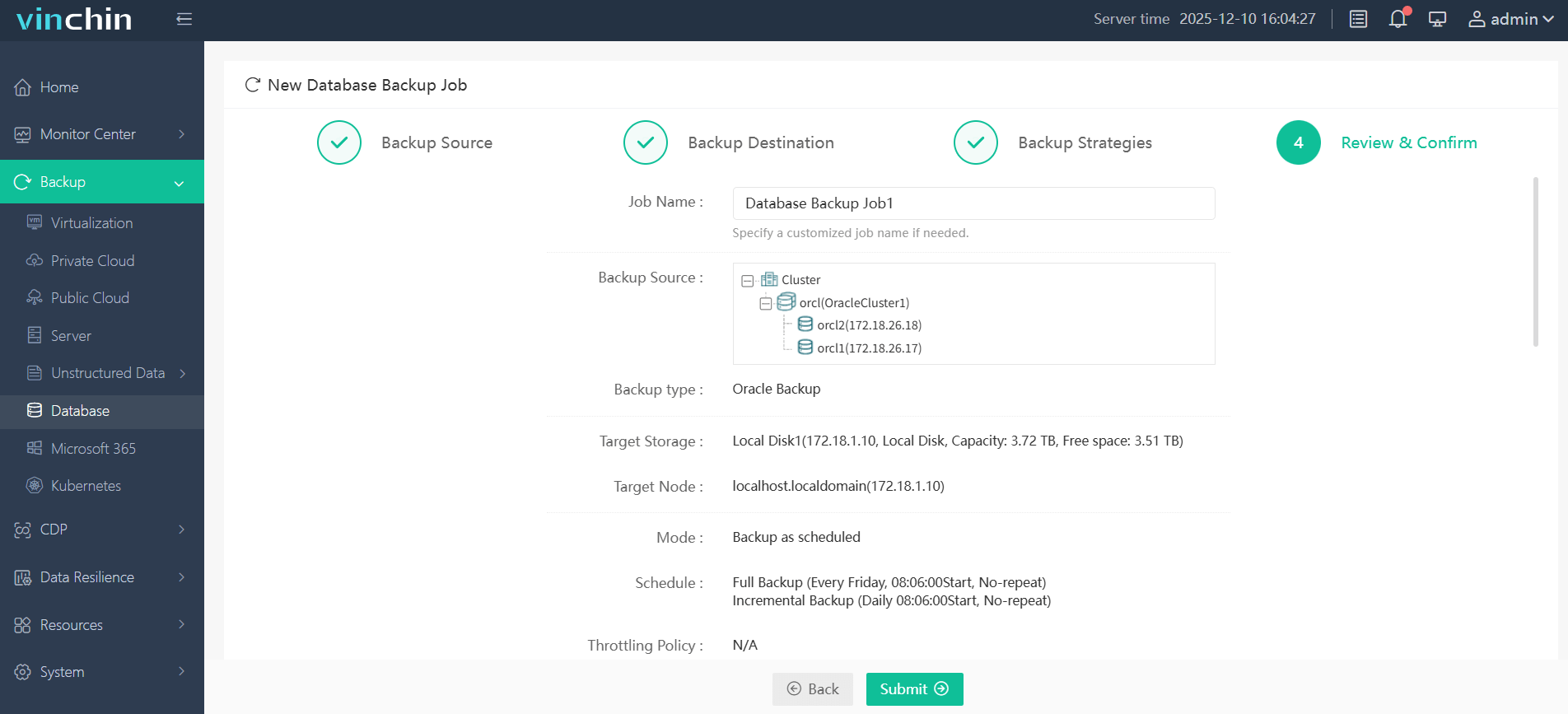
With its intuitive web console interface, Vinchin Backup & Recovery simplifies complex tasks into four straightforward steps tailored specifically for Oracle users:
Step 1. Select the Oracle database to back up
Step 2. Choose the backup storage
Step 3. Define the backup strategy
Step 4. Submit the job
Recognized globally with top ratings among enterprise customers worldwide,Vinchin Backup & Recovery offers a fully featured free trial valid for 60 days—click below to experience industry-leading data protection firsthand.
Oracle RMAN Performance Tuning FAQs
Q1: How do I quickly tell if my bottleneck is reading from disk versus writing out?
A1: Run BACKUP VALIDATE first; if it's fast but real backups are slow afterward—the problem lies in writing out rather than reading source files.
Q2: What should I check first if my cloud-based RMAN jobs run slowly?
A2: Measure end-to-end network latency/bandwidth between source server/cloud target before adjusting local settings.
Q3: Does changing DBWR_IO_SLAVES affect my ability to scale up parallel channels?
A3: Yes—increasing DBWR_IO_SLAVES enables asynchronous IO which allows more effective use of additional channels during large-scale backups.
Conclusion
Tuning Oracle RMAN performance means finding bottlenecks—in disk access patterns/network paths/parallel configurations—and fixing them step by step until jobs run reliably within required windows again! With Vinchin’s solution managing complex schedules gets easier than ever—try it free today!