Restoring an Oracle database is a vital skill for any operations administrator. But what if you need to recover your database when there’s no Recovery Catalog available? Many organizations use Oracle RMAN (Recovery Manager) for backup and recovery tasks. However, not every environment maintains a separate catalog. This guide walks you through restoring an Oracle database using RMAN without a catalog—step by step. We’ll also explore why this approach matters, how to avoid common pitfalls, and best practices to ensure success.
What Is Oracle RMAN Restore Without Catalog?
Oracle RMAN is built into every Oracle Database installation. It handles backup and recovery tasks efficiently. Usually, RMAN can use a Recovery Catalog—a separate schema that stores metadata about backups across multiple databases. But it’s not required. When running in “NOCATALOG” mode, all backup metadata stays inside the target database’s control file instead of an external repository.
Restoring without a catalog means you rely solely on the control file’s records plus your physical backup pieces. This approach works well but requires careful preparation because losing both your control file and Recovery Catalog makes restores more complex.
Why Restore Database Without Catalog?
You might need to restore without a catalog for several reasons. Sometimes the Recovery Catalog was never set up or has become unavailable due to hardware failure or network issues. In disaster recovery situations—such as server loss or site outages—you may only have access to backup files and control file autobackups.
While using a catalog provides more flexibility (like longer retention of backup history), restoring without one remains fully supported by Oracle. For many DBAs facing emergencies or migrations to new servers, NOCATALOG mode is often the only option.
Prerequisites for Restoring Without a Catalog
Before starting any restore operation in NOCATALOG mode, make sure you have everything ready:
The DBID (Database Identifier). You can find this in old logs or from the name of control file autobackup files (c-1234567890-YYYYMMDD-NN).
Access to all required backup pieces, including full backups of datafiles and archived redo logs.
Knowledge of your backup retention policy—how long backups are kept—and their storage locations.
The format/location used for control file autobackups if enabled; know whether they’re stored on disk or tape.
Proper OS permissions on the target server; set environment variables like ORACLE_SID and ORACLE_HOME correctly before launching RMAN.
Having these items at hand ensures your restore process goes smoothly—even under pressure.
Method 1 Restoring Using Control File
Restoring with just the control file is common when no Recovery Catalog exists. The control file holds metadata about all backups made while it was present. If you lose it too, you must first restore it from an autobackup or explicit copy.
Here’s how you proceed:
First, confirm your DBID—this number uniquely identifies your database during restores.
1. Start RMAN and set DBID:
Open terminal then run:
rman target /
At the RMAN> prompt enter:
SET DBID <your_dbid>;
Use SET DBID only if connecting before mounting any instance; otherwise skip this step if already mounted.
2. Start database in NOMOUNT mode:
STARTUP NOMOUNT;
If prompted about missing parameter files (spfile or init.ora), create a minimal init<sid>.ora. For example:
db_name='YOURDB'
3. Restore control file from backup:
If you know its location:
RESTORE CONTROLFILE FROM '/path/to/your/controlfile.bkp';
If relying on autobackups:
RESTORE CONTROLFILE FROM AUTOBACKUP;
RESTORE CONTROLFILE FROM AUTOBACKUP DEVICE TYPE DISK MAXDAYS 30;
4. Mount the database:
ALTER DATABASE MOUNT;
5. Catalog backup pieces if needed:
If backups aren’t in their original place:
CATALOG START WITH '/path/to/backup/files/';
Or use
CATALOG RECOVERY AREA;
6. Restore the database:
RESTORE DATABASE;
7. Recover the database:
This applies archived redo logs automatically:
RECOVER DATABASE;
8. Open with RESETLOGS:
After successful recovery,
ALTER DATABASE OPEN RESETLOGS;
If archive logs are missing during recovery—or some files cannot be found—you may need to provide them manually or recover up to an earlier point using commands like
RECOVER DATABASE UNTIL TIME 'YYYY-MM-DD HH24:MI:SS';
or
RECOVER DATABASE NOREDO;
if accepting some data loss is necessary.
This method relies entirely on having valid copies of both your control file (or its autobackup) plus all relevant datafile/backups available at restore time.
Method 2 Restoring From Autobackup
If there’s no explicit copy of your control file but you enabled autobackup during regular operations (CONFIGURE CONTROLFILE AUTOBACKUP ON;), RMAN can search for it automatically—even after total loss of server or storage system.
Follow these steps:
1. Start RMAN and set DBID:
As above,
     rman target /
     SET DBID <your_dbid>;
2. Start instance in NOMOUNT mode:
STARTUP NOMOUNT;
3. Restore SPFILE from autobackup (if missing):
If startup fails due to missing SPFILE,
      RESTORE SPFILE FROM AUTOBACKUP;
      SHUTDOWN IMMEDIATE;
      STARTUP NOMOUNT;
4. Restore control file from autobackup:
       RESTORE CONTROLFILE FROM AUTOBACKUP;
       ALTER DATABASE MOUNT;
5. Catalog additional backup pieces if necessary:
Register non-default location files as shown earlier using
CATALOG START WITH '/path/to/backup/files/';
6–9: Proceed as above—
RESTORE DATABASE;
RECOVER DATABASE;
ALTER DATABASE OPEN RESETLOGS;
This method works even after catastrophic failures because RMAN uses both DBID info embedded within filenames plus default search patterns based on configuration settings (CONTROL_FILE_RECORD_KEEP_TIME, etc.).
Always verify that all required backups—including archive logs—are accessible from wherever you're restoring!
Enterprise-Level Backup Solution for Oracle Databases — Vinchin Backup & Recovery
For organizations seeking robust protection beyond manual methods described above, Vinchin Backup & Recovery delivers enterprise-grade backup capabilities tailored for today’s mainstream databases—including comprehensive support for Oracle environments alongside MySQL, SQL Server, MariaDB, PostgreSQL, PostgresPro, and TiDB platforms alike (with particular focus here on Oracle). Key features include batch database backup management, flexible data retention policies including GFS options, cloud/tape archiving integration, integrity checks ensuring recoverability verification via SQL scripts, and secure restoration workflows—even onto new servers—all designed to streamline compliance while maximizing operational resilience against threats such as ransomware attacks or accidental deletions.
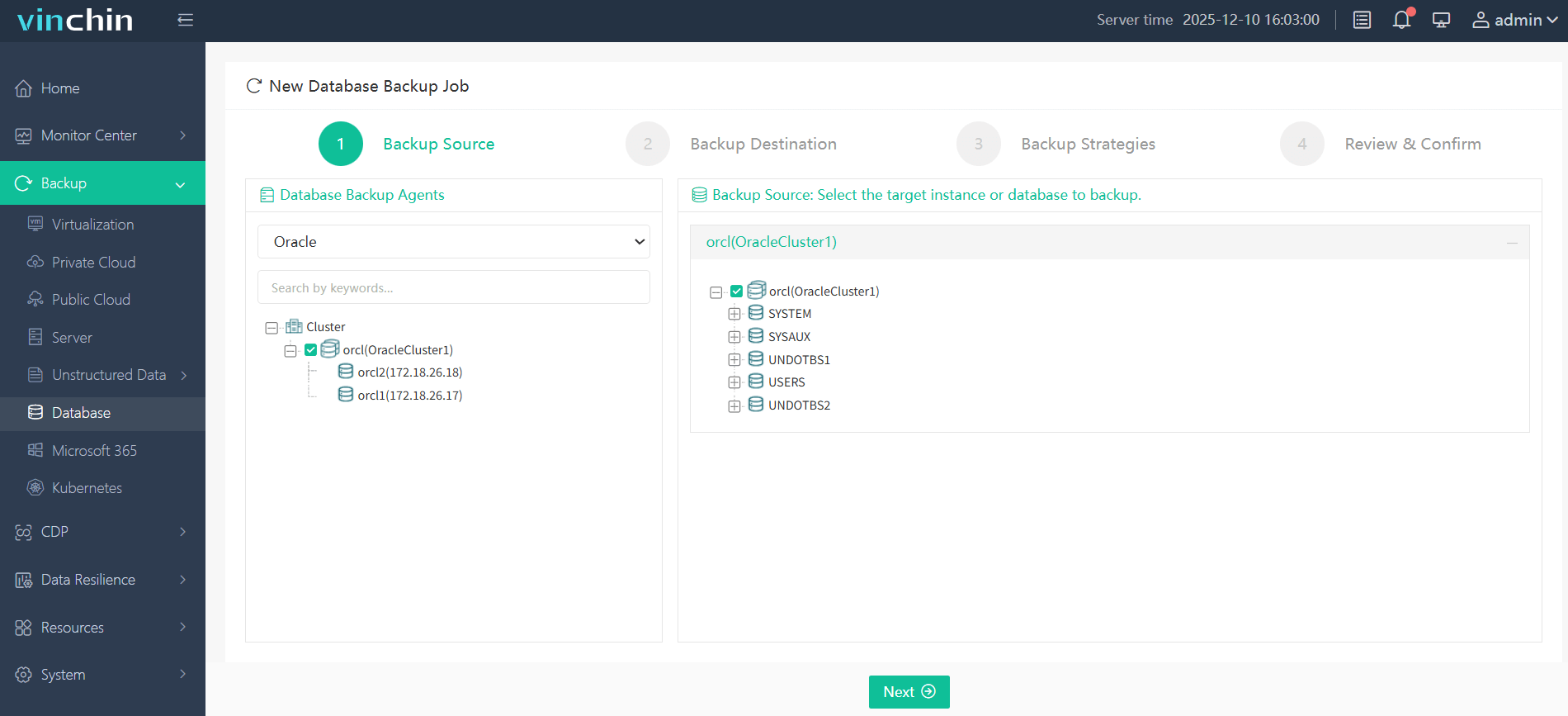
The intuitive web console makes safeguarding your Oracle workloads simple:
Step 1. Select the Oracle database to back up
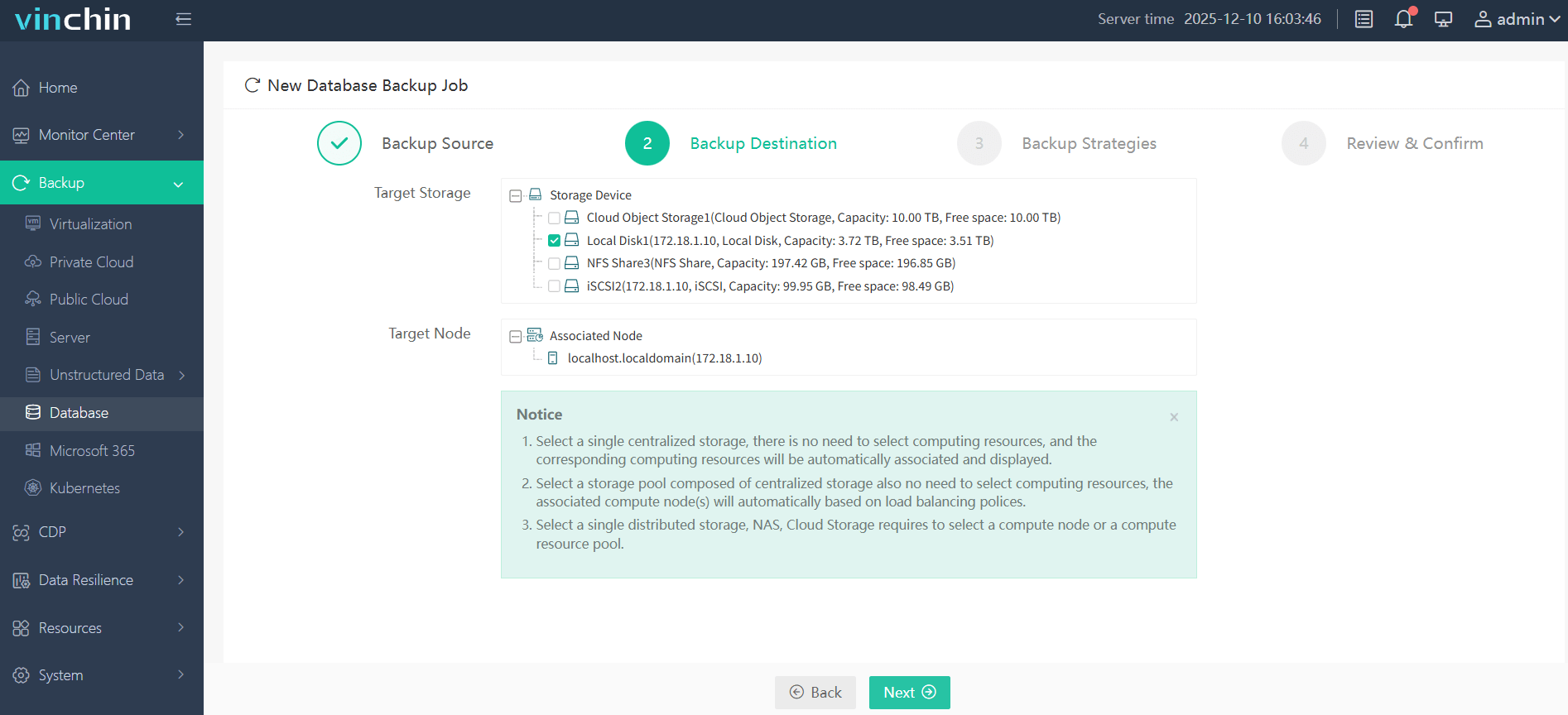
Step 2. Choose the backup storage
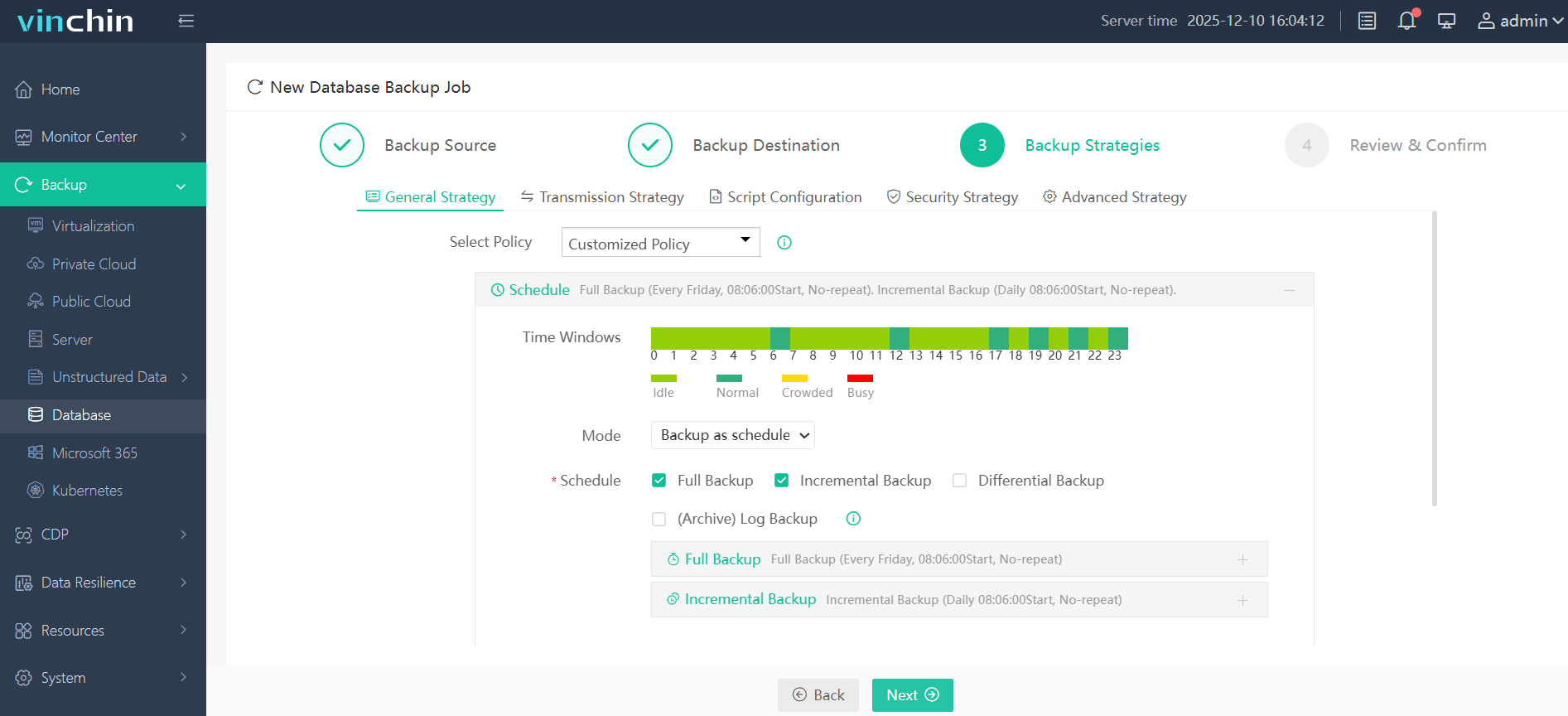
Step 3. Define the backup strategy
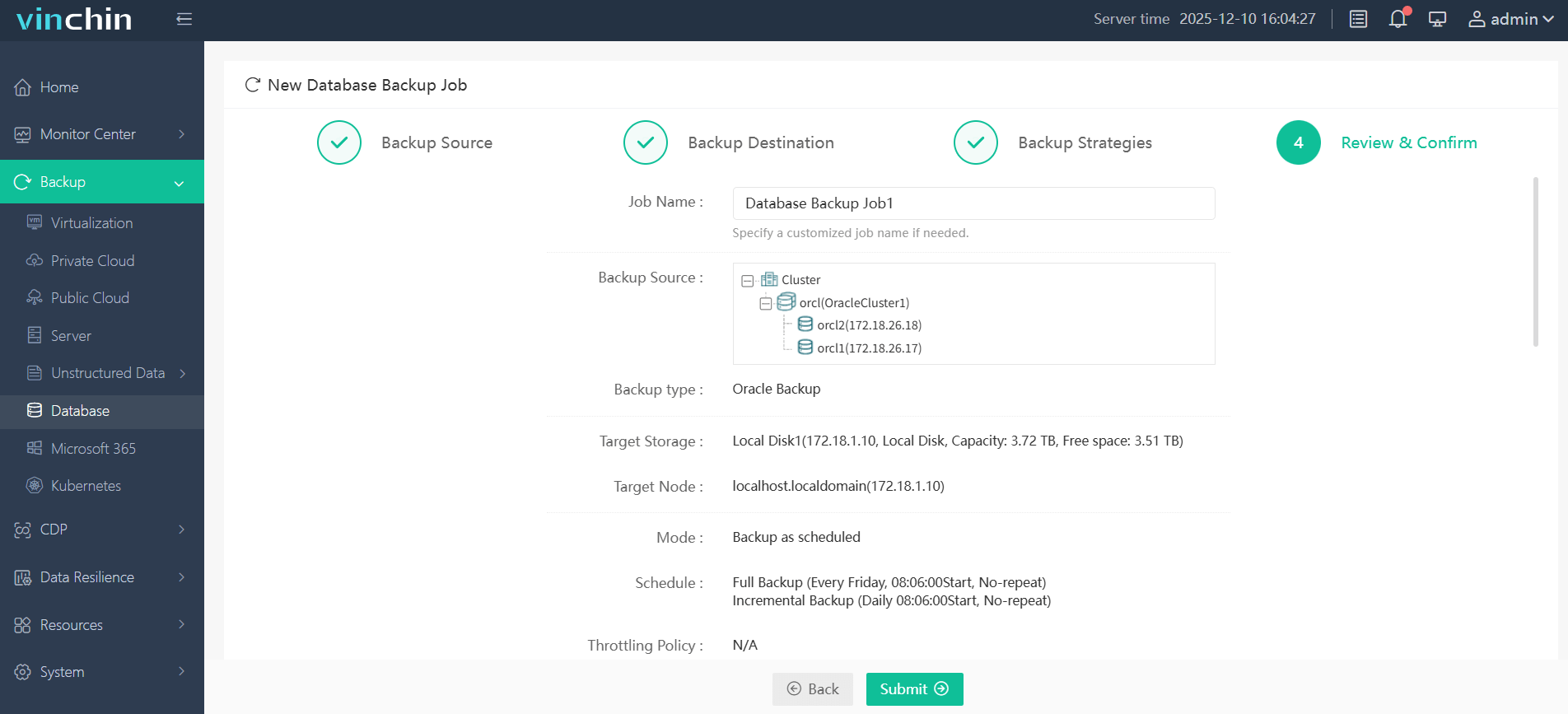
Step 4. Submit the job
Recognized globally among enterprise users for reliability and ease-of-use—with top industry ratings—Vinchin Backup & Recovery offers a risk-free 60-day trial granting access to its complete feature set so you can experience next-level data protection firsthand.
Oracle RMAN Restore Database Without Catalog FAQs
Q1: Can I perform point-in-time recovery (PITR) without using a Recovery Catalog?
A1: Yes; use SET UNTIL TIME 'YYYY-MM-DD HH24:MI:SS' before running RESTOREand RECOVER.
Q2: How do I recover only one tablespace or datafile without access to a catalog?
A2: Mount database > RUN { SET NEWNAME FOR DATAFILE X TO '<path>'; RESTORE DATAFILE X; RECOVER DATAFILE X } > switch back online > open resetlogs if needed.
Q3: What should I do if archive log gaps prevent complete recovery?
A3: Use available archive log backups > apply them > if still missing logs stop at last consistent SCN/time using SET UNTIL.
Conclusion
Restoring an Oracle database with RMAN without a catalog demands preparation but remains straightforward when armed with proper knowledge—and practice makes perfect! Always document key details ahead of time so emergencies don’t catch you off guard.Vinchin helps make robust protection easier than ever—with powerful automation tools designed specifically for enterprise needs.Try it today!