Backing up Oracle databases is a critical task for any operations administrator. When your data sits on ZFS storage, you have powerful options for both performance and flexibility. But how do you combine Oracle RMAN and ZFS to get reliable, fast, and manageable backups? This guide provides essential configuration steps and performance optimizations so you can implement a robust backup strategy.
What Is Oracle ZFS RMAN Backup?
Oracle ZFS RMAN backup refers to using Oracle Recovery Manager (RMAN) to back up Oracle databases directly to a ZFS Storage Appliance. RMAN is Oracle’s built-in tool for backup and recovery. ZFS is a high-performance enterprise storage system known for its advanced features. Together, they allow you to store backups over NFS or other supported protocols while leveraging ZFS features like snapshots, compression, deduplication, and analytics.
With this combination, administrators gain not only speed but also reliability in their backup processes. The integration supports both full database protection and flexible restore options.
Why Use ZFS with RMAN Backups?
Pairing ZFS with RMAN brings several advantages that go beyond basic file storage. Using these technologies together means you can optimize both speed and security in your backup workflow.
ZFS offers high throughput thanks to its architecture designed for large sequential writes—a perfect match for database workloads. Its end-to-end checksumming ensures data integrity at every stage. Advanced features like snapshots let you capture point-in-time copies of your data instantly.
RMAN complements this by providing efficient parallelized backups that reduce downtime during maintenance windows. It automates many tasks—such as incremental backups—so you don’t have to manage files manually.
When combined:
You get fast backup/restore speeds using Direct NFS (dNFS) over high-speed networks.
Snapshots enable rapid recovery or test environment refreshes without moving large amounts of data.
Management becomes easier through the browser-based interface of ZFS alongside automated scheduling in RMAN.
Built-in compression/deduplication saves space—and money—on storage hardware.
Flexible strategies support both full/incremental backups tailored to business needs.
Isn’t it reassuring when your backups are both fast and reliable?
How to Use RMAN Directly with ZFS?
Backing up Oracle databases directly to ZFS using RMAN is a proven method that scales well from small environments up through enterprise deployments. Let’s break down what’s involved—from initial setup through ongoing optimization—so even complex environments can benefit from this approach.
Prerequisites and ZFS Configuration
Before starting any backup jobs with RMAN on top of ZFS storage shares, make sure your infrastructure meets these requirements:
First set up your ZFS Storage Appliance:
1. Log into the Browser User Interface (BUI) of your appliance
2. Create a dedicated project specifically for storing database backups
3. For each share used by Oracle:
Set Record Size to 1M; this matches typical database block sizes
Choose Synchronous Write Bias as Throughput
Enable LZ4 Compression; it provides strong compression without sacrificing speed
These settings help maximize write performance during large sequential transfers typical of database dumps.
Next configure network access:
4. On the Protocols page in BUI add NFS exceptions granting read/write/root access from all relevant Oracle servers
5. Make note of export paths—for example /export/zs1/bkup_x9m_1
On each database server:
6. Edit /etc/fstab so shares mount automatically at boot time; an entry might look like:
192.168.8.201:/export/zs1/bkup_x9m_1 /zfssa/zs1/bkup_x9m_1 nfs rw,_netdev,hard,rsize=1048576,wsize=1048576,tcp,nfsvers=4,timeo=600 0 0
The _netdev option ensures mounts occur only after networking is available—a must if automated startup scripts depend on mounted shares.
7. Create local mount points (mkdir -p /zfssa/zs1/bkup_x9m_1) then assign ownership (chown oracle:dba /zfssa/zs1/bkup_x9m_1).
Oracle Database Server Preparation
For best results enable Direct NFS Client (dNFS). In most modern versions (12c onward), dNFS comes enabled by default—but always verify:
After starting your instance check the alert log file for Oracle instance running with ODM: Oracle Direct NFS ODM Library. Alternatively run SELECT FROM V$DNFS_SERVERS; inside SQLPlus; if configured correctly it returns active servers.
For advanced load balancing across multiple network paths edit/create $ORACLE_HOME/dbs/oranfstab:
server: STORAGE_NODE1
local: 192.168.x.10
path: 192.168.x.201
nfs_version: nfsv4
export: /export/zs1/bkup_x9m_1
mount: /zfssa/zs1/bkup_x9m_1
This allows multiple IP addresses per server/storage node pair—improving throughput via parallel streams.
Configuring Channels & Running Backups in RMAN
Once everything mounts cleanly it’s time to configure channels—the mechanism by which RMAN writes out data files in parallel streams:
You may persistently configure channels using commands like:
CONFIGURE CHANNEL 1 DEVICE TYPE DISK CONNECT 'sys/password@SCAN/hulk_bkup1' FORMAT '/zfssa/zs1/bkup_x9m_1/backup_%d_%U';
CONFIGURE CHANNEL 2 DEVICE TYPE DISK CONNECT 'sys/password@SCAN/hulk_bkup2' FORMAT '/zfssa/zs1/bkup_x9m_2/backup_%d_%U';
CONFIGURE DEVICE TYPE DISK PARALLELISM 2;
Or allocate them ad hoc within a RUN block if needed just once:
RUN {
 ALLOCATE CHANNEL ch01 DEVICE TYPE DISK FORMAT '/zfssa/zs1/bkup_x9m_1/backup_%d_%U';
 ALLOCATE CHANNEL ch02 DEVICE TYPE DISK FORMAT '/zfssa/zs1/bkup_x9m_2/backup_%d_%U';
 BACKUP AS BACKUPSET SECTION SIZE 64G INCREMENTAL LEVEL 0 DATABASE FILESPERSET 1 TAG 'bkup_weekly_L0';
}
Adjust channel count based on CPU/network/storage capacity—large sites often use eight or more channels split across controllers/NIC pairs for maximum throughput.
How to Perform Snapshot-Based Backups on ZFS?
While direct file-based backups are fundamental practice in most organizations’ disaster recovery plans there’s another powerful feature unique to enterprise-class file systems like ZFS—the ability to take instant point-in-time snapshots of entire datasets used by backup jobs themselves.
Snapshots provide near-zero overhead “freeze” images ideal not just for quick rollback but also rapid cloning/testing workflows common among DBAs supporting development teams or staging environments.
Creating Snapshots & Clones Step-by-Step
Here’s how snapshot-based protection works alongside traditional full/incremental dumps:
Start by performing a complete baseline backup using methods described above—targeting one dedicated share per environment/project whenever possible so snapshots remain logically isolated between applications/databases/users.
Then follow these steps:
Step 1 – In BUI navigate under Shares > Projects, select desired project/share
Step 2 – Click Snapshots, then click the plus sign (+)
Step 3 – Name new snapshot clearly (e.g., snap_june2024_full)
Step 4 – To create writable clone choose snapshot then click Clone, assigning result into new project/share
Step 5 – Mount cloned share onto target host(s); update /etc/fstab accordingly
Step 6 – Restore duplicate/test DB instance via standard tools (rman DUPLICATE, etc.) pointing source path at cloned share location
Snapshots themselves consume almost no extra space until underlying blocks change (“copy-on-write”). Clones inherit all parent snapshot content yet remain fully writable—a huge advantage when refreshing dev/test sandboxes daily without duplicating terabytes over LAN/WAN links.
Vinchin Backup & Recovery for Enterprise Database Protection
Beyond native tools, organizations seeking streamlined management may consider specialized solutions designed specifically for enterprise environments such as Vinchin Backup & Recovery—a professional-grade platform supporting today’s leading databases including Oracle, MySQL, SQL Server, MariaDB, PostgreSQL, PostgresPro, and TiDB. Vinchin Backup & Recovery delivers robust capabilities such as batch database backup, incremental backup support where available, GFS retention policy enforcement, cloud/tape archiving options, and comprehensive integrity checks—all engineered to simplify scheduling routines while ensuring compliance and operational resilience across hybrid infrastructures.
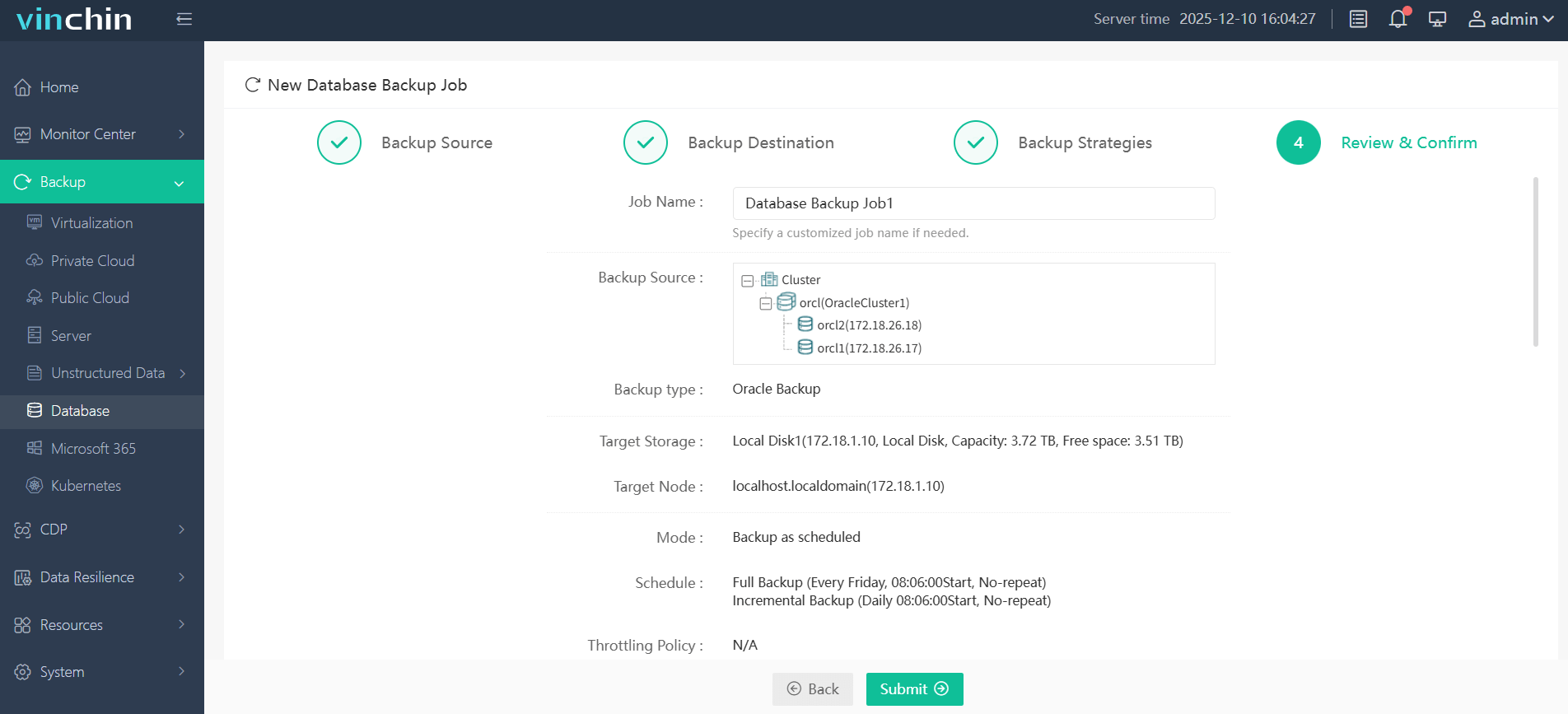
Its intuitive web console makes protecting an Oracle database straightforward:
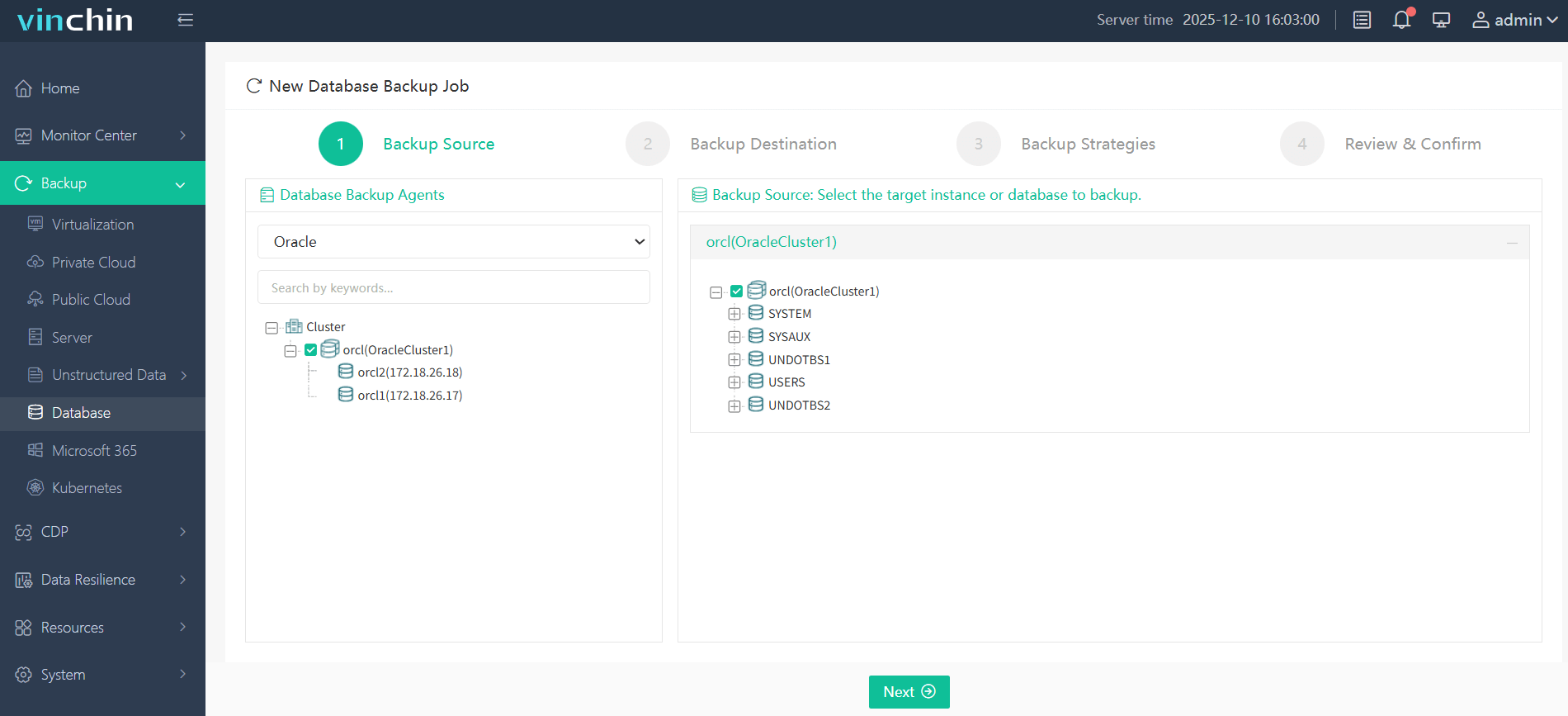
Step 1 — Select the Oracle database to back up;
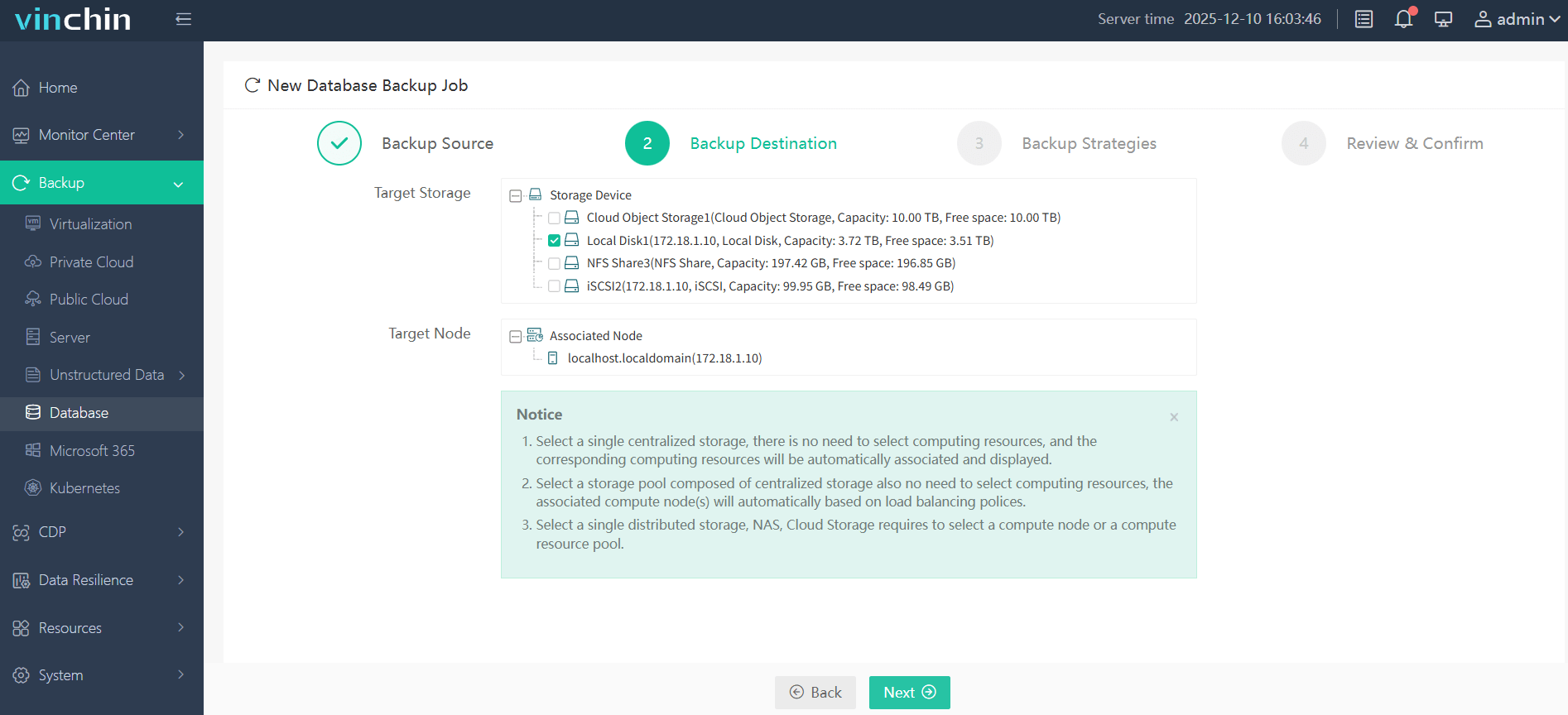
Step 2 — Choose the target storage location;
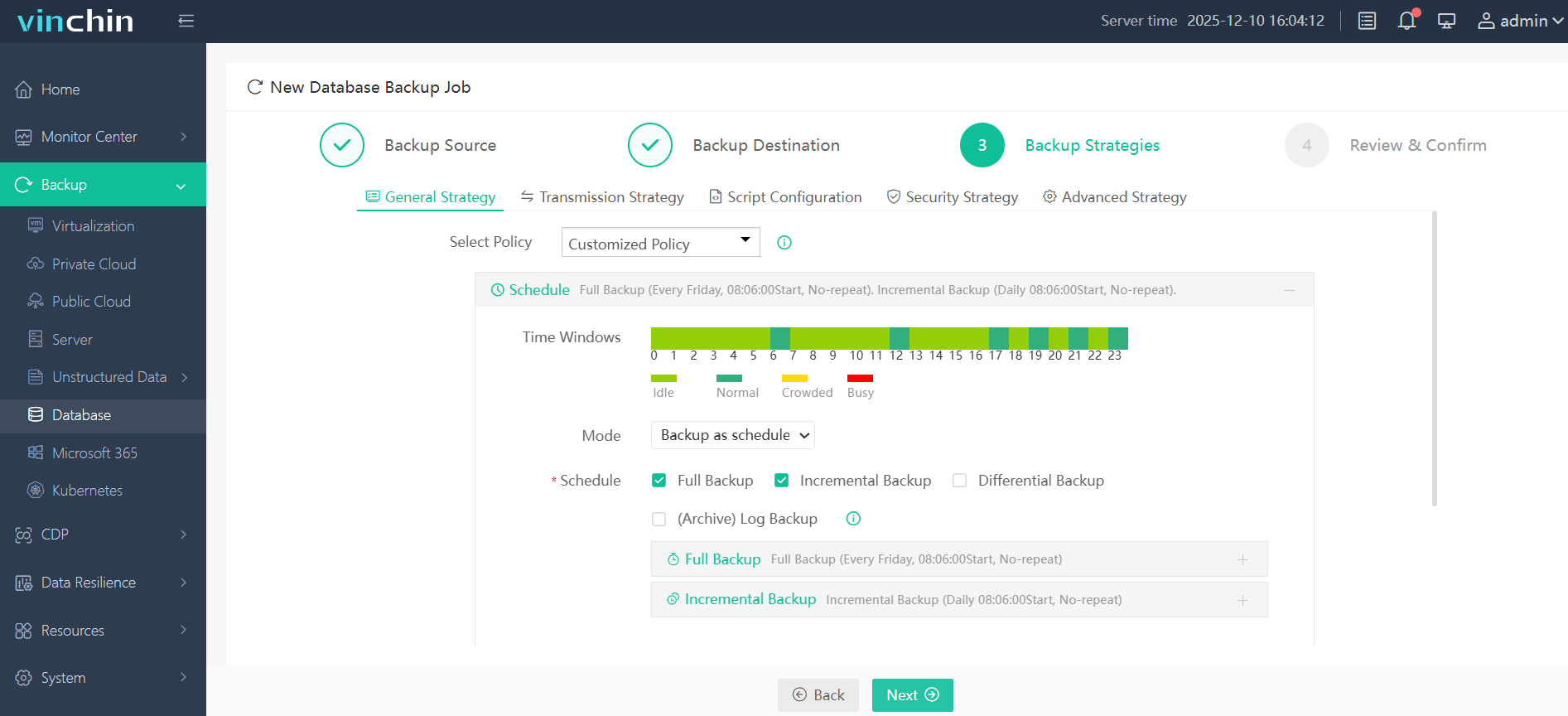
Step 3 — Define detailed strategies including retention policies or incremental mode;
Step 4 — Submit the job—all within minutes from a single pane of glass.
Recognized globally with top ratings among enterprise users worldwide, Vinchin Backup & Recovery offers a fully featured free trial valid for sixty days. Download now and experience why leading organizations trust it for mission-critical data protection!
Oracle ZFS RMAN Backup FAQs
Q1: How do I troubleshoot failed mounts when connecting my Linux server to a remote ZFS share?
A1: Check network connectivity first; confirm export permissions in BUI; review syslog/messages logs; verify correct fstab syntax including _netdev option; remount manually if needed using MOUNT command as root user.
Q2: What should I do if my scheduled nightly snapshot fails due to insufficient space?
A2: Delete older unused snapshots/clones from same project/share via BUI or CLI until enough free space exists before retrying operation again manually/scheduled job reruns automatically next cycle window opens up later that night/weekend/etc..
Q3: How can I monitor ongoing throughput during active rman jobs writing into zfs appliance?
A3: Open Analytics dashboard inside BUI focusing charts/widgets showing current IOPS/read/write bandwidth stats filtered down specifically against affected dataset/project being targeted right now by running workload(s).
Conclusion
Backing up Oracle databases onto enterprise-grade zfs appliances using native rman tooling delivers unmatched speed flexibility robust protection against disasters large small alike whether leveraging direct disk-based methods classic copy-on-write snapshots clones alike vinchin makes process even easier thanks automation policy enforcement verification try today see why global enterprises trust vinchin safeguarding mission-critical assets!