Backing up your Oracle database is not just about protecting datafiles. The server parameter file (SPFILE) is a small but critical file that stores your database’s configuration settings. If you lose it, you may not be able to start your database—even if all your datafiles are safe. So, how do you back up SPFILE with RMAN? Let’s walk through this process step by step so you can protect your environment at every level.
What Is an Oracle SPFILE?
The Oracle SPFILE (Server Parameter File) is a binary file that holds initialization parameters for your database instance. Unlike the older PFILE (a plain text file), the SPFILE allows dynamic changes to parameters without restarting the database.
Oracle recommends using SPFILE because it supports better manageability and automation of configuration tasks. When you change certain parameters using SQL*Plus or Enterprise Manager, those changes are written directly into the SPFILE—no need to edit files manually or restart services.
If you ever need to recover your database after a failure or migration, having a backup of the SPFILE is essential. Without it, recreating all custom settings can be time-consuming and error-prone.
For beginners: Think of the SPFILE as your database's “settings memory.” For intermediate users: It enables persistent parameter changes across restarts. For advanced admins: It supports clustering environments like RAC by centralizing configuration management.
Why Back Up SPFILE with RMAN?
RMAN (Recovery Manager) is Oracle’s built-in tool for backup and recovery operations across databases large and small. It can back up not only datafiles and control files but also your crucial configuration files like the SPFILE.
Why does this matter? If your SPFILE becomes lost or corrupted due to disk failure or human error, you may find yourself unable to start or restore your database instance—even if all other files are intact.
With an RMAN backup of the SPFILE:
You can quickly restore lost configurations
You avoid downtime caused by missing parameter values
You meet compliance requirements for disaster recovery
Oracle documentation stresses that recent backups of both control files and server parameter files are vital for full recovery. Would you risk business continuity on a missing configuration file?
For beginners: Always include configuration files in backups—not just user data! For intermediate users: Automate these backups so nothing gets missed during busy periods. For experts: Use retention policies so old backups don’t fill storage unnecessarily.
Method 1: How to Manually Back Up SPFILE Using RMAN
Manual backups give administrators direct control over when their most important files get protected—ideal before major changes or upgrades.
To perform a manual backup of your Oracle SPFILE using RMAN:
First connect to your target database with appropriate credentials using OS authentication (rman target /) or username/password (rman target sys/password@service_name). This flexibility lets you work locally or remotely depending on security policy.
Once connected:
1. At the RMAN prompt type:
BACKUP SPFILE;
By default, this command creates a backup piece in either the fast recovery area (FRA) if configured—or another default device location set in RMAN settings.
2. To specify exactly where you want this backup stored—for example before patching—run:
BACKUP SPFILE TO '/u01/app/oracle/backups/spfile_backup.bkp';
Replace /u01/app/oracle/backups/spfile_backup.bkp with any secure directory path suitable for long-term retention.
3. Watch as RMAN displays progress messages showing success status along with exact location details for later retrieval.
4. To confirm which backups exist at any time use:
LIST BACKUP OF SPFILE;
This approach gives peace of mind before risky operations such as migrations or hardware maintenance windows.
Method 2: How to Automatically Back Up SPFILE Using RMAN
Automation reduces human error—and ensures even late-night jobs never skip critical steps like backing up configuration files alongside regular datafiles.
RMAN supports automatic inclusion of both control file and server parameter file in every scheduled job via its autobackup feature:
To enable automatic autobackup:
1. Connect to your target system via rman target / (or remote syntax).
2. At prompt enter:
CONFIGURE CONTROLFILE AUTOBACKUP ON;
This tells RMAN that after every successful BACKUP command—or any structural change such as adding/dropping tablespaces—it should create an autobackup containing both control file AND current version of server parameter file (SPFILE).
3. Want custom naming/location? Use format variables like %F, which encodes DBID plus date/time sequence into unique filenames—a best practice recommended by Oracle:
CONFIGURE CONTROLFILE AUTOBACKUP FORMAT FOR DEVICE TYPE DISK TO '/u01/app/oracle/backups/autobackup_%F';
Here %F ensures no two autobackups overwrite each other even when taken seconds apart.
4. Now whenever running standard jobs such as
BACKUP DATABASE;
or
BACKUP DATABASE PLUS ARCHIVELOG;
…the latest copy of both control information AND active server parameters gets included automatically—no extra typing required!
5. Check results anytime via
LIST BACKUP OF SPFILE;
How to Restore Your Oracle Database's SPFILE Using RMAN?
Knowing how to restore an Oracle Server Parameter File from backup is just as important as knowing how to create one! Here’s what happens if disaster strikes:
First make sure instance is shut down cleanly—or at least mounted in NOMOUNT mode since startup requires reading valid initialization parameters first!
Begin restoration process by launching rman session again (rman target /). Then execute following steps:
1. Start instance without mounting full DB yet:
STARTUP NOMOUNT;
2a) If relying on most recent autobackup simply type:
RESTORE SPFILE FROM AUTOBACKUP;
2b) Or if restoring from specific known path use explicit filename instead:
RESTORE SPFILE FROM '/u01/app/oracle/backups/spfile_backup.bkp';
Afterwards shutdown/restart normally—or proceed straight into further recovery actions depending on broader incident scope involved!
Remember—even seasoned pros should test this workflow periodically outside production hours so there are no surprises under pressure later…
Pro tip for advanced admins: In complex environments track DBID carefully since some restore operations require setting correct value first (SET DBID = <your_dbid>;) especially when recovering onto new hosts/clusters after catastrophic failures.
Vinchin Backup & Recovery: Enterprise-Level Protection for Your Oracle Database
Beyond native tools, organizations seeking robust enterprise-grade protection often turn to specialized solutions tailored for mission-critical workloads such as Oracle databases—including comprehensive support for "backup spfile rman" scenarios. Vinchin Backup & Recovery stands out as a professional solution supporting mainstream platforms like Oracle, MySQL, SQL Server, MariaDB, PostgreSQL, PostgresPro, and TiDB—with deep integration specifically designed for complex environments running Oracle databases.
Key features relevant for safeguarding your environment include batch database backup capabilities, Incremental backups options tailored for efficient storage usage on supported platforms like Oracle itself, flexible data retention policies including GFS retention models, cloud/tape archiving support ensuring offsite safety, and integrity checks that validate recoverability before disaster strikes—all working together to maximize reliability while minimizing administrative overhead.
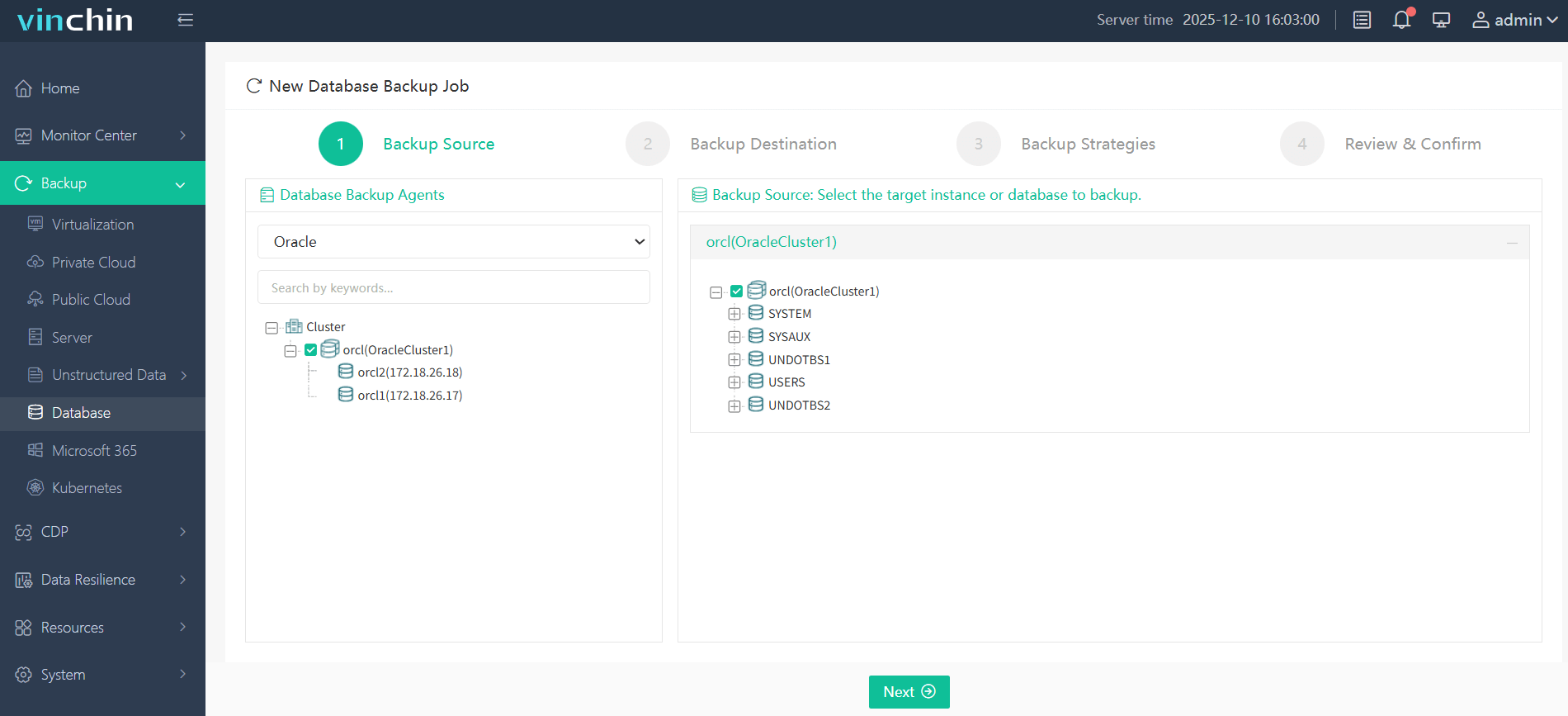
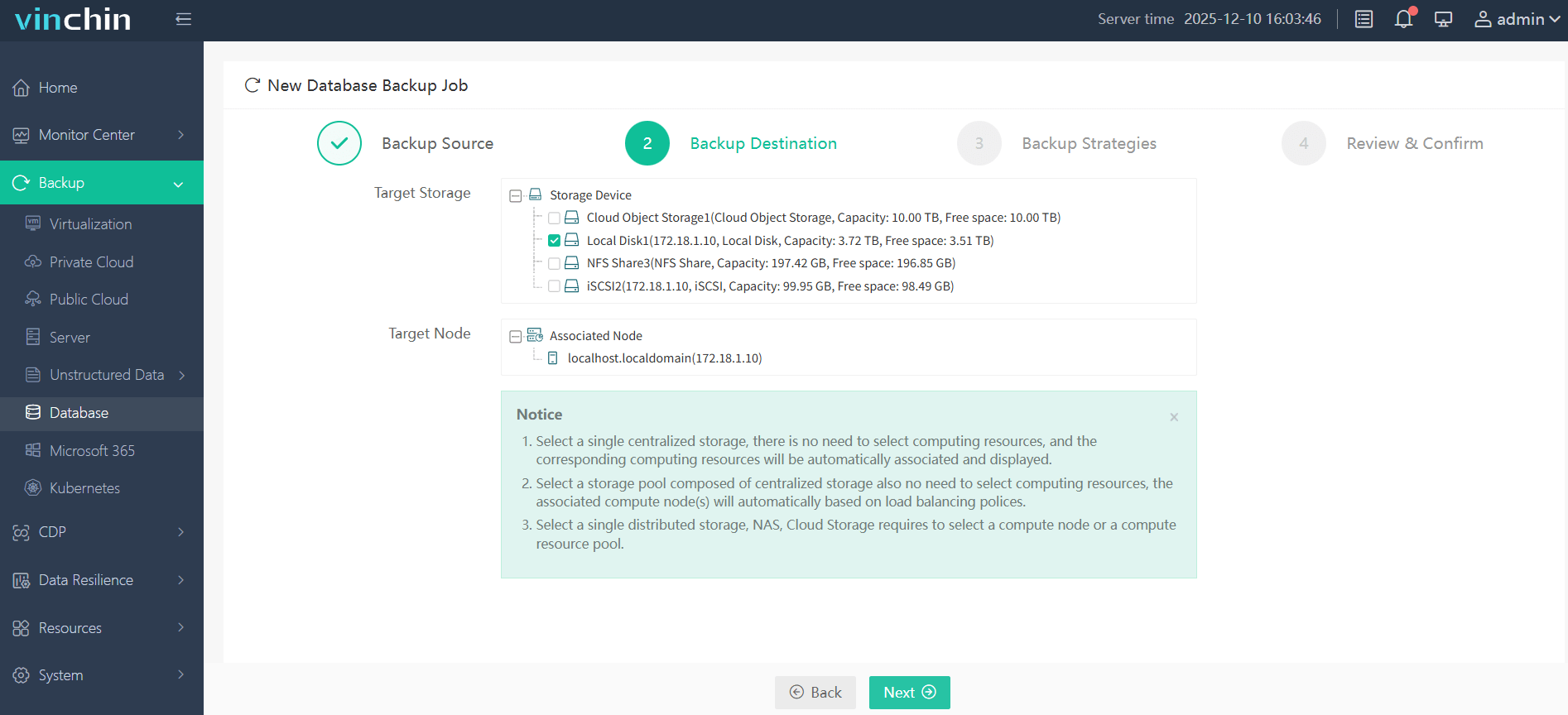
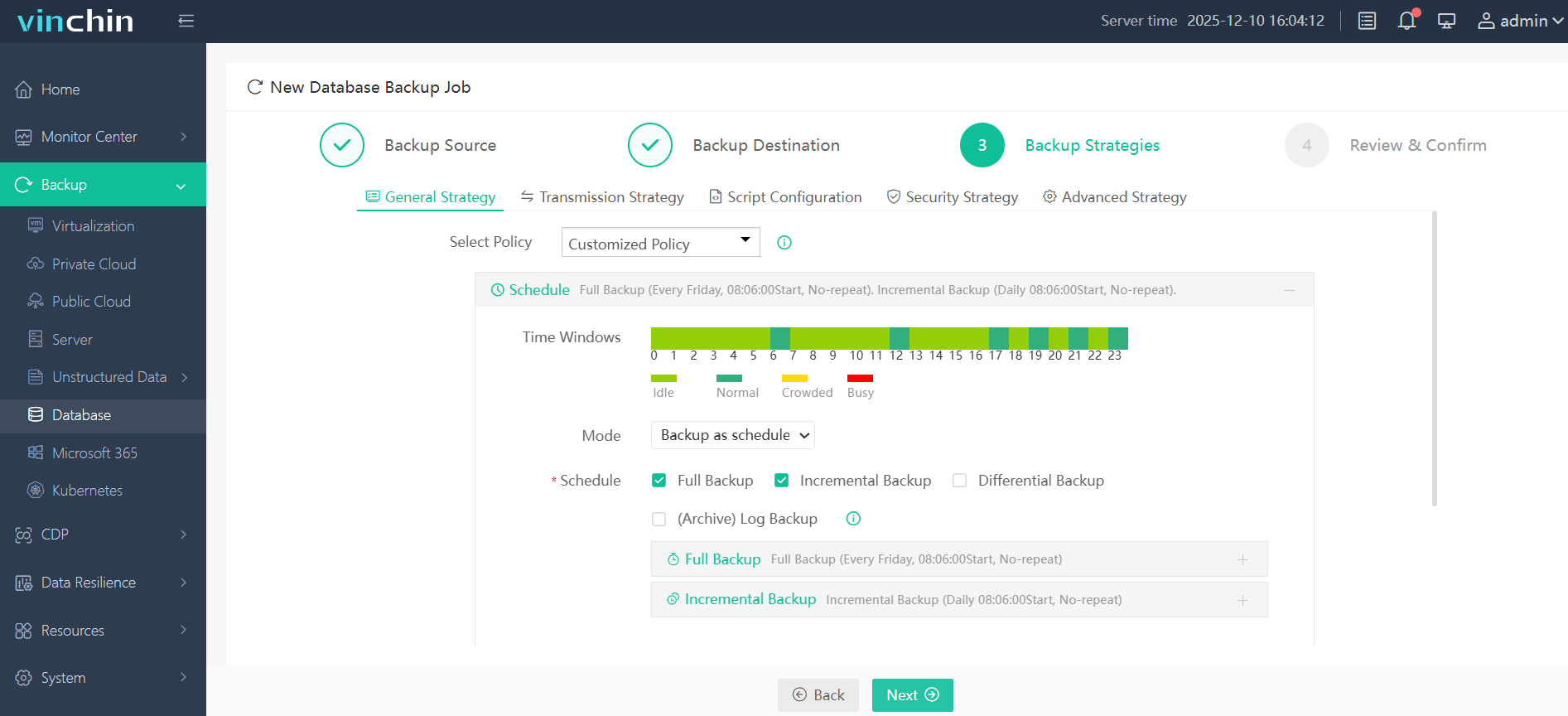
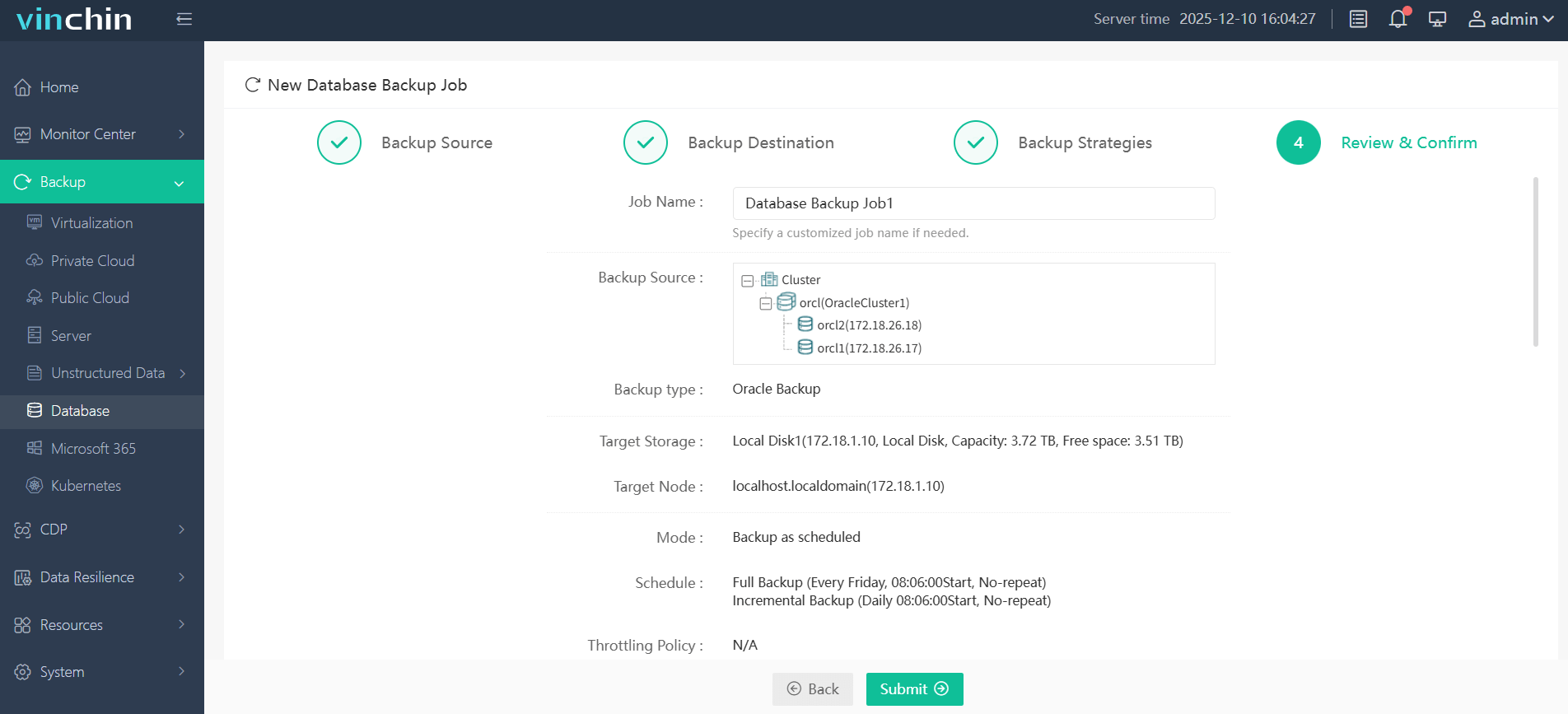
Vinchin Backup & Recovery offers an intuitive web console making protection simple even at scale; typically just four steps are needed when backing up an Oracle database:
Step 1. Select the Oracle database to back up
Step 2. Choose the backup storage
Step 3. Define the backup strategy
Step 4. Submit the job
Recognized globally among enterprise customers and highly rated by industry analysts,Vinchin Backup & Recovery delivers proven results—try its full-featured free trial for 60 days now by clicking download below.
Backup Spfile Rman FAQs
Q1: Can I schedule daily automatic backups of my Oracle spfile using only built-in tools?
Yes; enable CONTROL FILE AUTOBACKUP ON in RMAN so it includes spfile after every scheduled job automatically.
Q2: What should I do if my spfile gets corrupted but I still have access through pfile?
Start instance with pfile then use RESTORE SPFILE FROM AUTOBACKUP within an open rman session while NOMOUNTED.
Q3: Is it possible to verify whether my last spfile rman backup completed successfully?
Yes; run LIST BACKUP OF SPFILE inside rman prompt—it shows status/location/timestamp instantly.
Conclusion
Backing up your Oracle Server Parameter File with RMAN protects against unexpected outages—from accidental misconfiguration through hardware loss alike! Manual commands offer precision while automation delivers peace-of-mind coverage around-the-clock.Vinchin makes safeguarding these vital assets even simpler—try their free trial today!