When you manage Oracle databases, you often hear about RMAN and Data Guard. Both are essential for data protection, but they serve different purposes. If you are wondering which tool to use for backup, disaster recovery, or high availability, you are not alone. For a robust data protection strategy, understanding how RMAN forms your recovery foundation while Data Guard provides your availability shield is critical. Let’s break down what each does, how they differ, and when to use one or both.
What Is Oracle RMAN?
Oracle Recovery Manager (RMAN) is Oracle’s built-in tool for backup and recovery. It automates creating backups, restoring data, and recovering from failures. RMAN works at the block level—backing up only used parts of your database—which saves time and storage space.
You can use RMAN to perform full or incremental backups. It also validates backups and recovers lost data files or even the entire database if needed. RMAN supports backup to disk or tape and can be managed through command-line or Oracle Enterprise Manager.
In daily operations, using RMAN starts by connecting to your target database—sometimes also a recovery catalog—and issuing commands directly in its interface. A typical workflow might look like this: connect with rman TARGET /, then run BACKUP DATABASE PLUS ARCHIVELOG to create a consistent backup set.
For restores after failure or corruption events, you would use RESTORE DATABASE followed by RECOVER DATABASE. To ensure your backups remain valid over time (and avoid surprises during restore), it’s wise to run VALIDATE BACKUPSET regularly. The CROSSCHECK BACKUP command helps identify obsolete or missing backup pieces so you can clean up storage efficiently.
RMAN is designed primarily for single-database environments but integrates well into larger setups when combined with other tools like Data Guard. Its flexibility makes it suitable for everything from small departmental systems to large enterprise deployments needing granular control over retention policies.
What Is Oracle Data Guard?
Oracle Data Guard is a feature focused on disaster recovery and high availability. It maintains one or more standby databases that stay synchronized with your primary database through continuous redo log shipping.
If the primary database fails due to hardware issues or disasters like fire or flood, you can switch operations quickly to a standby database—minimizing downtime dramatically compared to traditional restore methods.
Data Guard supports two types of standby databases: physical standby (an exact binary copy) and logical standby (which allows some structural changes). Physical standbys are most common because they support fast failover without compatibility concerns.
Data Guard automates shipping redo logs from primary to standby databases using secure network channels. This process keeps standbys nearly current with production activity so that business continuity is possible even during planned maintenance windows or unexpected outages.
Key Configuration Modes: SYNC vs ASYNC & Protection Levels
A crucial operational decision involves choosing between synchronous (SYNC) mode—where transactions commit only after confirmation from both primary and standby—and asynchronous (ASYNC) mode—where logs ship immediately but acknowledgment isn’t required before committing locally.
SYNC mode offers zero data loss at the cost of potential performance impact if network latency rises; ASYNC mode reduces performance risk but may allow minimal data loss during sudden failures (usually just seconds’ worth). You must balance these trade-offs based on application needs: mission-critical financial systems often require Maximum Protection mode (always SYNC), while less sensitive workloads might accept Maximum Performance (default ASYNC).
Protection modes include:
1. Maximum Protection: Zero data loss; requires SYNC transport; highest safety
2. Maximum Availability: Near-zero loss; usually SYNC but allows temporary ASYNC if needed
3. Maximum Performance: Prioritizes speed; uses ASYNC transport by default
Choosing wisely here affects both business risk tolerance and system responsiveness day-to-day.
Oracle RMAN vs Data Guard Differences
Although both tools protect your data assets in Oracle environments, their approaches differ fundamentally—and understanding those differences shapes effective strategies.
RMAN focuses on backup-and-recovery tasks: it creates point-in-time copies so you can restore after accidental deletions (DROP TABLE) or corruption events caused by hardware faults or software bugs. Backups may be scheduled during off-hours using cron jobs—or triggered manually before risky maintenance activities—to minimize production impact.
Data Guard centers around real-time replication: it keeps one or more standbys updated almost instantly via redo log shipping so that failover is possible within minutes—or even seconds—with little manual intervention required beyond issuing a switchover/failover command in emergencies.
Resource Usage & Backup Offload Strategies
Running frequent full/incremental backups with RMAN consumes CPU cycles plus disk/tape bandwidth—but these jobs can be scheduled outside peak hours for efficiency. In contrast, maintaining active standbys via Data Guard demands extra server hardware plus reliable network links between sites; bandwidth requirements scale with transaction volume since every change must replicate promptly across locations.
A best practice combines both tools: offload heavy-duty backups onto a physical standby using RMAN rather than burdening production servers directly—a method called “backup offloading.” This approach preserves primary performance yet ensures all critical data remains protected against site-wide disasters as well as local mishaps like accidental file deletion.
However—even in robust Data Guard setups—you still need regular backups! Standby databases protect against site failure but do not guard against logical errors replicated across all nodes simultaneously (such as mass deletes). Only point-in-time backups let you roll back past such mistakes safely without losing legitimate recent work elsewhere in the system.
RTO/RPO Context: Business Metrics Matter
Recovery Point Objective (RPO) measures how much recent data could be lost after an incident; Recovery Time Objective (RTO) tracks how long until normal service resumes post-disaster:
With frequent incremental backups via RMAN plus archived logs stored securely offsite/cloud/tape—you control RPO tightly based on schedule frequency.
With properly configured synchronous Data Guard setups—RPO approaches zero since every committed transaction exists at multiple sites instantly.
For RTOs under five minutes? Only automated failover mechanisms like those built into Data Guard suffice; manual restores take longer even under ideal conditions due to media mount times/checksums/etc., especially at scale!
Understanding these metrics helps align technology choices directly with business priorities—from compliance mandates requiring minimal downtime/losses through budget-driven trade-offs favoring simpler periodic snapshots instead of always-on replication infrastructure.
Why Choose RMAN or Data Guard
Selecting between these technologies depends largely on organizational goals—and often means deploying both together rather than picking just one!
If recovering from accidental user actions (“Oops—I dropped our customer table!”), silent corruption detected days later (“Why won’t this index rebuild?”), ransomware attacks corrupting filesystems overnight—or meeting regulatory demands for multi-year retention—is top priority? Then prioritize robust scheduled/backups using RMAN along with regular validation/crosscheck routines ensuring recoverability at any moment in time desired.
If uninterrupted access matters most—for example running e-commerce platforms where downtime equals lost revenue/minutes matter—or supporting global teams who cannot wait hours/days while tapes restore? Then invest heavily in real-time replication/high availability via Oracle Data Guard across geographically separated datacenters.
In reality most enterprises combine both approaches:
1) Use RMAN for flexible point-in-time recovery,
2) Deploy Data Guard for instant failover/disaster resilience,
3) Periodically test restores/failovers so staff know exactly what steps work fastest when stress levels spike unexpectedly!
Decision Framework: Use Cases & Combined Strategy
Here’s how seasoned admins decide:
Use RMAN when needing granular restoration after logical errors/data corruption/user mistakes;
Use Data Guard when aiming for near-zero downtime/high availability/disaster-proofing;
Combine them so neither accidental nor catastrophic losses threaten core business functions.
This layered defense ensures no single event—from fat-fingered deletes through regional power outages—can cripple operations permanently.
How to Back Up Oracle Databases with Vinchin Backup & Recovery?
Beyond native solutions like RMAN and Data Guard, organizations seeking streamlined enterprise-grade protection should consider Vinchin Backup & Recovery—a professional solution supporting today’s leading databases including Oracle, MySQL, SQL Server, MariaDB, PostgreSQL, PostgresPro, and TiDB. Vinchin Backup & Recovery delivers advanced features such as batch database backup, multiple level data compression options tailored per workload size, comprehensive GFS retention policy management for compliance needs, cloud backup integration alongside tape archiving capabilities for hybrid storage strategies, as well as integrity check routines ensuring recoverability under real-world conditions—all designed to automate processes while safeguarding critical information efficiently across diverse environments.
The intuitive web console makes protecting an Oracle environment straightforward:
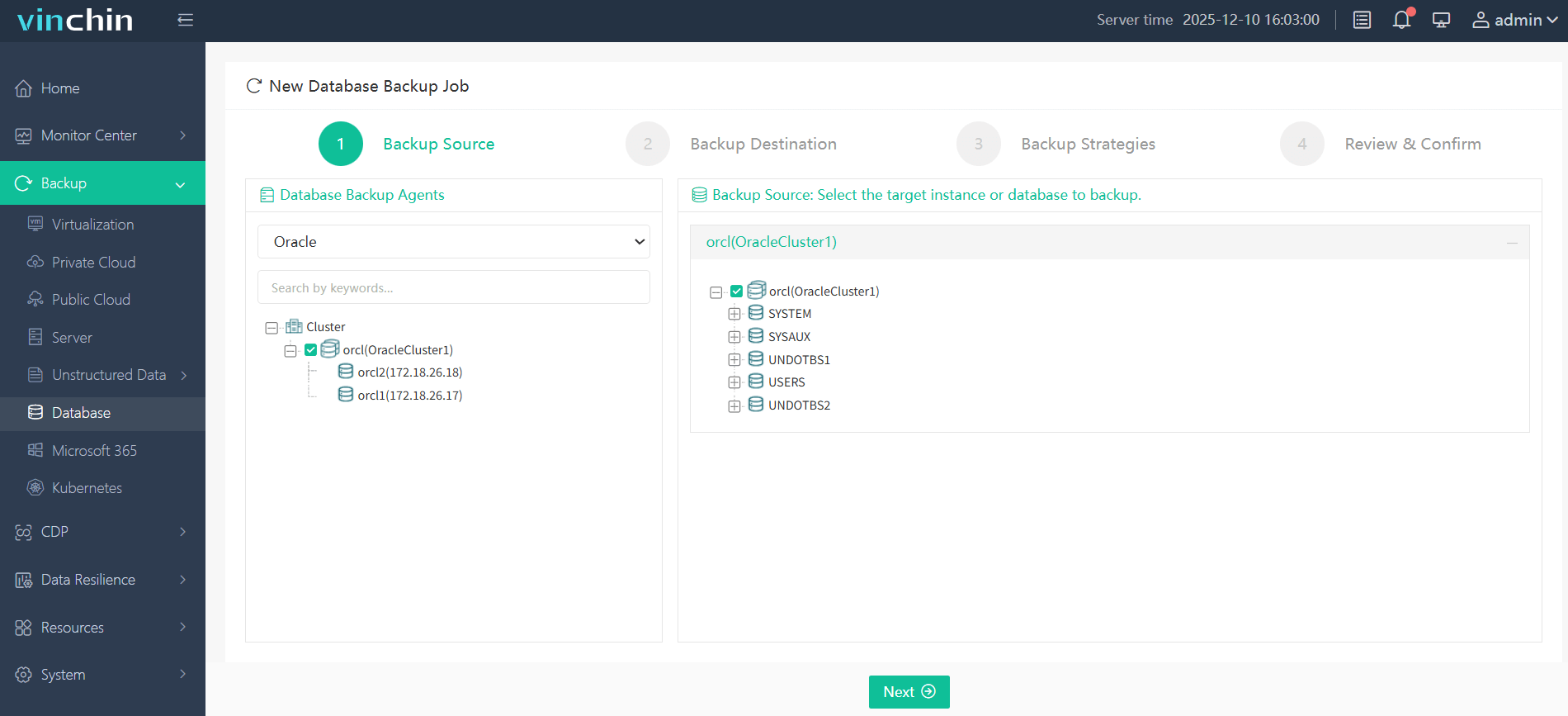
Step 1. Select the Oracle database to back up
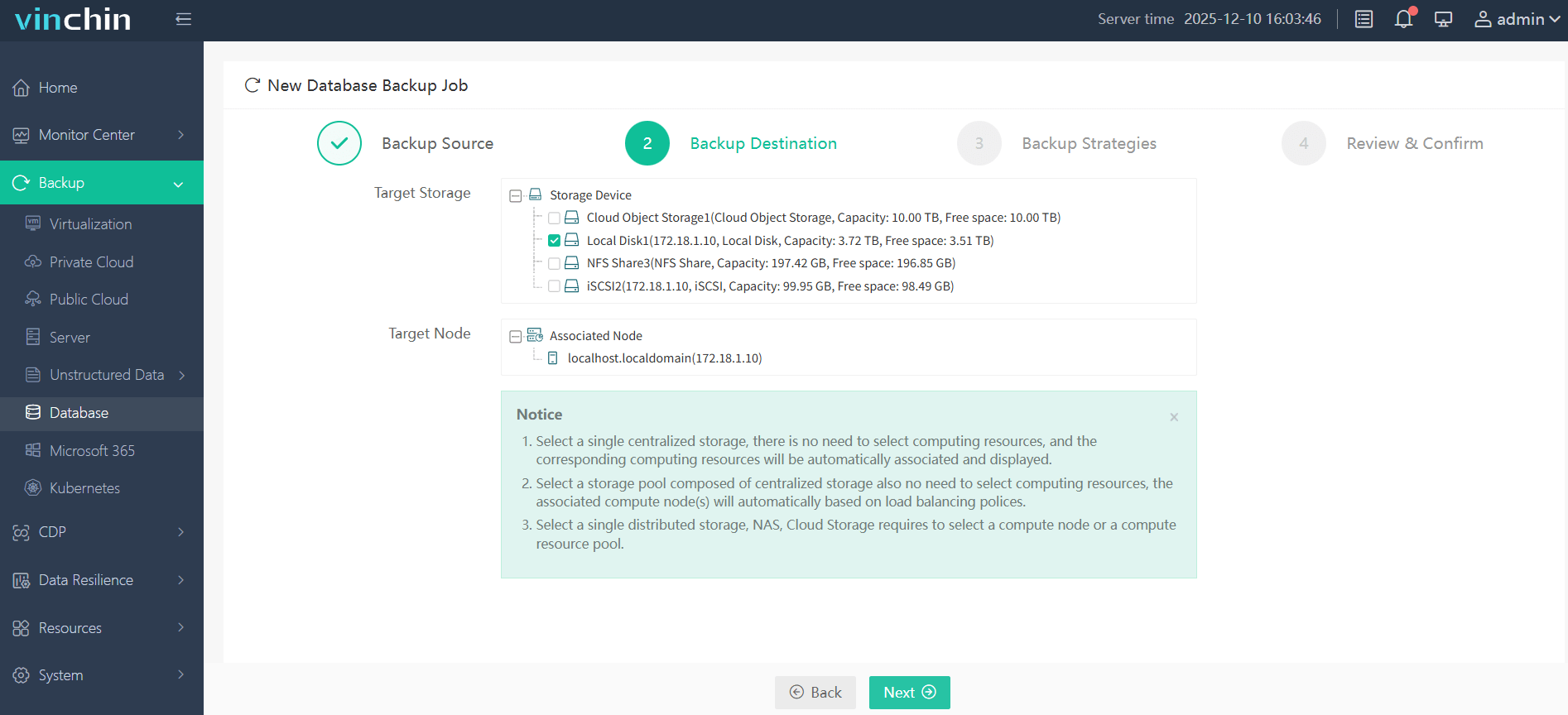
Step 2. Choose the backup storage
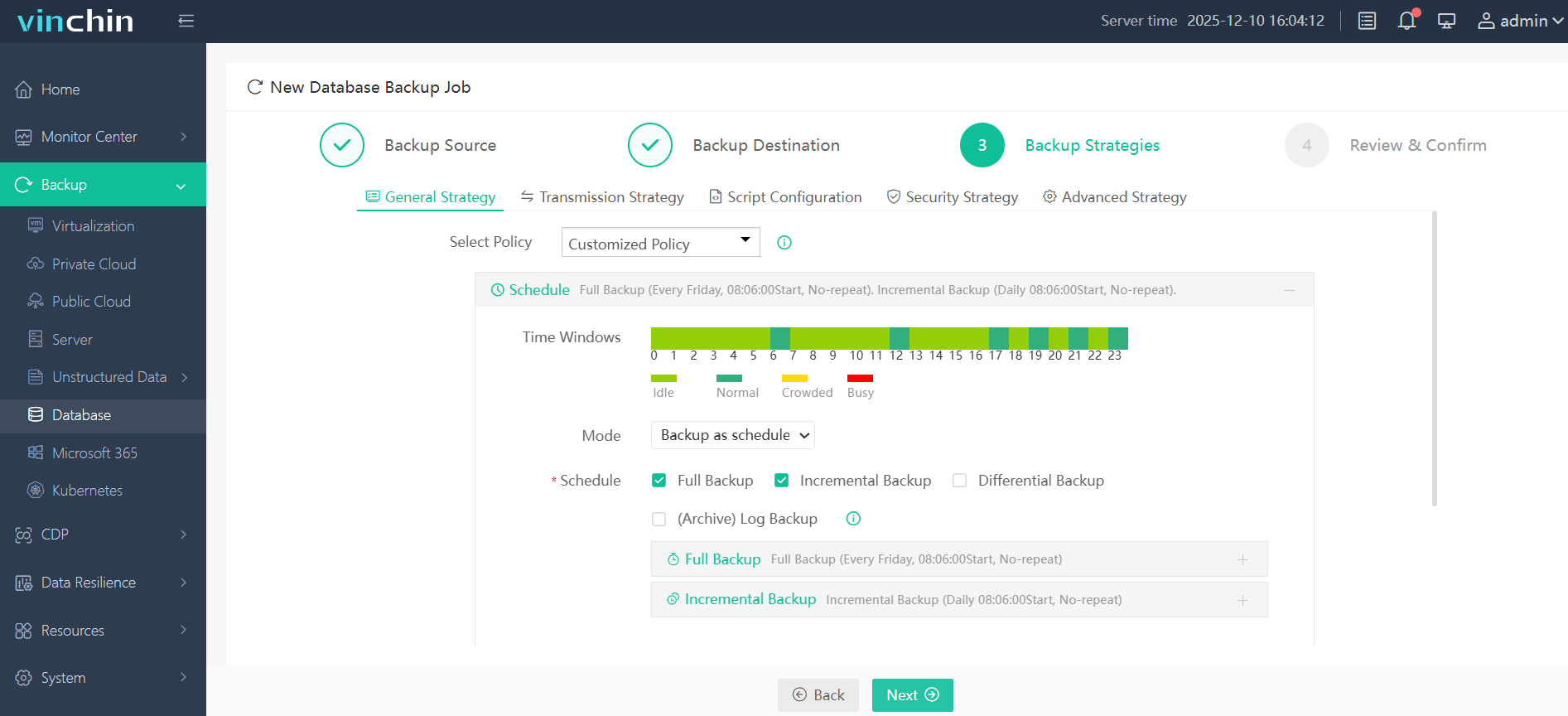
Step 3. Define the backup strategy
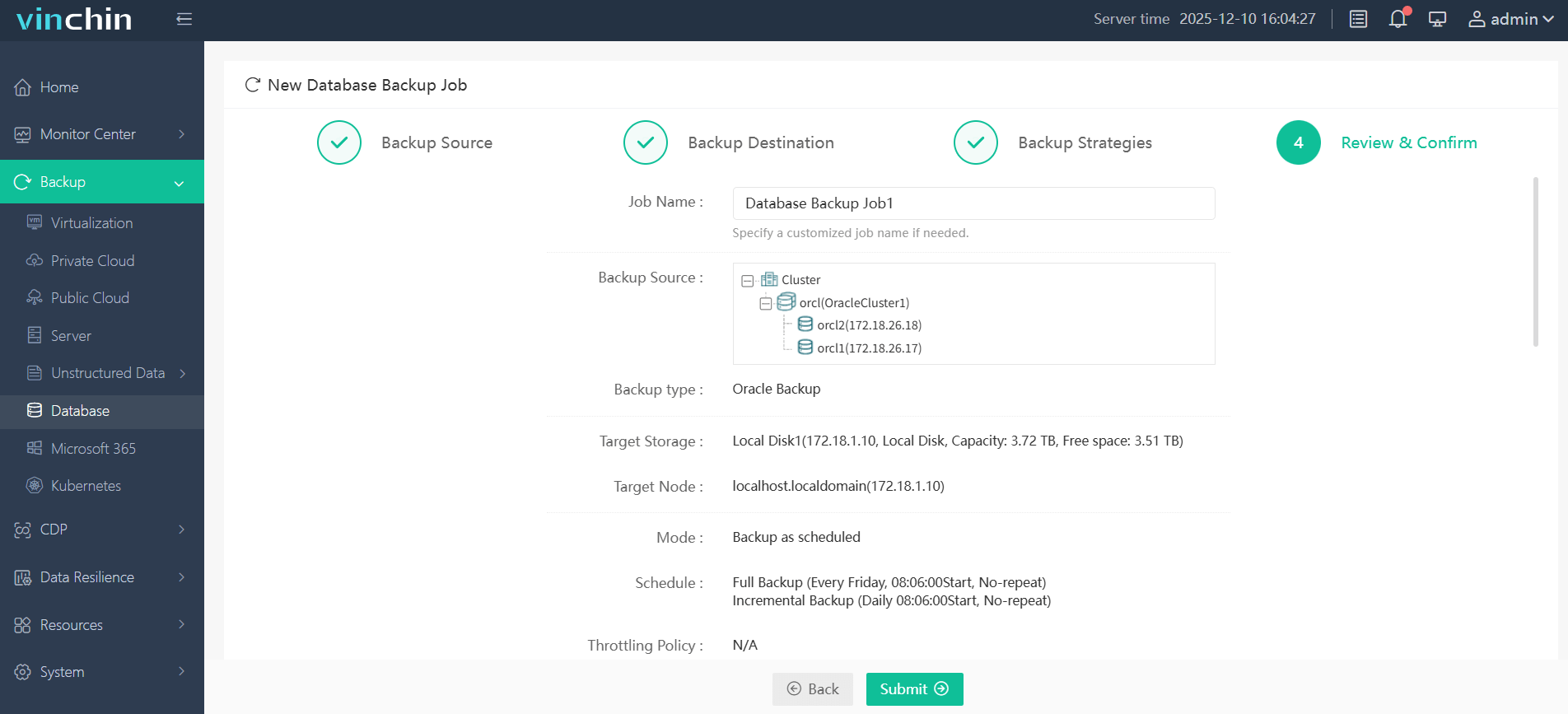
Step 4. Submit the job
Vinchin Backup & Recovery enjoys global recognition among enterprises thanks to its reliability and rich feature set—try all capabilities free for 60 days by clicking download below!
Oracle RMAN vs Data Guard FAQs
Q1: Can I migrate my existing standalone database setup into a combined RMAN/Data Guard environment?
Yes; configure Data Guard first then continue scheduling regular backups using RMAN as usual afterward.
Q2: Does enabling synchronous redo transport affect application response times?
Yes; synchronous transport may introduce slight latency depending on network speed between primary/standby sites.
Q3: How do I verify my standby database stays fully synchronized?
Check synchronization status regularly using SQL*Plus queries such as SELECT SEQUENCE#,APPLIED FROM V$ARCHIVED_LOG WHERE APPLIED='YES'.
Conclusion
RMAN handles flexible point-in-time recovery while Data Guard delivers high availability through real-time replication—they work best together as part of layered defense strategies against all kinds of threats large/small alike! Vinchin makes protecting critical databases easy efficient reliable—try their free trial today!