Backing up your Oracle database is not just a best practice—it’s essential. A reliable backup strategy protects your data from hardware failures, user errors, and disasters. Oracle Recovery Manager (RMAN) is the built-in tool for this job. In this article, you’ll learn what RMAN is, what a full backup means, how to create an Oracle RMAN full backup script, automate it safely—and optimize every step along the way.
What Is Oracle RMAN?
Oracle Recovery Manager (RMAN) is Oracle’s native utility for database backup and recovery. It handles everything from simple backups to complex disaster recovery tasks. RMAN integrates tightly with the Oracle database engine; it understands internal structures so it can perform both physical and logical backups efficiently. Unlike manual file copies or exports, RMAN ensures data consistency at all times—even during heavy workloads—and supports features like compression, encryption, parallelism, retention policies, and incremental backups. For any DBA who wants reliable automation without third-party tools or scripts that break easily under pressure—RMAN is essential.
What Is a Full Backup in Oracle?
A full backup in Oracle creates a complete copy of all your database’s data files at one point in time. This includes every tablespace and data file; you can also include archived redo logs and control files if needed. In RMAN terms:
A Level 0 incremental backup acts as a full backup but enables you to run faster Level 1 incrementals later—a key part of efficient enterprise strategies. Full backups are critical because they let you restore your entire system after major failures or corruption events.
How to Create an Oracle RMAN Full Backup Script?
Creating an oracle rman full backup script isn’t hard—but doing it right takes attention to detail at every level of experience.
Step 1: Prepare Your Environment
First things first: make sure your database runs in ARCHIVELOG mode so you can back up while users are connected (hot backups). To check:
SELECT log_mode FROM v$database;
If you see NOARCHIVELOG, switch modes by shutting down cleanly then starting up in mount mode:
SHUTDOWN IMMEDIATE;
STARTUP MOUNT;
ALTER DATABASE ARCHIVELOG;
ALTER DATABASE OPEN;
This change requires downtime but enables online backups going forward.
Step 2: Basic RMAN Full Backup Command
The simplest command backs up everything—including archived redo logs—for point-in-time recovery:
BACKUP DATABASE PLUS ARCHIVELOG;
This ensures all active data files plus necessary logs are captured together so you can recover right up until failure time—not just until last night’s snapshot.
Step 3: Writing a Full Backup Script
For repeatable results—and easier automation—use an explicit oracle rman full backup script like below:
backup_full.rman
RUN {
  ALLOCATE CHANNEL ch1 DEVICE TYPE DISK;
  ALLOCATE CHANNEL ch2 DEVICE TYPE DISK;
  BACKUP AS COMPRESSED BACKUPSET INCREMENTAL LEVEL 0 DATABASE PLUS ARCHIVELOG DELETE INPUT;
  BACKUP CURRENT CONTROLFILE;
  BACKUP SPFILE;
  RELEASE CHANNEL ch1;
  RELEASE CHANNEL ch2;
}
Let’s break down why each line matters:
ALLOCATE CHANNEL lets you run multiple streams in parallel for speed—adjust channel count based on server resources.
AS COMPRESSED BACKUPSET saves disk space but uses more CPU; test different algorithms (BASIC, LOW, MEDIUM) if needed.
INCREMENTAL LEVEL 0 makes this eligible as the base image for future Level 1 incrementals; plain BACKUP DATABASE cannot serve as such.
PLUS ARCHIVELOG DELETE INPUT includes all archived redo logs since last backup—and deletes them only after successful copy (be careful if network storage might go offline).
BACKUP CURRENT CONTROLFILE ensures structural metadata is protected; BACKUP SPFILE saves parameter settings too.
Step 4: Shell Script to Run the RMAN Backup
Automation means less human error—but only if scripts handle problems gracefully! Here’s an enhanced shell wrapper that sets environment variables safely—and captures errors clearly:
backup_rman.sh
#!/bin/bash
# Usage: ./backup_rman.sh -d ORACLE_SID -l BACKUP_LEVEL
ORATAB="/etc/oratab"
SCRIPT_DIR="$( cd "$( dirname "${BASH_SOURCE[0]}" )" &> /dev/null && pwd )"

if [ $# -eq 0 ]; then
    echo "Usage: $0 -d ORACLE_SID -l BACKUP_LEVEL"
    exit 1
fi

DB_SID=""
LEVEL=""

while getopts ":d:l:" opt; do
    case $opt in
        d) DB_SID="$OPTARG" ;;
        l) LEVEL="$OPTARG" ;;
        \?) echo "Invalid option -$OPTARG" >&2; exit 2 ;;
    esac
done

if [ -z "$LEVEL" ]; then
    echo "Warning: Backup level not specified."
    exit 3
fi

perform_backup() {
    local sid=$1
    local level=$2
    local LOG_FILE="${SCRIPT_DIR}/rman_backup_${sid}_L${level}_$(date '+%Y%m%d_%H%M%S').log"
    ORACLE_HOME=$(grep ^$sid: $ORATAB | cut -d: -f2)
    export ORACLE_HOME ORACLE_SID PATH=$PATH:$ORACLE_HOME/bin

    local cmdfile="${SCRIPT_DIR}/backup_level${level}.rman"

    timeout --kill-after=10m --signal=SIGKILL 8h \
      rman target / log=$LOG_FILE cmdfile=$cmdfile

    status=$?
    if [ $status -ne 0 ]; then
        echo "Backup failed with status $status" | mailx -s "RMAN Backup Failure ($sid)" admin@example.com
        exit $status
    fi
}

if [ "$DB_SID" = "A" ]; then
   grep -v '^#' $ORATAB | grep -v '^\*' | cut -d: -f1 | while read sid; do
       [ ! -z "$sid" ] && perform_backup "$sid" "$LEVEL"
   done
else
   grep "^$DB_SID:" $ORATAB >/dev/null && perform_backup "$DB_SID" "$LEVEL" || { echo "SID not found"; exit 4; }
fi
Notice how we:
Exit early on missing parameters or invalid SIDs,
Use timeout so jobs don’t hang forever,
Send email alerts automatically when something fails,
Log output per job run for easy auditing later.
You could also integrate REST API calls here—or push metrics into monitoring platforms like Zabbix or Prometheus—to track success rates over time.
Step 5: Test Your Script Thoroughly
Never trust untested backups! Always validate both creation and restoration processes regularly—in non-production environments whenever possible.
To check basic readability without restoring actual data:
RESTORE VALIDATE DATABASE;
VALIDATE BACKUPSET <backupset_number>;
But don’t stop there! Periodically rehearse end-to-end restores onto alternate hosts using commands like:
RUN {
   SET NEWNAME FOR DATABASE TO '/tmp/testdb/%b';
   RESTORE DATABASE VALIDATE CHECK LOGICAL;
}
This approach confirms both physical integrity and logical structure—so you’re ready when disaster strikes unexpectedly.
Vinchin Backup & Recovery for Enterprise-Level Oracle Database Protection
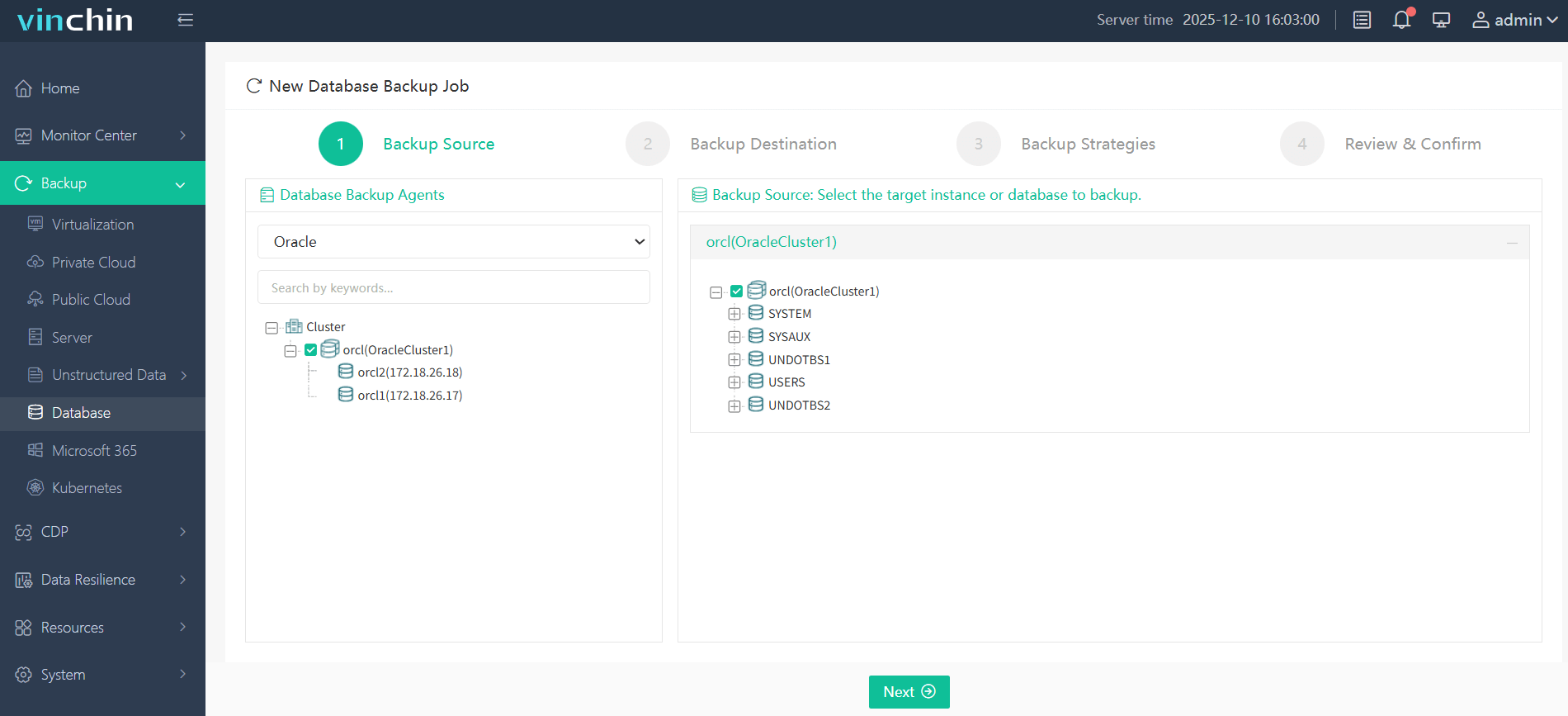
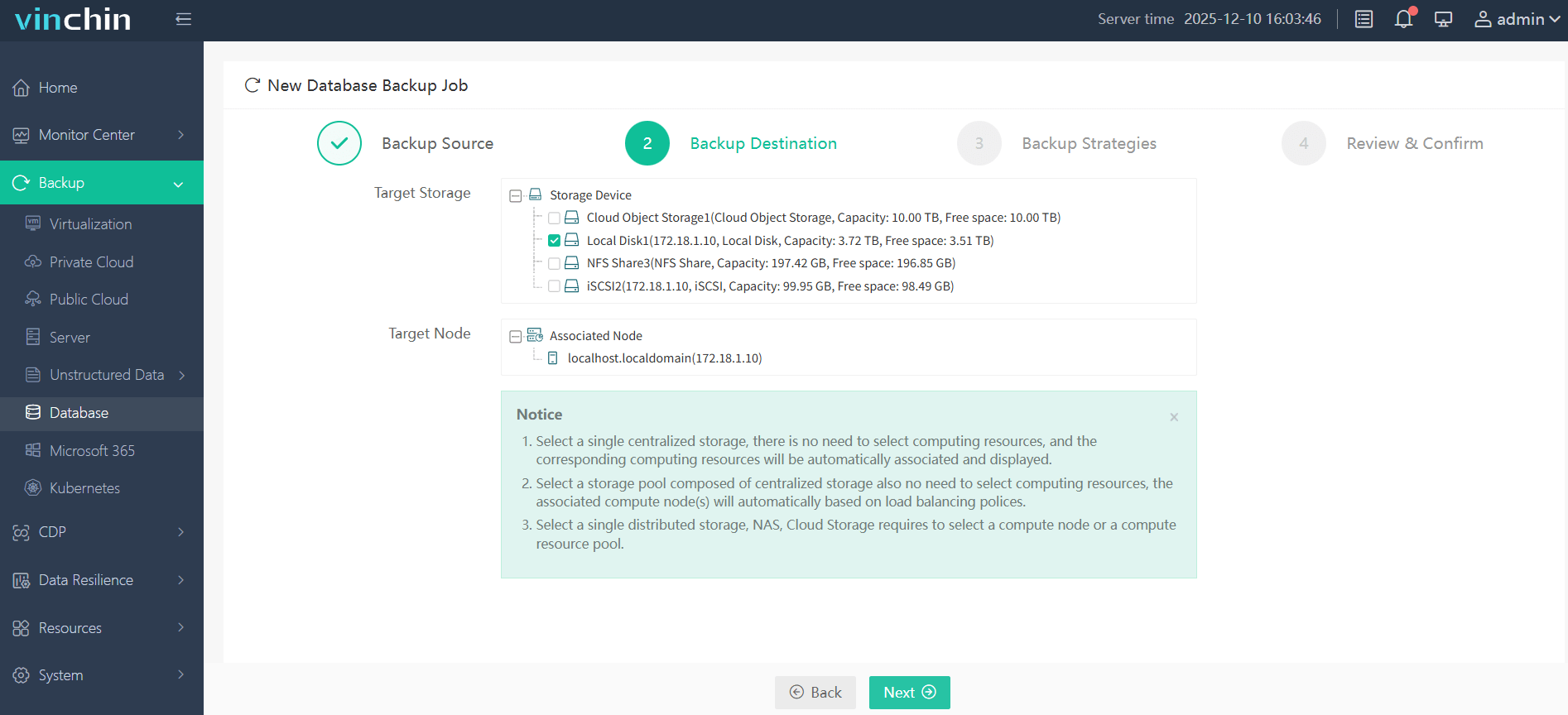
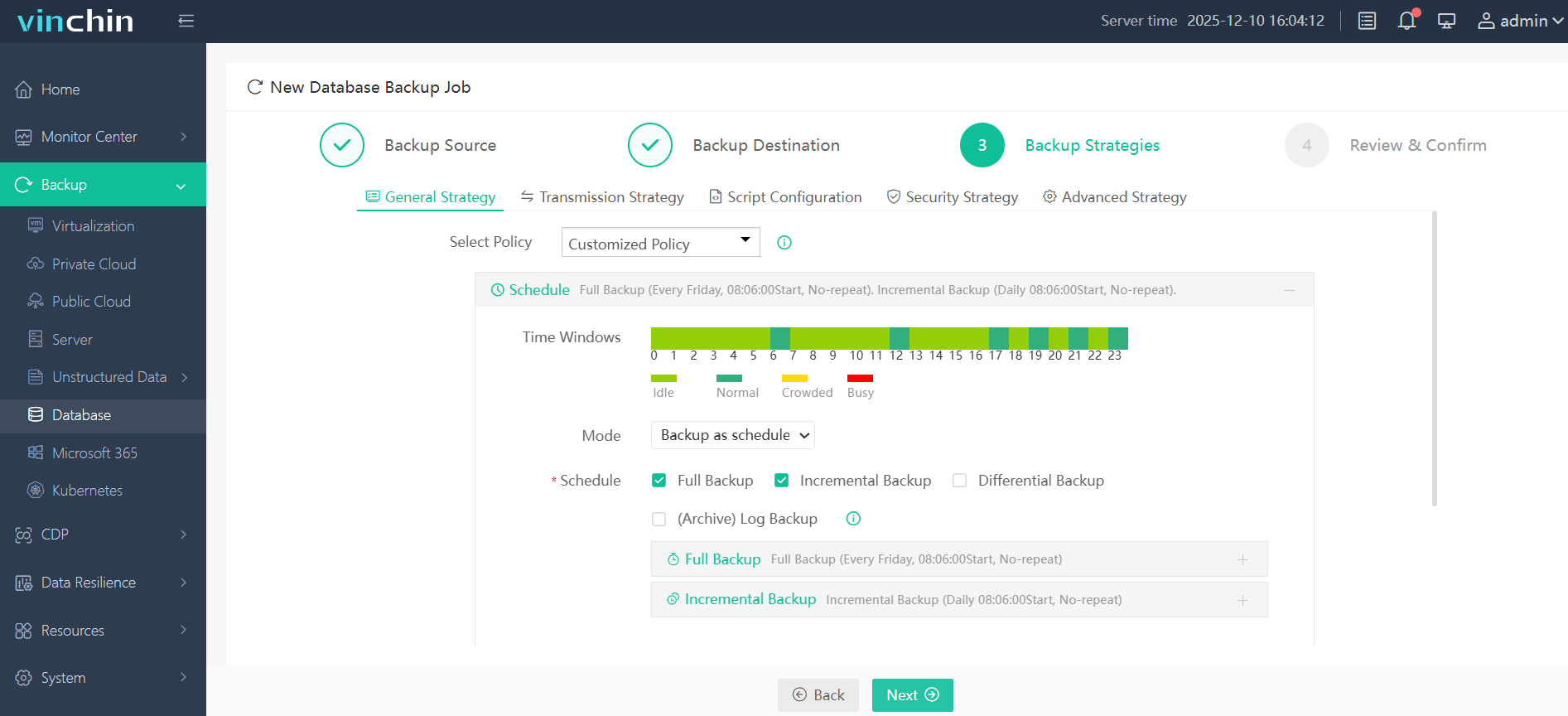
For organizations seeking streamlined management and robust protection beyond native scripting, Vinchin Backup & Recovery offers an enterprise-grade solution tailored for today’s leading databases—including comprehensive support for Oracle alongside MySQL, SQL Server, MariaDB, PostgreSQL, PostgresPro, and TiDB environments. With advanced source-side compression and incremental backup capabilities specifically optimized for Oracle workloads—as well as batch database operations, multi-level compression options, and flexible retention policies—Vinchin Backup & Recovery helps maximize efficiency while ensuring regulatory compliance and rapid recovery readiness. The intuitive web console simplifies administration into four steps:
Step 1. Select the Oracle database to back up
Step 2. Choose the backup storage
Step 3. Define the backup strategy
Step 4. Submit the job
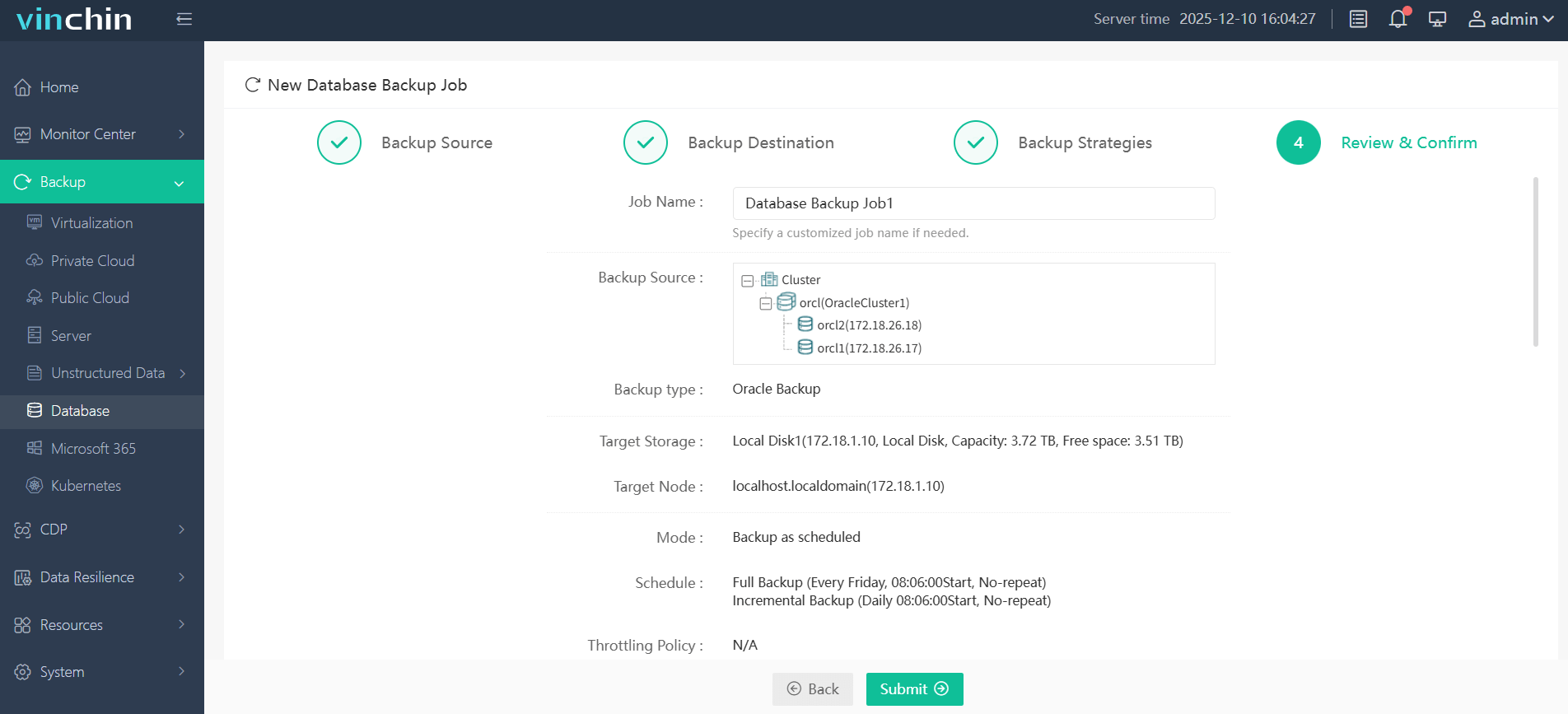
Recognized globally by thousands of enterprises with top ratings for reliability and service excellence—Vinchin Backup & Recovery offers a fully featured free trial valid for 60 days; click download now to experience effortless enterprise data protection.
Oracle RMAN Full Backup Script FAQs
Q1: How do I monitor progress during long-running RMAN jobs?
Query V$SESSION_LONGOPS or V$RMAN_STATUS views in SQL*Plus—they show current phase details including percent complete estimates per session ID.
Q2: What should I watch out for when backing up directly over NFS?
Use direct I/O mount options (cio, noac) where supported; always test write/read speeds beforehand since slow networks cause incomplete/corrupt sets under load conditions!
Q3: How do I validate both physical AND logical integrity of my latest backups?
Run RESTORE VALIDATE CHECK LOGICAL DATABASE, followed by VALIDATE BACKUPSET <number>, ensuring no errors appear before considering images safe.
Conclusion
A resilient oracle rman full backup script forms the backbone of any serious protection plan—from daily operations through disaster recovery drills alike! By following these steps—from validation through optimization—you’ll build confidence that restores work every time they’re needed most. For greater simplicity plus advanced features try Vinchin's enterprise solution today—download their free trial now!