Have you ever tried to restore an Oracle backup only to find dozens of files with cryptic names scattered across your storage? It’s stressful—especially when time is short during a recovery emergency. The Oracle RMAN FORMAT parameter solves this problem by letting you control exactly where backups go and what they’re called. This guide explains how FORMAT works at every level so you can make your backup process clear, predictable, and fast.
What Is Oracle RMAN Format?
The RMAN FORMAT parameter lets you define both the naming pattern and storage path for backup files created by Oracle Recovery Manager (RMAN). By default, RMAN uses internal variables to generate unique file names—but with FORMAT, you can customize these names to fit your organization’s standards or storage layout.
FORMAT supports substitution variables that help ensure each backup file is unique and easy to identify:
%d inserts the database name.
%s gives the backup set number.
%p adds the piece number.
%t provides a timestamp.
%u generates an eight-character unique identifier.
%T shows date in YYYYMMDD format.
If you don’t specify FORMAT in your command or configuration, RMAN defaults to using %U. This macro expands into a system-generated string that combines several elements (like %u_%p_%c) so every file name is guaranteed unique—even during parallel backups or repeated jobs.
It’s important to know that there’s a hierarchy when it comes to setting FORMAT:
1. If you use FORMAT directly in your BACKUP command, it overrides all other settings.
2. If not specified there, any channel-specific CONFIGURE CHANNEL ... FORMAT setting applies next.
3. If neither of those are set, CONFIGURE DEFAULT DEVICE TYPE ... TO DISK/WITH ... FORMAT applies last.
Understanding this order helps avoid confusion when managing complex backup strategies across multiple databases or environments.
Why Oracle RMAN Format Matters?
Why spend extra effort defining custom formats? Because clarity saves time—and sometimes saves jobs!
When every backup has a clear location and logical name pattern:
Storage management becomes easier; old files are simpler to archive or purge automatically based on age or type.
Restores become less stressful; operators know exactly what they’re looking at without hunting through logs.
Scripting becomes safer; automation tools can target only relevant files without risk of deleting something vital by mistake.
Consistent patterns also prevent accidental overwrites—a common pitfall if two jobs write generic filenames like backup.bkp. With proper variables included (%s, %t, etc.), every new job creates fresh files instead of replacing yesterday's work.
Oracle RMAN Format Usage Examples
Let’s look at how DBAs use FORMAT in daily operations—and why each approach matters.
Suppose your goal is simple: create a full database backup with human-readable names containing both database name and date for easy sorting later on. You might run:
BACKUP FORMAT '/u01/app/oracle/backup/%d_%T_%u' DATABASE;
Here,
This makes it easy for anyone scanning /u01/app/oracle/backup/ to spot which file belongs where—and when it was made—without opening logs or guessing from random strings.
For archive log backups—often stored separately—you may want more detail:
BACKUP FORMAT '/u01/app/oracle/arch/%d_al_%s_%p_%t' ARCHIVELOG ALL;
In this case,
%s marks which backup set,
%p tells which piece within that set,
%t adds precise timing down to seconds since 1988 (Oracle's epoch).
This structure helps keep archive log management organized—especially useful if compliance rules require long-term retention or frequent restores from specific points in time.
Control file autobackups are special because they’re critical for disaster recovery; losing them can mean losing access to all other backups! Here Oracle recommends using just one variable: %F, which combines DBID (database ID), date stamp, and sequence number into one string:
CONFIGURE CONTROLFILE AUTOBACKUP FORMAT FOR DEVICE TYPE DISK TO '/u01/app/oracle/cf_%F';
This follows a pattern like cf_c-1234567890-20240610-03, making it easy to trace back exactly which control file matches which database instance—even years later.
Sometimes you want redundancy by writing multiple copies of each backup piece—for example onto different disks or network shares:
BACKUP COPIES 2 DATABASE
  FORMAT '/backup1/%d_%T_%u', '/backup2/%d_%T_%u';
Each copy gets its own directory path but keeps consistent naming logic so restores are straightforward no matter where you pull data from later on.
Protecting Your Oracle Database with Vinchin Backup & Recovery
Beyond manual scripting and native tools, enterprise-grade protection requires robust solutions tailored for modern workloads. Vinchin Backup & Recovery stands out as a professional platform supporting most mainstream databases—including Oracle, MySQL, SQL Server, MariaDB, PostgreSQL, PostgresPro, and TiDB—with seamless integration into diverse IT environments.
For Oracle users specifically, Vinchin Backup & Recovery delivers advanced source-side compression, incremental backup capabilities, batch database processing options, multi-level data compression strategies, and flexible data retention policies—all designed to optimize storage usage while accelerating both routine backups and urgent recoveries. These features collectively streamline compliance management and operational efficiency across complex infrastructures.
The intuitive web console simplifies everything:
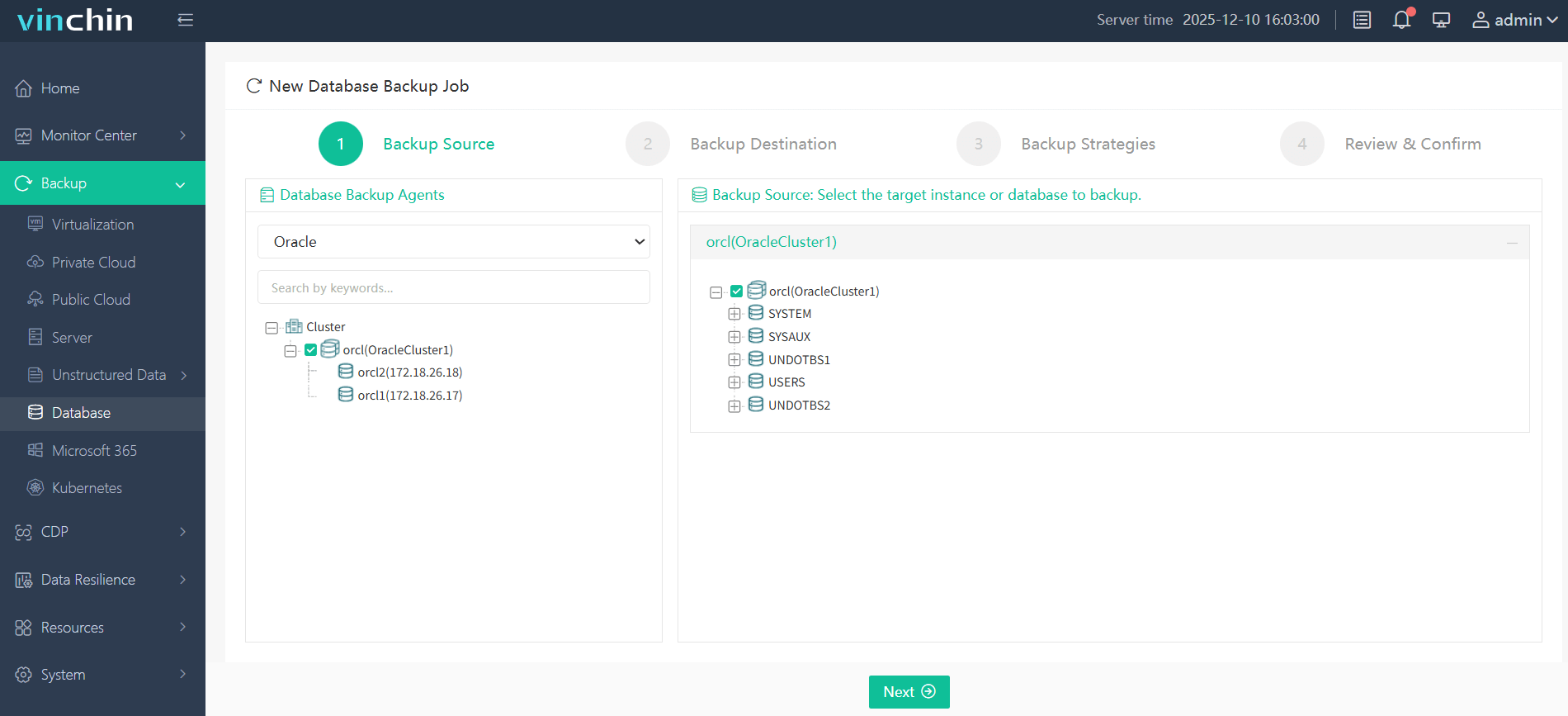
Step 1. Select the Oracle database to back up
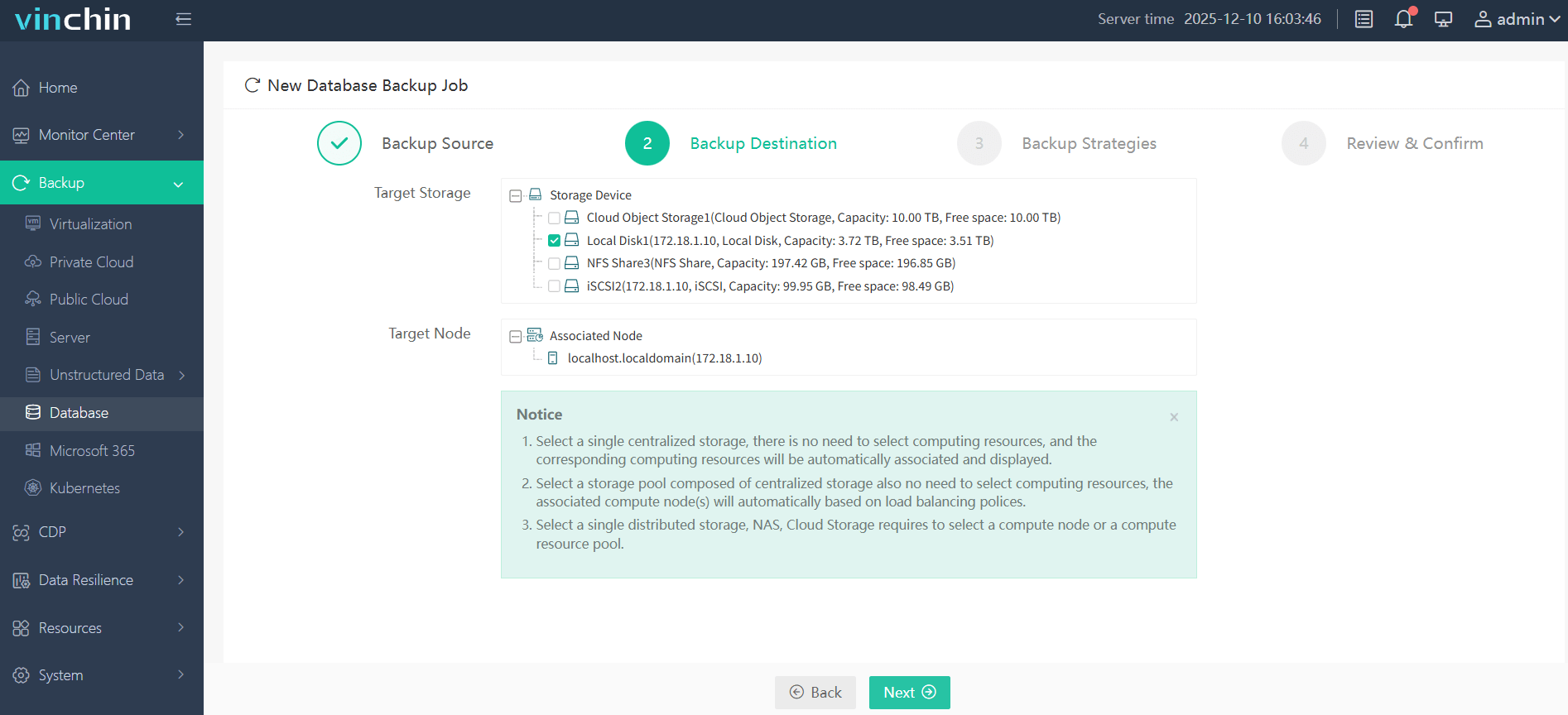
Step 2. Choose the backup storage
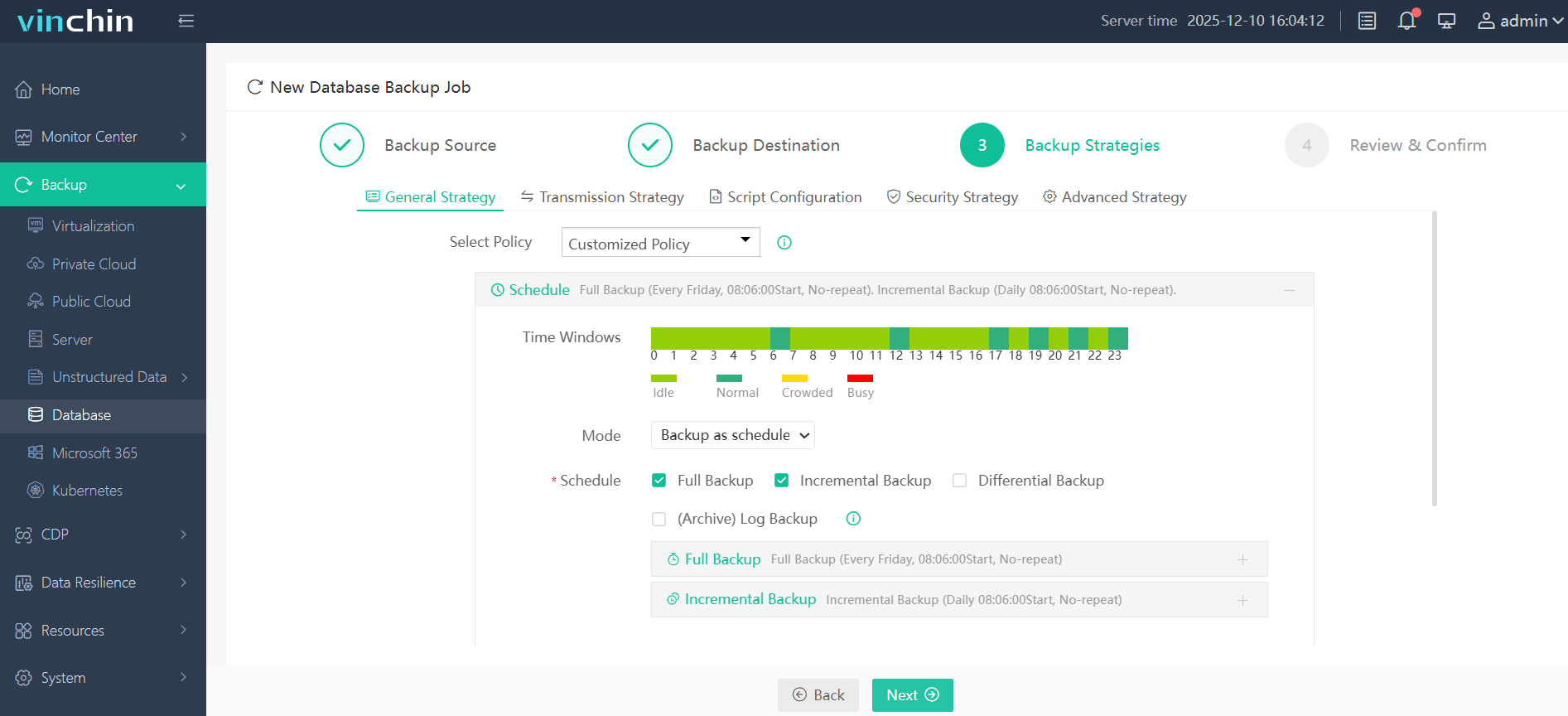
Step 3. Define the backup strategy
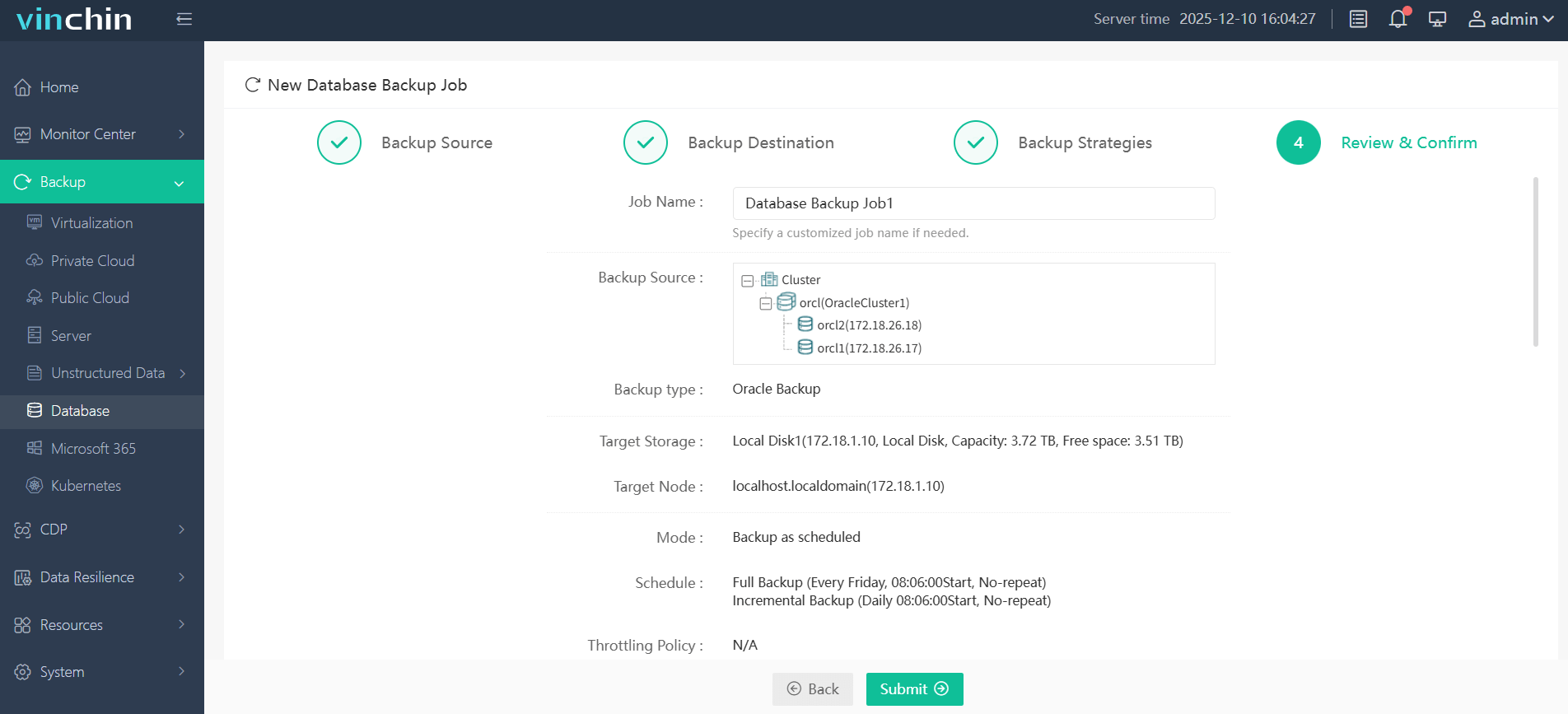
Step 4. Submit the job
With Vinchin Backup & Recovery guiding each step visually through its interface—not scripts—you gain reliable enterprise protection without complexity.
Recognized globally for reliability and customer satisfaction—with top ratings among enterprise users—you can experience all features free for 60 days; click below to start protecting your critical data now!
Oracle RMAN Format FAQs
Q1: Can I use environment variables inside my RMAN FORMAT string?
No; always specify absolute or relative paths directly because environment variables aren’t supported within FORMAT.
Q2: How do I guarantee unique filenames when running parallel backups?
Include variables such as %U, %s, %p, or %t in your FORMAT; using %U alone ensures global uniqueness even under heavy load.
Q3: My job failed with "ORA-19504: failed to create file." What should I check related specifically to FORMAT?
Check if target directory exists > confirm write permissions > verify filename length does not exceed OS limit > test manual creation outside RMAN.
Conclusion
Mastering the ORACLE RMAN FORMAT parameter gives DBAs confidence that their backups are organized logically—and recoverable quickly under pressure—with no guesswork involved when disaster strikes next time around! For smarter protection built right-in from day one try Vinchin's enterprise solution now—it could save hours when minutes count most!