Are you looking to save storage space and speed up backups for your Oracle databases? RMAN (Recovery Manager) compression is a popular feature, but many administrators wonder about its licensing requirements. If you’re unsure which compression levels are free and which require extra licenses, you’re not alone. Let’s break down the facts so you can make the right choice for your environment.
What Is Oracle RMAN Compression?
Oracle RMAN compression is a feature that reduces the size of your database backups by compressing backup sets before writing them to disk or tape. This process can help you save disk space, reduce network traffic during backup transfers, and sometimes even improve backup performance in certain environments.
RMAN offers several compression algorithms: BASIC, LOW, MEDIUM, and HIGH—each designed for different needs. These options let you balance between CPU usage and storage savings based on your infrastructure’s capabilities. However, not all these algorithms are available without an additional license; some require purchasing Oracle’s Advanced Compression option.
Compression is especially useful when dealing with large databases or limited storage resources. By reducing backup sizes, organizations can also lower their long-term storage costs while keeping recovery times manageable.
Oracle RMAN Compression License Explained
Licensing for RMAN compression often confuses administrators because it depends on both your database edition and chosen algorithm. Here’s what matters most: Oracle includes the BASIC compression algorithm in all editions—no extra license required. This means any organization running Standard Edition or Enterprise Edition can use BASIC freely.
However, if you want higher efficiency or smaller backup files using LOW, MEDIUM, or HIGH algorithms, you must purchase the Advanced Compression option—but only if you're running Enterprise Edition; these advanced levels are not available at all in Standard Edition.
To summarize:
Use BASIC for free—no extra license needed.
Use LOW, MEDIUM, or HIGH only if you've licensed Advanced Compression with Enterprise Edition.
If your environment uses Oracle Secure Backup or the Secure Backup Cloud Module specifically for tape or cloud targets, special-use licensing may allow advanced compression just for those destinations—not for general disk-based backups unless Advanced Compression is licensed across your environment.
Always check your contract terms carefully before enabling advanced algorithms; using unlicensed features puts your organization at risk of non-compliance during audits—a costly mistake no IT team wants to make.
Evaluating Compression Performance & Trade-offs
Choosing a compression level isn’t just about licensing—it directly impacts system performance during backups and restores. Each algorithm has different effects on CPU load and resulting file size reduction.
Here’s how they compare:
| Algorithm | License Needed | CPU Overhead | Typical Compression Ratio | Best For |
|---|
| BASIC | None | Low | Moderate | General use; compliance with base license |
| LOW | Advanced Compression | Low | Lower than BASIC | Fastest backups where some space saving helps |
| MEDIUM | Advanced Compression | Medium | Good balance | Most common in licensed environments |
| HIGH | Advanced Compression | High | Highest | Maximum storage savings; slow networks |
For example:
With BASIC compression enabled on a typical transactional database (hundreds of GBs), expect moderate reductions in file size—often 30–50% depending on data type.
MEDIUM or HIGH can push this further (sometimes 60–70%), but at the cost of increased CPU usage during backup jobs.
LOW offers minimal overhead but less impressive space savings than BASIC itself.
The best way to decide? Test each setting against your own workload:
1. Run BACKUP AS COMPRESSED BACKUPSET DATABASE PLUS ARCHIVELOG; under different algorithms.
2. Monitor job duration via v$rman_backup_job_details view.
3. Check OS-level CPU utilization during each run.
4. Compare resulting backup set sizes in bytes using v$backup_set.
Remember: Even if MEDIUM gives great results technically, it requires an active Advanced Compression license—never enable it unless fully compliant!
Why Use Oracle RMAN Compression?
Why bother with any form of backup compression? Compressed backups take up less physical space—which means lower hardware costs over time—and move faster across networks due to reduced data volumes sent over wire (especially important when backing up remotely).
This efficiency becomes critical as databases grow larger every year while budgets remain tight—or when disaster recovery plans demand rapid offsite replication over bandwidth-limited links.
However: Higher levels like MEDIUM or HIGH put more strain on server CPUs during both backup creation and restore operations—a key consideration if running production workloads simultaneously with maintenance jobs.
For many organizations operating within standard licensing constraints (without Advanced Compression), BASIC provides enough benefit without risking compliance issues or overwhelming hardware resources.
But if minimizing downtime after failures—or maximizing long-term storage ROI—is paramount (and budget allows), investing in higher-level options may pay off handsomely despite their added complexity.
How to Enable RMAN Compression?
Enabling RMAN compression involves two main steps: configuring the desired algorithm and then specifying compressed output when creating backups.
First: Set the default algorithm according to what you're licensed for:
RMAN> CONFIGURE COMPRESSION ALGORITHM 'BASIC';
(Optionally add AS OF RELEASE 'DEFAULT' OPTIMIZE FOR LOAD TRUE if targeting older versions or tuning load distribution.)
You can verify which algorithm is currently set by running:
RMAN> SHOW COMPRESSION ALGORITHM;
Second: When issuing a backup command—including compressed output:
RMAN> BACKUP AS COMPRESSED BACKUPSET DATABASE;
If you have purchased an Advanced Compression license—and only then—you may select other levels:
RMAN> CONFIGURE COMPRESSION ALGORITHM 'MEDIUM';
Or override just one job:
RMAN> BACKUP AS COMPRESSED BACKUPSET DATABASE COMPRESSION ALGORITHM 'HIGH';
Always remember: Using LOW/MEDIUM/HIGH without proper entitlement violates Oracle's terms. Regularly review both configuration scripts and actual job logs to ensure ongoing compliance—especially after upgrades or staff changes that might alter settings unintentionally.
How to Back Up Oracle Databases Using Vinchin Backup & Recovery
Beyond native tools like RMAN, organizations seeking streamlined enterprise protection should consider Vinchin Backup & Recovery—a professional solution supporting today’s mainstream databases including Oracle, MySQL, SQL Server, MariaDB, PostgreSQL, PostgresPro, and TiDB (with particular strength in Oracle environments). Vinchin Backup & Recovery delivers robust features such as advanced source-side compression, incremental backup capabilities tailored for Oracle workloads, batch database management automation, flexible data retention policies including GFS support, and seamless cloud/tape archiving integration—all working together to maximize efficiency while ensuring regulatory compliance and rapid recoverability across complex infrastructures.
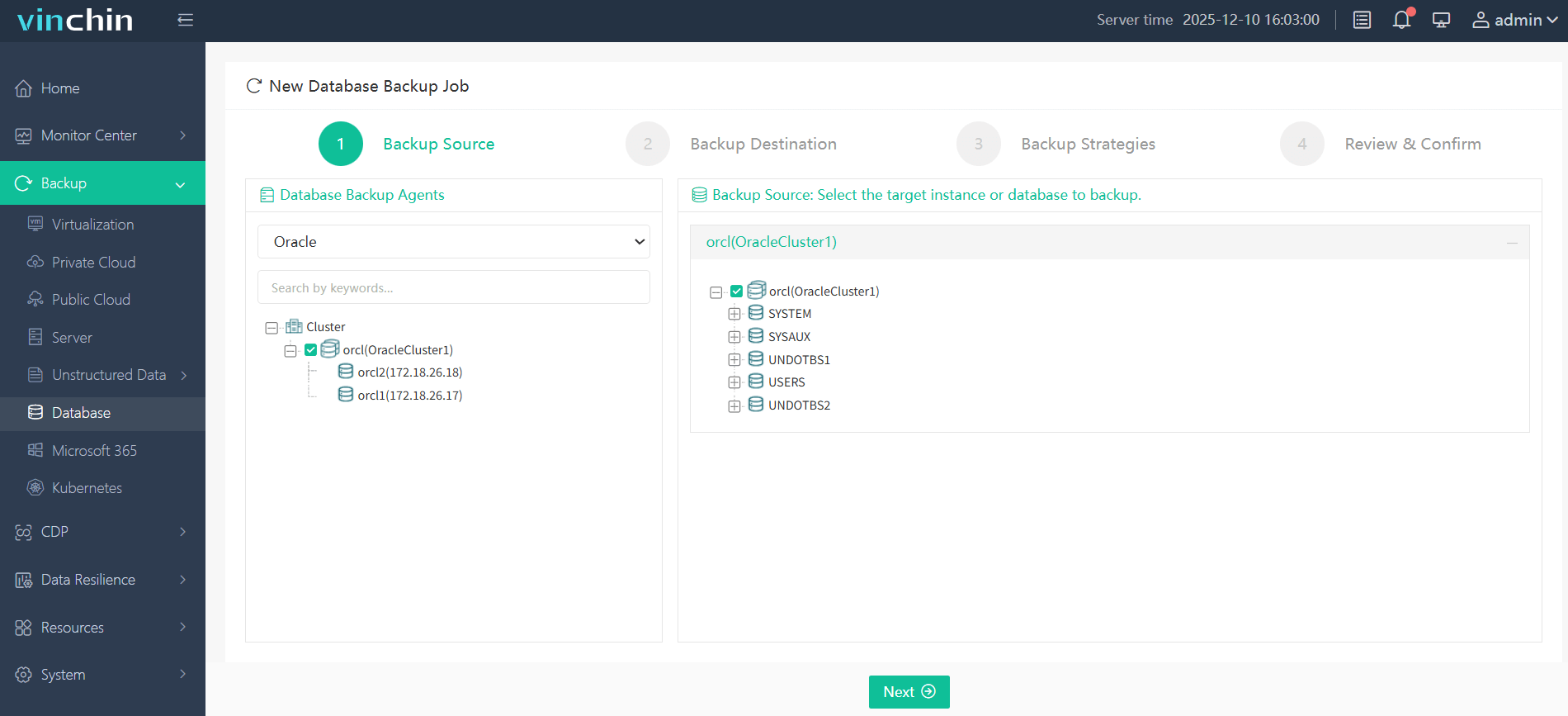
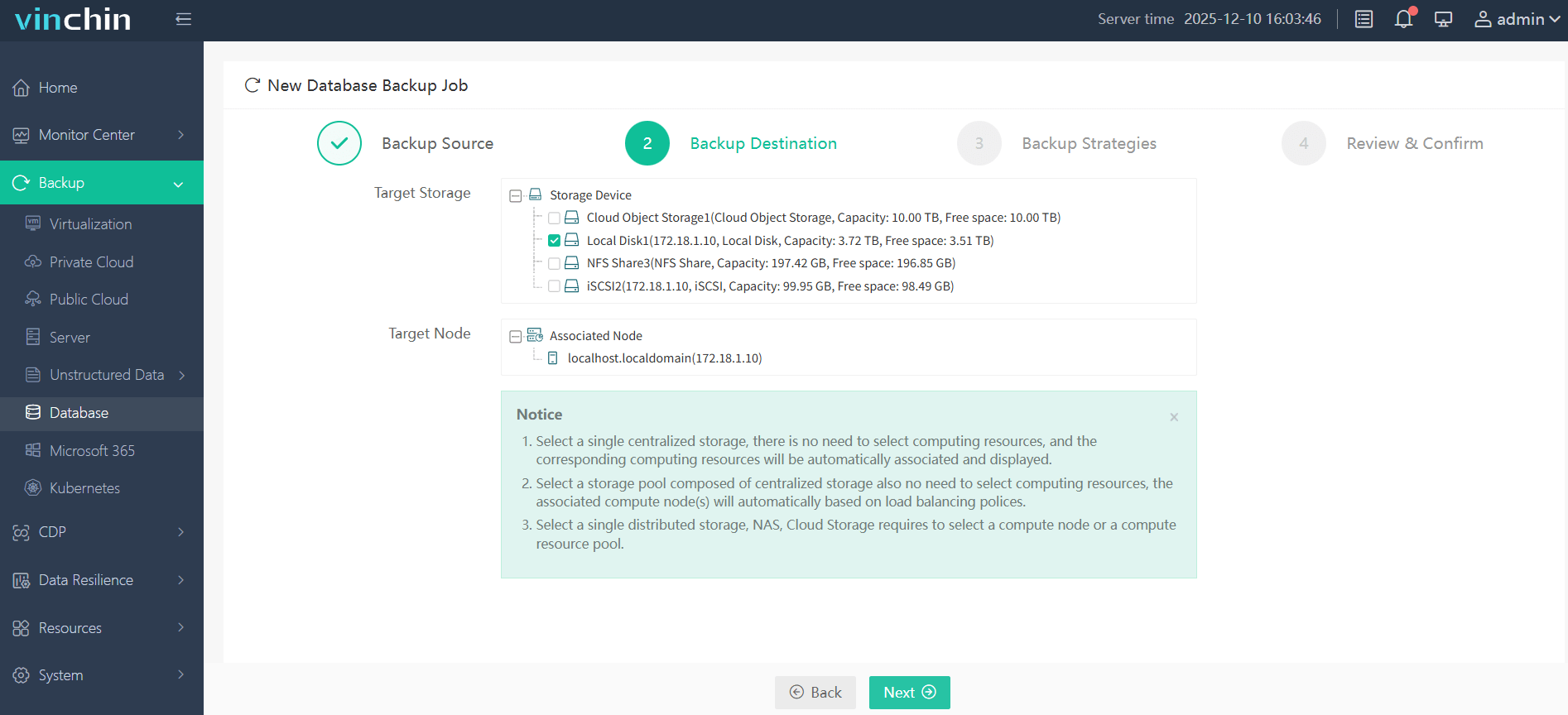
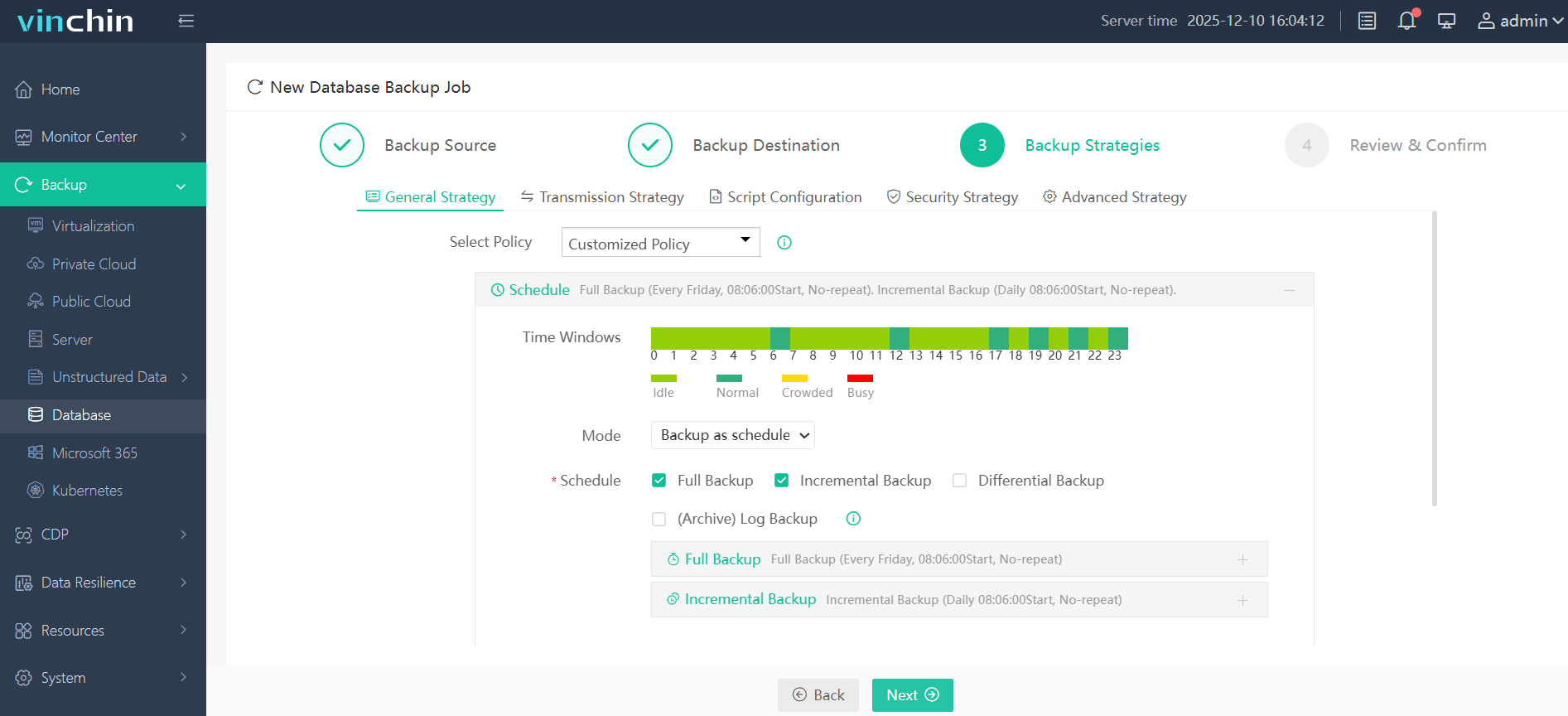
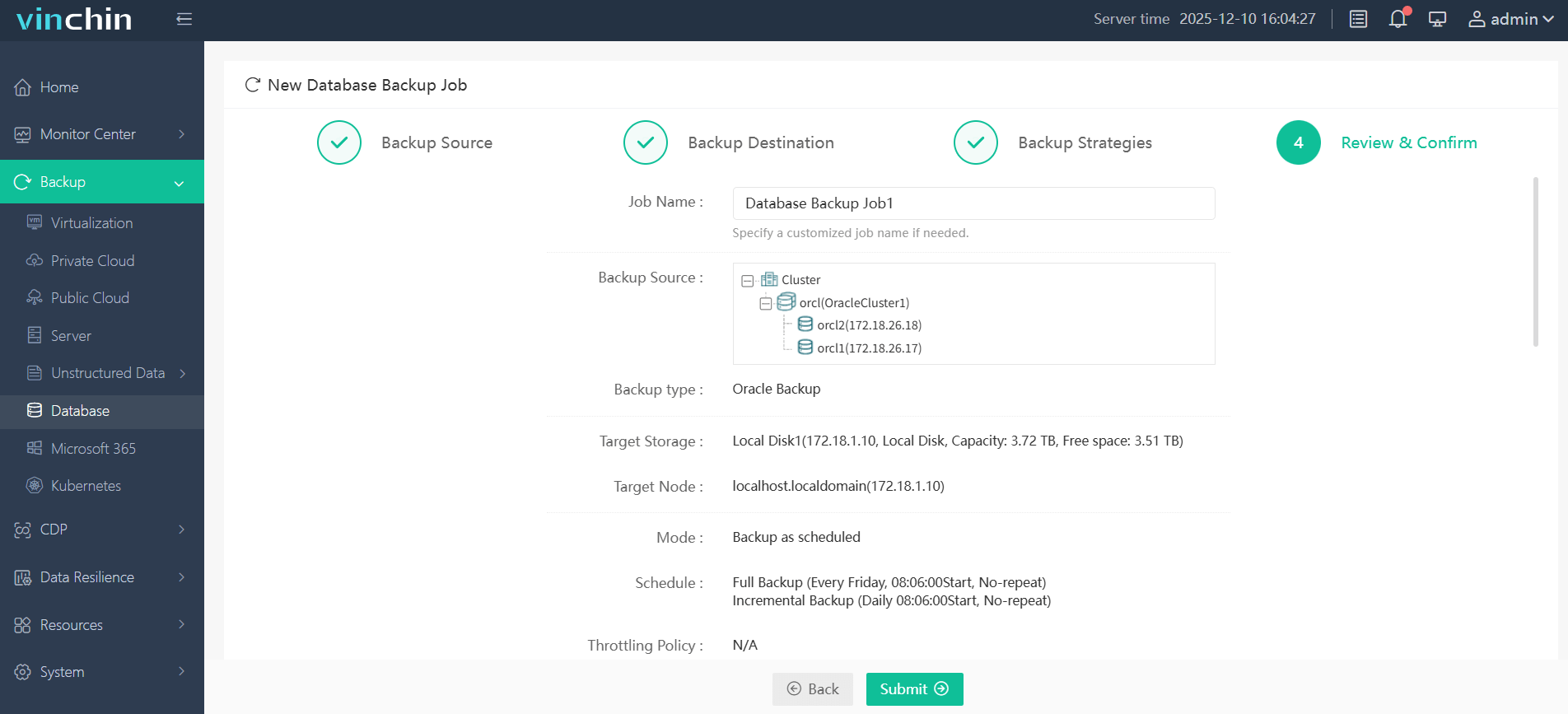
The intuitive web console makes safeguarding your data straightforward—in just four steps:
1. Select the Oracle database to back up
2. Choose the backup storage
3. Define the backup strategy
4. Submit the job
Vinchin Backup & Recovery enjoys global recognition among enterprise users—with top ratings reflecting its reliability and innovation in data protection software worldwide! Experience every feature risk-free with a full-featured 60-day trial—click download now to get started!
Oracle RMAN Compression License FAQs
Q1: Can I enable multiple algorithms at once?
No; only one default algorithm applies per configuration—you must change it explicitly before switching methods between jobs.
Q2: How do I audit past backups’ actual compression method?
Query v$backup_set using SELECT BACKUP_TYPE COMPRESSION_ALGORITHM FROM V$BACKUP_SET WHERE COMPLETION_TIME > [date] ORDER BY COMPLETION_TIME DESC;
Q3: Are legacy ZLIB/LZO algorithms still supported?
These are deprecated by Oracle—they require an Advanced Compression license too—and should not be used in new deployments.
Conclusion
Understanding how oracle rman compression license rules affect daily operations keeps teams compliant while optimizing resource use long term—for free benefits stick with BASIC; go beyond only after securing proper entitlements! Vinchin makes modernizing enterprise-grade oracle protection easy—try it today risk-free!