Oracle databases power many critical business systems worldwide. If you lose this data or face long downtime, your company could suffer financial loss or even legal trouble. That’s why every operations administrator must master reliable backup strategies—and at the heart of these lies Oracle Recovery Manager (RMAN). Whether you are just starting out or want to automate complex routines, understanding the oracle rman command is key to keeping your data safe.
What Is Oracle RMAN Command?
The oracle rman command refers to instructions used with Oracle Recovery Manager (RMAN), which is Oracle’s built-in tool for database backup, restore, and recovery tasks. Unlike basic operating system file copies or exports, RMAN works at the block level inside Oracle databases. It checks for corruption as it backs up data and integrates tightly with Oracle's internal structures. This means you get faster restores, better reliability checks, and easier automation than manual methods.
You can run RMAN commands interactively at its prompt or through scripts saved in files. These commands let you create backups of entire databases or just parts like tablespaces or archived logs; restore lost data after failures; validate that backups are usable; enforce retention policies; and automate routine maintenance—all without leaving the Oracle environment.
Essential Oracle RMAN Commands
Everyday database operations rely on a handful of core RMAN commands. Knowing when—and why—to use each one helps prevent mistakes that could cost hours of work or even lead to lost data.
The BACKUP command creates copies of your database objects—this might mean backing up everything at once or targeting only certain tablespaces if space is tight or compliance rules demand it.
Use RESTORE when you need to bring back lost files after hardware failure or accidental deletion. Pair this with RECOVER to apply changes from archived logs so your restored database matches its last good state.
Want to see what backups exist? Use LIST BACKUP for quick overviews or REPORT OBSOLETE to find files no longer needed under current retention policies.
If you've moved backup files manually between storage devices—or suspect some have gone missing—run CROSSCHECK BACKUP. This synchronizes records between what’s actually present on disk/tape/cloud storage versus what’s listed in the control file or catalog.
After crosschecking obsolete files can be cleaned up using DELETE OBSOLETE, which enforces whatever retention policy you've set (for example: “keep daily backups for 7 days”).
Finally, always check integrity before disaster strikes: use VALIDATE DATABASE to scan for physical corruption in both live datafiles and existing backups—but remember this does not guarantee a full restore will succeed unless you also test restores using RESTORE VALIDATE.
These building blocks form both manual workflows (“I need a quick copy now!”) and automated schedules (“Back up every night at 2 AM”). Mastering them gives you confidence that your recovery plan works when it matters most.
Method 1: Using Oracle RMAN Command Line
Direct access via command line gives full control over every aspect of backup management—and immediate feedback if something goes wrong. Before connecting make sure your user has SYSDBA privileges; otherwise many actions will fail due to lack of permission.
To start RMAN on Linux/UNIX open Terminal then type:
rman
On Windows launch Command Prompt first then enter:
rman
Connect using operating system authentication:
rman target /
Or connect explicitly by providing credentials:
rman target sys/password@ORCL
Once connected you'll see an RMAN> prompt ready for action. Here are some everyday tasks:
To back up everything—including all tablespaces:
BACKUP DATABASE;
Need point-in-time recoverability? Include archived logs too:
BACKUP DATABASE PLUS ARCHIVELOG;
This ensures recoverability right up until the last archived log was created—a must-have for production systems where every transaction counts!
For targeted protection (say only user tablespace):
BACKUP TABLESPACE users;
Or focus on a single file if space is limited:
BACKUP DATAFILE 4;
Customize output location by specifying format strings:
BACKUP DATABASE FORMAT '/backup/orcl_%U.bkp';
Check which backups exist using:
LIST BACKUP;
Validate physical health before relying on old copies:
VALIDATE DATABASE;
Remember: while this scans live files/backups for corruption it does not guarantee successful restores unless combined with restore validation steps like:
RESTORE DATABASE VALIDATE;
Synchronize catalog/controlfile metadata after moving/deleting files outside RMAN's control:
CROSSCHECK BACKUP;
Remove outdated files based on policy settings:
DELETE OBSOLETE;
Exit cleanly when done by typing:
EXIT
The command line method suits ad-hoc needs (“quickly back up before patching”), learning exercises (“what happens if I delete X?”), as well as deep troubleshooting sessions where GUIs fall short.
Method 2: Automating Oracle RMAN Commands with Scripts
Manual operation works fine until scale grows—or human error creeps in during late-night shifts! Automation brings consistency plus peace of mind that jobs run even when you're off duty.
Start by writing all required commands into a plain text file (backup_db.rman). For example,
BACKUP DATABASE PLUS ARCHIVELOG;
DELETE NOPROMPT OBSOLETE;
Run this script from shell using:
rman target / @backup_db.rman
Shell scripts add flexibility—set variables dynamically based on date/time/environmental factors:
#!/bin/bash
export ORACLE_SID=ORCL
LOG=/var/log/rman_backup_$(date +%F).log
rman target / <<EOF >> $LOG 2>&1
CONFIGURE RETENTION POLICY TO RECOVERY WINDOW OF 7 DAYS;
BACKUP DATABASE FORMAT '/backup/orcl_full_%T.bkp';
EXIT
EOF
if [ $? -ne 0 ]; then echo "Backup failed!" | mail -s "RMAN Backup Alert" admin@example.com; fi
Here we set an explicit seven-day retention window so old backups get purged automatically—no manual cleanup needed! Output gets logged per day making audits easy later; errors trigger email alerts so failures never go unnoticed overnight.
Schedule regular runs via cron (Linux/UNIX):
0 2 * /path/to/backup_script.sh
Or Task Scheduler (Windows) if that's your platform preference—just point it at your batch/shell script file set up similarly above.
Pass arguments into scripts using substitution variables (USING) so one template fits many scenarios—for instance tagging special event backups differently than nightly ones:
rman target / @backup_db.rman USING 'TAG2024' '2'
How to Back Up Oracle Databases with Vinchin Backup & Recovery?
For those seeking streamlined enterprise-level protection beyond native tools, Vinchin Backup & Recovery offers comprehensive support for today’s leading databases—including robust capabilities tailored specifically for Oracle environments alongside MySQL, SQL Server, MariaDB, PostgreSQL, PostgresPro, and TiDB. With features such as incremental backup, batch database backup, advanced source-side compression, multiple level data compression, and flexible GFS/data retention policies available for supported platforms like Oracle, Vinchin Backup & Recovery empowers organizations with efficient storage usage and automated compliance while ensuring rapid recovery options remain available whenever needed—all managed through a unified interface designed around operational simplicity.
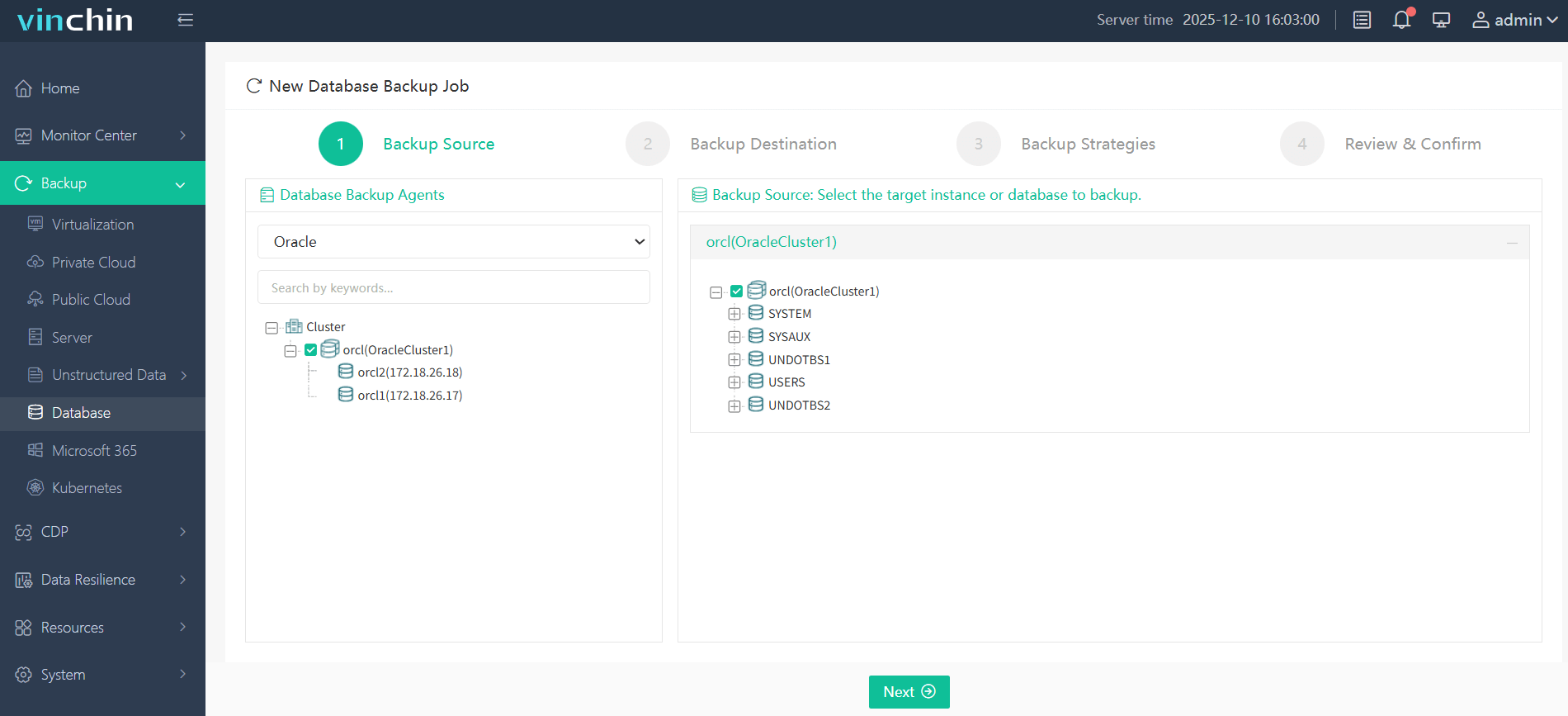
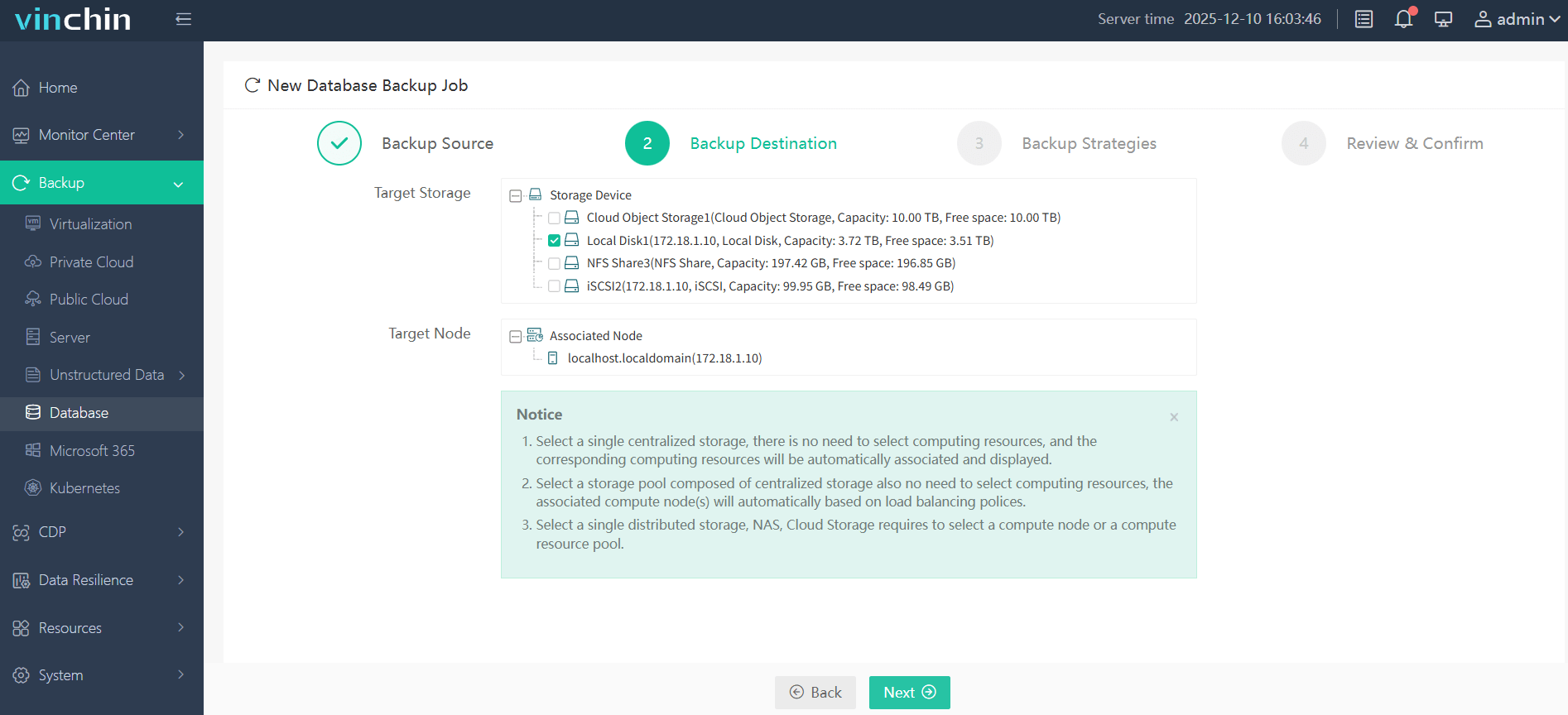
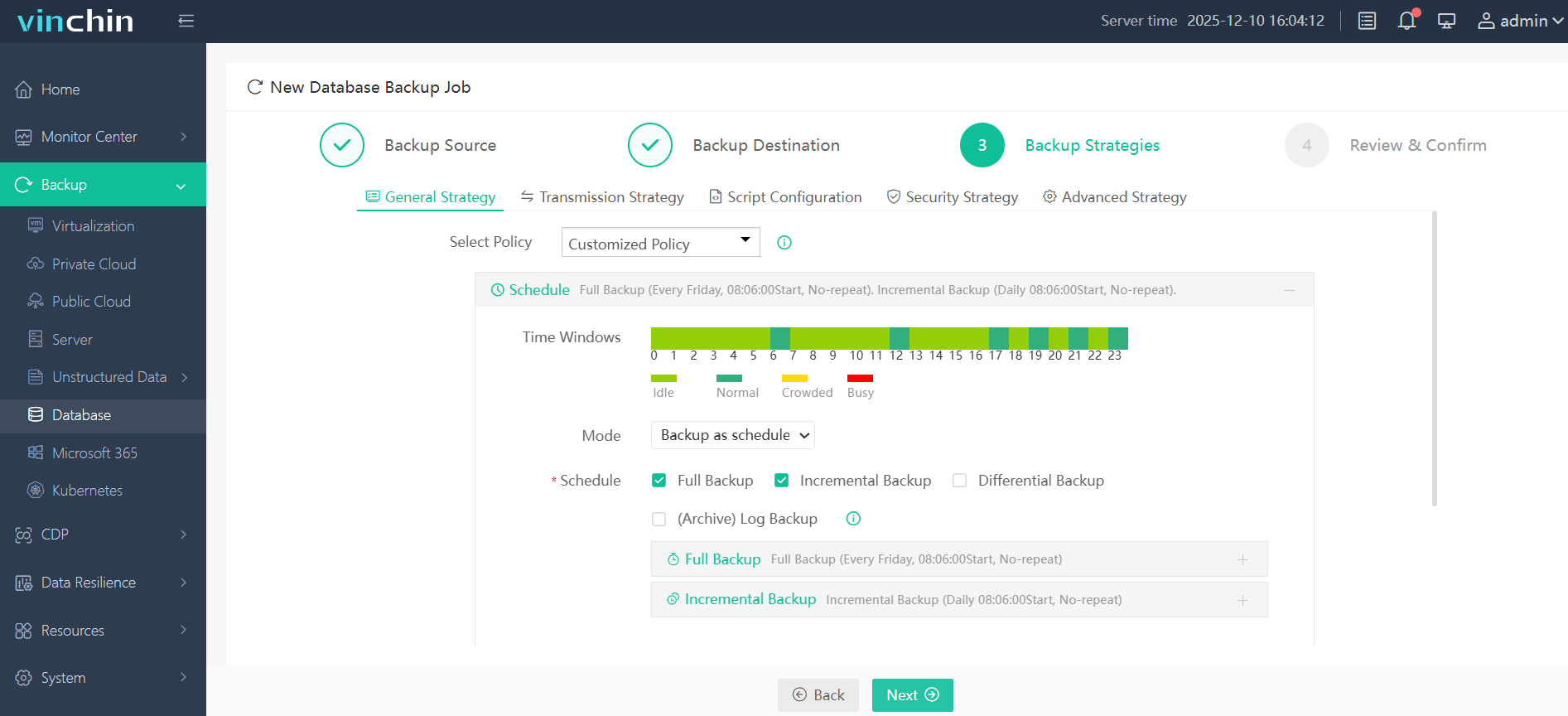
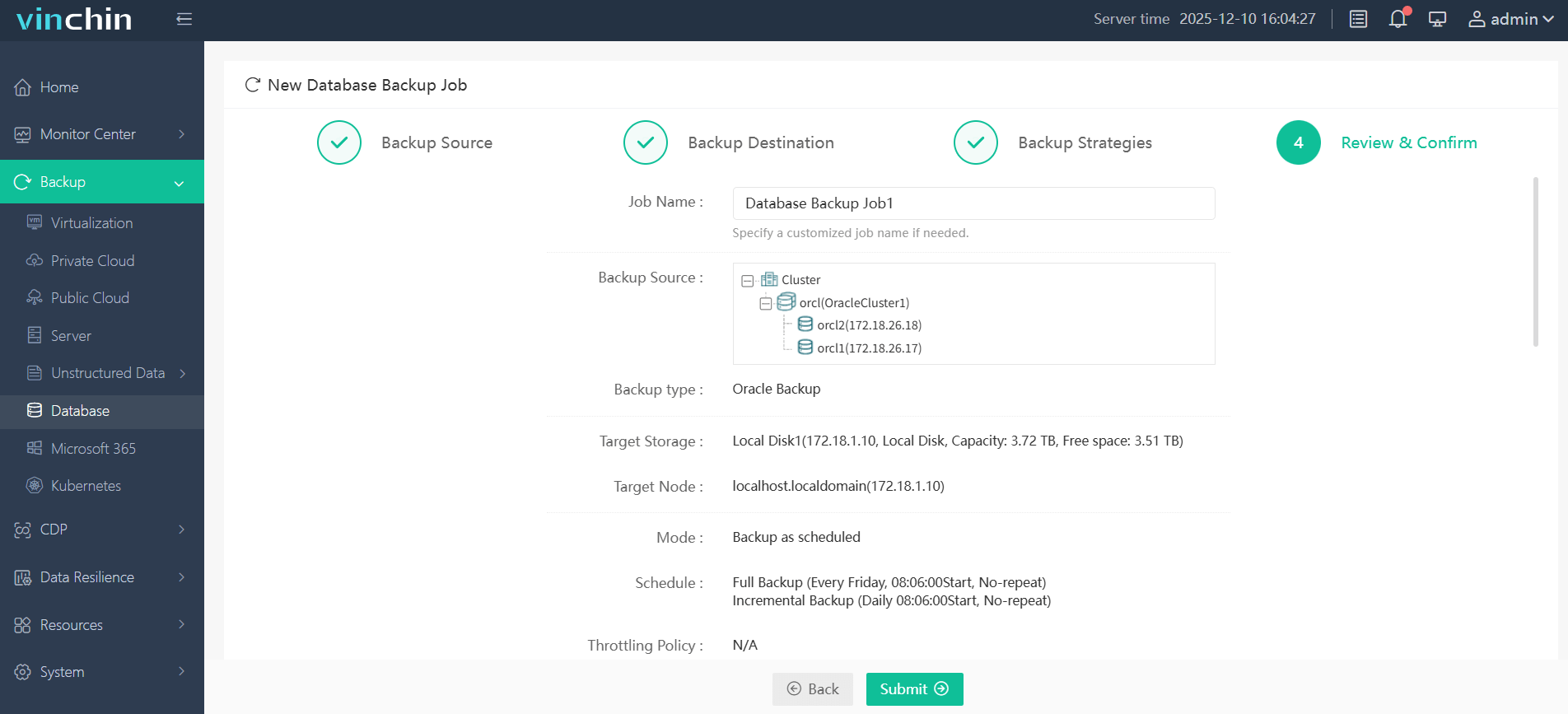
The intuitive web console makes safeguarding your Oracle database straightforward:
Step 1. Select the Oracle database to back up
Step 2. Choose the backup storage
Step 3. Define the backup strategy
Step 4. Submit the job
Recognized globally by enterprises across industries—with top customer ratings—Vinchin Backup & Recovery offers a fully featured free trial valid for 60 days. Experience trusted enterprise-grade protection today by clicking below to download.
Oracle RMAN Command FAQs
Q1: Can I limit my backup job size if disk space runs low?
Yes—you can back up individual tablespaces/datafiles instead of full databases using dedicated commands like BACKUP TABLESPACE users or specify compression options within advanced configurations.
Q2: How do I confirm my scheduled automated script ran successfully overnight?
Check log output generated by redirecting script results into a text file; look for lines stating “Finished backup at...” plus absence of error messages—or query V$RMAN_BACKUP_JOB_DETAILS directly from SQL*Plus after login as SYSDBA.
Q3: What should I do if my catalog/controlfile shows expired entries after moving/deleting old backups?
Run CROSSCHECK BACKUP, review flagged items as EXPIRED then execute DELETE EXPIRED immediately afterward.
Conclusion
Mastering essential oracle rman command skills protects business-critical databases against loss—from simple ad-hoc tasks through fully automated schedules backed by robust logging practices. Whether managing everything yourself via CLI/scripts—or choosing an integrated solution like Vinchin—you’ll keep vital information secure no matter what challenges arise tomorrow.