Managing Oracle database backups is a daily challenge for every administrator. You need to balance storage costs against recovery needs while ensuring compliance with business requirements. How do you decide which backups to keep—and which are safe to delete? This is where an RMAN retention policy becomes essential. With careful configuration, you can automate backup cleanup, save disk space, and guarantee that critical restore points are always available when disaster strikes. Let’s explore how RMAN retention policy works at every level—from basics through advanced automation—so you can make informed decisions for your environment.
What Is RMAN Retention Policy?
The RMAN retention policy defines rules that tell Oracle Recovery Manager (RMAN) how long to retain backups and how many copies to keep on disk or tape. By setting this policy, you give RMAN clear instructions about which backups are still needed for recovery—and which have become obsolete.
When a backup is marked as obsolete by RMAN’s rules, it means that backup is no longer required to meet your defined recovery objectives. These obsolete files can be safely deleted without risking your ability to restore data within your chosen window or redundancy level.
You set up the retention policy using the CONFIGURE RETENTION POLICY command inside RMAN. This policy applies directly to full (level 0) datafile backups and control file backups but also affects incremental backups and archived redo logs indirectly—since those files may be necessary for restoring from kept datafile backups.
It’s important to note: RMAN does not delete obsolete files automatically after marking them; you must run DELETE OBSOLETE yourself or schedule it as part of routine maintenance.
Why Use an RMAN Retention Policy?
A well-defined retention policy does more than tidy up old files—it forms the backbone of disciplined backup management in any serious Oracle environment. Without one in place, outdated backups accumulate unchecked; this wastes valuable storage space and increases administrative overhead during audits or restores.
With a proper policy:
You ensure enough recent backups exist so you can recover from failures at any time within your business-defined window.
Needed restore points aren’t accidentally lost due to manual deletions.
Cleanup becomes automated rather than error-prone guesswork.
Compliance with corporate governance standards—like meeting RPO (Recovery Point Objective) or RTO (Recovery Time Objective)—is easier since policies enforce minimum coverage.
Manual errors decrease because scripts handle routine tasks instead of humans sifting through hundreds of files by hand.
Think about it: would you rather spend hours sorting through old backup sets—or let RMAN handle everything based on clear rules?
Types of RMAN Retention Policies
Oracle offers two main types of retention policies in RMAN: Recovery Window and Redundancy. Each serves different operational needs depending on how you define “enough” protection for your data.
First up is Recovery Window, which keeps all necessary backups so you can restore your database back to any point within a specified number of days—for example, seven days ago if set accordingly. This approach guarantees point-in-time recovery across that period regardless of how many actual backup copies exist during those days.
Next is Redundancy, which focuses simply on keeping a fixed number of recent backup copies per datafile/control file—say two or three most current versions—and marks anything older as obsolete once newer ones appear.
You cannot use both at once; only one type may be active at any time per database instance. If no explicit choice is made after installation/configuration begins, Oracle defaults silently to REDUNDANCY 1, meaning only one copy per file will ever be considered necessary unless changed later by an administrator.
Choosing Between Recovery Window and Redundancy
How do you pick between these two strategies? It comes down mainly to business requirements:
If regulations demand that “we must always be able to restore our system back up until X days ago,” then choose RECOVERY WINDOW—it ensures continuous coverage over time regardless of individual backup frequency or size fluctuations day-to-day.
If instead your concern centers around hardware resilience (“we want three separate good copies just in case”), then opt for REDUNDANCY—this keeps things simple but doesn’t guarantee point-in-time coverage beyond however often fulls/incrementals run successfully within those last N cycles.
For most production environments needing precise Point-in-Time Recovery capabilities—a common requirement today—the Recovery Window method remains standard best practice.
How to Configure RMAN Retention Policy?
Configuring an effective retention strategy requires understanding both syntax and implications behind each command used inside RMAN sessions. Here’s what every operations admin should know before making changes:
Start by connecting securely via command line:
rman target /
To set a specific time-based window:
CONFIGURE RETENTION POLICY TO RECOVERY WINDOW OF n DAYS;
Replace n with however many days’ worth of recoverable history you require—for example:
CONFIGURE RETENTION POLICY TO RECOVERY WINDOW OF 7 DAYS;
To switch instead toward copy-counting mode:
CONFIGURE RETENTION POLICY TO REDUNDANCY n;
Here n stands for total valid copies wanted per file—for instance:
CONFIGURE RETENTION POLICY TO REDUNDANCY 2;
Curious about current settings? Check anytime using:
SHOW RETENTION POLICY;
Wondering what will actually get deleted next run? Preview candidates first:
REPORT OBSOLETE;
Sample output might look like this:
RMAN> REPORT OBSOLETE;

Obsolete Backup Set
-------------------
BS Key  Size       Device Type Elapsed Time Completion Time
------- ---------- ----------- ------------ -------------------
12      1024M      DISK        00:01:23     2024-06-01
...
The following objects are obsolete...
...
This tells you exactly which sets/files would disappear if deletion ran now under current rules—a crucial safety check before removing anything!
Ready for cleanup? Free up space manually anytime via:
DELETE OBSOLETE;
Want everything reset back default?
CONFIGURE RETENTION POLICY CLEAR;
Need all policies off temporarily (not recommended except rare cases)?
CONFIGURE RETENTION POLICY TO NONE;
Protecting Oracle Databases with Vinchin Backup & Recovery
Beyond native tools like RMAN, organizations increasingly turn toward comprehensive solutions designed specifically for enterprise environments. Vinchin Backup & Recovery stands out as a professional-grade platform supporting today’s mainstream databases—including Oracle, MySQL, SQL Server, MariaDB, PostgreSQL, PostgresPro, and TiDB—with robust features tailored especially for Oracle users seeking advanced protection and efficiency gains.
Key highlights include advanced source-side compression and incremental backup options that optimize storage usage and speed up operations; batch database backup capabilities streamline large-scale environments; flexible multi-level data compression adapts easily across workloads; while granular data retention policies help maintain compliance without manual intervention—all working together to simplify administration while maximizing reliability and cost-effectiveness.
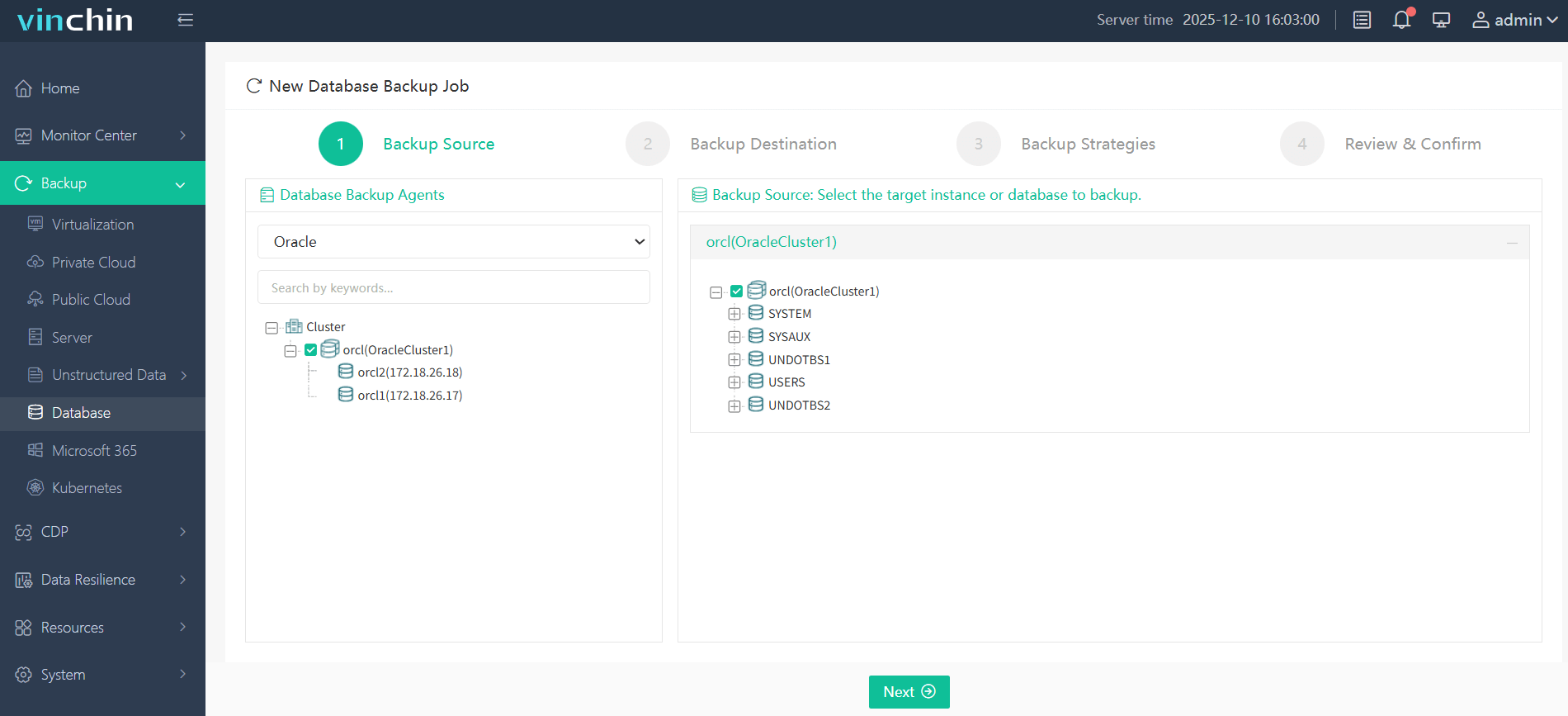
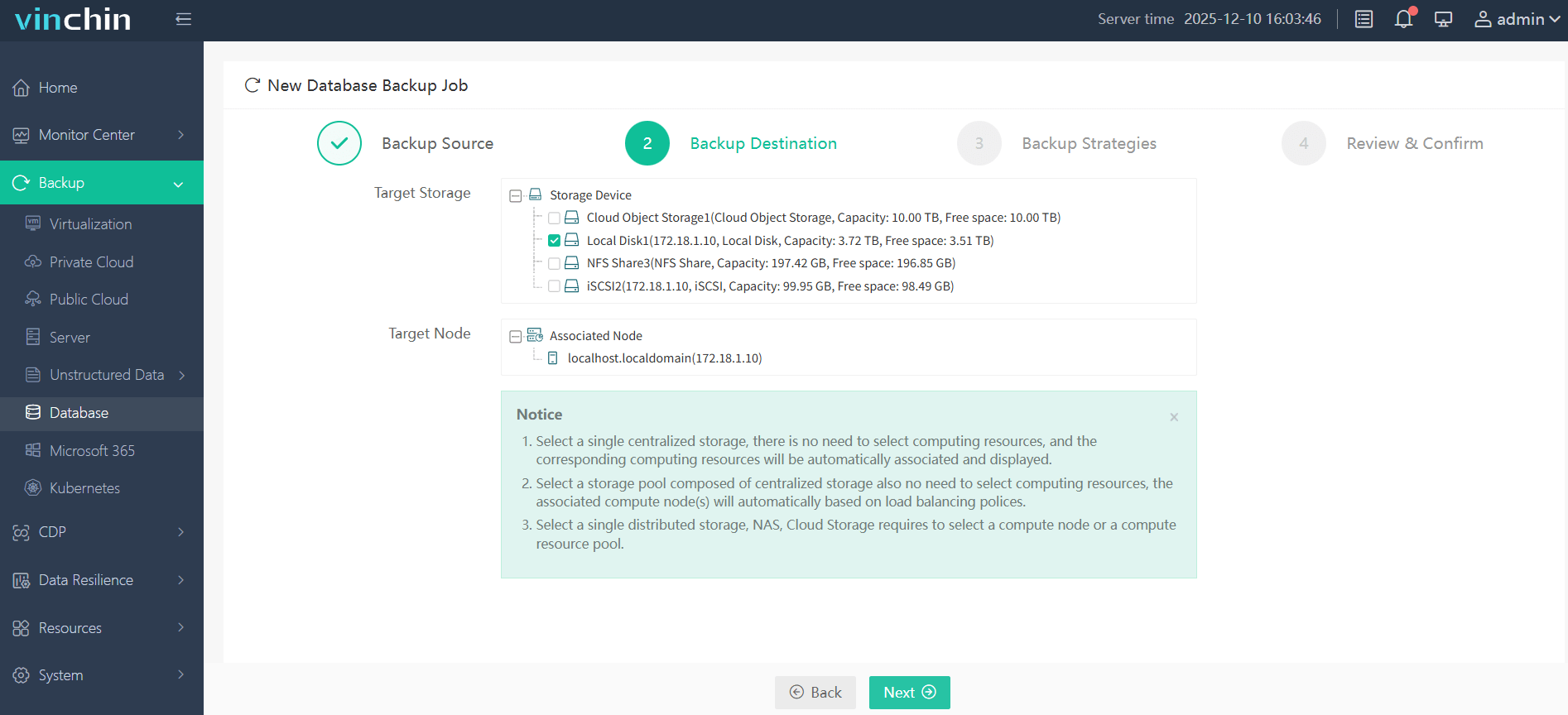
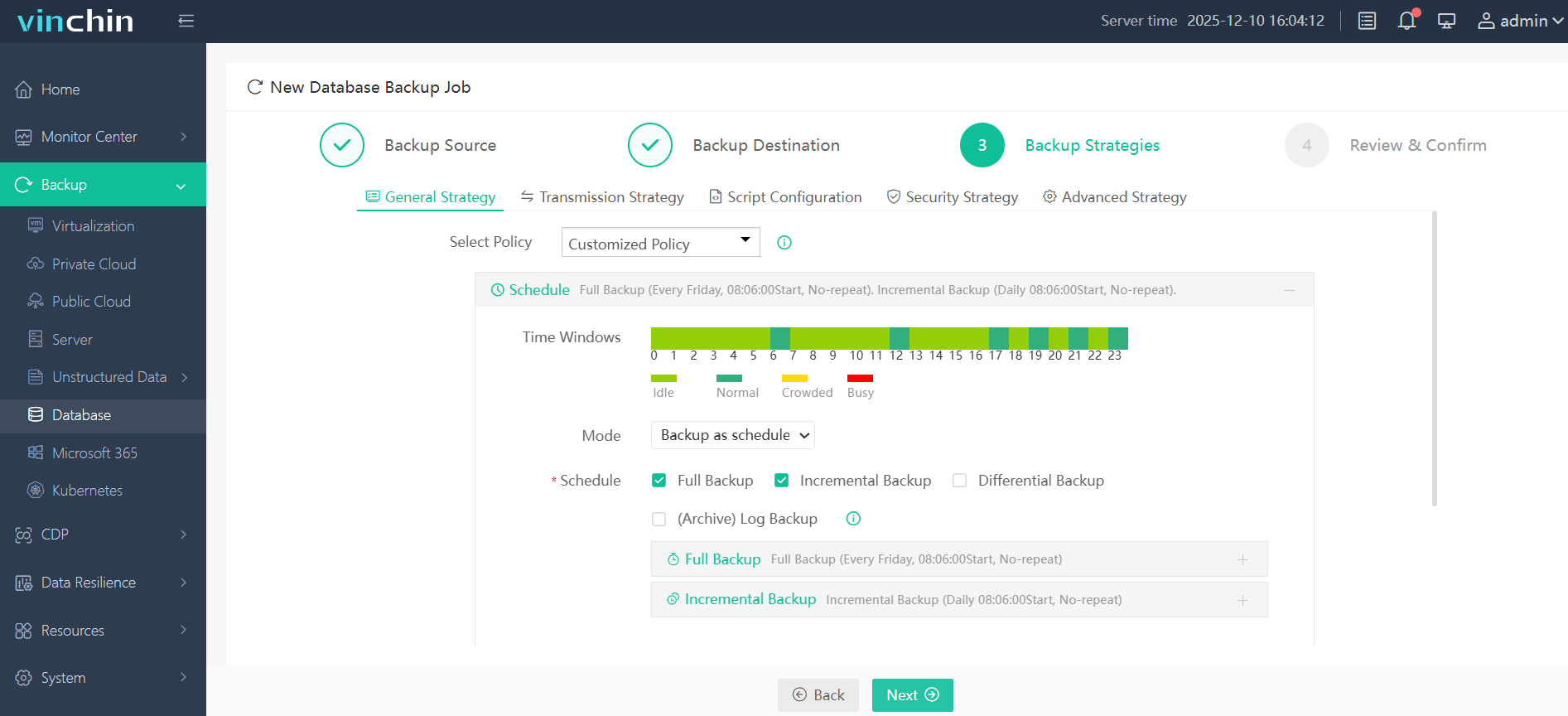
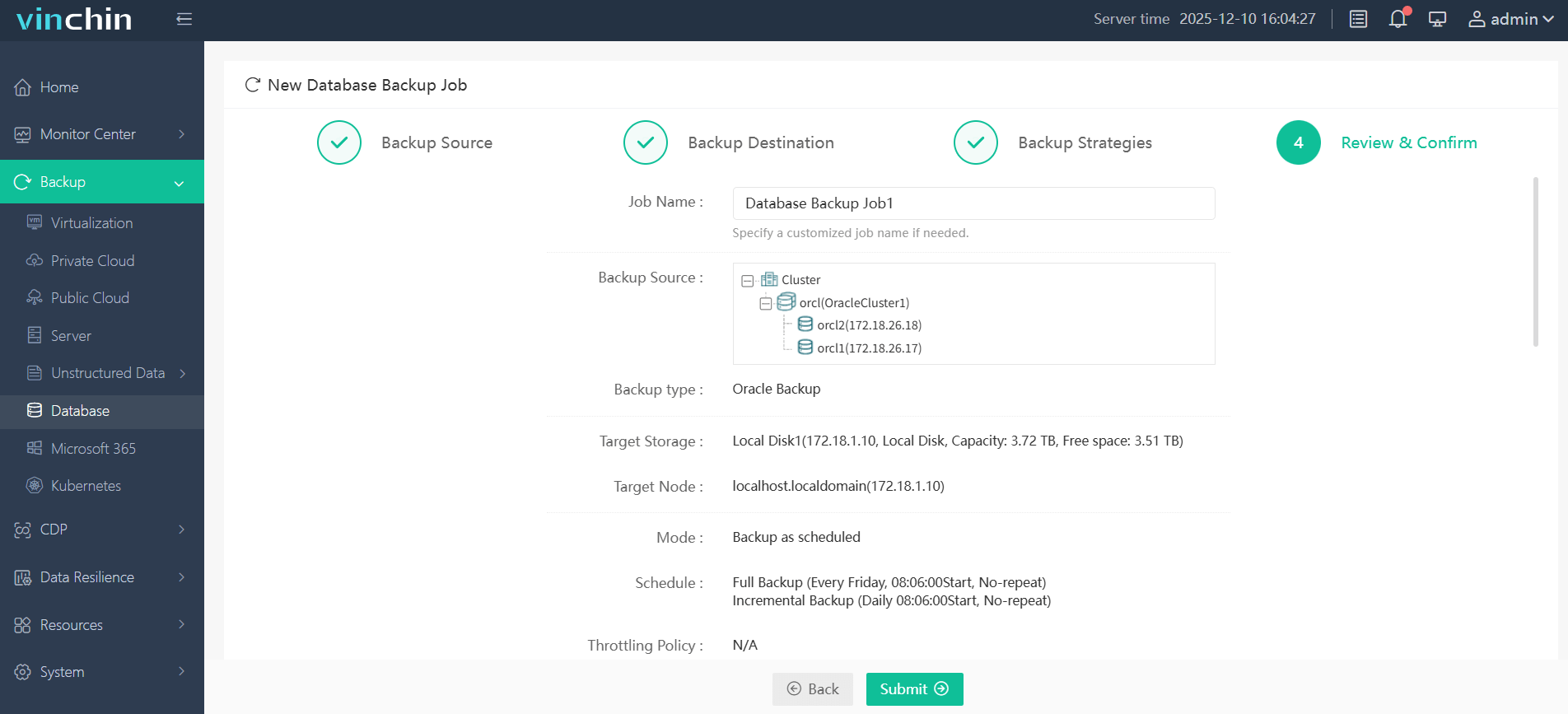
Vinchin Backup & Recovery features an intuitive web console that makes safeguarding Oracle databases straightforward:
Step 1. Select the Oracle database to back up
Step 2. Choose backup storage
Step 3. Define your backup strategy
Step 4. Submit the job
Recognized globally with top customer ratings across industries, Vinchin Backup & Recovery delivers proven enterprise-grade protection trusted by thousands worldwide—start your risk-free journey today with a fully featured 60-day free trial by clicking below.
RMAN Retention Policy FAQs
Q1: Can I automate deleting obsolete Oracle backups without manual intervention?
A1: Yes—embed DELETE OBSOLETE into scheduled scripts using cron (Linux) or Task Scheduler (Windows).
Q2: Why aren’t some old archived redo logs being deleted even though my oldest full backup was removed?
A2: Those logs are still required by other retained incremental/full/datafile/control file sets under current recovery objectives—they’ll stay until truly unneeded per active policy rules.
Q3: What happens if my server clock changes significantly—is my RECOVERY WINDOW affected?
A3: Yes—a major system date/time change could cause unexpected results since RECOVERY WINDOW calculations rely strictly on timestamps stored in catalog/control files.
Conclusion
A strong RMAN retention policy keeps Oracle databases protected yet efficient—balancing risk against cost while simplifying management tasks over time. Vinchin builds upon these principles with advanced features designed specifically for enterprise-grade protection needs worldwide.