Restoring a schema from an RMAN backup in Oracle 19c is a task that often puzzles even experienced database administrators. The core challenge? RMAN operates at the physical level—it backs up files like datafiles and control files—but schemas are logical objects. This means you cannot simply point to a schema in your backup set and restore it directly. So what do you do if someone drops a critical schema or corruption strikes just one part of your database? In this article, we break down proven methods to recover only what you need without risking your entire production system.
What Is RMAN Backup in Oracle 19c
RMAN (Recovery Manager) is Oracle’s built-in utility for backing up and restoring databases. In Oracle 19c, it can back up complete databases, pluggable databases (PDBs), tablespaces, individual datafiles, or even single tables under certain conditions. However, all these operations work at the storage layer—they deal with blocks on disk rather than logical groupings like schemas.
Because of this design choice, there’s no direct “restore my_schema” command in RMAN. If you lose or corrupt just one schema but everything else is fine, you still have to perform broader recovery steps. Usually this means restoring the whole database somewhere safe first—often called an auxiliary instance—then extracting only what you need using logical tools such as Data Pump.
This limitation shapes every approach to schema-level recovery with RMAN backups.
Why Restore Schema from RMAN Backup 19c?
Why would you ever need to restore just one schema instead of rolling back your whole database? There are several common reasons:
First is accidental deletion—a user might drop an important application schema by mistake. Second is corruption; sometimes only one part of your data gets damaged due to hardware failure or software bugs. Third is testing; maybe you want to roll back just one application area without affecting others.
Since direct schema restores aren’t possible with RMAN alone, administrators must use workarounds that combine physical restoration with logical export/import utilities. These methods let you recover exactly what was lost while keeping downtime low for everyone else who depends on your system.
Method 1 Restoring Schema Using Data Pump After Full Restore
The most reliable way to restore a single schema from an RMAN backup involves two main phases: first restoring your full database onto an isolated environment (so production stays safe), then exporting only the needed schema using Oracle Data Pump before importing it back into production.
Preparing Your Auxiliary Environment
Before starting any restore process, set up an auxiliary instance where you can safely bring back your full database without interfering with live users or applications. This could be another server entirely or a separate ORACLE_SID on existing hardware if resources allow.
Make sure:
The operating system matches production
The same version of Oracle Database software is installed
There’s enough storage space for both restored datafiles and exported dump files
If Transparent Data Encryption (TDE) was used in production backups, ensure wallet files are available so decryption succeeds during recovery.
Performing Full Database Restore Using RMAN
Once your environment is ready:
1. Start RMAN and connect to both target (auxiliary) database and catalog if used.
2. Restore control file:
RESTORE CONTROLFILE FROM 'autobackup_location';
If unsure about location details run LIST BACKUP OF CONTROLFILE; within RMAN first.
3. Mount the restored instance:
ALTER DATABASE MOUNT;
4. Restore all datafiles:
RESTORE DATABASE;
5. Recover changes since last backup:
RECOVER DATABASE;
6. Open new incarnation:
ALTER DATABASE OPEN RESETLOGS;
This step resets redo logs—a required action after point-in-time recovery.
Check alert logs throughout these steps for errors related to missing archive logs or mismatched parameters.
Exporting Target Schema Using Data Pump
With your test copy open:
1. Create directory object inside SQL*Plus:
CREATE OR REPLACE DIRECTORY dpdir AS '/path/to/export';
2. Use Data Pump Export (expdp) as SYSDBA or SYSTEM:
expdp system/password schemas=your_schema directory=dpdir dumpfile=your_schema.dmp logfile=export.log
If moving between different Oracle versions specify VERSION=19.0 parameter for compatibility.
3. Transfer resulting .dmp file securely over network or via external drive to production server.
Importing Schema Back Into Production Database
On production:
1. Ensure destination directory exists (CREATE OR REPLACE DIRECTORY dpdir AS ...)
2. Run Data Pump Import (impdp):
impdp system/password schemas=your_schema directory=dpdir dumpfile=your_schema.dmp logfile=import.log TABLE_EXISTS_ACTION=REPLACE
3. Review import log carefully for warnings about missing objects or failed grants—these may require manual intervention later.
After import completes:
This method restores only what was lost while leaving other business areas untouched—a big win when uptime matters!
Method 2 Manual Export Import After Recovery
Sometimes recovering isn’t just about putting things back where they were—it’s also about adapting them for new uses like cloning environments or migrating between systems with different naming conventions.
This method builds on Method 1 but adds flexibility through advanced Data Pump features such as REMAP_SCHEMA (to rename during import) or REMAP_TABLESPACE (to move objects onto new storage).
Advanced Scenario: Cloning & Migration With REMAP Parameters
Suppose you want not just to recover but also clone “HR” as “HR_TEST” in another testbed—or migrate it into fresh infrastructure altogether:
1. On restored auxiliary instance:
expdp system/password schemas=hr directory=dpdir dumpfile=hr.dmp logfile=export.log
2. On target/test/migration server:
impdp system/password directory=dpdir dumpfile=hr.dmp logfile=import.log remap_schema=hr:hr_test remap_tablespace=data:data_new table_exists_action=replace
These parameters let you change ownership (“remap_schema”), shift storage (“remap_tablespace”), or resolve conflicts (“table_exists_action”) all at once during import—saving time compared to manual edits afterward.
How to Back Up or Migrate Oracle Databases with Vinchin Solutions
Given these complexities around native tools, many organizations seek streamlined solutions for protecting their critical databases such as Oracle 19c—including efficient backup management and rapid recovery options at both granular and full-database levels. Vinchin Backup & Recovery stands out as a professional enterprise-grade solution supporting today’s mainstream platforms including Oracle, MySQL, SQL Server, MariaDB, PostgreSQL, PostgresPro, and TiDB databases—all managed through a unified interface designed for operational simplicity and reliability.
Vinchin Backup & Recovery delivers robust features tailored for enterprise needs: batch database backup streamlines protection across multiple instances; incremental backup minimizes resource usage by capturing only changed data; flexible retention policies help meet compliance requirements; cloud backup ensures offsite safety; while integrity check verifies recoverability before disaster strikes—all contributing toward secure business continuity strategies without unnecessary complexity.
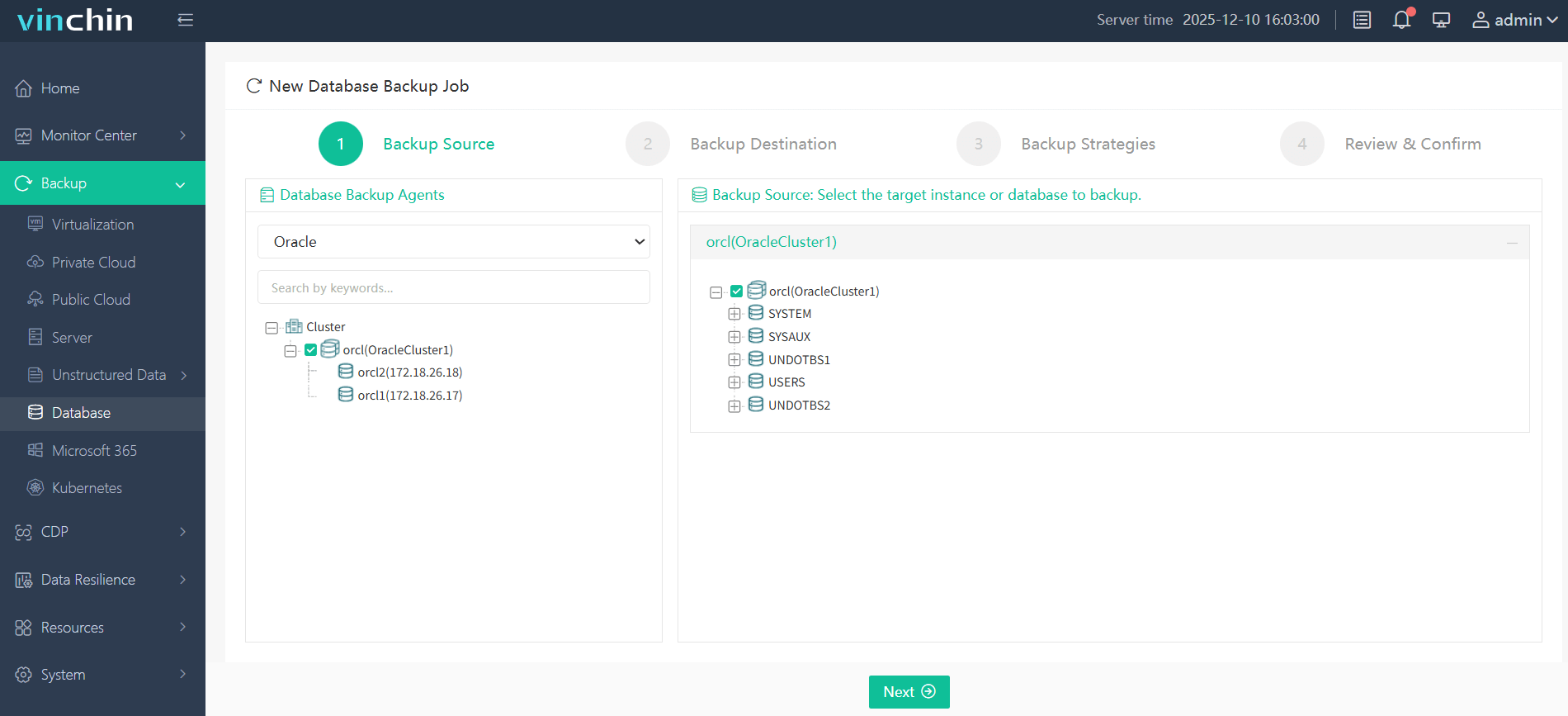
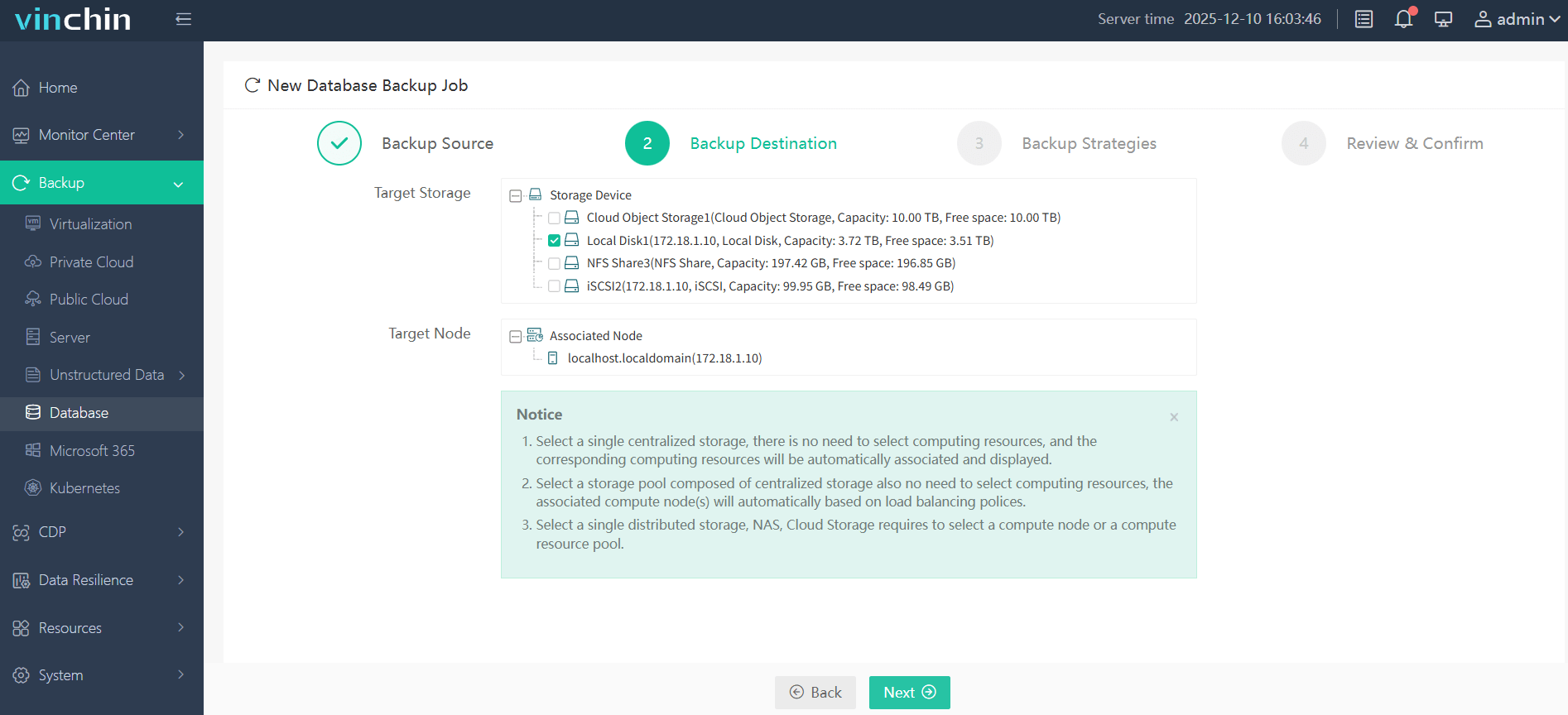
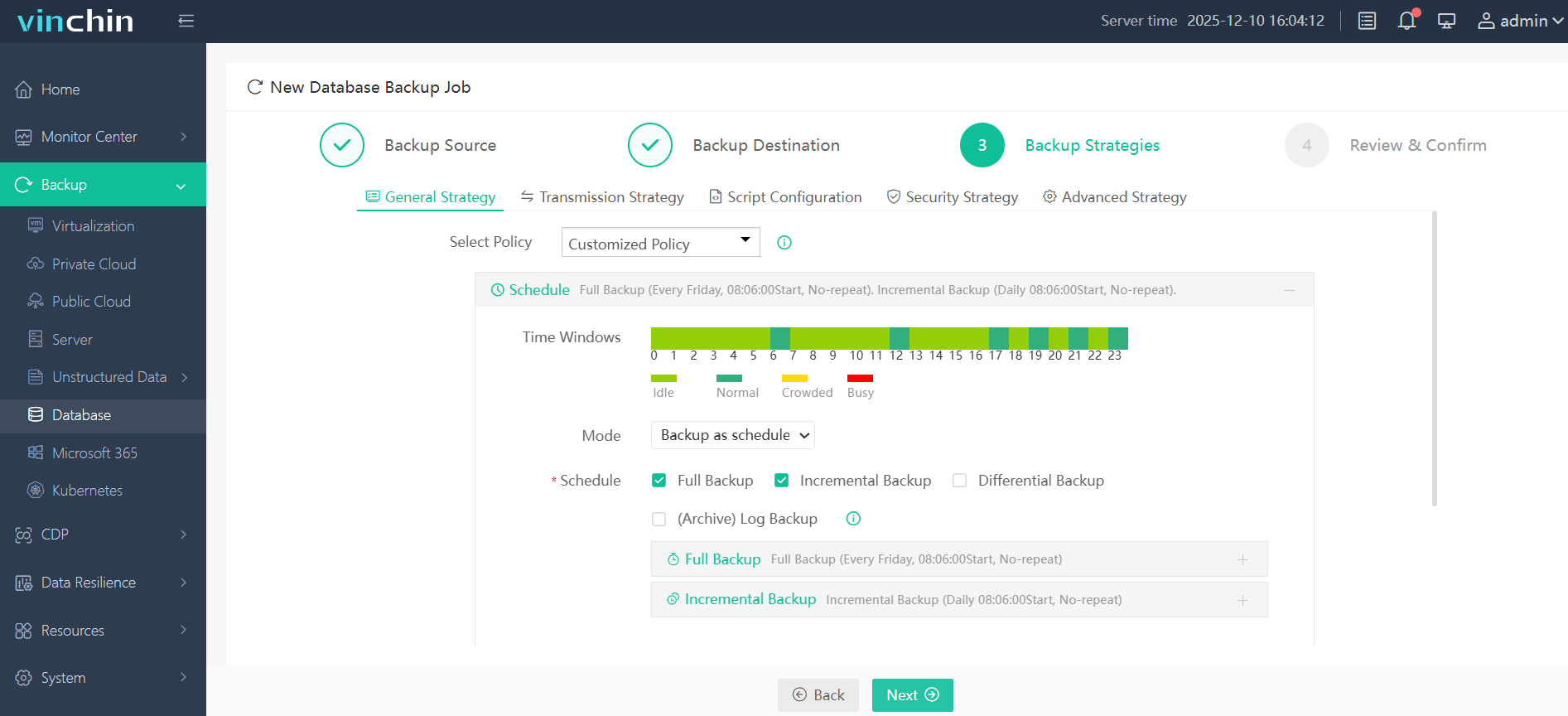
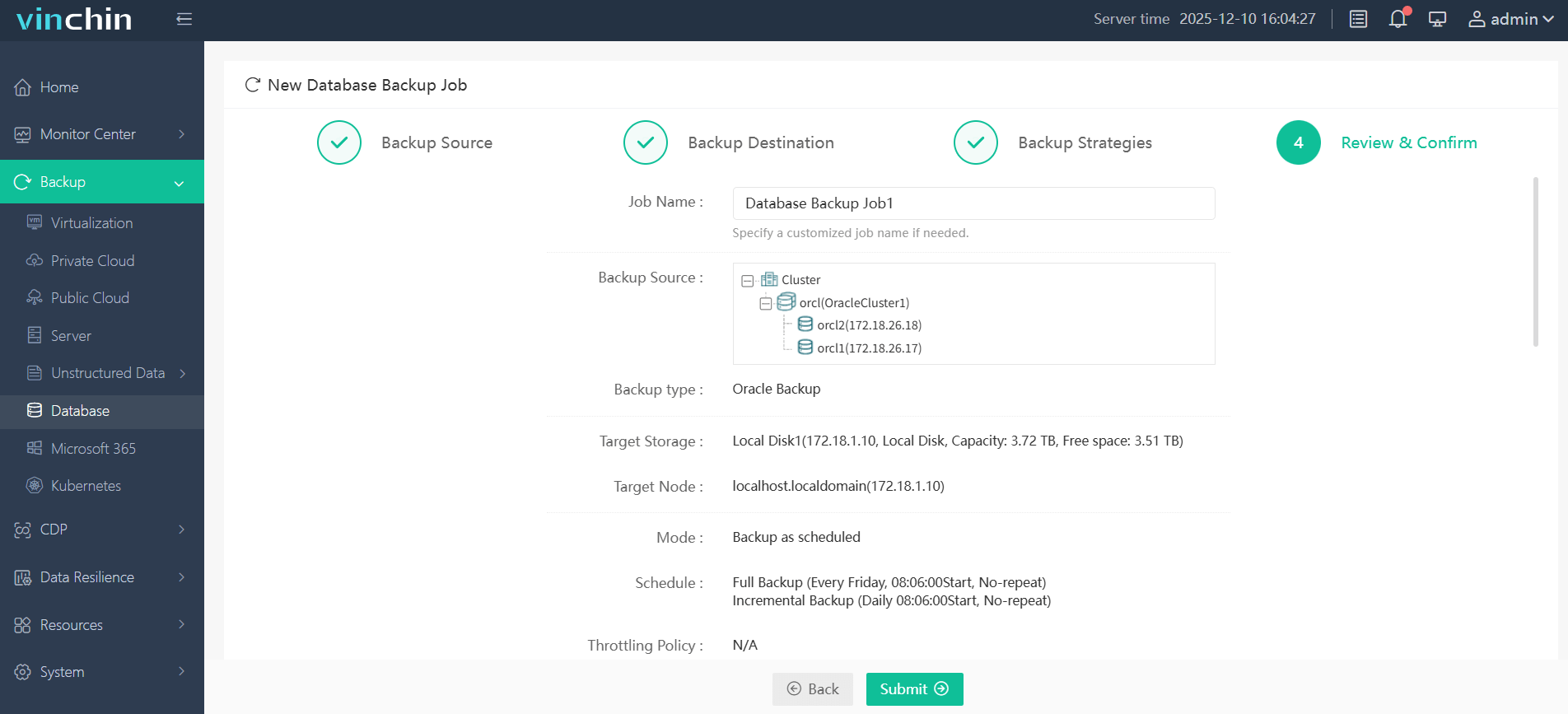
Managing backups via Vinchin Backup & Recovery’s intuitive web console typically takes just four steps:
Step 1. Select the Oracle database to back up
Step 2. Choose the backup storage
Step 3. Define the backup strategy
Step 4. Submit the job
Recognized globally by thousands of customers with top industry ratings,Vinchin Backup & Recovery offers a fully featured free trial valid for 60 days.Download now and experience enterprise-class protection firsthand!
Restore Schema from RMAN Backup 19c FAQs
Q1: Can I restore a single schema directly from an RMAN backup in Oracle 19c?
No; direct schema-level restores aren’t supported—you must fully restore elsewhere then export/import logically.
Q2: What should I check before restoring encrypted backups?
Ensure TDE wallet files are accessible so decryption works during recovery steps.
Q3: How can I reduce downtime when importing large schemas?
Use NETWORK_LINK parameter in Data Pump so import pulls data directly over network instead of transferring large dump files manually.
Conclusion
Restoring a schema from an RMAN backup in Oracle 19c requires careful planning—a full database restore followed by targeted export/import ensures accuracy without disrupting other workloads.Vinchin makes protecting critical databases easier through automation and centralized management so IT teams can focus on business needs instead of complex manual processes.