Upgrading an Oracle database from 12c to 19c is a major milestone for any organization. It promises better performance, new features, and long-term support—but it also brings risks like data loss or downtime if not handled carefully. Many administrators rely on RMAN backups to move data safely between versions with minimal disruption. But how do you restore a 12c RMAN backup to 19c without running into trouble? This guide explains key concepts step by step—from basic preparation through advanced troubleshooting—and shows you two proven methods: using the RMAN DUPLICATE command or performing a manual restore with upgrade steps. Let’s make your upgrade smooth and reliable.
What Is Restoring 12c RMAN Backup to 19c?
Restoring a 12c RMAN backup to 19c means taking a physical backup of your Oracle Database version 12c and using it as the foundation for an upgraded database running Oracle Database 19c. This process is often called “restore-and-upgrade” because you cannot simply restore; you must also run upgrade scripts so that all structures are compatible with the newer version.
Organizations use this approach when migrating databases during hardware refreshes or moving workloads to new servers while minimizing downtime. The goal is simple: transfer all data, configuration settings, users, history—even hidden metadata—without losing integrity or business continuity.
RMAN (Recovery Manager) is Oracle’s built-in tool for backup and recovery tasks. It supports both full and incremental backups at block level for efficiency. When restoring across versions like this (from 12c to 19c), careful planning ensures that every object migrates correctly—and that no incompatible features cause failures mid-upgrade.
Prerequisites for Restore 12c RMAN Backup to 19c
Before starting any migration project involving different Oracle versions, preparation is critical at every stage—beginner through expert.
First steps include checking your source (12c) database health by reviewing alert logs and ensuring there are no corrupt blocks or invalid objects present. Next, run Oracle’s preupgrade.jar utility against your live production database before taking your final backup; this tool highlights obsolete parameters or unsupported features that could block upgrades later.
You must have a recent valid RMAN backup—including all datafiles, control file(s), spfile/pfile parameter files, password file if needed, plus archived redo logs up until just before cutover time.
On your target server where Oracle Database 19c will run:
Install the correct version of Oracle software.
Do not create a new database yet; only install binaries.
Ensure operating system type matches (Linux-to-Linux works; cross-endian platforms like AIX-to-Linux require extra conversion steps).
Confirm enough disk space exists for restored files.
Check user permissions so you can read/write all necessary directories.
Verify network connectivity if transferring files over LAN/WAN.
Make sure the COMPATIBLE initialization parameter in your pfile/spfile is set appropriately (at least ‘12.x.x’); otherwise restoration may fail due to version mismatch.
If file paths differ between source/target servers—for example due to storage layout changes—document these differences now so you can adjust them during restore using either SET NEWNAME commands in RMAN or conversion parameters in your pfile/spfile (DB_FILE_NAME_CONVERT, LOG_FILE_NAME_CONVERT).
Method 1: Using Duplicate Command
The RMAN DUPLICATE command offers an efficient way to clone or migrate databases between servers—even across major versions like from Oracle Database 12c to 19c. This method automates much of the heavy lifting while reducing manual error risk—a good choice for most admins seeking reliability with less hands-on work.
Preparing Your Target Environment
Begin by copying all required backup pieces—including full/incremental datafiles backups, control file autobackup(s), archived redo logs—from your source server onto local storage accessible by the target server running Oracle Database 19c binaries.
Also copy over your parameter file (pfile) from source; edit its contents as needed:
Update directory/file paths reflecting new storage locations
Adjust memory settings based on available resources
Set COMPATIBLE parameter value appropriate for upgrade path
Add/modify DB_FILE_NAME_CONVERT/LOG_FILE_NAME_CONVERT entries if directory structure has changed
Start up the instance in NOMOUNT mode using this edited pfile:
SQL> STARTUP NOMOUNT PFILE='/path/to/init_targetdb_ora';
Running DUPLICATE Command
Connect via RMAN on target server:
rman TARGET SYS@dummy AUXILIARY /
Now issue:
RMAN> DUPLICATE DATABASE TO <new_db_name> NOOPEN BACKUP LOCATION '/path/to/backup/';
The NOOPEN clause keeps database mounted after duplication finishes so you can perform further upgrade actions before opening fully.
If you encounter errors about missing archived logs during duplication:
Double-check that all log files covering period since last full/incremental backup are present in specified location
Use SET UNTIL SCN or SET UNTIL TIME clauses within DUPLICATE command if restoring only up until certain point
Once duplication completes successfully:
SQL> ALTER DATABASE OPEN RESETLOGS UPGRADE;
This opens database in special mode ready for upgrade scripts execution—but does not yet allow normal user access until those scripts finish cleanly.
Method 2: Manual Restore and Upgrade Steps
Some administrators prefer granular control over every detail—which makes manual restore plus explicit upgrade steps appealing despite being more complex than automated approaches like DUPLICATE command.
Copying Files & Editing Parameters
First copy all relevant backup sets—including datafiles/control/autobackups/archive logs/pfile—from source system onto target machine hosting fresh install of Oracle Database 19c software stack.
Edit copied pfile:
Change directory/file paths as needed
Set memory allocations suitable for hardware resources available
Adjust COMPATIBLE parameter value upward only after successful testing
Create required directories ahead of time so restores won’t fail due missing folders (for example /u01/app/oracle/oradata/newdb).
Restoring Control File & Mounting Database
Start instance in NOMOUNT mode:
SQL> STARTUP NOMOUNT PFILE='/path/to/init_targetdb_ora';
Restore control file from designated location:
RMAN> RESTORE CONTROLFILE FROM '/path/to/control_file_backup';
Mount newly restored control structure:
RMAN> ALTER DATABASE MOUNT;
Restoring Datafiles With SET NEWNAME Commands
If original datafiles lived under different folder names than current environment provides—or if consolidating multiple disks—you’ll need explicit mapping via SET NEWNAME inside an RMAN RUN block:
Example:
RMAN> RUN {
   SET NEWNAME FOR DATAFILE '/old/path/system01.dbf' TO '/new/path/system01.dbf';
   SET NEWNAME FOR DATAFILE '/old/path/users01.dbf' TO '/new/path/users01.dbf';
   RESTORE DATABASE;
   SWITCH DATAFILE ALL;
}
For larger environments consider scripting these mappings based on output from LIST DATAFILECOPY.
Restore tempfiles separately if needed using similar syntax (SET NEWNAME FOR TEMPFILE...).
Comparing Methods: Which Should You Choose?
Both methods achieve safe migration from Oracle Database 12c backups into modernized environments running version 19c—but they suit different needs depending upon complexity level desired versus automation preference sought out by admin teams.
The DUPLICATE command streamlines many tedious details automatically making it ideal when speed/reliability matter most especially across large estates where repeatability counts.
Manual restoration gives maximum flexibility letting experts tweak every aspect including custom directory layouts/exotic configurations but demands greater familiarity with underlying architecture plus willingness troubleshoot edge cases independently.
No matter which route fits best always validate success thoroughly before cutting over production traffic!
How to Back Up Oracle Databases During Upgrade with Vinchin Backup & Recovery
To ensure robust protection throughout an upgrade such as restoring a 12c RMAN backup to 19c, leveraging enterprise-grade solutions is essential. Vinchin Backup & Recovery stands out as a professional platform supporting today’s mainstream databases—including comprehensive support for Oracle, MySQL, SQL Server, MariaDB, PostgreSQL, PostgresPro, and TiDB—with particular emphasis here on seamless integration with Oracle environments. Among its extensive feature set are batch database backup capabilities, advanced source-side compression specifically optimized for Oracle workloads, flexible retention policies including GFS retention policy options, cloud/tape archiving support for offsite safety and compliance needs, as well as integrity checks that help guarantee recoverable backups prior to any major operation—all designed to simplify management while maximizing reliability and security throughout complex migrations or upgrades.
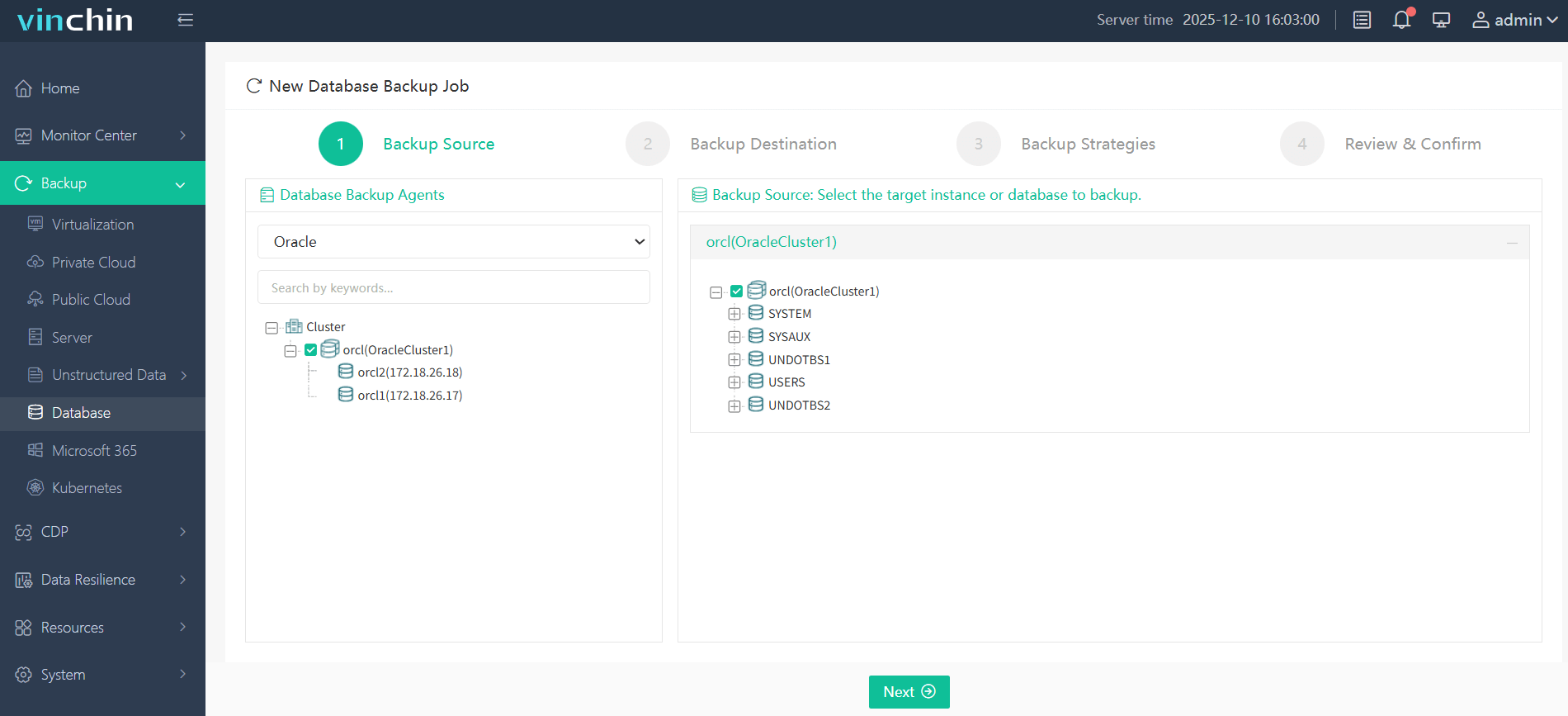
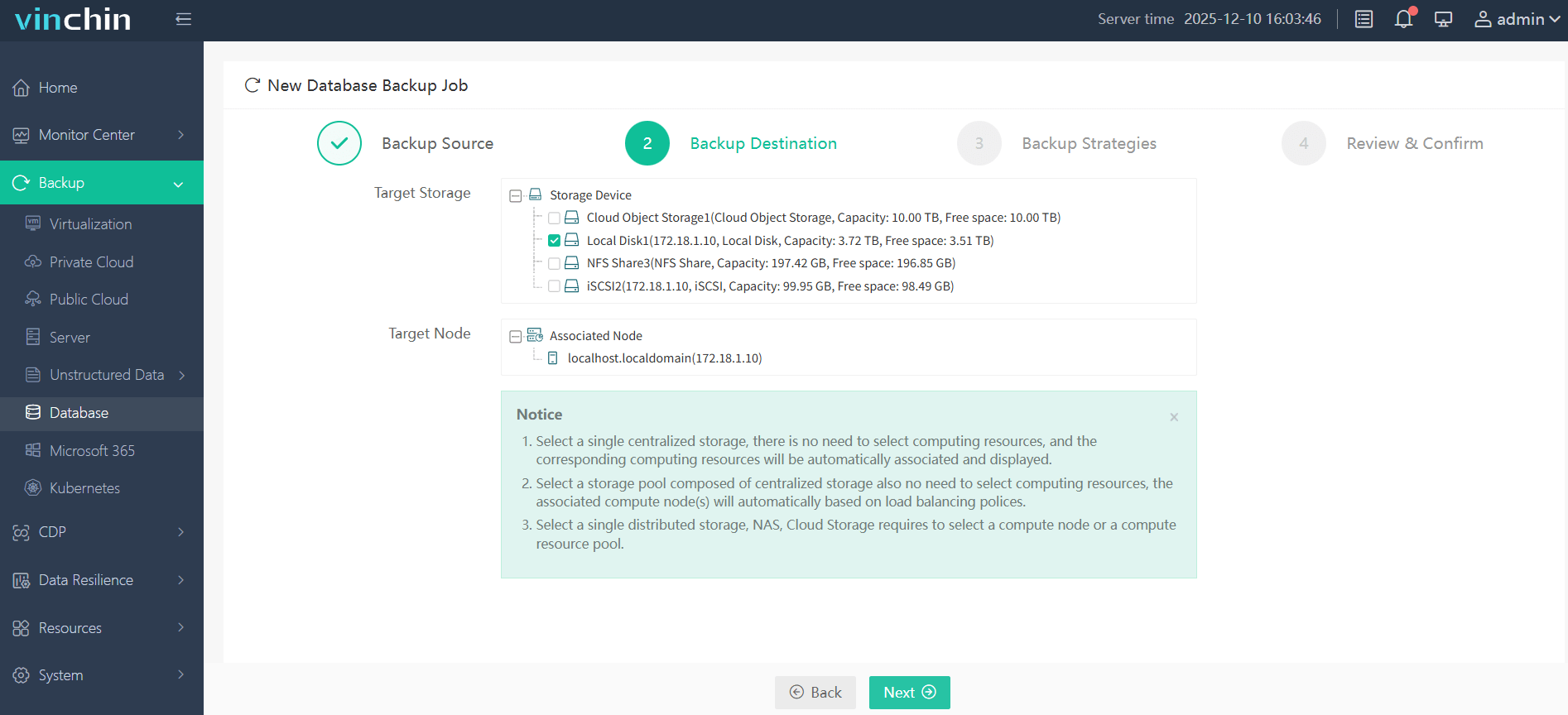
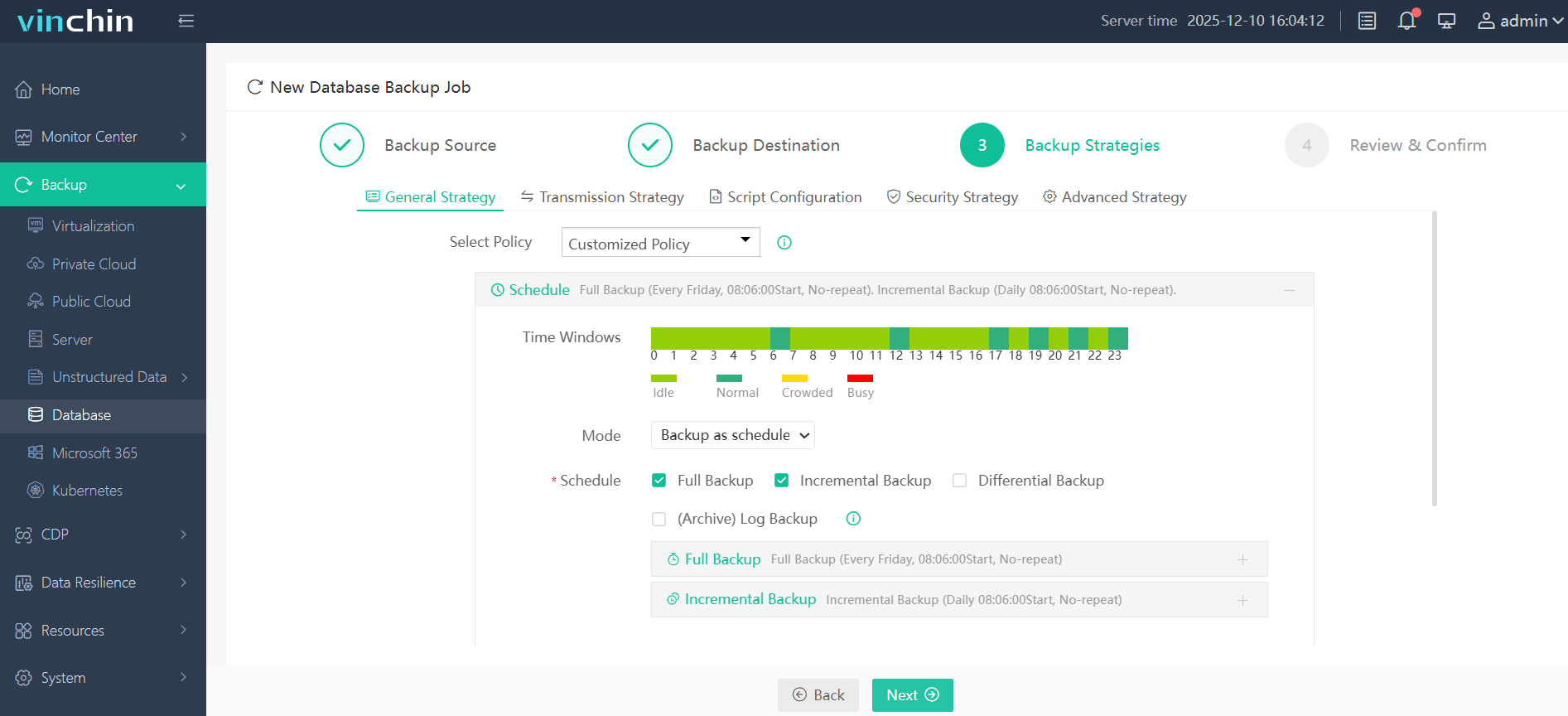
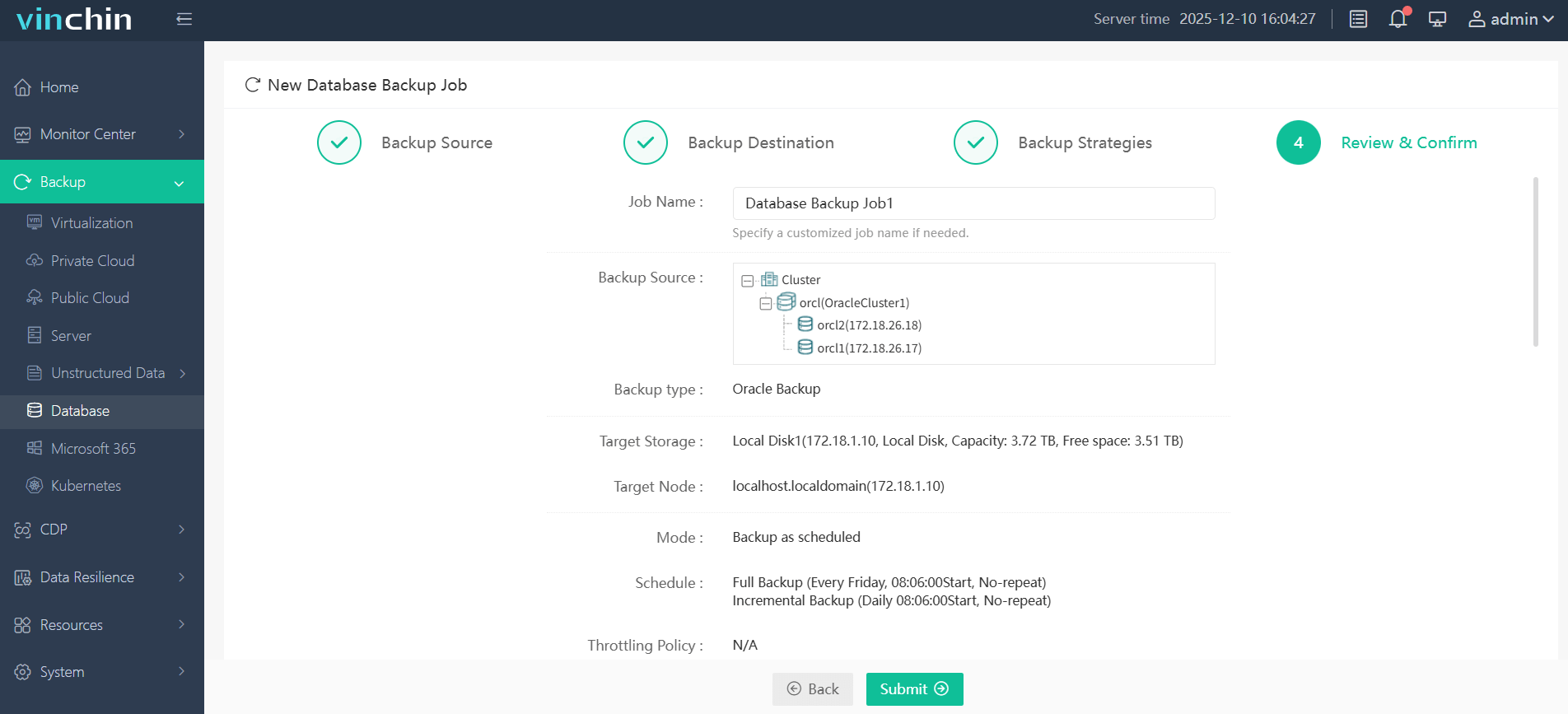
Vinchin Backup & Recovery offers an intuitive web console that streamlines the entire process into four straightforward steps:
Step 1. Select the Oracle database to back up
Step 2. Choose the backup storage
Step 3. Define the backup strategy
Step 4. Submit the job
Recognized globally by thousands of organizations and rated highly among enterprise users,Vinchin Backup & Recovery delivers trusted protection—try its full-featured free trial for sixty days by clicking the download button below.
Restore 12C RMAN Backup To 19C FAQs
Q1: What should I do if my preupgrade check finds unsupported objects?
Remove or replace unsupported objects before proceeding with restore-and-upgrade; consult preupgrade.log output for specific recommendations.
Q2: How do I handle password files when migrating?
Recreate password files manually on target server using ORAPWD utility since they are not included in standard RMAN backups.
Q3: What role do DB_FILE_NAME_CONVERT / LOG_FILE_NAME_CONVERT parameters play?
They automate renaming/mapping old file paths into new ones during duplicate/manual restores reducing need for individual SET NEWNAME commands.
Conclusion
Restoring a twelve c rman backup into nineteen c lets organizations modernize infrastructure while preserving valuable business history.Whether choosing automated duplicate workflows or detailed manual processes careful planning plus robust verified backups remain essential pillars.Vinchin makes protecting upgrading oracle databases easier than ever—try their free trial today!