Every Oracle database administrator knows that a backup is only as good as its ability to restore. But how can you be sure your RMAN backup pieces are valid and restorable—before disaster strikes? This is where the oracle rman validate backup piece process comes in. In this article, we’ll break down what validation means, why it matters, and how you can use RMAN commands to check your Oracle backups step by step.
What Is Oracle RMAN Validate Backup Piece?
The RMAN VALIDATE BACKUP PIECE command is a tool that checks the integrity of your Oracle backup sets and backup pieces. When you run a validation, RMAN reads every block in the specified backup piece to confirm it is free from corruption and can be restored if needed. This process does not actually restore any data or change your database; it simply verifies that your backup files are usable. According to Oracle’s official documentation, this is a proactive way to ensure your backups are reliable.
Validation works at several levels: you can check an entire database, specific tablespaces or datafiles, or individual backup sets or pieces. By default, RMAN checks for physical corruption—such as unreadable blocks—but you can also instruct it to check for logical corruption (like invalid row structures) using an extra option.
Why Validate Backup Pieces in Oracle RMAN?
Validating backup pieces is a critical part of any Oracle backup strategy. Even if your backup jobs complete without errors, hardware issues, storage failures, or silent corruption can still affect your backup files. By validating regularly, you catch problems early—before you need to restore.
RMAN validation checks for both physical corruption by default (damaged blocks) and logical corruption if you specify CHECK LOGICAL (data structure errors). This means you can trust that your backup pieces are not only present but also intact and restorable when disaster strikes.
Would you want to discover a corrupt backup only during a real recovery? Of course not! Regular validation gives confidence that restores will succeed when needed.
How to Validate Backup Piece Using RMAN Commands?
Before starting validation tasks with RMAN, remember: these operations do not write data—they only read from disk or tape—and they are input/output intensive since every block must be checked. It’s best practice to schedule validations during maintenance windows or periods of low activity.
You may work with either catalog mode (using a recovery catalog database) or nocatalog mode (using control file metadata). The commands below work in both modes; however, using a catalog helps keep long-term history for audits.
To validate specific backups efficiently:
1. Start RMAN and connect to your target database
2. Identify the correct backup set key or piece handle
LIST BACKUP OF DATABASE COMPLETED AFTER 'SYSDATE-7';
Review output columns like BS Key (Backup Set Key), Type, Completion Time, and Piece Name (full path)
Example output:
     BS Key  Type LV Size       Device Type Elapsed Time Completion Time
     ------- ---- -- ---------- ----------- ------------ ---------------
     218     Full    5G         DISK        00:02:30     15-JUN-24
         BP Key: 219 Status: AVAILABLE Compressed: NO Tag: TAG20240615T020000
         Piece Name: /u01/app/oracle/backup/db_full_218_1.bkp
3. Run the VALIDATE command
VALIDATE BACKUPSET 218;
To validate by piece handle:
VALIDATE BACKUPPIECE '/u01/app/oracle/backup/db_full_218_1.bkp';
Replace paths with actual locations from the listing above
4. Validate other objects as needed
VALIDATE DATABASE;
Specific tablespace:
VALIDATE TABLESPACE users;
5. Check for logical corruption too
VALIDATE BACKUPSET 218 CHECK LOGICAL;
After running these commands, review the summary output carefully—look for lines showing “Status: OK” next to each file validated.
Keep in mind that large validations may impact storage performance due to heavy reads; plan accordingly if working in production environments.
Interpreting Validation Output and Handling Corruption
Once validation completes, understanding its results is crucial—especially if something goes wrong.
If all files show “Status: OK,” then no issues were found at either the physical or logical level (if checked). However, if there’s trouble detected:
Details about corrupted blocks get recorded in the dynamic view V$DATABASE_BLOCK_CORRUPTION. You should query this view after any failed validation:
SELECT * FROM V$DATABASE_BLOCK_CORRUPTION;
What should you do if corruption appears?
1. Isolate which file(s) or block(s) have problems based on output.
2. Check operating system logs around the time those backups were created—look for disk errors.
3. Immediately create new full backups of affected datafiles/tablespaces.
4. Test restoring older validated backups using:
RESTORE DATAFILE <n> VALIDATE;
This ensures there’s still at least one recoverable copy available.
5. If possible—and especially before deleting old backups—run RESTORE DATABASE VALIDATE; periodically so you know all required files exist for full recovery scenarios.
6. Document findings so future audits show due diligence was performed.
Remember that regular monitoring of both successful validations (“Status: OK”) and error logs helps prevent surprises during real disasters!
Advanced Validation Scenarios
For larger environments—or when compliance requires strict audit trails—you might need more than basic manual checks:
Use scripts that dynamically select recent completed backups rather than hard-coded keys.
Integrate validation steps into nightly job flows so every fresh Level 0 incremental gets checked automatically.
Store detailed logs from each run; parse them afterward looking for keywords like “error” or “corrupt.”
If using Recovery Catalog mode (CATALOG), take advantage of persistent history tracking—all validations get logged centrally over time.
Consider running periodic full-database validations weekly during scheduled downtime while checking smaller objects daily.
For cloud-based storage targets or tape libraries where access speed varies greatly compared with local disk storage—test restores regularly using RESTORE ... VALIDATE instead of just validating static files alone.
These approaches help ensure compliance standards are met while minimizing risk across complex infrastructures.
How to Automate Validation for Oracle Backups?
Manual validation is useful—but automating it ensures consistency across teams and reduces human error risk over time.
Here’s how experienced DBAs automate their oracle rman validate backup piece routines:
1. Write an RMAN script containing dynamic logic—for example,
    RUN {
      ALLOCATE CHANNEL c1 DEVICE TYPE DISK;
      # Find most recent full Level 0 set dynamically
      SQL 'ALTER SESSION SET NLS_DATE_FORMAT="YYYY-MM-DD HH24:MI:SS"';
      REPORT OBSOLETE;
      # Replace <key> with logic/script variable pointing at latest set
      VALIDATE BACKUPSET <key>;
      RELEASE CHANNEL c1;
    }
2. Save this script as validate_backup.rman.
3. Schedule execution via cron on Linux systems:
0 2 * * * /u01/app/oracle/product/19c/dbhome_1/bin/rman target / @/path/to/validate_backup.rman > /path/to/logs/validate_backup_$(date +\%F).log 2>&1
4. After each run—or within another script—scan log files automatically:
grep -i "error\|corrupt" /path/to/logs/validate_backup_$(date +%F).log | mailx -s "RMAN Validation Alert" dba_team@example.com
5. Adjust frequency based on environment size/resource constraints—a common pattern is daily incremental validations plus weekly full-database checks during maintenance windows only.
6. If using job schedulers like Enterprise Manager Grid Control instead of cron jobs—the same principles apply but configuration happens through web UI menus such as “Create Job,” “Schedule,” etc., selecting appropriate scripts/actions per policy requirements.
Automated alerts mean no failed check slips through unnoticed—even overnight!
Introducing Vinchin Backup & Recovery – Enterprise Database Protection Made Simple
Beyond native tools like RMAN validation, organizations often require comprehensive solutions tailored for enterprise-scale protection and streamlined management workflows across multiple platforms—including Oracle 10g, 11g/11g R2, 12c, 18c, 19c, 21c, Oracle RAC, MySQL, SQL Server, MariaDB, PostgreSQL, PostgresPro, and TiDB.
Vinchin Backup & Recovery delivers advanced features such as batch database backup operations, granular data retention policies including GFS retention schemes, cloud/tape archiving integration options for offsite safety assurance, WORM protection against accidental deletion/modification threats—even under ransomware attacks—and automated integrity verification via SQL scripts ensuring true recoverability before disaster strikes—all designed around operational efficiency and regulatory compliance needs typical in modern IT landscapes.
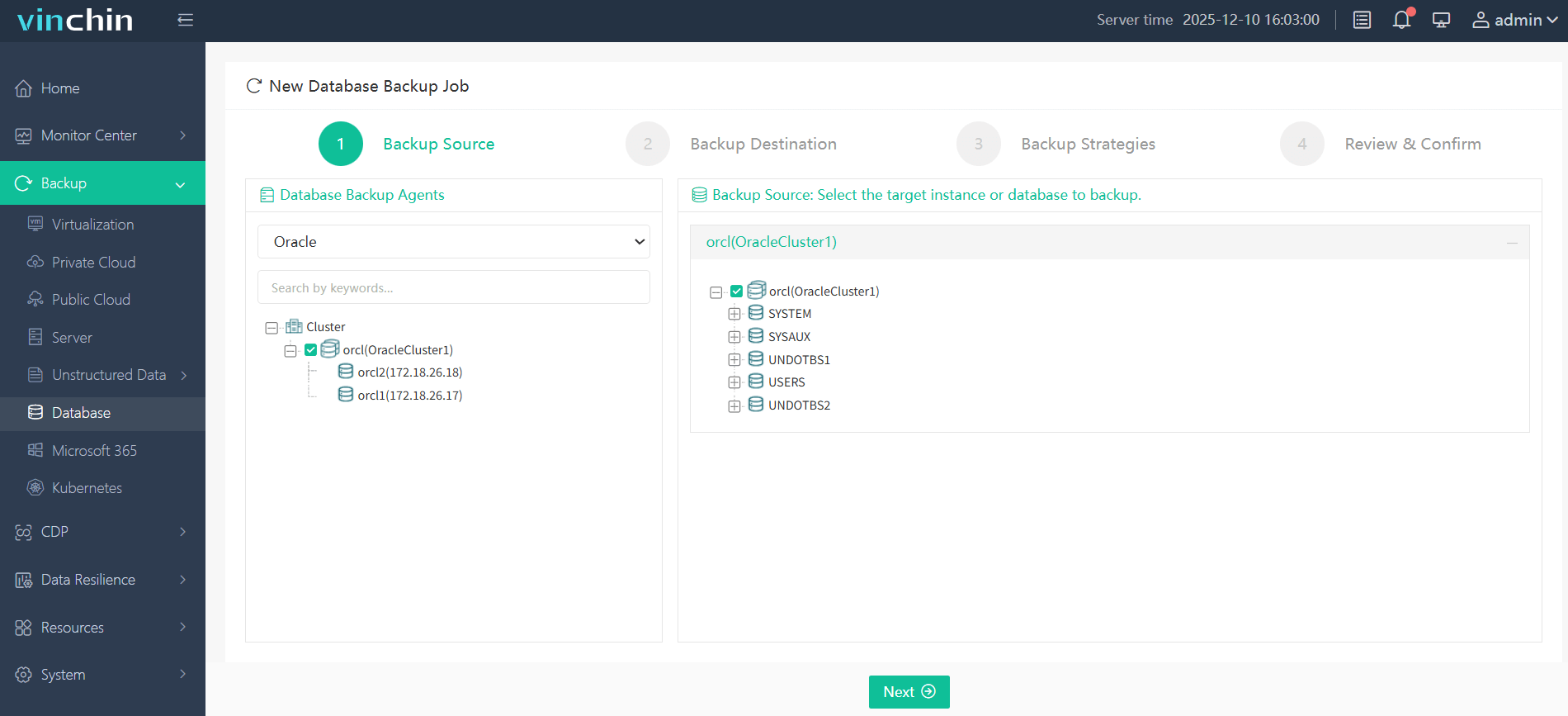
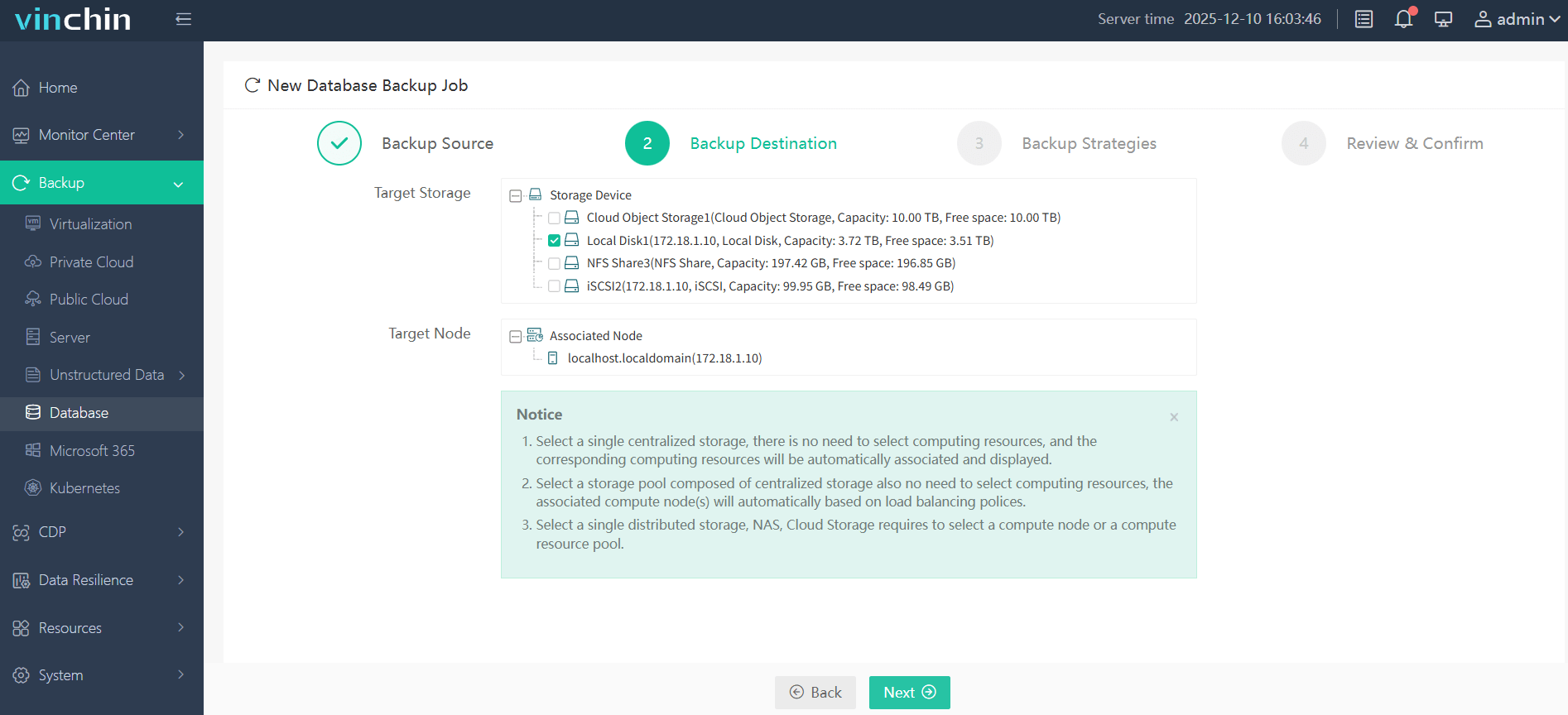
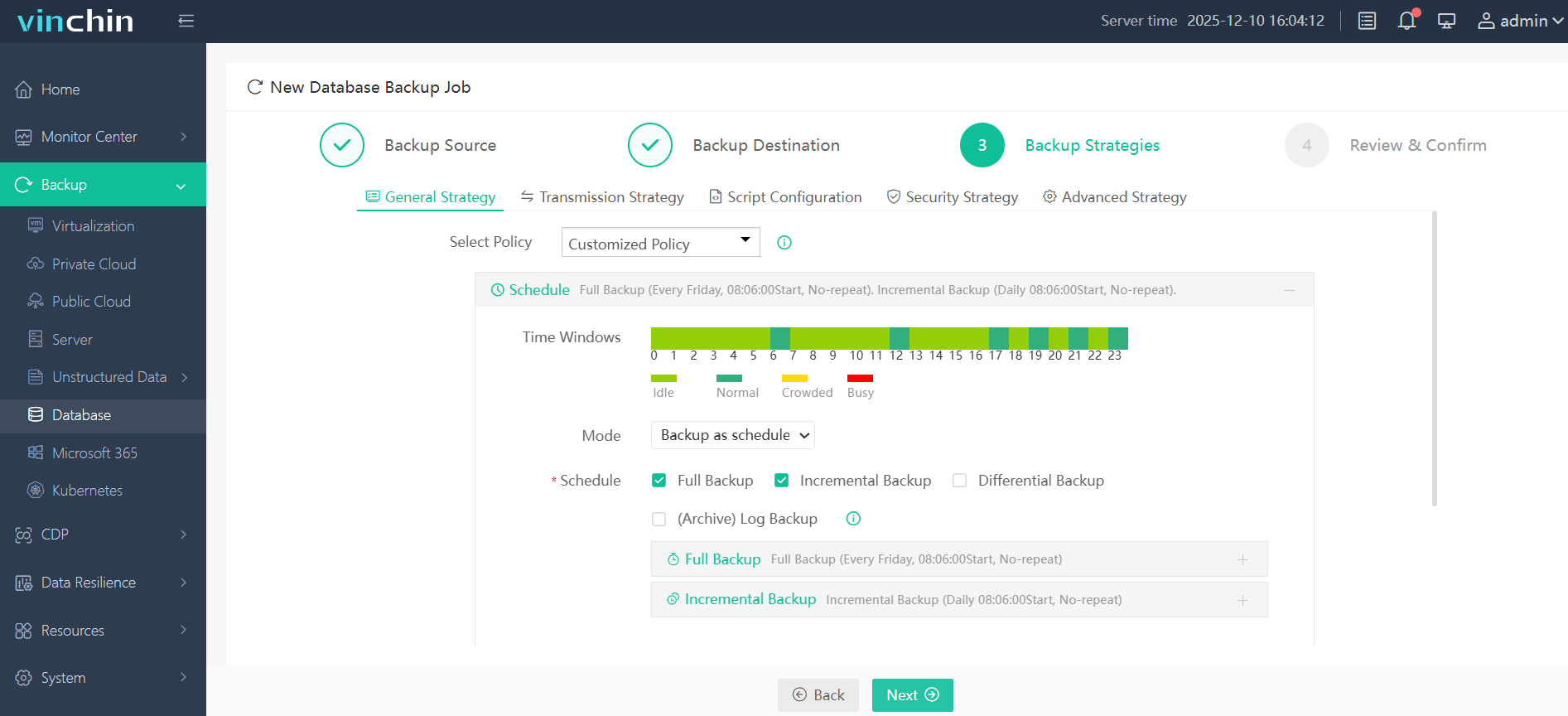
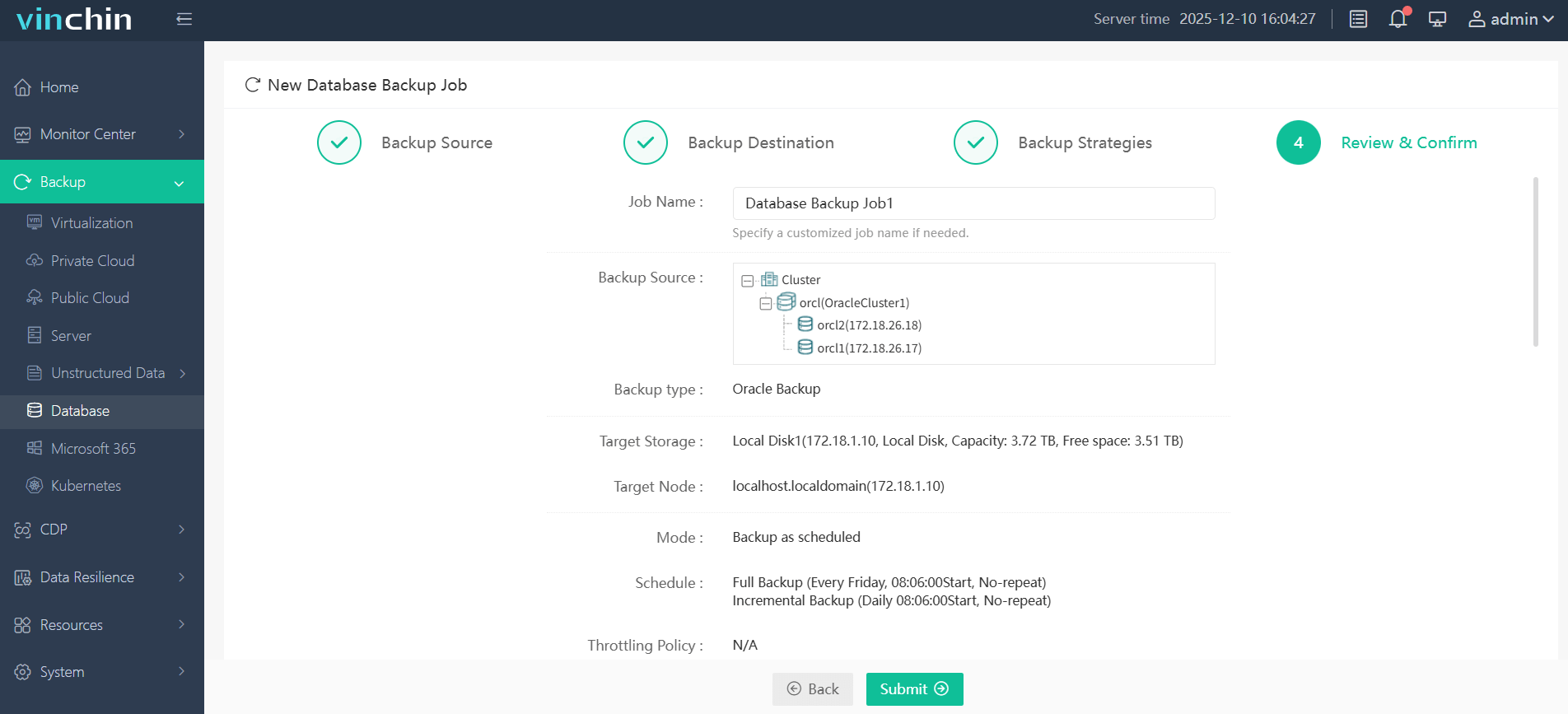
The intuitive web console makes safeguarding Oracle databases straightforward through four guided steps:
Step 1. Select the Oracle database to backup
Step 2. Choose target storage
Step 3. Define scheduling/policy parameters
Step 4. Submit the job
Recognized globally among leading enterprises—with top customer ratings—you can experience every feature free for 60 days by clicking download below and see firsthand why Vinchin Backup & Recovery stands out among enterprise data-protection solutions worldwide.
Oracle RMAN Validate Backup Piece FAQs
Q1: Can I validate multiple recent backups at once?
Yes; use LIST BACKUP SUMMARY then run separate VALIDATE commands on each relevant BACKUPSET key shown there.
Q2: Will validating large backups slow down my production system?
Validation uses significant disk I/O resources; schedule these jobs outside peak hours whenever possible.
Q3: How do I receive alerts when automated validations fail?
Redirect log output from scheduled scripts then scan logs after completion; send email notifications if keywords like "error" appear.
Conclusion
Validating your Oracle RMAN backup pieces keeps your recovery plans solid even under stress.Testing both physical integrityandlogicalconsistencyisbestpractice.Automatecheckswherepossibletoavoidgaps.VinchinmakesOracledatabaseprotectioneveneasierwithadvancedfeaturesandintuitiveworkflows.Tryitfreetodaytoprotectyourcriticaldatawithconfidence .