Keeping your Oracle database healthy is a top priority for any operations administrator. But how can you be sure your data is safe from corruption or missing files? Relying only on backups without checking their integrity leaves your business exposed. Oracle Recovery Manager (RMAN) offers a powerful way to check both your live database and backup files—without risking production data or causing downtime. In this article, we’ll explore what the oracle rman validate database command does, why it matters so much in real-world environments, and how you can use it step by step—from basic checks to advanced scenarios.
What is oracle rman validate database?
The oracle rman validate database command is a built-in feature of Oracle RMAN designed to check the health of your entire Oracle environment. It scans all data files for physical and logical corruption, verifies that no files are missing, and ensures that backups are restorable when needed. When you run this command, RMAN reads every block in each data file as well as control files and the server parameter file (SPFILE)—but only if SPFILE is currently in use. If your instance uses a static PFILE instead of an SPFILE at startup, that file will not be validated.
After running validation commands, results appear directly in the RMAN output window as well as in the V$DATABASE_BLOCK_CORRUPTION view within Oracle itself. This makes it easy for administrators to track down issues quickly before they become critical problems.
Why use oracle rman validate database?
Validating your Oracle environment with oracle rman validate database isn’t just good practice—it’s essential for disaster recovery planning and daily operations alike. Data corruption can happen at any time due to hardware failures like disk errors or controller faults; software bugs; power outages; or even silent bit rot over time.
If you wait until a restore operation fails during an emergency to discover these issues, it may already be too late to recover lost information or avoid extended downtime. By running oracle rman validate database regularly:
You detect corrupt blocks early—before they cause data loss.
You confirm all required files are present and readable.
You ensure backups are usable when restores are needed.
You reduce risk by catching problems before they escalate.
Wouldn’t you rather find out about hidden risks now than during a crisis? Regular validation gives peace of mind while supporting compliance requirements many organizations face today.
How to validate an Oracle database using RMAN basic command?
Before starting any validation task with RMAN, make sure your target database is either open or mounted (not shut down). You need access privileges such as SYSDBA or SYSBACKUP, along with access to the RMAN command line interface.
The simplest way to check every part of your active Oracle environment is:
RMAN> VALIDATE DATABASE;
This single command instructs RMAN to read every block from all data files currently attached to the instance—including control files and SPFILE if one was used at startup—and report any corruptions found along the way. Each file’s status appears in output: “OK” means no corruption detected; “FAILED” signals issues needing attention.
For more targeted checks—such as after replacing hardware or restoring specific tablespaces—you might want only certain areas validated:
RMAN> VALIDATE DATAFILE 4;
RMAN> VALIDATE TABLESPACE users;
These commands focus on individual datafiles or tablespaces without affecting other parts of the system. No changes occur during validation: all actions are read-only so there’s no risk of accidental modification or downtime.
You can always review results later by querying:
SELECT * FROM V$DATABASE_BLOCK_CORRUPTION;
This view lists details about any corrupt blocks discovered during recent validations—helpful for tracking trends over time or confirming repairs have worked.
How to perform advanced validation in Oracle RMAN?
Sometimes basic checks aren’t enough—especially in large-scale environments where performance matters or where logical consistency must be guaranteed alongside physical health checks.
Checking for Logical Corruption
By default, VALIDATE DATABASE looks only for physical corruption (bad sectors on disk). To include logical errors—such as inconsistent row pieces inside tables—you should add CHECK LOGICAL:
RMAN> VALIDATE CHECK LOGICAL DATABASE;
Logical checks dig deeper but require more CPU resources since each block’s contents must be interpreted according to table structures rather than just checked at binary level.
Speeding Up Validation with Parallelism
Large databases can take hours—or even days—to scan fully if processed serially through one channel. To accelerate this process safely without impacting production workloads too much:
1. Allocate multiple channels using separate device types (usually DISK).
2. Run parallel validations across those channels simultaneously:
   RUN {
     ALLOCATE CHANNEL ch1 DEVICE TYPE DISK;
     ALLOCATE CHANNEL ch2 DEVICE TYPE DISK;
     VALIDATE DATABASE;
   }
Each channel processes different sets of files concurrently so overall runtime drops significantly compared with single-threaded scans—a major benefit when validating multi-terabyte systems overnight or during maintenance windows.
Alternatively, if focusing on very large individual datafiles that support section-based processing (for example SAN-attached storage):
RUN {
  ALLOCATE CHANNEL c1 DEVICE TYPE DISK;
  ALLOCATE CHANNEL c2 DEVICE TYPE DISK;
  VALIDATE DATAFILE 1 SECTION SIZE 1200M;
}
Here each channel works on different sections within one big file at once—a useful trick when dealing with huge warehouse tablespaces split across multiple disks.
What Should You Do If Corruption Is Found?
Finding corruption doesn’t mean disaster—but ignoring it might! Here’s what most administrators do next:
1. Query V$DATABASE_BLOCK_CORRUPTION right away using:
SELECT * FROM V$DATABASE_BLOCK_CORRUPTION;
2. For physical corruption reported inside normal tablespaces/datafiles:
RMAN> RECOVER DATAFILE <file_number>;
After repair rerun validation again until status returns “OK”.
3. For logical corruption flagged via CHECK LOGICAL option:
Investigate affected objects further using DBMS_REPAIR package.
Sometimes export/import cycles may help recover clean versions depending on severity/type involved.
Always analyze root causes before resuming normal service!
4. If entire file shows FAILED status rather than isolated block-level errors:
Prompt response keeps small glitches from growing into major outages later!
Vinchin Backup & Recovery: Enterprise-Level Protection for Your Oracle Database
Beyond manual methods like RMAN validation, organizations seeking streamlined protection should consider automated solutions tailored specifically for enterprise needs. Vinchin Backup & Recovery delivers professional-grade backup capabilities supporting leading platforms including Oracle, MySQL, SQL Server, MariaDB, PostgreSQL, PostgresPro, and TiDB—with robust features designed around modern operational demands.
With Vinchin Backup & Recovery safeguarding your Oracle environment, key features such as incremental backup support, log backup/archived log management, any-point-in-time recovery options, storage protection against ransomware threats, and comprehensive integrity checking work together seamlessly to maximize reliability while minimizing administrative overhead—all through efficient automation and centralized policy controls.
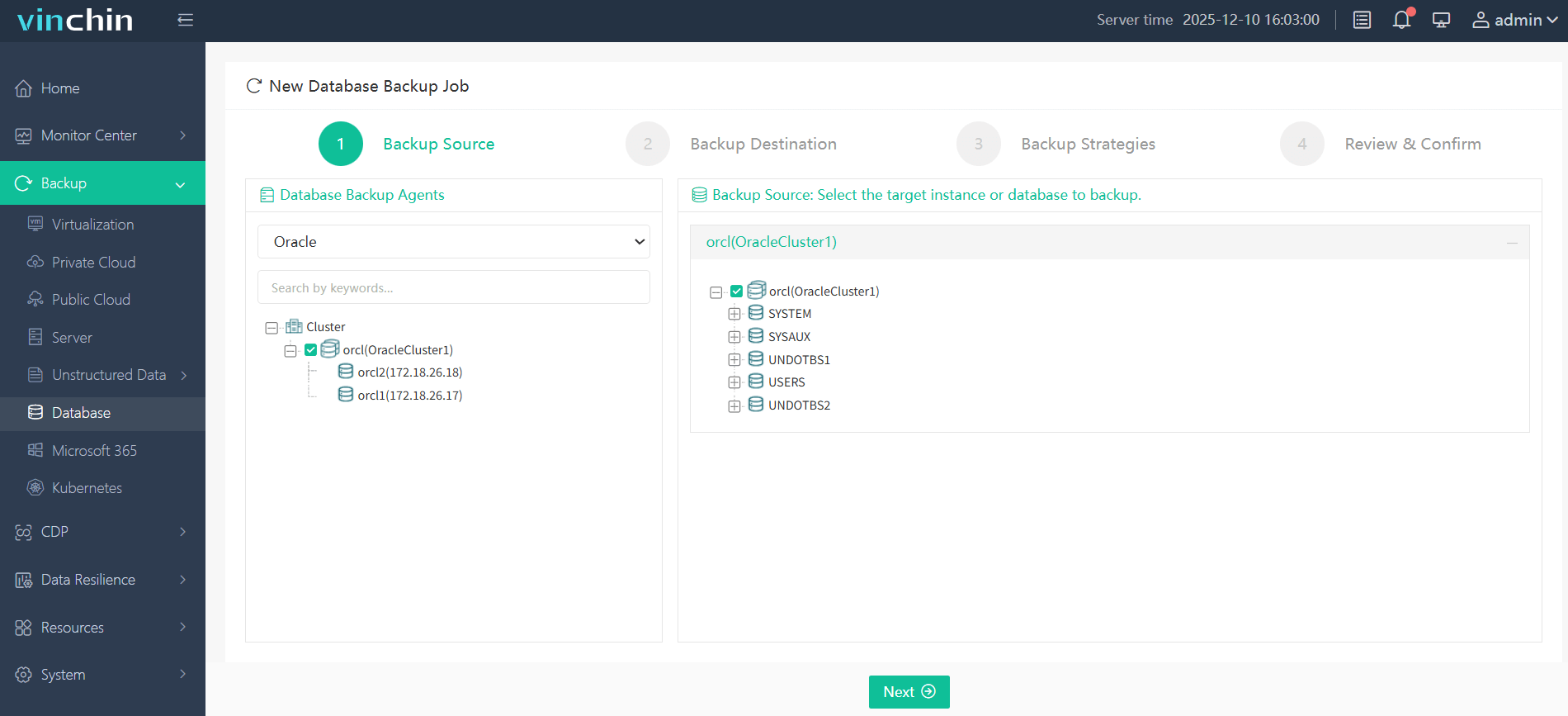
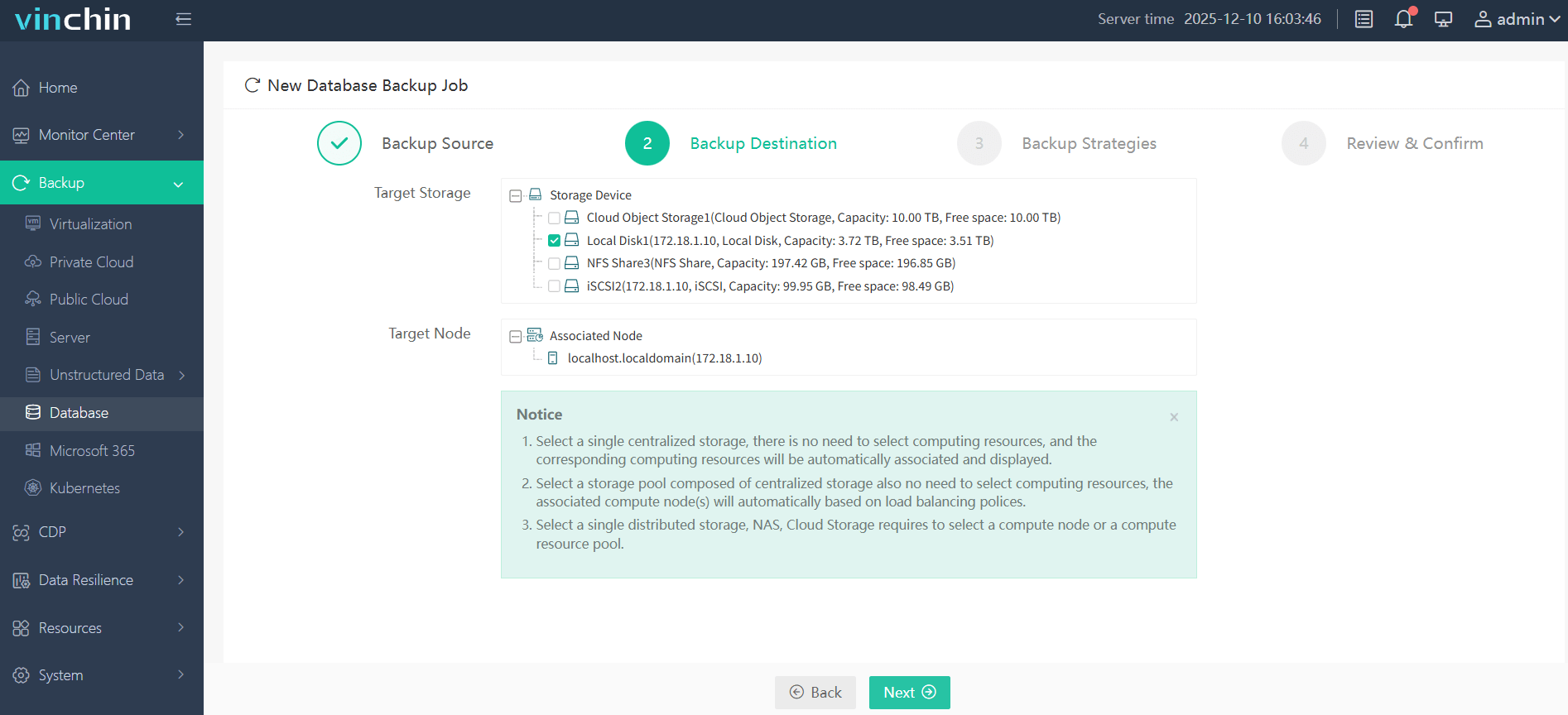
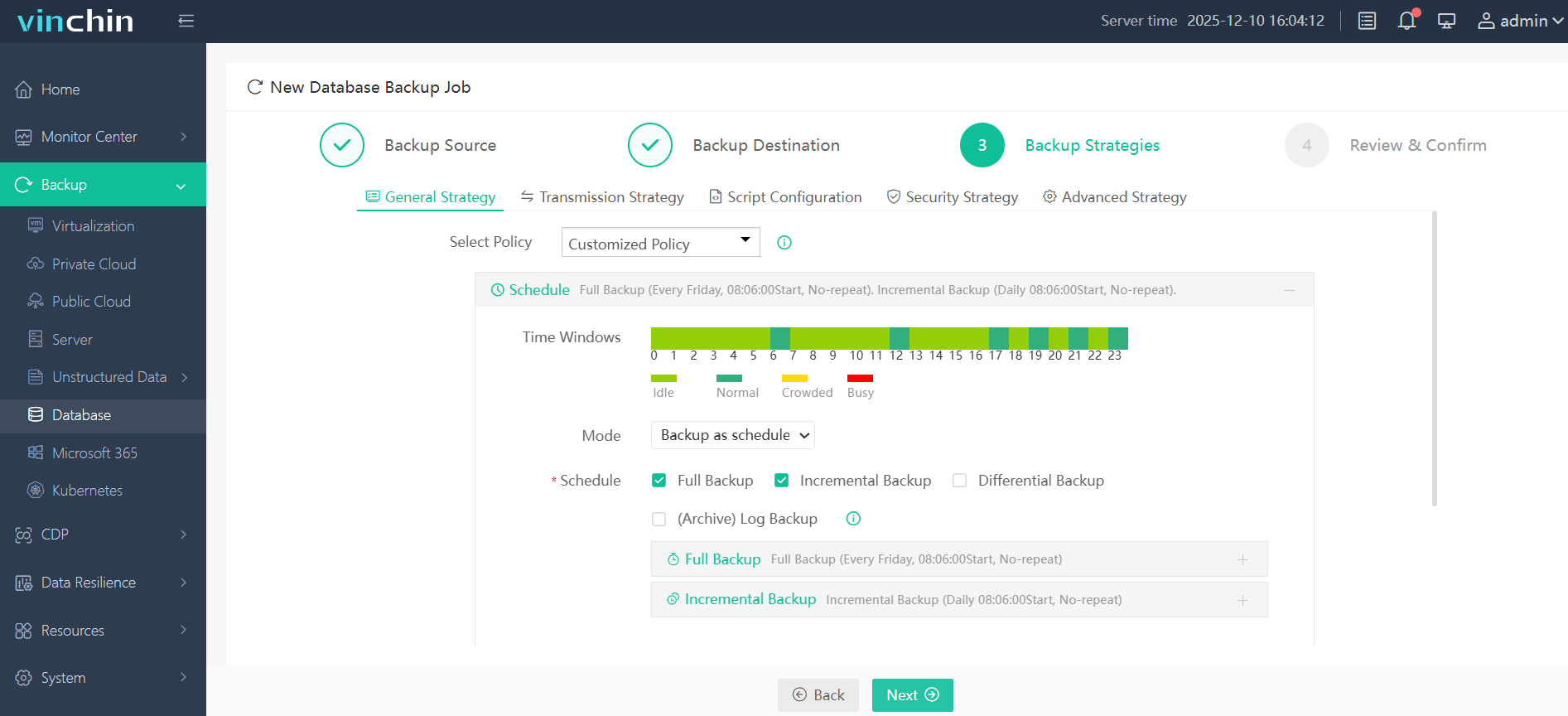
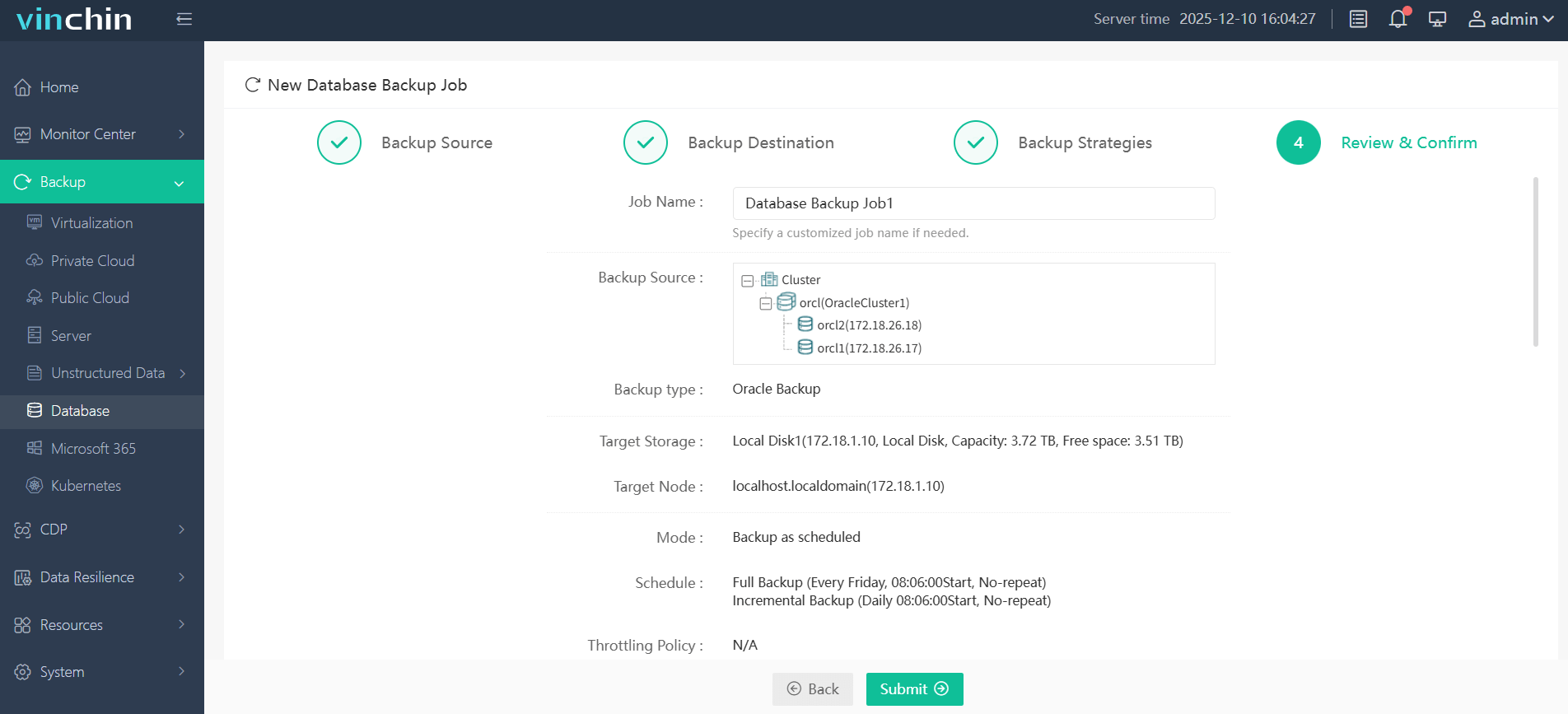
The intuitive web console makes protecting an Oracle database straightforward:
Step 1. Select the Oracle database to back up
Step 2. Choose the backup storage
Step 3. Define the backup strategy
Step 4. Submit the job
Recognized globally among enterprise users for its reliability and strong customer satisfaction ratings,Vinchin Backup & Recovery offers a fully featured free trial valid for 60 days—click below to experience industry-leading protection firsthand!
oracle rman validate database FAQs
Q1: Can I schedule automatic periodic validations using scripts?
Yes; create shell scripts calling RMAN commands via cron jobs or Windows Task Scheduler based on desired frequency.
Q2: Does validating backups require taking my production system offline?
No; validating backups uses existing copies without affecting live databases’ availability or performance directly.
Q3: What should I do if my archive log validation fails?
Check archive log locations’ accessibility then re-run VALIDATE ARCHIVELOG ALL after resolving path/storage issues.
Conclusion
Regularly using oracle rman validate database helps catch hidden risks before they threaten business continuity while supporting compliance goals easily over time—for complete automation plus seamless management consider adding Vinchin solutions alongside manual best practices today!