Restoring an Oracle database to a different server is a frequent task for operations administrators. You may need this process when migrating to new hardware, setting up test environments, or recovering from disasters. Each scenario requires a reliable method that ensures your data moves safely and efficiently.
Oracle Recovery Manager (RMAN) is the standard tool used by professionals worldwide for these tasks. This guide explains how to perform an oracle rman restore database to different server using proven techniques suitable for both beginners and advanced users.
There are two primary approaches: using RMAN’s active duplication when the source is online or restoring from backup sets if you only have backup files or the source is unavailable. Before you begin any restore operation across servers, remember that your target Oracle binary version must match or exceed the source version—restoring to an older version is not supported.
What Is RMAN in Oracle Database?
RMAN stands for Recovery Manager—a built-in utility included with every Oracle Database installation. It automates many complex tasks such as creating backups on disk or tape, restoring lost datafiles or control files, recovering from failures large or small—even entire site outages.
With RMAN you can perform full backups as well as incremental ones; it also manages archived log backups automatically if configured correctly. Most importantly for migrations and disaster recovery projects: RMAN supports restoring databases onto different servers regardless of hardware differences—as long as certain compatibility rules are followed.
Pre-Restore Validation and Checklist
Before starting any cross-server restore project with RMAN—or any other tool—it's critical to validate your environment thoroughly.
First: verify backup integrity by running VALIDATE BACKUPSET <backupset_key> or VALIDATE DATAFILE <file#> commands within RMAN on your intended backup pieces. This step confirms there’s no corruption in your backups before you rely on them.
Next: check compatibility between source and target systems:
Ensure both servers use compatible operating system bitness (for example 64-bit).
Confirm endian format matches unless you plan a cross-platform migration—which requires additional steps like converting datafiles using RMAN CONVERT.
Make sure patch levels are consistent enough so restored databases function properly after migration.
Document all important details from your source environment:
Record the DBID (select dbid from v$database), DB_UNIQUE_NAME (show parameter db_unique_name), character set (select value from nls_database_parameters where parameter='NLS_CHARACTERSET'), file locations, tablespaces layout—anything needed later during troubleshooting or validation.
Finally: review available disk space on target server; confirm all required directories exist; double-check network connectivity if using active duplication; ensure correct permissions on all transferred files so Oracle processes can read them without issue.
Preparing for Cross-Server Restore
Proper preparation makes any oracle rman restore database to different server smoother—and reduces risk of costly mistakes later on.
Start by confirming you have a complete set of valid RMAN backups from your source database—including all datafiles, control files (ideally autobackups), archived logs needed for point-in-time recovery if required—and note down their locations carefully.
You’ll need the DBID of your original database; this can be found either by connecting through RMAN (connect target /) or examining control file backup names which often include it (e.g., c-1234567890-date).
Transfer all necessary backup files securely to the target server:
Check file ownerships after transfer—Oracle must be able to read every piece!
On your destination machine:
Create required directories ahead of time—for datafiles/control/logs—to avoid permission errors mid-process
Copy over password file (orapwd) plus parameter file (PFILE/SPFILE) if possible; adjust paths inside PFILE/SPFILE so they reflect new directory structure
Lastly: confirm again that free disk space meets requirements based on size of original database plus room for growth during recovery process
Method 1. Using RMAN Duplicate for Oracle RMAN Restore Database to Different Server
The most efficient way to clone an entire Oracle database onto another server—when both systems are online—is with RMAN’s DUPLICATE command. This method automates much of what would otherwise be manual work.
Before starting: ensure network connectivity exists between both machines via Oracle Net Services; configure tnsnames entries appropriately so each instance can reach the other over TCP/IP ports used by listener processes
This approach requires both databases share identical DB_NAME values but allows unique DB_UNIQUE_NAME settings per site—a best practice in multi-site deployments
Here’s how you perform an oracle rman restore database to different server using active duplication:
1. Prepare auxiliary instance
On target host create minimal PFILE containing at least DB_NAME/DB_UNIQUE_NAME parameters
Example content:
   db_name=orcl
   db_unique_name=orcl_clone
2. Start auxiliary instance
Use SQL*Plus command line interface:
SQL> startup nomount pfile='/path/to/initorcl_clone.ora';
3. Connect with RMAN
On target run:
rman TARGET sys@source_db AUXILIARY sys@aux_db
4. Run DUPLICATE command
Issue following inside connected session:
DUPLICATE TARGET DATABASE TO aux_db FROM ACTIVE DATABASE NOFILENAMECHECK;
Add UNTIL TIME 'SYSDATE-1' or UNTIL SCN clauses if point-in-time recovery needed
Use SET NEWNAME FOR DATAFILE ... TO '/new/path/file.dbf'; statements if directory structures differ between servers
The NOFILENAMEHECK clause lets you bypass filename conflicts when duplicating same-named databases onto separate hosts—a common scenario during migrations
5. Open cloned database
After completion script opens new instance automatically with RESETLOGS option enabled
A word of caution: FROM ACTIVE DATABASE streams blocks directly over network—this places significant load on production sources especially during large transfers! For very large environments consider first creating physical backups then running duplicate-from-backup instead
This method works best when rapid provisioning/testing/cloning is required while minimizing manual intervention
Method 2. Using RMAN Backup Sets for Oracle RMAN Restore Database to Different Server
If direct connection isn’t possible—or only offline copies/backups remain—you can manually rebuild everything using just those backup sets plus some careful scripting
This approach gives maximum flexibility but demands attention at each stage:
1. Set environment variables & start local instance
On destination export correct ORACLE_SID then launch local shell session:
    export ORACLE_SID=orcl_clone
    rman target /
2. Set DBID
If control file missing supply known value via:
set dbid 1234567890;
3. Startup NOMOUNT mode
Begin initialization process:
startup nomount;
4. Restore SPFILE/PFILE if needed
If parameter file absent recover it first:
restore spfile TO pfile '/path/to/initorcl_clone_restore_temporaily_used_by_rman' FROM AUTOBACKUP;
5. Edit PFILE
Adjust directory/file paths inside text editor so they match actual layout under new system
6–7 Restart & mount
Restart instance referencing updated PFILE then mount control structure:
      startup nomount pfile='/path/to/initorcl_clone_restore_temporaily_used_by_rman';
      restore controlfile FROM AUTOBACKUP;
      alter database mount;
8–9 Catalog external backup pieces
If location changed since original creation inform catalog subsystem accordingly:
catalog start with '/new/location/of/backups/';
10–11 Restore/recover datafiles
Map old-to-new paths explicitly where necessary using SET NEWNAME syntax within RUN block then execute RESTORE DATABASE followed by SWITCH DATAFILE ALL commands
Example snippet:
         RUN {
           SET NEWNAME FOR DATAFILE 1 TO '/u02/oradata/system01.dbf';
           ...
           RESTORE DATABASE;
           SWITCH DATAFILE ALL;
}12 Open resetlogs
Finalize operation opening newly restored copy into production/test mode:
alter database open resetlogs;
This manual route supports disaster recovery even when original hardware/networking has failed completely—it also enables advanced scenarios like cross-platform restores provided endian conversion steps are handled separately beforehand.
Effortless Cross-Server Migration With Vinchin Backup & Recovery
For organizations seeking a streamlined alternative beyond native tools, Vinchin Backup & Recovery delivers professional enterprise-level protection tailored specifically for today’s mainstream databases—including robust support for Oracle environments alongside MySQL, SQL Server, MariaDB, PostgreSQL, PostgresPro, and TiDB platforms. Its broad compatibility makes it ideal whether you're managing homogeneous Oracle fleets or mixed-database infrastructures requiring unified oversight.
Vinchin Backup & Recovery empowers teams with features such as incremental backup, batch management across multiple instances, flexible retention policies including GFS scheduling, cloud/tape archiving options, and comprehensive integrity checks—all designed to maximize operational efficiency while ensuring business continuity at scale.
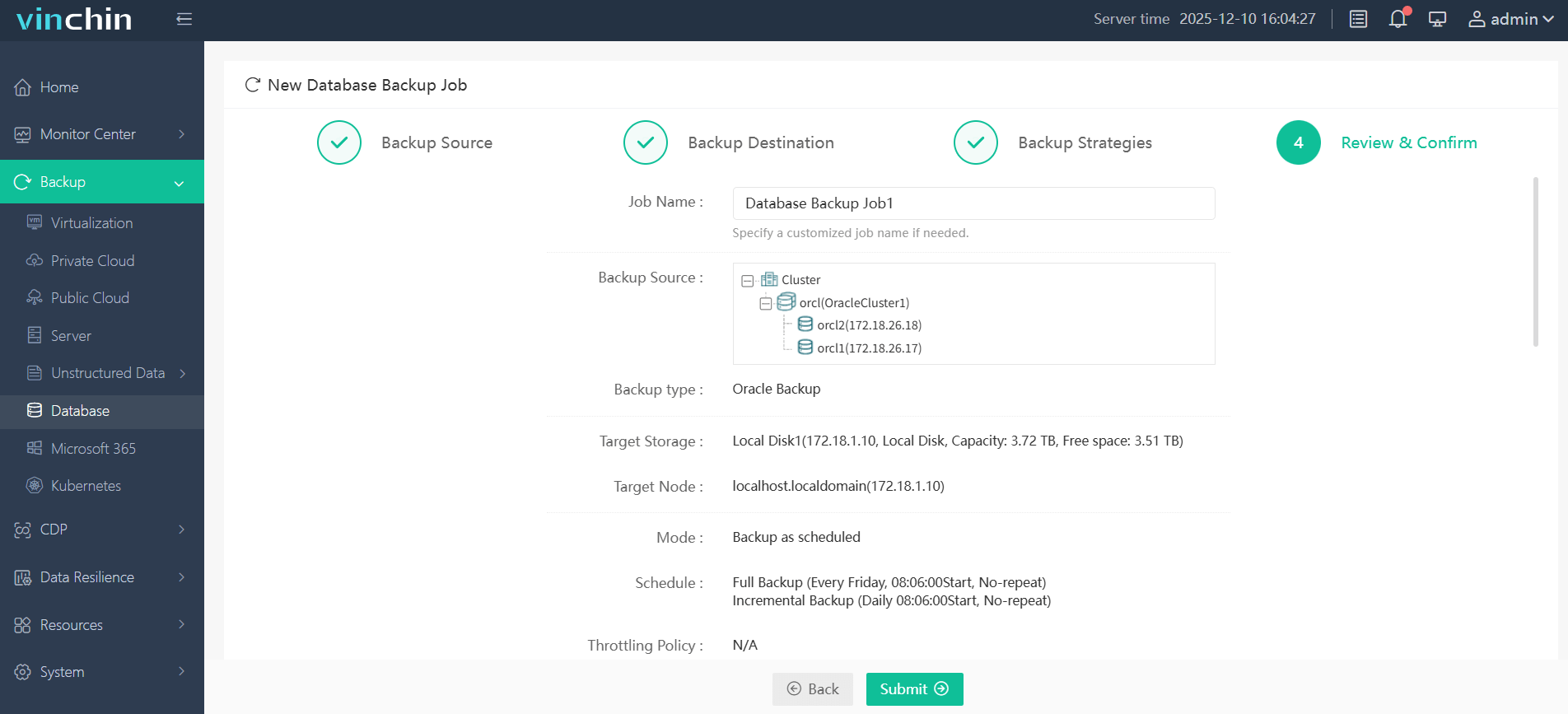
The intuitive web console simplifies every step of protecting your Oracle workloads
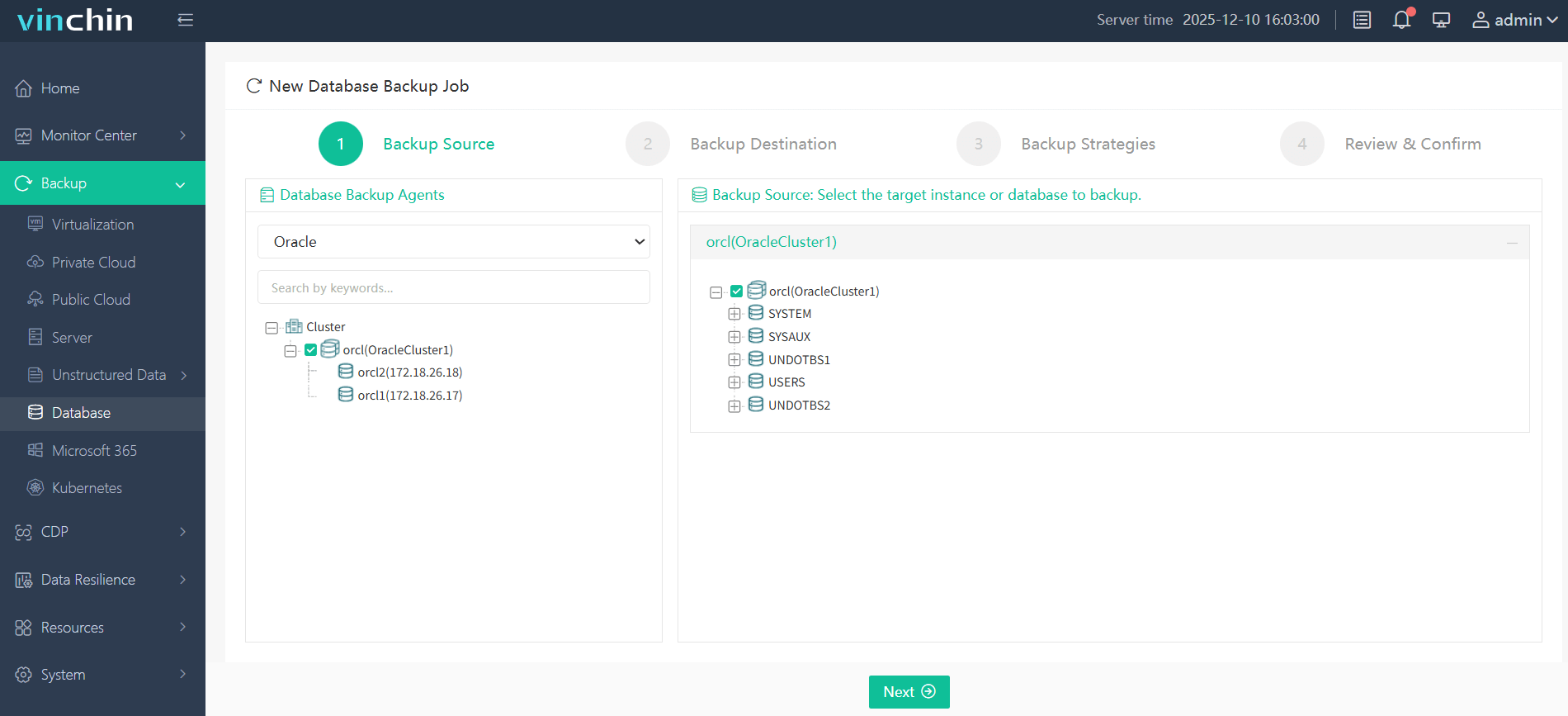
Step 1. Select the Oracle database to back up
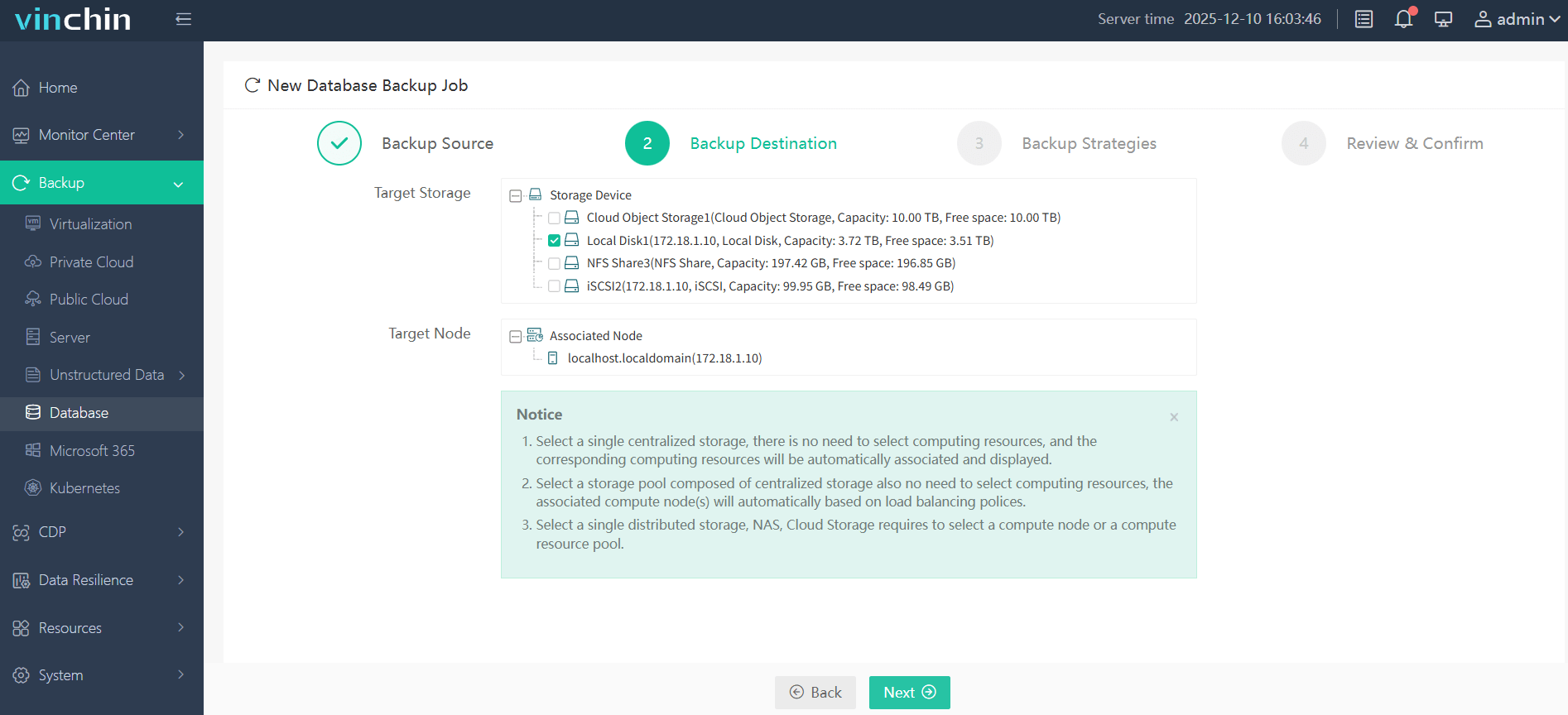
Step 2. Choose the backup storage
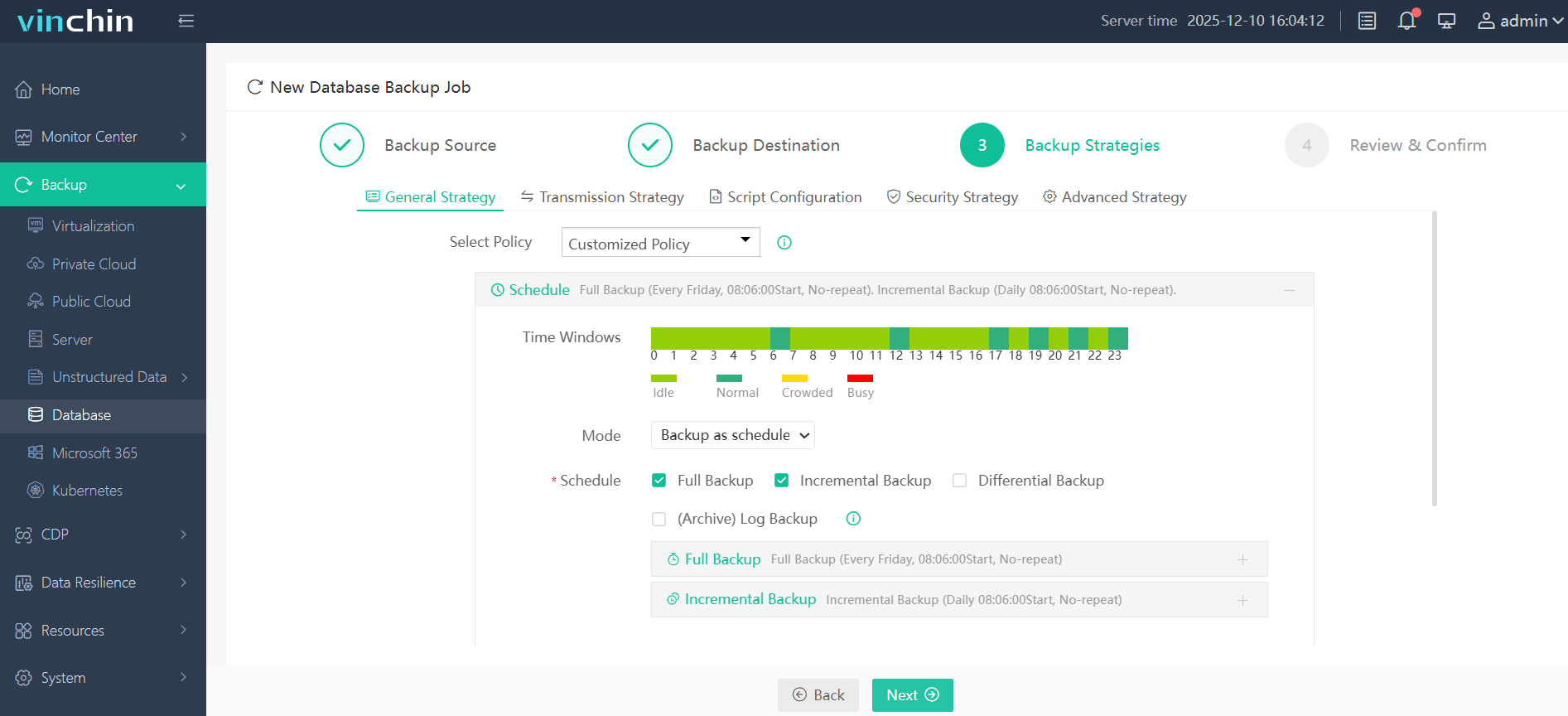
Step 3. Define the backup strategy
Step 4. Submit the job
Recognized globally among enterprise IT leaders—with thousands of satisfied customers and top industry ratings—Vinchin Backup & Recovery offers a fully featured 60-day free trial so you can experience its power firsthand before committing further investment.
Oracle RMAN Restore Database To Different Server FAQs
Q1: Can I map datafiles differently when restoring my Oracle database onto another host?
A1: Yes—with SET NEWNAME commands in your RUN block during RESTORE phase specify alternate locations per-file basis easily within standard scripts
Q2: Can I use this method across differing versions/platforms?
A2: Target must run same-or-higher binary release than source; after upgrade restores run post-upgrade scripts such as catupgrd.sql before returning system fully live
Q3: What does “ORA‑19870 error while restoring” mean?
A3: Usually indicates missing/corrupt/mis-permissioned backup pieces—verify OS-level access rights re-run VALIDATE commands fix issues before retrying operation
Conclusion
Restoring an Oracle database across servers with RMAN provides robust solutions whether cloning live systems or rebuilding from offline archives—even supporting complex migrations/disaster recoveries when planned carefully upfront Vinchin further streamlines these workflows through automation intuitive controls trusted globally