Are you preparing for an interview focused on Oracle RMAN? If you have years of experience as a database administrator, you know that interviewers expect more than just basic knowledge. They want to see your understanding of advanced RMAN concepts, troubleshooting skills, and best practices. In this article, we’ll cover the most common Oracle RMAN interview questions and answers for experienced professionals. We’ll also include scenario-based questions that test your practical skills.
What Is Oracle RMAN?
Oracle RMAN (Recovery Manager) is Oracle’s built-in tool for backup and recovery. It automates many tasks such as taking backups, restoring data, and recovering from failures. Because it is tightly integrated with the Oracle database engine, it is often chosen as part of enterprise backup strategies. RMAN supports full and incremental backups, point-in-time recovery, block-level corruption detection, backup validation, encryption options, and automated management of backup metadata—either in the control file or in a separate recovery catalog.
Key Concepts Deep Dive
Before tackling advanced interview questions about Oracle RMAN, let’s review some key concepts every experienced administrator should master.
RMAN works by connecting to three main components: the target database (the one being backed up), the RMAN client interface where commands are issued, and optionally a recovery catalog—a schema in another database that stores historical metadata about backups beyond what’s kept in control files. The Fast Recovery Area (FRA) is an important storage location managed by Oracle where backups, archived logs, flashback logs, and other recovery-related files are stored automatically.
Backups can be stored as backup sets (RMAN’s proprietary format supporting compression/encryption) or image copies (exact byte-for-byte copies). Incremental backups come in two types: differential (since last level 1 or 0) or cumulative (since last level 0). Block change tracking helps speed up incremental backups by recording changed blocks since the last backup.
Understanding these building blocks will help you answer both theoretical questions and solve real-world problems during interviews.
Advanced Oracle RMAN Interview Questions and Answers
When you’re an experienced administrator, interviewers will ask questions that go beyond basics. Let’s look at some advanced Oracle RMAN interview questions grouped by topic—with clear answers to help you prepare.
Backup Strategies & Configuration
Interviewers often focus on how well you understand different backup types and how they fit into business continuity plans.
Q1: What is the difference between a full backup and a level 0 incremental backup in RMAN?
A full backup copies all data blocks but cannot serve as a base for incremental backups. A level 0 incremental backup also copies all blocks but acts as the baseline for future level 1 incrementals. By default, BACKUP DATABASE creates a full backup; BACKUP INCREMENTAL LEVEL 0 DATABASE creates an incremental baseline.
Q2: How does RMAN incremental backup work? What are its types?
Incremental backups only copy blocks changed since a previous reference point. There are two types:
This approach reduces storage needs while ensuring recoverability.
Q3: Can you perform an RMAN backup when the database is down?
No—RMAN requires access to either MOUNT or OPEN state databases. For consistent whole-database online backups without ARCHIVELOG mode enabled, use MOUNT state after clean shutdown; otherwise use OPEN state if ARCHIVELOG mode is active. If completely down (“shutdown immediate” or crash), only OS-level cold backups are possible—not through RMAN itself.
Q4: How do you enable block change tracking? Why is it important?
Block change tracking speeds up incremental backups by recording which blocks have changed since your last run—so only those need scanning later. Enable it using:
ALTER DATABASE ENABLE BLOCK CHANGE TRACKING;
The tracking file location matters; placing it within FRA improves performance on large systems. You can check its status via V$BLOCK_CHANGE_TRACKING.
Q5: How do you configure retention policies in RMAN?
Retention policies define how long old backups are kept before deletion:
CONFIGURE RETENTION POLICY TO REDUNDANCY 2;
This keeps two complete sets of recent backups.
CONFIGURE RETENTION POLICY TO RECOVERY WINDOW OF 7 DAYS;
This keeps enough data to restore any time within seven days.
Recovery Operations & Troubleshooting
Restoring lost files quickly—and knowing which method fits each situation—is vital during interviews.
Q6: What is a snapshot control file? When does RMAN use it?
A snapshot control file is a read-consistent copy created temporarily at start of certain operations like resynchronizing catalogs or running complex jobs needing stable metadata views. Its default name (snapcf_<SID>.f) appears in $ORACLE_HOME/dbs unless configured elsewhere; it's deleted automatically after use so manual cleanup isn’t needed under normal circumstances.
Q7: How do you recover from losing your control file using RMAN?
First start your instance in NOMOUNT mode:
STARTUP NOMOUNT;
If autobackup uses non-default naming/location formats set them first with SET CONTROLFILE AUTOBACKUP FORMAT. Then restore:
RESTORE CONTROLFILE FROM AUTOBACKUP;
Mount your database next (ALTER DATABASE MOUNT;) then continue restoring/recovering datafiles as needed until fully operational again.
Q8: How do you perform point-in-time recovery (PITR) using RMAN?
Point-in-time recovery lets you roll back part or all of your database to an earlier moment—useful after accidental deletes/updates:
1. Use SET UNTIL TIME or SET UNTIL SCN before restore commands
2. Restore relevant files
3. Run RECOVER command
4. Open with RESETLOGS once done
Example:
RUN {
   SET UNTIL TIME '2024-06-01:12:00:00';
   RESTORE DATABASE;
   RECOVER DATABASE;
   ALTER DATABASE OPEN RESETLOGS;
}
Q9: How do you handle block corruption detected by RMAN?
Use targeted block-level repair rather than full restores whenever possible:
BLOCKRECOVER DATAFILE <file#> BLOCK <block#>;
This recovers only corrupted portions from available good backups—minimizing downtime.
Backup Mechanics & State Management
Understanding how different formats affect restores—and when each applies—is essential knowledge at senior levels.
Q10: What’s the difference between obsolete vs expired backups in RMAN?
Obsolete means no longer needed per retention policy but still present on disk; expired means missing from expected location due to manual deletion/move outside of proper channels—marked so after running CROSSCHECK commands.
Administration & Catalog Management
Managing catalogs efficiently shows mastery over larger environments with multiple databases/backups tracked centrally.
Q11: How do you check integrity of an existing backup set using VALIDATE command?
Run this inside your session:
VALIDATE BACKUPSET <backupset_number>;
It checks whether contents can be restored successfully without actually writing anything back out—a crucial step before deleting older sets!
Q12: How do you register/categorize externally created image copies into current catalog/controlfile metadata store?
Register them like this:
CATALOG DATAFILECOPY '/path/to/datafile';
Q13: Why use a separate Recovery Catalog instead of just relying on control files alone?
A Recovery Catalog preserves history even if local control files age out records due to space limits—it enables cross-database reporting/scripts across multiple targets plus easier disaster recovery planning.
Cloning & Duplication Techniques
Database cloning comes up often during upgrades/testing/disaster drills—knowing both theory AND syntax impresses hiring managers!
Q14: How do you clone/duplicate entire databases using active connections versus offline media sets via DUPLICATE command series?
You can duplicate directly from live source (“active”) OR from pre-existing physical/media-set based sources depending on bandwidth/storage constraints:
Active example—
DUPLICATE TARGET DATABASE TO newdb FROM ACTIVE DATABASE;
Offline example—
DUPLICATE TARGET DATABASE TO newdb BACKUP LOCATION '/backupdir';
Scenario-Based Oracle RMAN Interview Questions and Answers
Scenario-based questions test if candidates can apply their knowledge under pressure—or adapt when things go wrong unexpectedly! Here are several examples:
Datafile Loss Restoration Steps
Suppose one datafile goes missing but weekly fulls plus archive logs exist since then—what now?
First take affected tablespace/datafile offline (SQL "ALTER TABLESPACE users OFFLINE IMMEDIATE"), then restore/recover sequence follows:
1. Issue RESTORE DATAFILE <file#>;
2. Follow with RECOVER DATAFILE <file#>;
3. Bring online again via SQL "ALTER TABLESPACE users ONLINE";
This ensures minimal disruption while leveraging existing archives/backups efficiently.
Recovering Dropped Table Without Flashback Enabled
If flashback isn’t enabled yet someone drops critical table accidentally—you must perform Tablespace Point-In-Time Recovery (TSPITR):
1. Restore tablespace containing table into auxiliary instance using TSPITR workflow (RECOVER TABLESPACE ... UNTIL TIME ... AUXILIARY DESTINATION ...)
2. Export recovered table(s)
3. Import them back into production environment safely
For some cases consider TRANSPORT TABLESPACE feature combined with image copies/conversion tools if moving across platforms.
Handling New Datafiles During Ongoing Backups
What happens if someone adds new datafiles mid-backup job?
If backing up specific tablespaces including newly added ones—they’re included immediately; otherwise not captured until next scheduled run covering whole DB/tablespace explicitly.
Speeding Up Large Database Backups
Large environments require tuning! To optimize speed:
1. Configure parallelism via multiple channels (ALLOCATE CHANNEL)
2. Enable block change tracking early-on
3. Use compression judiciously based on CPU availability
4. Exclude rarely used tablespaces/files where appropriate
Regularly monitor throughput stats via dynamic views like V$BACKUP_SYNC_IO/V$BACKUP_ASYNC_IO.
Offloading Backups Using Standby Databases
Can standby databases be used for regular production offloads?
Yes—you may run most standard jobs against standby instances directly reducing load/stress on primaries while maintaining compliance/SLA targets.
Restoring After Losing Both Control File And Parameter File
Losing both config/control structures sounds scary—but here’s what works:
1.Create PFILE manually referencing correct paths/settings
2.Start instance NOMOUNT
3.Restore CONTROL FILE FROM AUTOBACKUP
4.Mount DB then proceed restoring/recovering remaining objects
Archive Log Destination Full – Immediate Actions Needed
When archive log destination fills up unexpectedly:
1.Delete/move oldest logs confirmed already backed-up elsewhere
2.Increase destination size if possible
3.Schedule frequent log archiving/cleanup jobs going forward
Cross-platform Database Migration With Endian Conversion
Moving between platforms requires endian conversion steps:
1.Backup AS COMPRESSED BACKUPSET FOR TRANSPORT clause usage recommended
2.CONVERT DATAFILES specifying source/target platform names/formats explicitly
3.Restore/recover normally post-transfer
Lost Online Redo Log – Next Steps
If inactive redo log lost simply drop/recreate; if current/active must restore latest available archives/incrementals then open DB incomplete resetlogs style
Automating Regular Backups Reliably
Automate recurring jobs through built-in schedulers like DBMS_SCHEDULER or OS cron equivalents calling saved scripts regularly; always monitor completion/status through V$RMAN_STATUS reports/views
Vinchin Backup & Recovery — Enterprise-Level Protection for Your Oracle Database
To further enhance your enterprise-grade protection strategy for Oracle environments discussed above, consider Vinchin Backup & Recovery, a professional solution designed specifically for robust database protection across mainstream platforms such as Oracle 10g, 11g/11g R2, 12c, 18c, 19c, 21c, Oracle RAC, MySQL, SQL Server, MariaDB, PostgreSQL, PostgresPro, and TiDB.
Vinchin Backup & Recovery delivers features including advanced source-side compression for efficient storage utilization, fast incremental backup capabilities tailored to minimize impact during busy periods, batch database management automation at scale, flexible multi-level data compression options to optimize resource consumption according to business needs, plus comprehensive retention policies including GFS models.
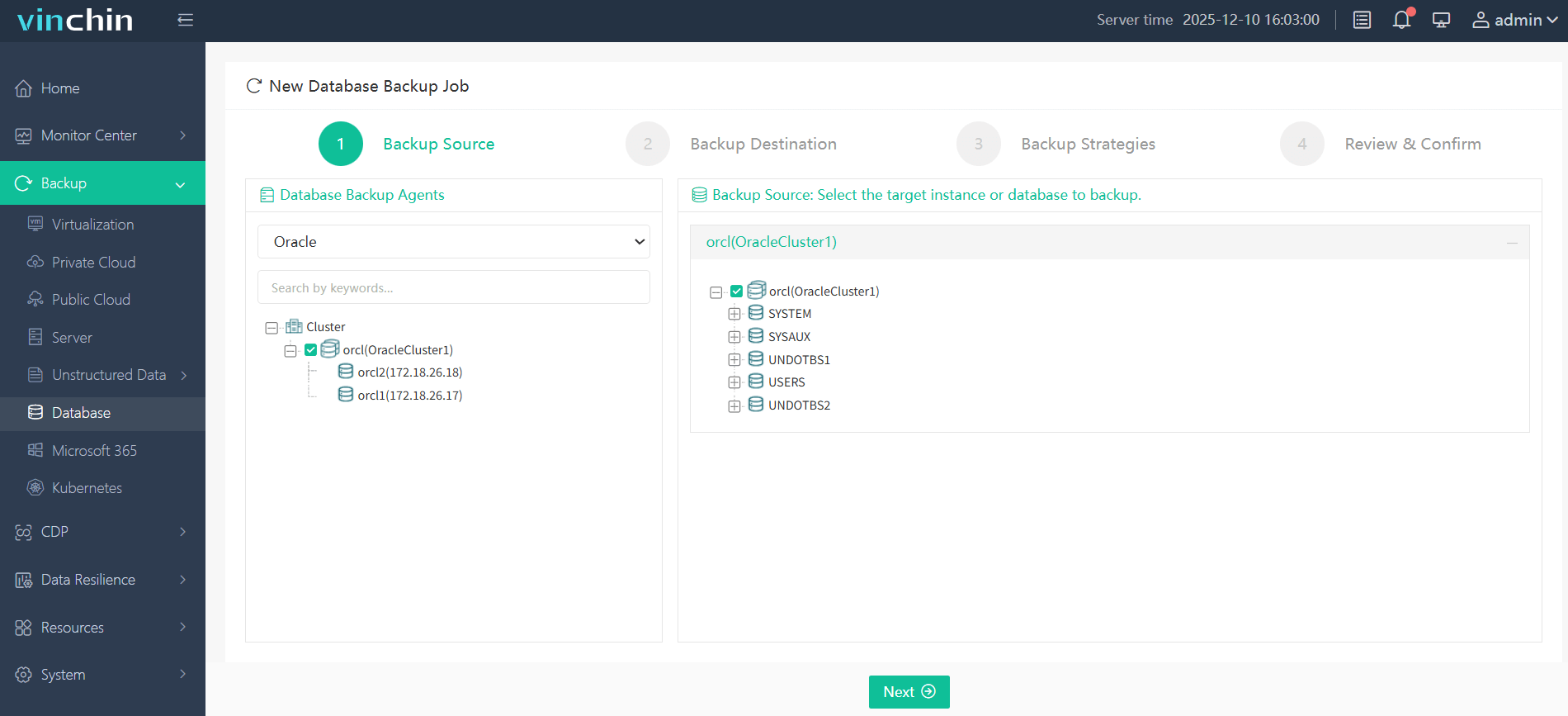
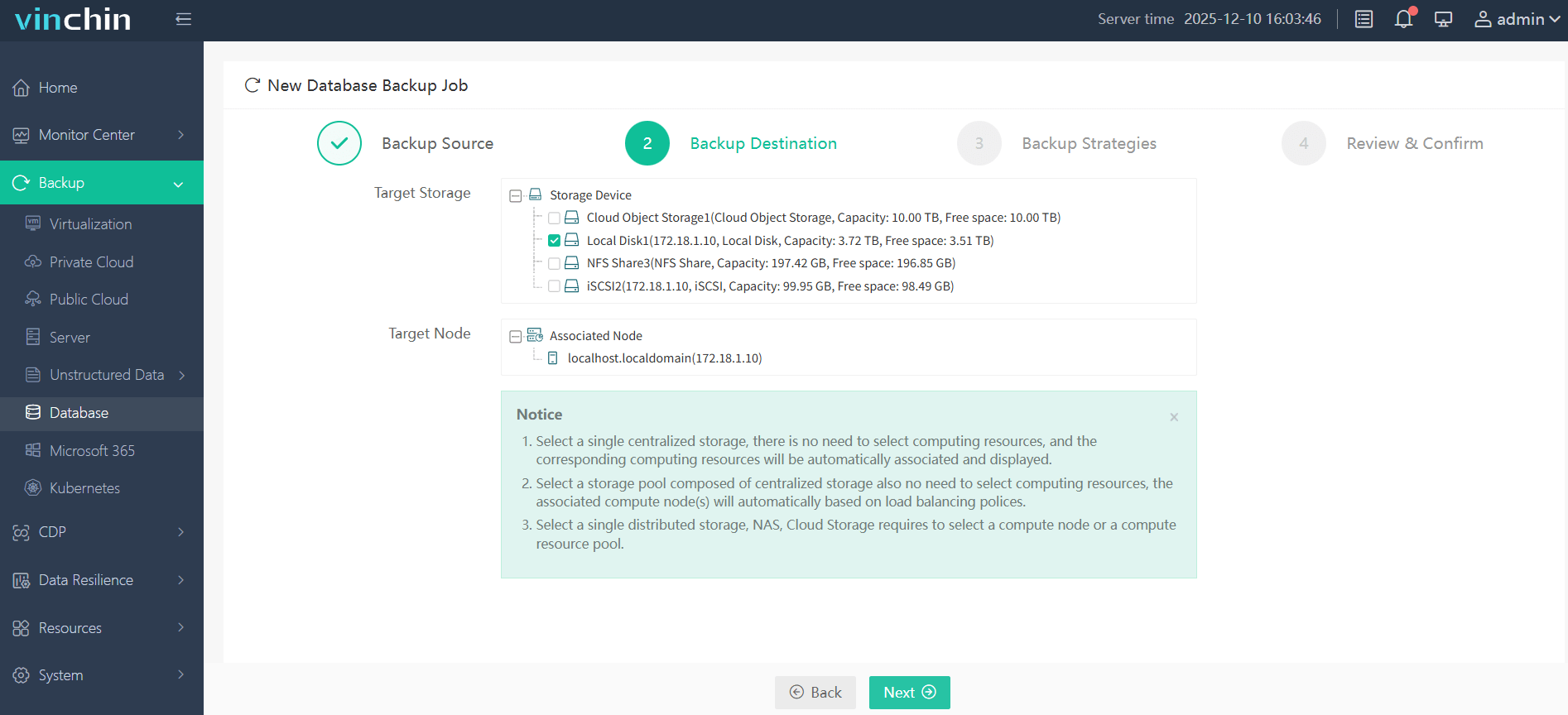
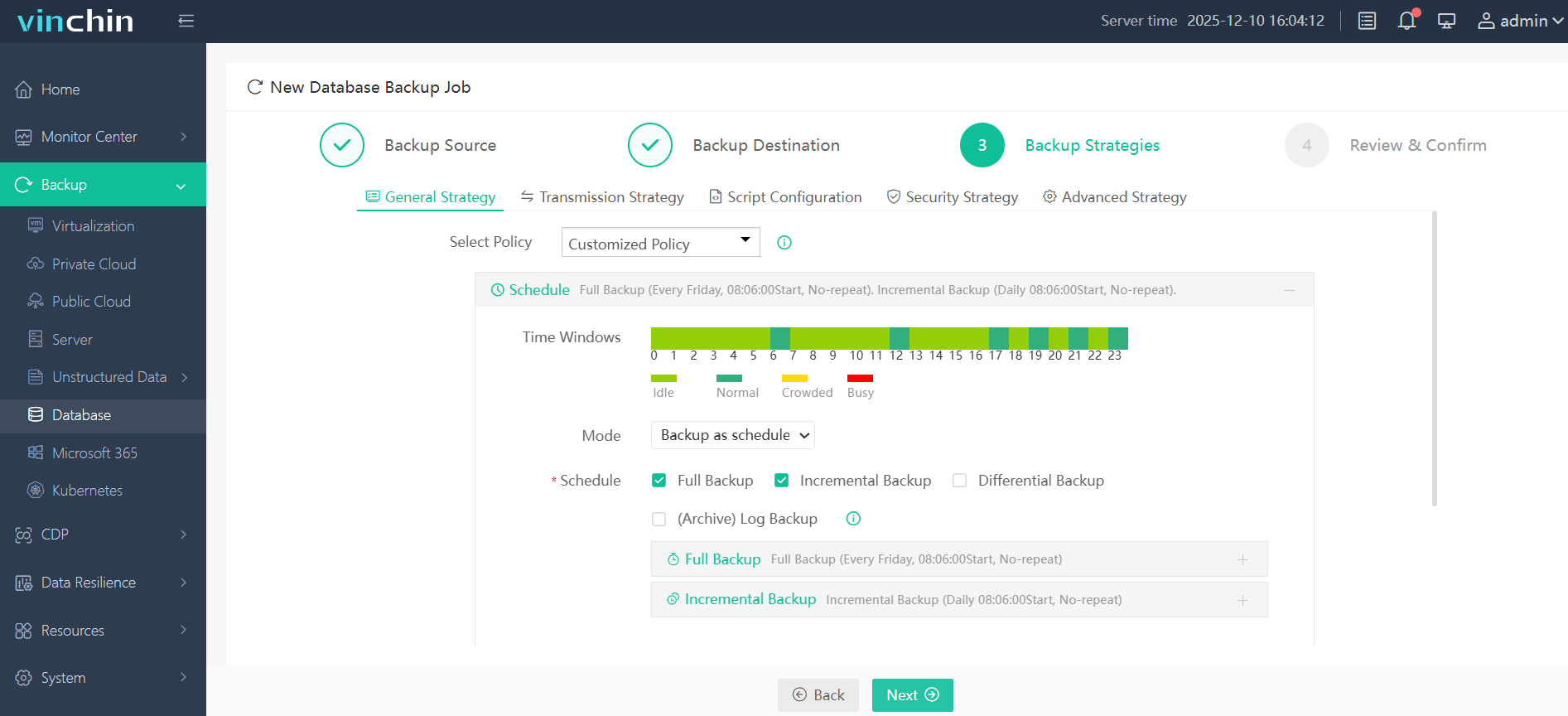
The intuitive web console makes protecting your critical databases straightforward in just four steps:
Step 1. Select the Oracle database to backup
Step 2. Choose the desired backup storage
Step 3. Define your preferred backup strategy
Step 4. Submitthe job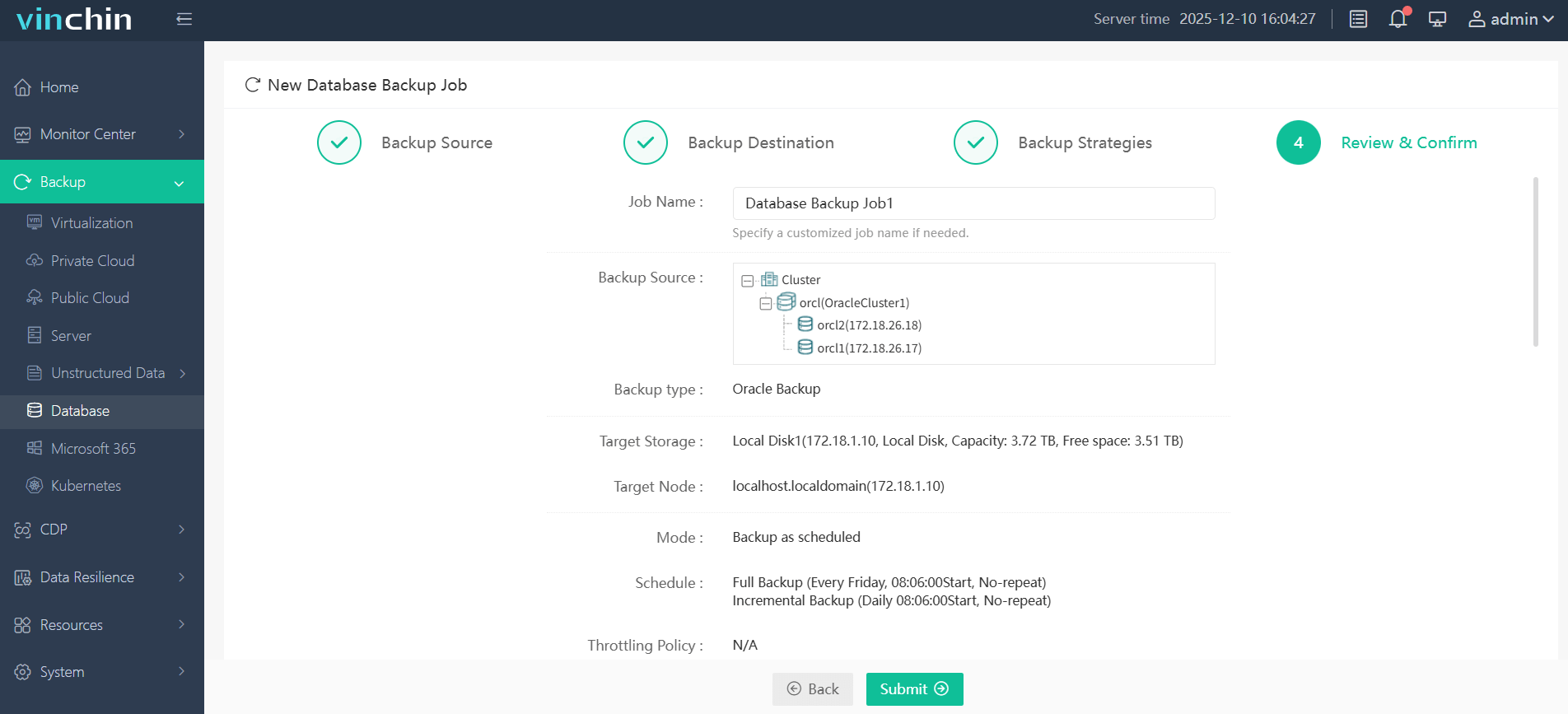
Recognized globally with top ratings from thousands of customers worldwide,Vinchin Backup & Recovery offers a risk-free 60-day trial packed with all features. Click download now to experience trusted enterprise-grade protection firsthand!
Oracle RMAN Interview FAQs
Q1: Can I schedule daily automatic validation checks on my existing backups?
A1: Yes—use DBMS_SCHEDULER, create job running VALIDATE BACKUPSET, set frequency as needed.
Q2: Is there any way to encrypt my archived redo logs during transport?
A2: Yes—configure CONFIGURE ENCRYPTION FOR DATABASE ON, then run encrypted archive log exports/backups accordingly.
Q3: My FRA fills too fast even though I delete old files regularly; what else should I check?
A3: Review retention settings/log generation rates—increase FRA size or adjust policy thresholds if necessary.
Conclusion
Mastering Oracle RMAN takes practice applying both theory and troubleshooting skills across many scenarios.Interviewers expect depth—not just syntax memorization.Vinchin helps automate secure enterprise-grade protection so teams stay ready.Try Vinchin free today—and make every DBA interview count!