Protecting your Oracle database is not just a best practice—it’s a necessity in today’s demanding IT environments. Downtime or data loss can mean lost revenue, compliance violations, or even damage to your company’s reputation. Operations teams face strict recovery time objectives (RTO) and recovery point objectives (RPO), shrinking backup windows, growing data volumes, and the constant threat of corruption or hardware failure. Oracle Recovery Manager (RMAN) is built into every Oracle Database installation and provides command-line tools that give you full control over backup and recovery tasks—helping you meet these challenges head-on.
What Is Oracle RMAN Command Line?
The Oracle RMAN command line is a text-based interface designed for managing all aspects of database backup, restore, and recovery operations. You launch it by running rman from your operating system shell—whether on Linux/UNIX or Windows platforms—and then enter commands at the RMAN> prompt.
With RMAN command line access, you can back up entire databases or specific objects like tablespaces or datafiles; restore files after failures; recover lost changes using archived logs; validate backups; automate jobs; enforce retention policies; check for corruption at the block level; and integrate seamlessly with Oracle’s internal structures. This approach ensures reliable results without leaving the secure Oracle environment.
Why Use RMAN Command Line Tools?
Why not just copy files directly or rely on graphical interfaces? The oracle rman command line offers unique advantages: scriptability for automating regular tasks; detailed feedback with clear error messages for easier troubleshooting; support for advanced features like incremental backups or validation checks; enforcement of retention policies so storage doesn’t fill up unexpectedly; plus tight integration with Oracle internals so every backup is consistent at the block level. Most importantly—it’s what Oracle recommends if you want peace of mind about recoverability.
How to Back Up an Oracle Database Using RMAN Command Line?
Backing up your database using oracle rman command line follows several core steps designed for flexibility and safety.
Start by launching rman from your OS shell:
Connect to your target database:
rman target /
For username/password authentication:
rman target sys/password@yourdb
At the RMAN> prompt:
BACKUP DATABASE;
To include archived redo logs (for point-in-time recovery):
BACKUP DATABASE PLUS ARCHIVELOG;
The PLUS ARCHIVELOG clause switches out current redo logs first—ensuring no transactions are missed—and backs up all archived logs required for full consistency.
Want only certain tablespaces?
BACKUP TABLESPACE users;
Need just one datafile?
BACKUP DATAFILE 1;
To specify exactly where backups go:
BACKUP DATABASE FORMAT '/backup/ORCL_%d_%T_%U.bkp';
Here %U generates unique filenames while %d adds database name and %T adds date stamp—making management easier.
Check which backups exist:
LIST BACKUP;
Validate integrity without moving any data:
BACKUP VALIDATE DATABASE ARCHIVELOG ALL;
When finished:
EXIT
You can combine these commands into scripts—or chain them together interactively—to match complex operational needs.
How to Restore and Recover an Oracle Database Using RMAN Command Line?
Restoring from backup is just as critical as creating one—and must be practiced regularly before disaster strikes! Here’s how experts do it using oracle rman command line tools:
First ensure your instance is started but not open—in MOUNT mode—for most restore operations:
1. Launch rman
2. Connect:
rman target /
3. If needed:
STARTUP MOUNT;
Now restore everything:
    RESTORE DATABASE;
    RECOVER DATABASE;
After applying changes from archived logs during RECOVER, open the database again:
ALTER DATABASE OPEN;
For targeted restores (such as one tablespace):
    RESTORE TABLESPACE users;
    RECOVER TABLESPACE users;
Or single datafile repair:
    RESTORE DATAFILE 1;
    RECOVER DATAFILE 1;
Preview what would happen before actually restoring anything—a great way to double-check plans without risk:
RESTORE DATABASE PREVIEW;
Validate that existing backups are usable before relying on them in production scenarios:
RESTORE DATABASE VALIDATE;
How to Automate Backups Using Advanced RMAN Scripting Techniques?
Manual work doesn’t scale well—so automation becomes essential when managing multiple databases or large environments with tight RTO/RPO targets.
Write scripts containing sequences of commands in plain text files such as backup_db.rman. For example:
RUN {
   ALLOCATE CHANNEL ch1 DEVICE TYPE DISK FORMAT '/backup/%d_%T_%U.bkp';
   SQL 'ALTER SYSTEM ARCHIVE LOG CURRENT';
   BACKUP DATABASE PLUS ARCHIVELOG DELETE INPUT TAG 'DAILY_BACKUP';
   BACKUP CURRENT CONTROLFILE TAG 'CTRL_BKP';
   DELETE NOPROMPT OBSOLETE REDUNDANCY=2 DEVICE TYPE DISK;
   RELEASE CHANNEL ch1;
}
Here,
DELETE INPUT removes archived logs after they’re safely backed up.
Tagging helps identify jobs later.
Control file backup ensures metadata safety.
Obsolete cleanup prevents storage bloat.
Save this script then run it via shell scheduling tools.
On Linux/UNIX use cron—for example,
0 2 * * * /usr/bin/rman target / @/path/to/backup_db.rman >> /var/log/rman_backup.log 2>&1
On Windows use Task Scheduler similarly by pointing it at an appropriate batch file calling rman.exe.
Pass variables dynamically using USING clause inside scripts if needed—for instance,
BACKUP DATABASE TAG '&1';
# Run with: rman target / @backup_db.ran USING 'WEEKLY'
Test syntax ahead of time without executing actions by starting RMAN like this:
rman checksyntax @backup_db.ran
Automated scripting reduces human error risk while ensuring regular protection—even when nobody’s watching!
Vinchin Backup & Recovery: Enterprise-Level Protection for Your Oracle Databases
Beyond native tools like RMAN, organizations seeking streamlined enterprise-grade protection should consider Vinchin Backup & Recovery—a professional solution supporting today’s mainstream databases including Oracle, MySQL, SQL Server, MariaDB, PostgreSQL, PostgresPro, and TiDB. For Oracle environments specifically, Vinchin Backup & Recovery delivers robust features such as incremental backup capabilities, advanced source-side compression options, batch database backup operations across instances, flexible multi-level data compression strategies, and comprehensive retention policy management. Together these functions enable efficient storage utilization while simplifying compliance efforts and ensuring rapid recoverability even under demanding SLAs.
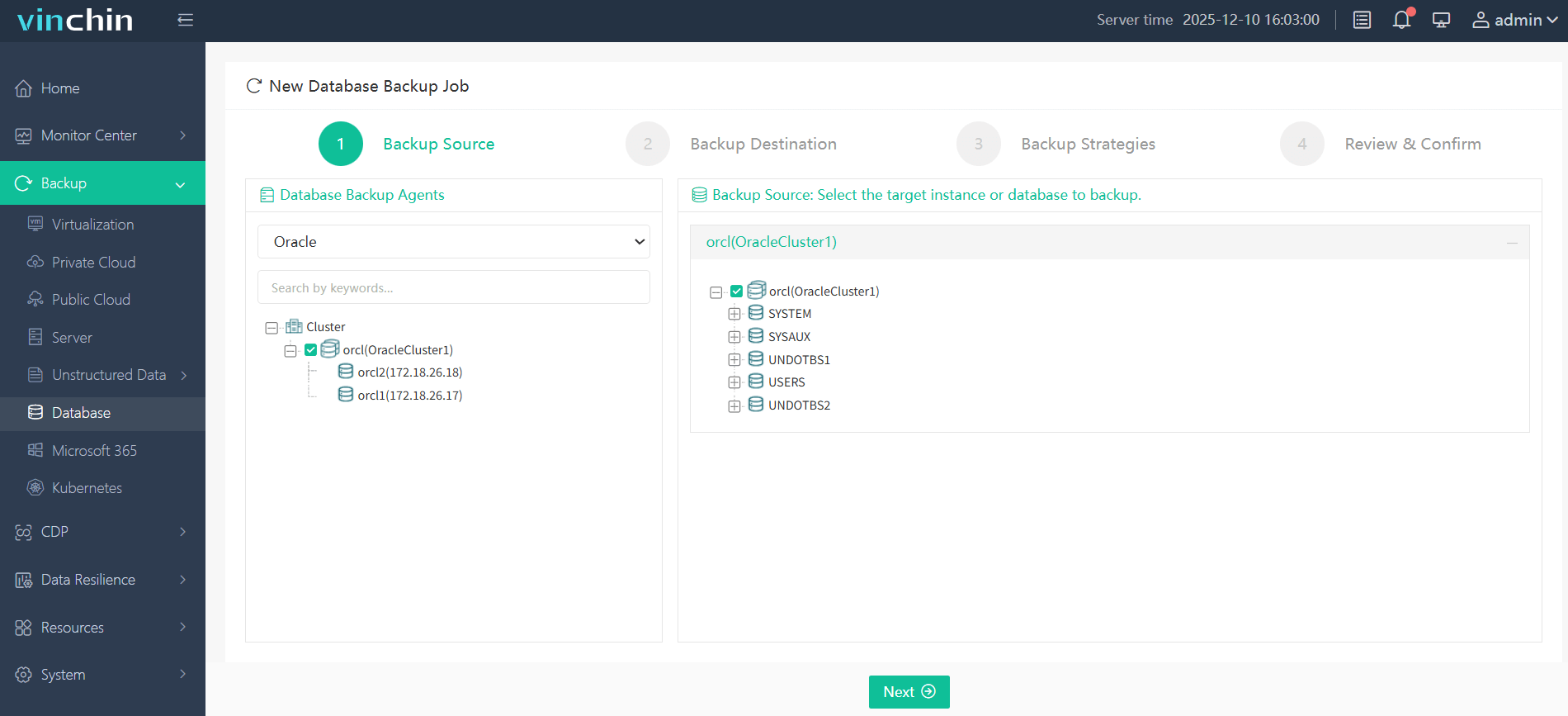
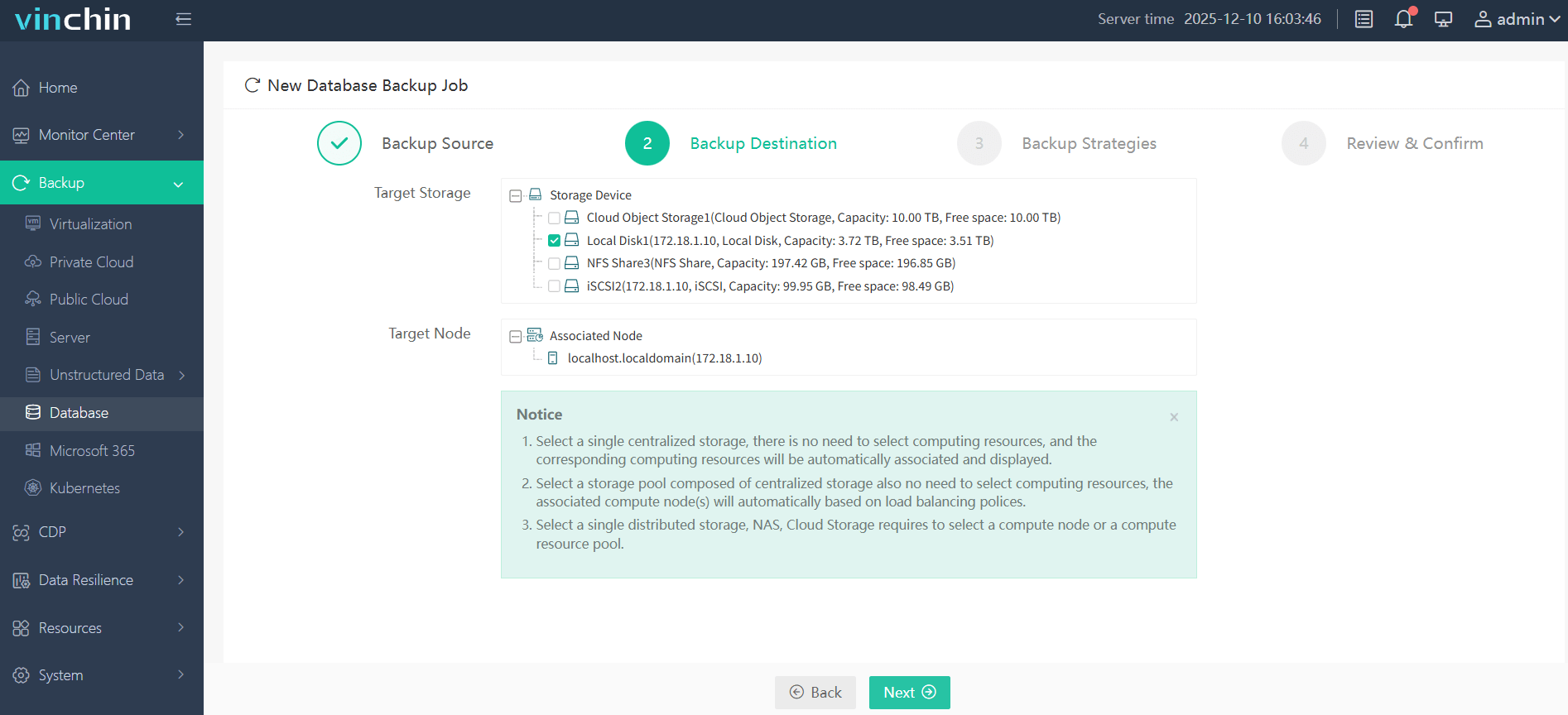
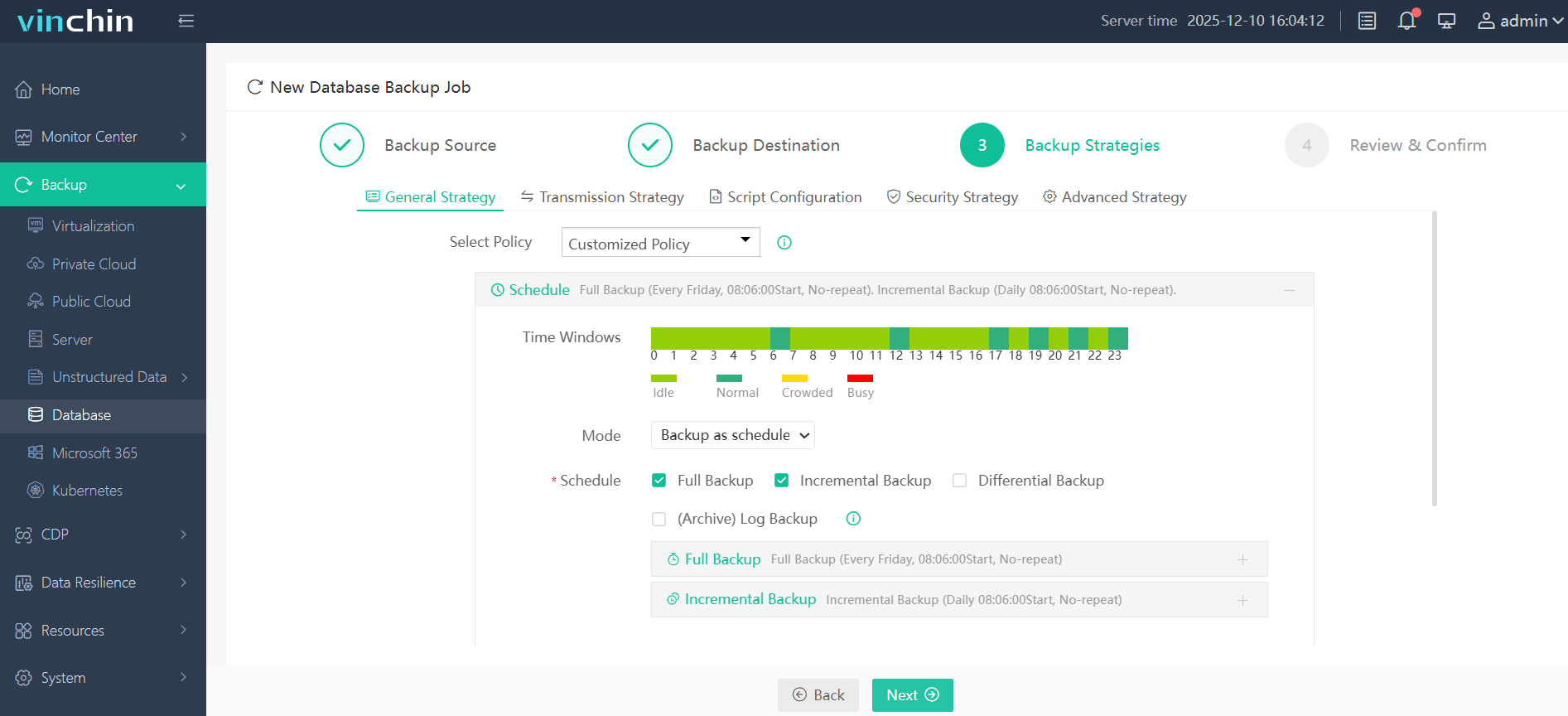
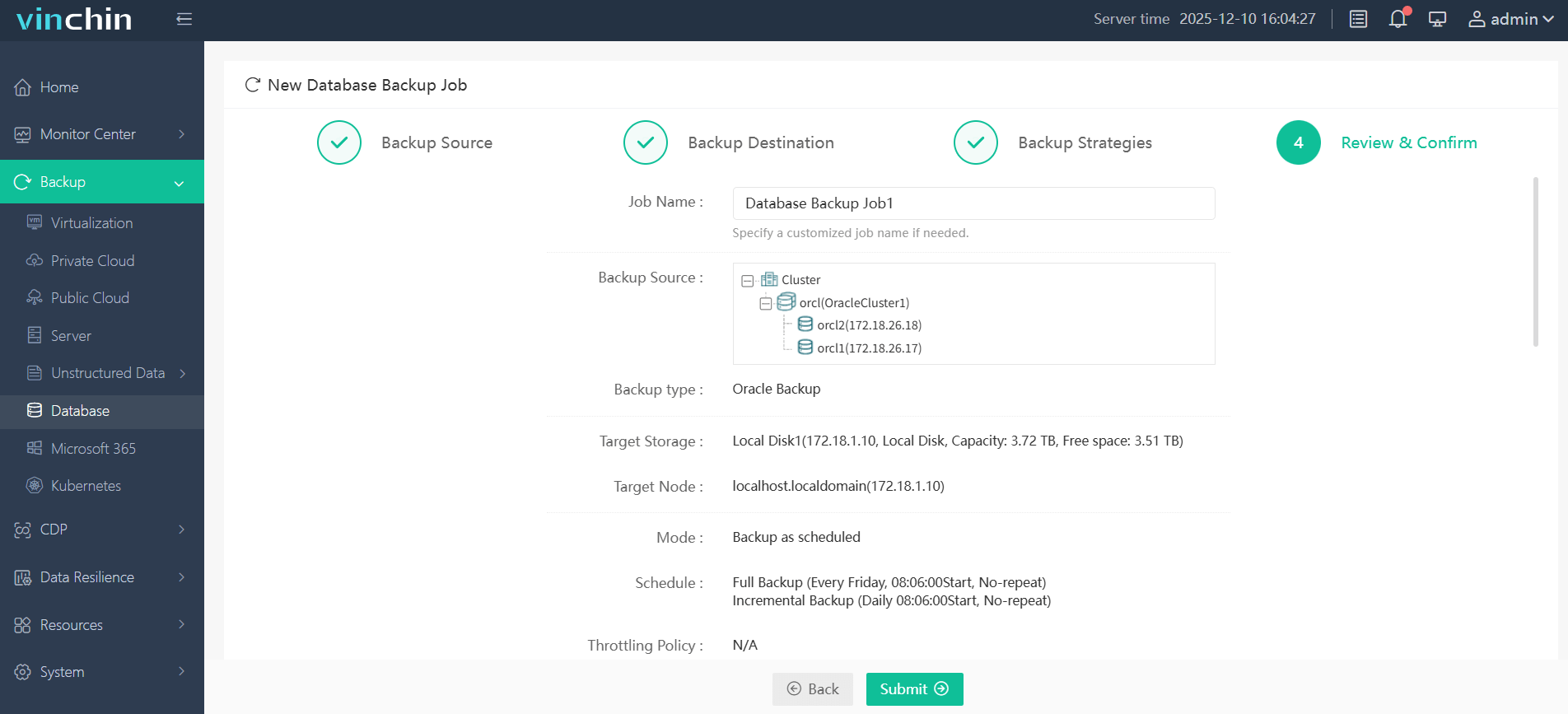
Vinchin Backup & Recovery stands out with its intuitive web console—making complex tasks accessible through four straightforward steps tailored for Oracle users:
The intuitive web console makes safeguarding Oracle databases straightforward:
Step 1. Select the Oracle database to back up
Step 2. Choose the backup storage
Step 3. Define the backup strategy
Step 4. Submit the job
Recognized globally among enterprise customers for reliability and ease-of-use—with top industry ratings—Vinchin Backup & Recovery offers a fully featured free trial valid for sixty days. Click below to experience trusted enterprise-class protection firsthand!
Oracle RMAN Command Line FAQs
Q1: How do I enable encryption in my oracle rman command line backups?
Use CONFIGURE ENCRYPTION FOR DATABASE ON IDENTIFIED BY password then add ENCRYPTED WITH PASSWORD password in your BACKUP commands.
Q2: What should I do if my Fast Recovery Area fills up during nightly jobs?
Increase its size using ALTER SYSTEM SET DB_RECOVERY_FILE_DEST_SIZE, delete obsolete/backups via DELETE OBSOLETE, then rerun failed jobs once space clears.
Q3: Can I send my oracle rman command line backups directly to cloud object storage?
Yes—with proper configuration of SBT channels supporting cloud plugins—but always consult official documentation first regarding compatibility requirements.
Conclusion
Mastering oracle rman command line unlocks reliable flexible control over every aspect of database protection—from setup through automation monitoring validation troubleshooting restoration Whether using native tools alone or combining them with Vinchin's enterprise-grade platform you'll minimize downtime safeguard business continuity Try Vinchin's free trial today