Are you preparing for an Oracle DBA interview and expect questions about RMAN? You’re not alone. Oracle Recovery Manager (RMAN) is a core tool for backup and recovery, and interviewers often test your practical knowledge. This guide assumes you have some hands-on experience with RMAN’s command-line interface. In this article, we’ll walk through the most common Oracle RMAN interview questions and answers. We’ll cover both basic and advanced topics, as well as real-world scenarios you might face on the job. Ready to boost your confidence? Let’s get started.
What Is Oracle RMAN?
Oracle RMAN (Recovery Manager) is Oracle’s built-in tool for database backup, restore, and recovery. It automates many tasks that used to be manual—such as tracking backups, validating data integrity, managing retention policies, and handling restores. RMAN is tightly integrated with the Oracle database engine itself. It supports both disk-based backups and tape storage through media management interfaces.
RMAN can perform full backups of entire databases or incremental backups that only capture changes since a previous backup. It also manages archived redo logs so you can recover from data loss or corruption with minimal downtime. Because it keeps detailed metadata about every operation in its repository or control file, it helps DBAs ensure compliance with business continuity requirements.
Basic Oracle RMAN Interview Questions and Answers
Let’s begin with essential concepts every DBA should know about using RMAN day-to-day.
1. What is the difference between catalog and nocatalog mode in RMAN?
In catalog mode, RMAN stores backup metadata in a separate recovery catalog database outside of your target system. In nocatalog mode, it keeps metadata within the target database’s control file itself. Technically it is possible to use the same database as both target and catalog but this defeats redundancy; if your main system fails completely you could lose both production data and backup records at once.
2. Can you use the same database as both the target and the recovery catalog?
No—the best practice is never to store your recovery catalog inside your production (target) database because if that system becomes unavailable due to failure or corruption you may lose access to critical backup metadata needed for restore operations.
3. How do you check the progress of an RMAN backup or restore job?
Query either V$RMAN_STATUS or V$SESSION_LONGOPS views from SQL*Plus while jobs are running to monitor their status in real time.
4. How do you delete archive logs older than 7 days using RMAN?
Use this command:
RMAN> DELETE ARCHIVELOG ALL COMPLETED BEFORE 'SYSDATE-7';
This removes archived logs older than seven days based on their completion timestamp.
5. What is the use of the CROSSCHECK command in RMAN?
CROSSCHECK verifies whether physical backup files listed in your repository still exist on disk or tape storage locations; if they are missing it marks them as EXPIRED so they won’t be considered valid during restores.
6. What is the difference between CROSSCHECK and VALIDATE commands?
CROSSCHECK checks only whether files exist at their expected location; VALIDATE goes further by reading each file block-by-block to confirm there are no corruptions preventing successful restores.
7. What is the difference between a backup set and a backup piece?
A backup set refers to a logical collection of backed-up datafiles or archived logs grouped together by one operation; each set consists of one or more physical files called backup pieces which actually store those blocks on disk or tape.
8. What is the difference between expired and obsolete backups?
Expired backups are missing from their expected location when checked by CROSSCHECK; obsolete backups are simply no longer needed according to your configured retention policy—even if they still exist physically—and can be deleted safely after review.
9. Can you take an RMAN backup when the database is down?
No—you cannot back up an offline instance directly using standard methods because neither control file nor datafiles are accessible unless mounted by Oracle software first (either OPEN state for online backups or MOUNT state after clean shutdown for consistent cold backups).
For example: If performing a cold (consistent) whole-database backup after shutting down cleanly (SHUTDOWN IMMEDIATE), start up again using STARTUP MOUNT before running any BACKUP commands so that all necessary structures are available but user activity remains paused during snapshot creation.
10. Does RMAN put the database in backup mode?
No—unlike user-managed hot backups which require placing tablespaces into BACKUP MODE manually before copying files at OS level—RMAN uses its own mechanisms internally so there’s no need for extra steps; this reduces risk of human error during busy periods.
Advanced Oracle RMAN Interview Questions and Answers
Now let’s move deeper into features that test how well you understand complex situations involving incremental strategies, catalogs, point-in-time recovery options, performance tuning—and more.
1. What are Level 0 and Level 1 backups in RMAN?
A Level 0 incremental creates a full image copy of each specified datafile—it serves as baseline reference for future incrementals; Level 1 incrementals record only changed blocks since last Level 0 (or last Level 1 if differential), saving space/time while allowing fast roll-forward restores later on.
Level 1 comes in two flavors:
Both types help optimize storage usage over time without sacrificing recoverability windows required by business policies.
2. Can you perform a Level 1 backup without a Level 0 backup present yet?
If no prior Level 0 exists within scope defined by retention settings then first attempted Level 1 will automatically act like full baseline instead—ensuring there’s always something usable even if initial setup was missed accidentally due to scheduling errors.
However best practice dictates scheduling regular explicit Level 0s periodically based on workload change rates rather than relying solely on fallback logic!
3. What is a snapshot control file?
A snapshot control file provides read-consistent static view of current control file contents at moment-in-time when certain operations run—such as resynchronizing external catalogs—or creating consistent images during long-running multi-channel jobs where underlying structure may change mid-stream otherwise leading potentially inconsistent results.
Snapshot copies reside temporarily under $ORACLE_HOME/dbs directory unless overridden via configuration parameters (CONFIGURE SNAPSHOT CONTROLFILE NAME TO ...). They’re deleted automatically after use but should be monitored occasionally for cleanup issues caused by failed jobs.
4. How do you register a user-managed backup with RMAN?
Use CATALOG DATAFILECOPY '/path/to/datafile', CATALOG ARCHIVELOG, etc., depending on what type was created externally outside normal automated routines—this tells repository about existence/location so future RESTORE commands can find them even though original job wasn’t tracked natively.
Example:
RMAN> CATALOG DATAFILECOPY '/u01/backups/users01.dbf';
This process helps bridge gap between legacy/manual scripts versus modern managed workflows.
5. How do you recover a lost datafile if you have full backups plus all archived logs available?
First determine exact filename/number using V$DATAFILE, then recreate placeholder shell via:
SQL> ALTER DATABASE CREATE DATAFILE '/u01/oradata/mydb/users02.dbf' AS '/u01/oradata/mydb/users02.dbf';
Next issue:
RMAN> RECOVER DATAFILE '/u01/oradata/mydb/users02.dbf';
This applies all relevant archived redo logs until fully synchronized again before opening tablespace/datafile online.
Always double-check correct SCN range/log sequence numbers involved before proceeding!
6. What is the difference between hot backup versus an automated (RMAN) approach?
Hot/user-managed requires putting individual tablespaces into BACKUP MODE manually then copying raw OS files—a risky process prone to mistakes under pressure! By contrast,
RMAN handles everything transparently without special modes thanks to block-level tracking algorithms built into engine itself.
This means less downtime/disruption plus better consistency guarantees across large environments.
Scenario-Based Oracle RMAN Interview Questions And Answers
Interviewers often present real-world scenarios testing troubleshooting skills under pressure.
Here are expanded examples showing how experienced DBAs respond step-by-step:
Scenario 1: Recovering A Datafile Created After Last Full Backup
Suppose someone added new tablespace/datafile post-backup cycle which now needs restoration due hardware failure/corruption event:
Step 1 — Identify missing object(s) via V$DATAFILE/V$TABLESPACE queries
Step 2 — Recreate empty shell matching original specs using ALTER DATABASE CREATE DATAFILE
Step 3 — Use RECOVER DATAFILE command inside rman prompt applying all available archived redo logs until complete
Step 4 — Bring affected tablespace/datafile online again
Always verify log sequence coverage matches period since creation date otherwise incomplete results may occur!
Scenario 2: Restoring Lost Control File
Losing primary control file disables almost every operation except basic startup/mount attempts:
Step 1 — Issue RESTORE CONTROLFILE FROM AUTOBACKUP inside rman session
Step 2 — Mount instance normally afterwards
Step 3 — Run RECOVER DATABASE followed by ALTER DATABASE OPEN RESETLOGS
Keep offsite copies/autobackups enabled wherever possible!
Scenario 3: Handling Block Corruption Detected During Backup
If validation phase reports corrupted blocks mid-job:
Step 1 — Note affected filenames/block addresses from output/logs
Step 2 — Use BLOCKRECOVER command specifying problematic ranges only
Step 3 — Confirm fix succeeded via VALIDATE afterward
Partial repairs avoid unnecessary downtime elsewhere.
Scenario 4: Cloning Database For Testing Purposes With Minimal Downtime
To create development/test copy rapidly:
Option A – Use DUPLICATE DATABASE FROM ACTIVE DATABASE method requiring network connectivity between source/destination hosts
Option B – Use DUPLICATE ... BACKUP LOCATION syntax referencing previously staged image copies/backups already present locally
Both approaches automate renaming/resetting internal IDs ensuring safe isolation from production workloads.
Scenario 5: Backup Destination Is Full During Scheduled Job
When destination fills unexpectedly:
Immediate Action – Run DELETE OBSOLETE command freeing space occupied by unneeded old sets per policy rules
Short-Term Fix – CROSSCHECK BACKUP followed by DELETE EXPIRED BACKUP cleans out references/files missing physically already
Long-Term Solution – Review CONFIGURE CHANNEL MAXPIECESIZE parameter adjusting chunk sizes downward OR increase capacity/add new mount points accordingly
Proactive monitoring prevents repeat incidents disrupting SLAs!
Scenario 6: Identifying Files Needing Media Recovery After Failure Event
Quickest way involves querying V$RECOVER_FILE view listing objects flagged IN NEED OF MEDIA RECOVERY status along with reason codes/log gaps detected automatically behind scenes
Scenario 7: Performing Restore When Some Archived Logs Are Missing Or Unavailable
If gaps exist among required log sequences:
You may only recover up through last contiguous set found locally/in archive destinations;
afterwards must open instance forcibly via ALTER DATABASE OPEN RESETLOGS accepting potential transactional loss post-gap boundary
Incomplete recoveries should always be documented thoroughly explaining business impact/tradeoffs made under duress
Vinchin Backup & Recovery: Enterprise-Level Protection for Your Oracle Database
For organizations seeking robust protection beyond native tools like RMAN, Vinchin Backup & Recovery delivers comprehensive enterprise-grade solutions tailored specifically for today’s mainstream databases—including Oracle, MySQL, SQL Server, MariaDB, PostgreSQL, PostgresPro, and TiDB—with particular strength supporting advanced features for Oracle environments first among equals here given our focus topic.
Key capabilities include batch database protection across instances, advanced source-side compression optimizing storage efficiency (for supported platforms), flexible incremental strategies minimizing daily load (for supported platforms), granular any-point-in-time recovery options ensuring rapid RTO/RPO compliance needs are met even at scale, plus strong storage protection mechanisms guarding against ransomware threats.
Together these features streamline administration while maximizing reliability—all managed through Vinchin Backup & Recovery's intuitive web console.
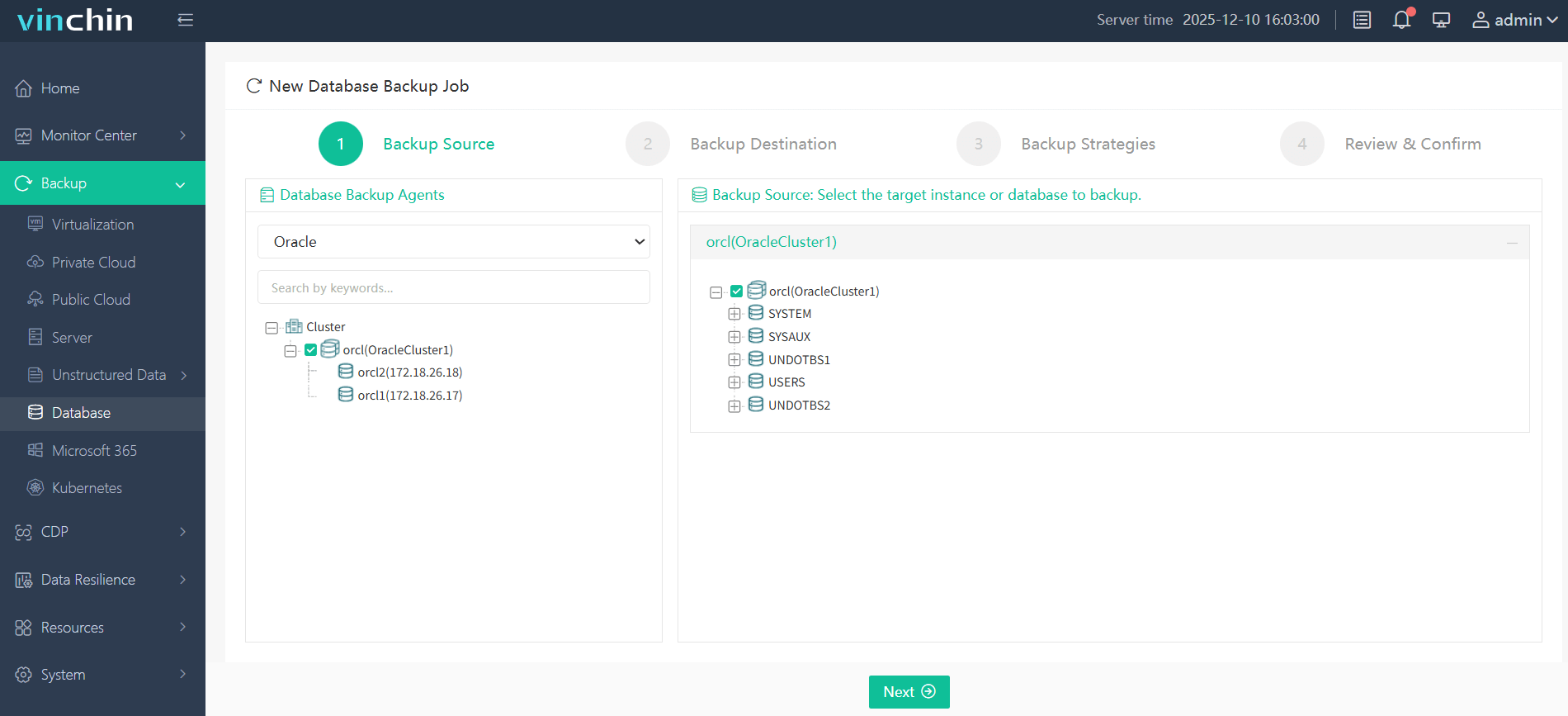
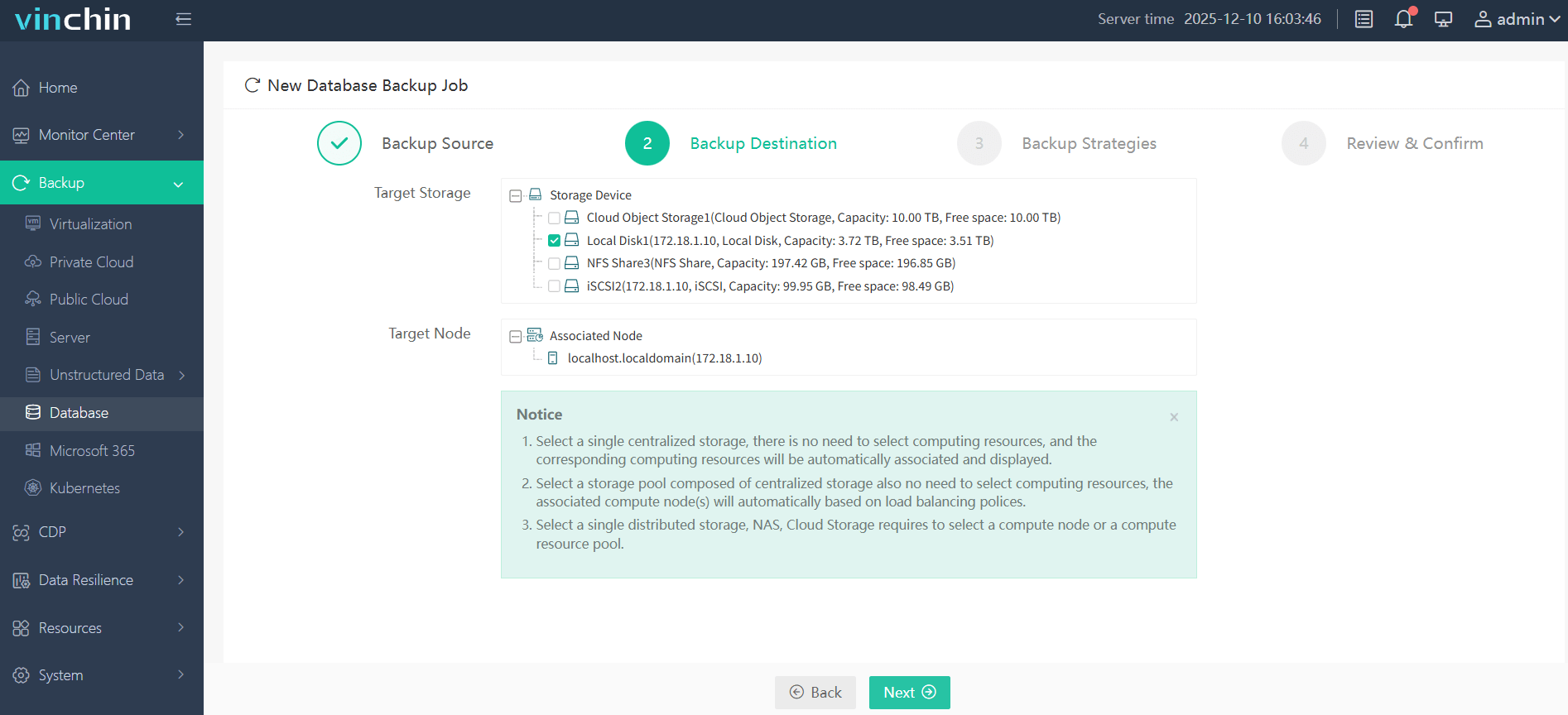
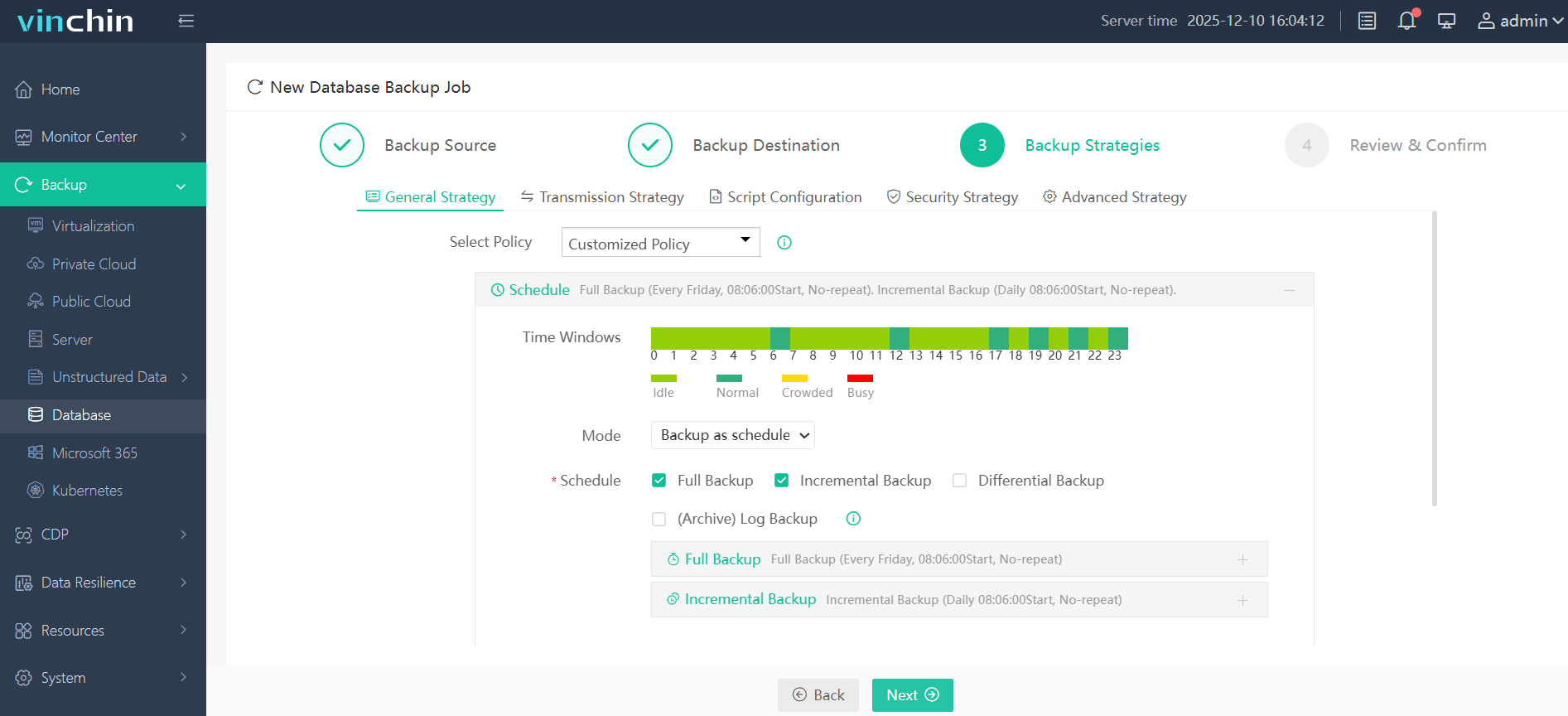
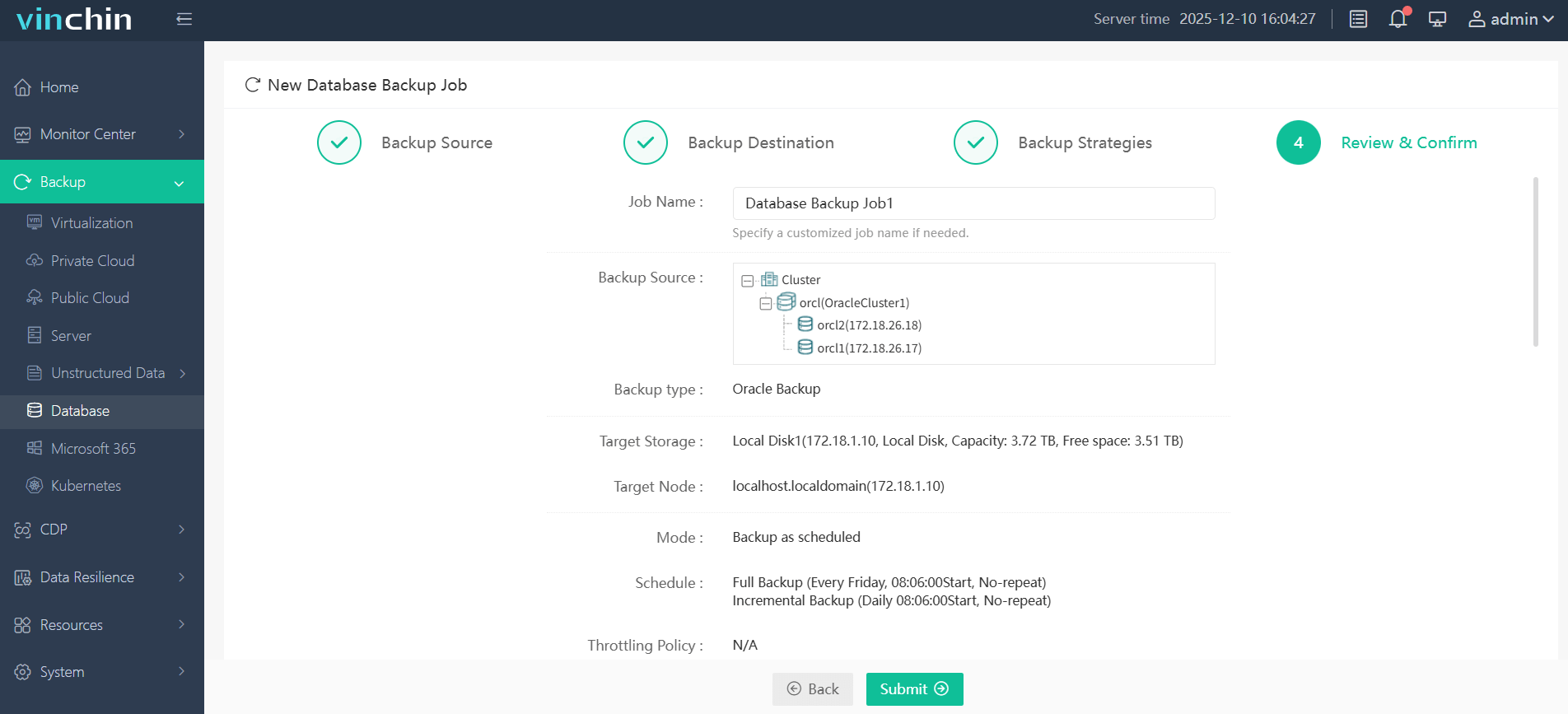
Backing up your Oracle environment typically takes just four steps:
Step 1. Select the Oracle database to back up
Step 2. Choose the backup storage
Step 3. Define the backup strategy
Step 4. Submit the job
Recognized globally with top ratings from thousands of customers worldwide,Vinchin Backup & Recovery offers industry-leading security combined with ease-of-use. Try every feature free for sixty days—click download below!
Oracle RMAN Interview Questions And Answers FAQs
Q1.Can I use rman backing up only specific tablespaces/datafiles instead whole instance?
Yes specify TABLESPACE/DATAFILE clauses directly within BACKUP command targeting subset objects required minimizing impact runtime/storage consumption overall
Q2.How validate integrity existing rman sets periodically confirming usability ahead actual disaster event?
Run VALIDATE command pointing at desired sets/files detecting latent corruptions proactively avoiding surprises later
Q3.What should I do if my rman job fails citing missing channel resource allocation problem?
Configure additional channels explicitly using CONFIGURE CHANNEL statement matching hardware topology then rerun failed task verifying success afterward
Q4.How enforce strict retention policy deleting outdated/unneeded sets automatically over time?
Set CONFIGURE RETENTION POLICY TO REDUNDANCY N/COPY WINDOW OF X DAYS accordingly enforcing cleanup regularly issuing DELETE OBSOLETE afterward keeping repository lean/effective
Conclusion
Mastering both theory AND practice around oracle rman ensures readiness facing tough interviews AND daily emergencies alike! Understanding these concepts demonstrates operational expertise employers value most today. Vinchin streamlines oracle protection further combining ease-of-use powerful automation trusted globally—try free trial see difference firsthand!