Managing backup storage growth and shrinking backup windows are constant challenges for database administrators. Are you running out of storage space for your Oracle database backups? Do you want to speed up backup and restore times while saving on storage costs? Oracle Recovery Manager (RMAN) offers built-in compression features that can help address both issues directly. In this article, we’ll explain what Oracle RMAN compression is, why it matters, how you can enable it step by step, and how to monitor its impact in your environment.
What Is Oracle RMAN Compression?
Oracle RMAN compression is a feature that reduces the size of your database backup sets by compressing data before writing it to disk or tape. This process helps save valuable storage space while also making backups easier to transfer across networks or store offsite.
RMAN supports several compression algorithms. The default BASIC method is available in all Oracle Database Enterprise Editions at no extra cost. For organizations needing greater flexibility or higher compression ratios, advanced options—LOW, MEDIUM, and HIGH—are available through the separately licensed Oracle Advanced Compression Option.
When you restore from a compressed backup set, RMAN automatically decompresses the data during recovery operations. This means administrators do not need to perform any manual decompression steps; the process remains seamless whether you are backing up or restoring.
Why Use Oracle RMAN Compression?
Using RMAN compression brings several important benefits to your backup strategy. First, it reduces the amount of storage required for backups—a critical advantage as databases grow larger over time. Lower storage needs can translate into significant cost savings for both on-premises hardware and cloud-based solutions.
Second, compressed backups move faster across networks because there is less data to transfer. This is especially useful if you send backups offsite or replicate them between locations for disaster recovery purposes.
Third, by reducing the volume of data written during each job, compression can help meet tight backup windows—a common challenge when working with large production databases that must remain online as much as possible.
However, these benefits come with a trade-off: enabling compression increases CPU usage during both backup creation and restore operations. Administrators should balance potential storage savings against available processing power on their servers before enabling high levels of compression everywhere.
How Does Oracle RMAN Compression Work?
Before diving into configuration steps, it's helpful to understand how RMAN handles data during compression jobs at a basic level.
When an administrator initiates a compressed backup using RMAN commands or policies:
1. Data blocks from the source database are read into memory.
2. The selected algorithm (such as BASIC, LOW, MEDIUM, or HIGH) compresses these blocks.
3. Compressed blocks are written out as part of a new backup set file.
4. During restores or recoveries from these files later on, RMAN reverses this process automatically—reading compressed blocks back into memory and decompressing them before applying changes back into your live database.
This approach ensures compatibility with standard recovery workflows while maximizing efficiency behind the scenes.
How to Enable Basic Compression in RMAN?
Enabling basic compression in RMAN is straightforward if you're running Oracle Database Enterprise Edition; no special licensing beyond this edition is required.
To make all future disk backups use basic compression by default:
1. Open your command-line interface and start an RMAN session connected to your target database.
2. Enter:
CONFIGURE DEVICE TYPE DISK BACKUP TYPE TO COMPRESSED BACKUPSET;
This tells RMAN always to create compressed backup sets when writing disk-based backups going forward.
3. If you only want specific backups compressed rather than every job by default:
BACKUP AS COMPRESSED BACKUPSET DATABASE;
Here you're instructing just this one operation to use basic compression.
4. To check which algorithm is currently configured:
SHOW COMPRESSION ALGORITHM;
By default (unless changed), this will display BASIC as active unless you've enabled advanced options described below.
5. When restoring from any compressed set created with BASIC mode enabled—or any other supported algorithm—no extra steps are needed; decompression happens transparently within standard restore commands like:
RESTORE DATABASE;
Remember that CONFIGURE settings persist across sessions until explicitly changed again using another CONFIGURE command or reset operation.
How to Use Advanced Compression Options in RMAN?
If your organization has licensed the Oracle Advanced Compression Option alongside Enterprise Edition software, three additional algorithms become available: LOW, MEDIUM, and HIGH.
Each provides different balances between CPU consumption during jobs versus total reduction achieved:
LOW: Uses minimal CPU resources but achieves moderate space savings
MEDIUM: Offers balanced CPU usage with good overall reduction (recommended starting point)
HIGH: Delivers maximum space savings but requires significant processor time
To configure an advanced algorithm globally:
1. Start an RMAN session connected appropriately.
2. Run:
CONFIGURE COMPRESSION ALGORITHM 'MEDIUM';
Replace 'MEDIUM' with 'LOW' or 'HIGH' depending on requirements.
3. After setting this policy globally via CONFIGURE, run normal backup commands such as:
BACKUP AS COMPRESSED BACKUPSET DATABASE;
If you'd like only one particular job—not all future ones—to use a specific algorithm:
BACKUP AS COMPRESSED BACKUPSET DATABASE
  COMPRESSION ALGORITHM 'HIGH';
This overrides any global setting just for this execution instance without changing persistent configuration elsewhere.
Keep in mind that higher levels of compression may slow down both backup creation and restores due to increased processing demands per block handled by server CPUs involved in those tasks.
It's wise always to test various algorithms under realistic workloads before rolling out changes broadly across production environments so you know exactly what impact each will have given current hardware constraints.
Vinchin Backup & Recovery: Simplifying Enterprise-Level Oracle Backup
Beyond native tools like RMAN, many organizations seek streamlined solutions for managing complex enterprise environments efficiently—including robust protection for mission-critical databases such as Oracle, MySQL, SQL Server, MariaDB, PostgreSQL, PostgresPro, and TiDB among others. Vinchin Backup & Recovery stands out as a professional enterprise-grade platform supporting most mainstream databases—with particularly strong support for Oracle environments through features like advanced source-side compression and incremental backup capabilities tailored specifically for demanding workloads.
With Vinchin Backup & Recovery’s unified solution architecture comes access to batch database backup management, multiple-level data compression strategies adaptable per scenario needs, flexible retention policies including GFS retention policy support—all designed to maximize efficiency while ensuring compliance-ready recoverability at scale without operational complexity getting in the way.
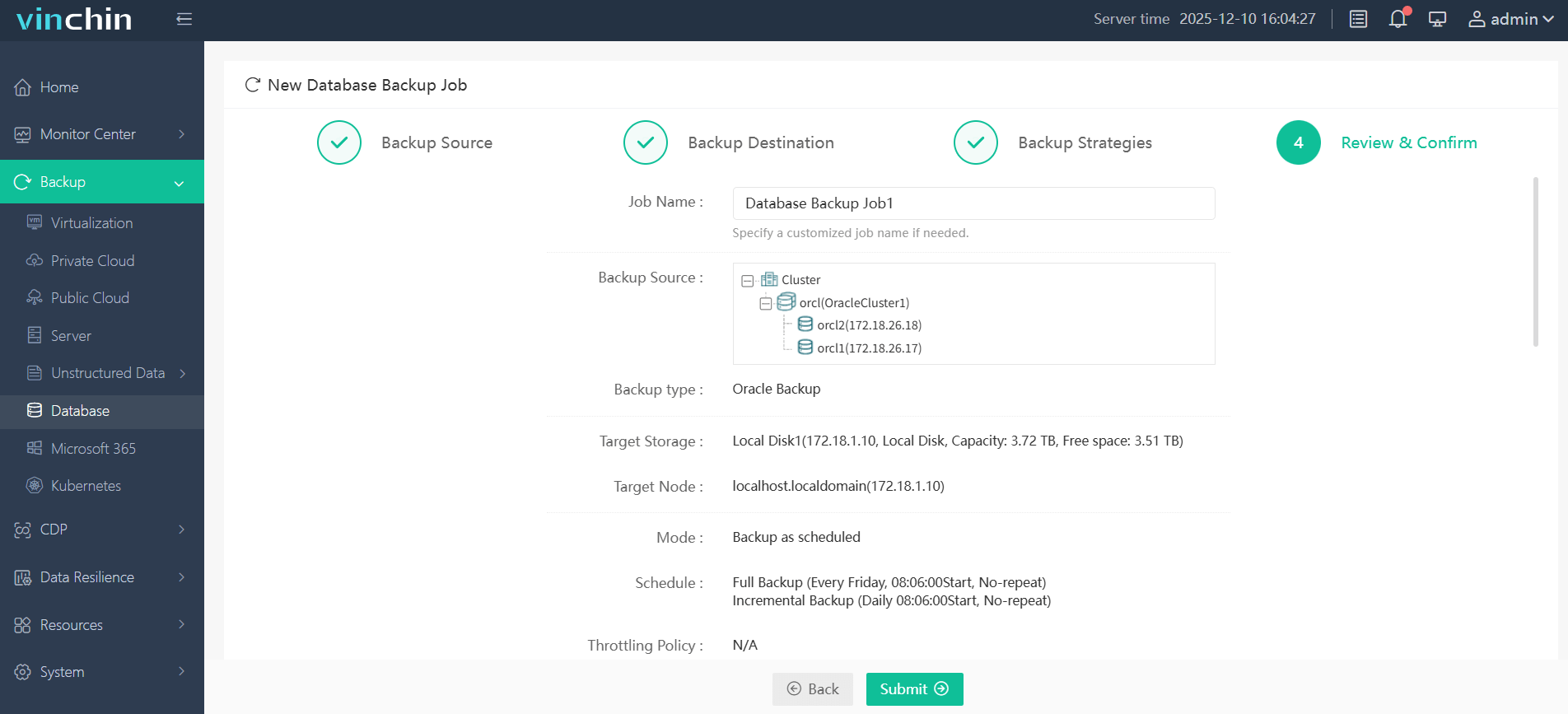
The intuitive web console makes protecting your critical databases remarkably simple:
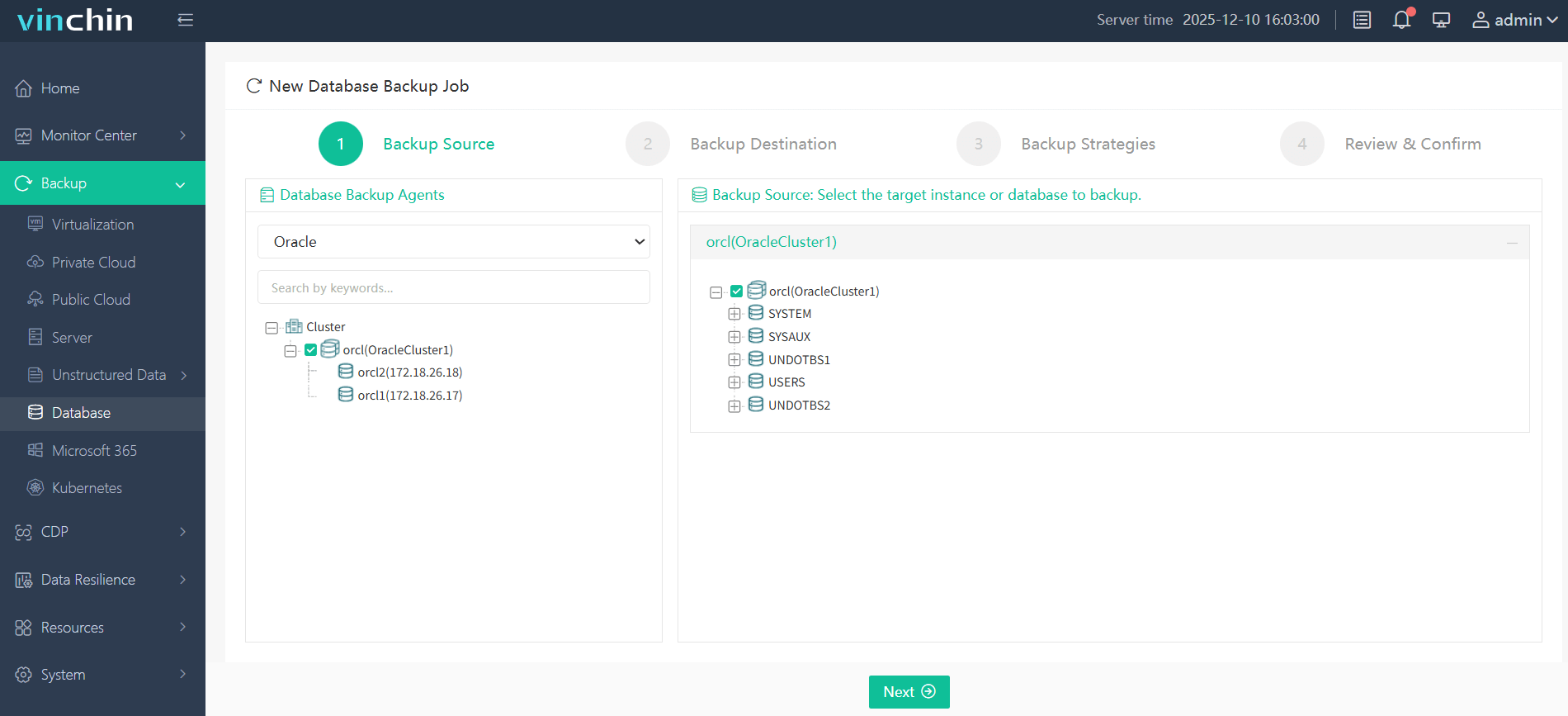
Step 1. Select the Oracle database to back up
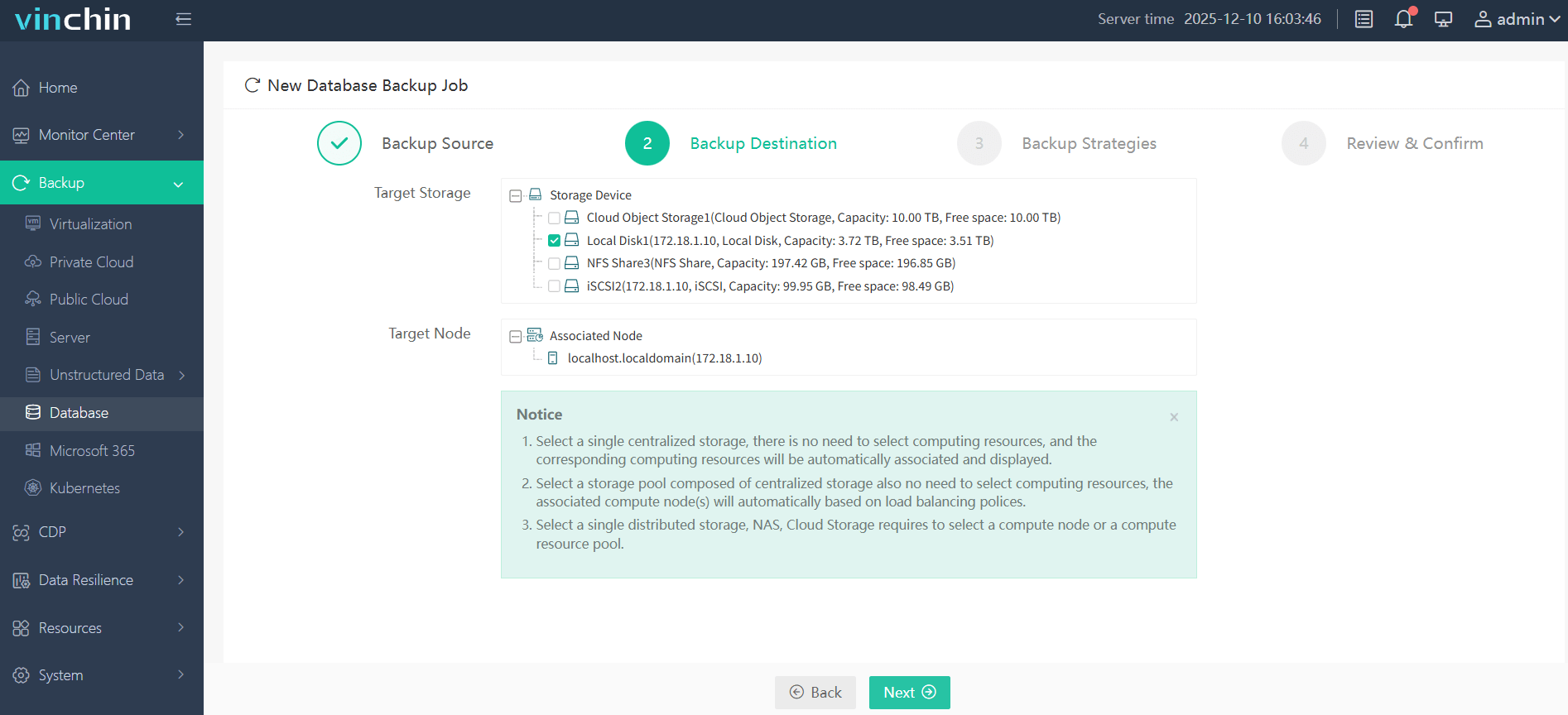
Step 2. Choose the backup storage
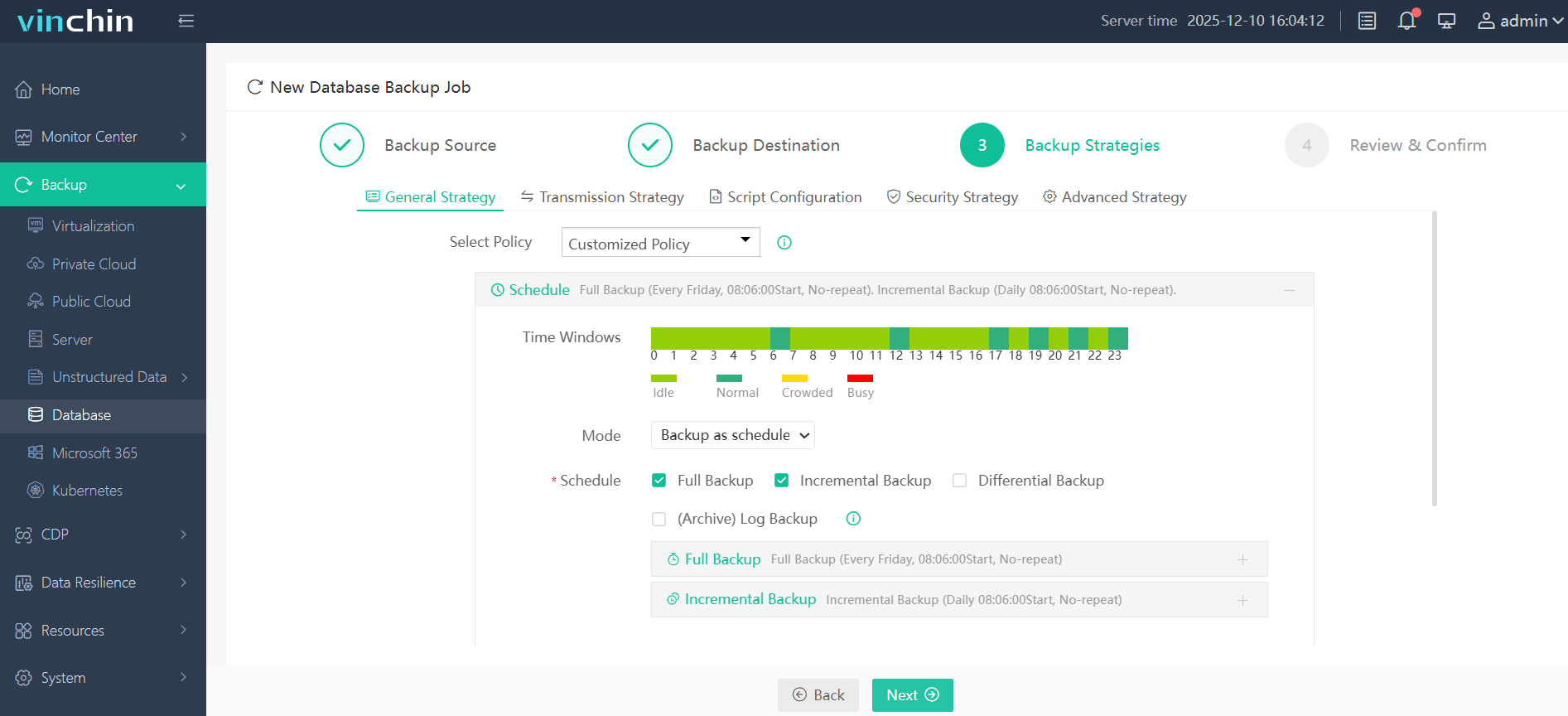
Step 3. Define the backup strategy
Step 4. Submit the job
Recognized worldwide for reliability and ease-of-use—with thousands of satisfied customers—Vinchin Backup & Recovery offers a fully featured 60-day free trial so you can experience top-rated enterprise protection firsthand—click download now!
Oracle RMAN Compression FAQs
Q1: Can I change my existing uncompressed backups into compressed ones?
No—you must create new compressed backups since existing ones cannot be retroactively compressed within RMAN itself.
Q2: Will enabling high-level compression affect my application performance?
Yes—it increases CPU load during both backing up and restoring; monitor server performance closely after enabling higher algorithms like MEDIUM or HIGH .
Q3: How do I verify which algorithm was used on an old backup?
Query V$BACKUP_SET view’s COMPRESSION_ALGORITHM column using SQL*Plus or another query tool.
Conclusion
Oracle RMAN compression helps reduce storage needs while improving network efficiency—but requires careful tuning based on actual system capacity versus expected gains.Test thoroughly before deploying widely.For complete automation,Vinchin delivers reliable enterprise-grade protection tailored specifically for modern IT environments.Try Vinchin free today!